
How to Handle Negative Responses or Unsubscribes Professionally in 2026
Every SDR, AE, and marketer running outreach will face negative responses and unsubscribe requests. How you handle them determines your domain reputation, your pipeline health, and whether a "not now" turns into a future opportunity. Mishandling these moments is not just an etiquette problem — it is a deliverability and revenue problem. Before diving in, make sure your outreach is built on a solid foundation: learn how to write sales emails that get responses so you generate fewer negative reactions in the first place.

Let Apollo Find Your Next Buyer
Tired of burning hours verifying contact info that goes nowhere? Apollo surfaces accurate, ready-to-engage prospects so your team sells instead of searches. 600K+ companies have already made the switch.
Start Free with Apollo →Key Takeaways
- Unsubscribes and negative replies are deliverability signals, not just courtesy issues — mishandling them can damage your domain reputation and inbox placement.
- Sending more than three follow-ups in a cold sequence dramatically increases unsubscribe and spam complaint rates, so restraint is a core best practice.
- Suppressions must sync across your CRM and marketing automation immediately — not on a weekly batch — to prevent repeat outreach that triggers escalated complaints.
- SDRs and RevOps teams should treat negative responses as targeting feedback: route the signal into ICP refinement, not into more sends.
- Offering preference controls (frequency, topic, channel) reduces total unsubscribes while still respecting buyer intent.
Why Do Negative Responses and Unsubscribes Hurt More Than You Think?
Negative responses and unsubscribes hurt because they compound: a single frustrated prospect who marks your email as spam can damage domain reputation at scale. Google's bulk sender guidelines require user-reported spam rates to stay below 0.3% — a threshold that sounds generous until you realize it takes very few complaints to cross it on a large send volume. According to Belkins, sending more than three follow-up emails in a cold outreach sequence can triple unsubscribe and spam complaint rates. That single data point should reshape every SDR's sequence strategy.
The reputational stakes extend beyond email. Research cited by Trustmary shows 94% of consumers have avoided a company due to negative reviews. One poor interaction, escalated publicly, can have an outsized impact on pipeline. Handling negative responses professionally is not optional — it is a revenue-protection strategy.
What Is the Right Response Framework for Negative Replies?
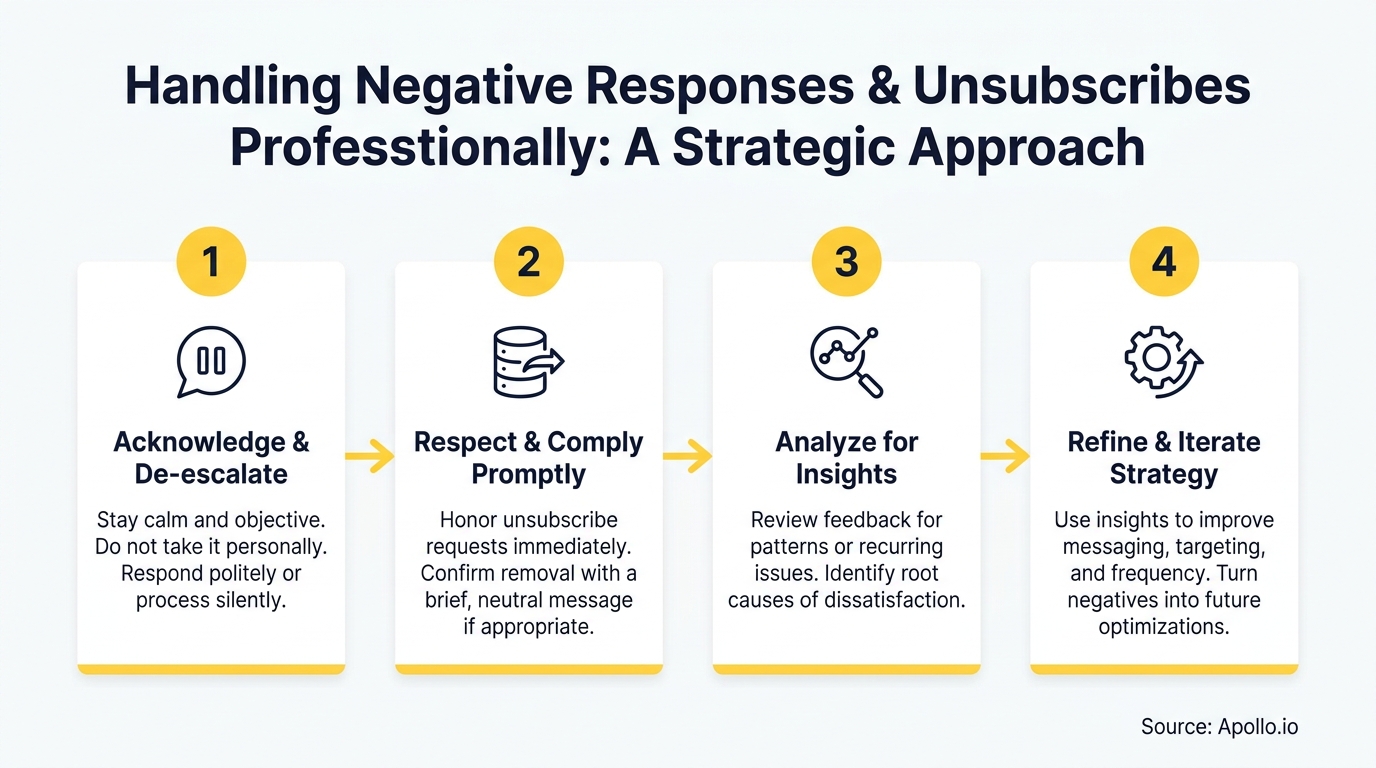
The right framework for negative replies is: acknowledge, suppress, log, and improve — in that order, within a defined SLA. Do not argue, do not re-pitch, and do not send a "just checking in" follow-up after someone has said no.
| Response Type | Immediate Action | SLA Target | CRM Action |
|---|---|---|---|
| "Stop emailing me" | Confirm removal, pause sequence | Within 1 business hour | Add to suppression list, log reason |
| "Not relevant to me" | Acknowledge, offer preference center | Within 4 business hours | Tag for ICP review, update persona data |
| "Not now / wrong timing" | Thank them, set a future re-engage date | Within 4 business hours | Snooze contact 90 days, log context |
| Angry / hostile reply | Apologize, confirm removal, escalate internally | Immediate | Suppress all channels, flag for manager review |
| One-click unsubscribe | Process automatically via platform | Real-time | Sync to CRM suppression within 24 hours |
For AEs managing active prospects, the same principle applies. A "not now" is not a closed-lost — it is a snooze. Log the reason, set a re-engage task, and respect the timeline they gave you. This is also where strong sales objection handling skills become essential for distinguishing a timing objection from a genuine disqualification.

How Should SDRs Handle Unsubscribe Requests Operationally?
SDRs should treat every unsubscribe request as a suppression task that must be completed before the next send cycle, not at the end of the week. According to RampIQ, the average unsubscribe rate for B2B emails is approximately 0.1% — a figure that looks small but adds up quickly when list volume scales. The operational steps are clear:
- Remove from all active sequences immediately — not just the current cadence.
- Sync the suppression to your CRM so marketing cannot re-enroll the contact in a nurture flow.
- Log the removal with a timestamp for audit trail purposes.
- Do not contact the same company through a different rep without first checking the suppression list.
- Send a single, brief confirmation if the unsubscribe was manual (reply-based, not one-click): "Confirmed — you've been removed and won't hear from us again."
RevOps leaders should enforce a unified suppression list that syncs across the sales engagement platform and marketing automation in near-real-time. Batch syncs running weekly are a compliance and reputation liability. Salesforce notes that multiple unsubscribe requests from single subscribers can account for 20% to over 50% of daily unsubscribe rates for larger senders — a direct signal that suppression is failing operationally somewhere in the stack.
Struggling to reach the right contacts in the first place? Search Apollo's 230M+ verified contacts with 65+ filters to target buyers who actually match your ICP before sending a single email.
Turn Funnel Guesswork Into Real Pipeline
Pipeline forecasting a guessing game while leads stall before they ever reach your AEs? Apollo surfaces high-intent prospects and keeps your funnel moving with verified contacts. Top revenue teams close more with less noise.
Start Free with Apollo →What Are the Best Response Templates for Common Negative Scenarios?
Ready-to-use templates reduce response time and protect tone consistency across your team.
Adapt these to your brand voice.
What Should You Say to "Stop Emailing Me"?
Keep it short, confirm the action, and close with goodwill:"Understood — I've removed you from all outreach and you won't hear from us again. Apologies for any inconvenience." No pitch. No "before I go, can I ask one question."
What Should You Say to "Not Relevant / Wrong Person"?
Acknowledge the miss and use it:"Thanks for letting me know — I'll update our records. If there's a better contact for [topic], I'd appreciate the pointer, but no pressure either way." This converts a negative into a potential referral without pressuring the prospect.
What Should You Say to an Angry Reply?
Lead with an apology, confirm removal on all channels, and avoid defensive language:"I sincerely apologize for the frustration. You've been removed from all outreach effective immediately. I've also flagged this internally so it doesn't happen again." Log the interaction and escalate to a manager if the tone suggests a compliance concern.
For context on building outreach that earns fewer angry replies, see how to build a B2B email list that converts — the quality of your list directly predicts the quality of your responses.
How Can RevOps Teams Prevent Negative Responses Through Better Targeting?
RevOps teams can prevent a large share of negative responses by improving ICP fit before outreach starts, not after complaints arrive. Negative responses are often targeting failures, not messaging failures.
If someone replies "this is completely irrelevant to my role," the sequence did not fail — the segmentation did.
- Use intent data to prioritize contacts showing active buying signals before enrolling them in sequences.
- Audit your persona definitions quarterly — job titles, company size, and buying authority shift faster than most ICP documents are updated.
- Build suppression hygiene into your QBR checklist: review complaint rates, unsubscribe trends, and bounce rates as a team.
- Implement frequency caps at the contact level, not just the sequence level, to prevent the same person being hit by SDR, marketing, and re-engagement flows simultaneously.
Data from Insight Mark Research shows that average unsubscribe rates rose from approximately 0.08% to 0.22% between 2024 and 2025, indicating rising list fatigue across B2B programs. That upward trend is a direct argument for quality-over-volume outreach strategies. Spending too much time managing disqualified contacts manually? Automate your sequences with Apollo's multi-channel engagement platform and enforce suppression rules at the platform level so nothing slips through.
What Is a Preference Center and Should B2B Teams Use One?
A preference center is a self-service page where contacts can control the type, frequency, or channel of communications they receive — and yes, B2B teams should use one as an alternative to binary unsubscribes. Instead of forcing an all-or-nothing choice, a preference center lets a prospect say "send me product updates but not sales emails" or "monthly only, not weekly." This reduces total unsubscribes while still respecting intent.
Preference centers are most practical for marketing-led programs with defined content categories (newsletters, product updates, event invites). For pure cold outreach from SDRs, the standard remains a clean, no-friction global opt-out. The key rule: never make the opt-out harder to find than the subscribe. That is the line between preference management and a dark pattern — and crossing it damages trust more than any follow-up sequence ever could. For broader pipeline context, see how to build a B2B marketing funnel that converts to understand where preference capture fits in the buyer journey.
How to Turn a Negative Response Into a Future Opportunity
A professional "no" handled well preserves the relationship for a future "yes." The goal after any negative response is to leave the door open without forcing it. Remove them, log the context, and set a re-engage condition — not a time-based drip, but a trigger-based one.
If they change companies, expand their team, or show intent signals again, that is when re-engagement is appropriate.
For teams using sales automation responsibly, this means configuring your workflow to automatically resurface snoozed contacts when specific job change or intent signals fire — not when a 90-day timer expires. The difference is relevance versus persistence, and buyers in 2026 can tell the gap instantly.

Conclusion: Professional Handling Is a Revenue Strategy
Handling negative responses and unsubscribes professionally protects your domain reputation, preserves future pipeline, and signals to the market that your team operates with integrity. The playbook is straightforward: suppress fast, sync everywhere, log everything, and use the signal to improve targeting.
SDRs who treat a "no" as data rather than a defeat will build cleaner lists, earn better reply rates, and hit quota more consistently over time.
Apollo's all-in-one GTM platform helps B2B teams run smarter outreach from the start — with verified contact data, built-in sequence controls, and suppression management in a single workspace. As Cyera put it, "Having everything in one system was a game changer." Try Apollo free and build outreach programs that earn positive responses — not complaints.
Prove Pipeline ROI From Day One
ROI pressure killing your next budget approval? Apollo delivers measurable pipeline impact fast — so you walk into every review with hard numbers. Leadium 3x'd their revenue. Your proof starts here.
Start Free with Apollo →Don't miss these
Sales
Inbound vs Outbound Marketing: Which Strategy Wins?
Sales
What Is a Sales Funnel? The Non-Linear Revenue Framework for 2026
Sales
What Is a Go-to-Market Strategy? The 2026 GTM Playbook
See Apollo in action
We'd love to show how Apollo can help you sell better.
By submitting this form, you will receive information, tips, and promotions from Apollo. To learn more, see our Privacy Statement.
4.7/5 based on 9,690 reviews
