
How to Find Leads With a Specific Job Title or Department in 2026
Finding leads by job title used to mean building a list of "VP Marketing" contacts and blasting them with outreach. That approach fails in 2026. B2B purchases involve multiple stakeholders across departments, and buyers increasingly self-research before engaging sales. To find high-quality buyer leads, you need a department-first, multi-role strategy that combines precise filtering, intent signals, and relevance-matched messaging.

Let Apollo Find Your Next Deal
Tired of hours lost to manual research and dead-end contact data? Apollo surfaces verified leads instantly, so your reps spend time selling — not searching. Join 600K+ companies building pipeline faster.
Start Free with Apollo →Key Takeaways
- Job title targeting alone underperforms: map the full buying group per department, not just one decision-maker.
- Combine job function and persona filters with intent signals to prioritize who to contact first, not just who fits the title.
- ABM-style targeting by department dramatically improves pipeline quality — companies with strong ABM strategies attribute 79% of opportunities to ABM efforts.
- SDRs and RevOps teams get the most leverage from a unified platform that filters by title, department size, and hiring signals in one workspace.
- Irrelevant outreach actively hurts pipeline — department-specific messaging is a competitive requirement, not a nice-to-have.
Why Does Job Title Targeting Alone Fall Short?
Job title targeting falls short because B2B deals involve multiple roles, not one perfect contact. A single "VP of Engineering" search misses the procurement lead, the finance approver, and the end-user champion who all influence the same decision.
Title data is also inconsistent. "Growth Marketing Manager," "Demand Gen Lead," and "Senior Marketing Specialist" can all represent the same function at different companies. Searching only by exact title creates false negatives and gaps in your coverage. Modern outbound prospecting requires job function and persona normalization alongside title filters to handle this variance reliably.
According to G2, companies with strong ABM strategies attribute 79% of opportunities and 73% of their total revenue to those efforts — a result that requires targeting the full buying group, not a single title.
How Do You Build a Department-Level Buying Group Map?
A buying group map identifies every role that influences a purchase decision within a target department, then assigns outreach priority and messaging by role type.
Use this framework per deal type:
| Role Type | Example Titles | Outreach Priority | Message Angle |
|---|---|---|---|
| Economic Buyer | CFO, VP Finance, COO | High | ROI, cost reduction, risk |
| Champion / End User | Marketing Ops Manager, RevOps Analyst | High | Efficiency, workflow, daily pain |
| Technical Evaluator | IT Director, Solutions Architect | Medium | Security, integration, compliance |
| Influencer | SDR Manager, Demand Gen Lead | Medium | Team productivity, quota attainment |
| Procurement | Vendor Manager, Sourcing Lead | Low (later stage) | Contract terms, vendor comparison |
Build one map per product line and deal size. A $15K deal may have two influencers; a $150K deal may have seven. Adjust depth of coverage accordingly. According to Martal, defining ICPs and buyer personas is the critical first step that ensures lead research focuses on the right decision-makers from the start.
Struggling to find every role in a target department? Search Apollo's 230M+ contacts with 65+ filters including job function, persona, and department headcount to map your full buying group fast.
Turn Weak Leads Into Pipeline That Closes
Pipeline forecasting a guessing game because quality leads never make it past the first stage? Apollo surfaces in-market buyers with verified contact data so your team reaches the right person at right moment. 600K+ companies stopped guessing and started closing.
Start Free with Apollo →How Do SDRs Find Leads by Job Title and Department at Scale?
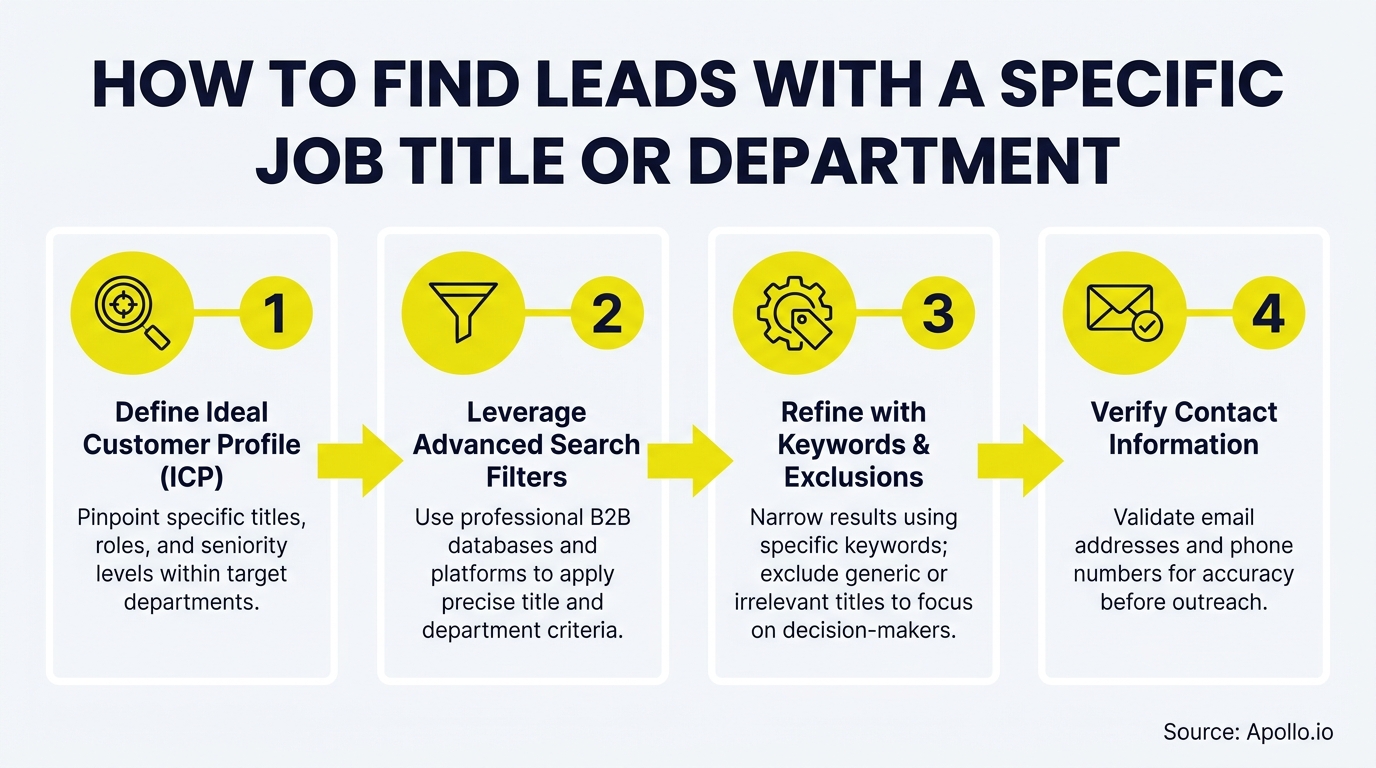
SDRs find the most qualified leads by layering job function filters on top of firmographic context, then adding intent signals to prioritize outreach order.
The most effective filtering sequence for SDRs:
- Start with job function, not title. Filter by "Marketing," "Engineering," or "Finance" function to capture all relevant titles in that department.
- Add seniority level. Filter by Director, VP, or C-Suite to match deal size to stakeholder authority.
- Apply department headcount context. A "Marketing Ops Manager" at a 5-person marketing team behaves differently than one at a 200-person org. Department size filters surface the right profile.
- Layer in intent signals. Prioritize accounts with recent hiring in the target department — a company posting five new SDR roles signals active investment in sales tools. Read more about using intent data to prioritize outreach.
- Use job change alerts. Contacts who recently moved into a new role are actively evaluating vendors. Job change alerts surface these high-conversion moments automatically.
RevOps leaders find this approach reduces list waste significantly — filtering by function and headcount context removes contacts who technically match the title but don't fit the buying profile.

How Does Intent Data Improve Department-Based Lead Finding?
Intent data improves department-based targeting by revealing which accounts are actively researching topics relevant to your product, so you contact the right department at the right time rather than blasting your entire title list.
Data from The Insight Collectivereports that more than 98% of B2B marketing leaders view intent data as crucial for successful demand generation. The practical application: overlay intent signals on your department filter results to sequence contacts showing active buying behavior first.
Intent signals to prioritize by department:
- IT/Engineering: Content consumption around security, APIs, or integration topics
- Marketing: Engagement with competitor comparison content or martech category pages
- Finance: Activity on ROI calculators or budgeting content
- Sales Leadership: Hiring signals for SDRs or AEs (signals active pipeline investment)
For a deeper dive into building a B2B marketing funnel that captures this demand, intent-gated content by department function is the highest-leverage entry point.
What Messaging Framework Works for Department-Specific Outreach?
Department-specific messaging works by matching pain points, proof points, and CTAs to the functional priorities of each role type — not sending the same email to every title on your list.
A relevance framework by department:
| Department | Primary Pain Point | Proof Point Type | CTA Style |
|---|---|---|---|
| Sales / SDR Team | Low connect rates, manual research | Meeting volume, quota attainment | "See how teams book more meetings" |
| Marketing / Demand Gen | Low lead quality, poor attribution | Pipeline contribution, CPL reduction | "Improve lead-to-opportunity rate" |
| RevOps | Data fragmentation, CRM decay | Data accuracy, stack consolidation | "Unify your GTM data in one platform" |
| IT / Engineering | Integration complexity, security | API reliability, compliance posture | "Review security and integration docs" |
| Finance | Cost justification, vendor sprawl | ROI case studies, cost benchmarks | "Calculate your expected ROI" |
Personalization by department drives measurable results. Research from Leadspicker shows that 80% of business buyers are more likely to purchase from companies that provide personalized experiences. Generic title-based blasts produce the opposite effect. Learn how email personalization for sales improves reply rates with department-matched content.
Spending hours manually personalizing outreach for every department? Automate department-specific sequences with Apollo's multi-channel sales engagement platform — one workspace for filtering, messaging, and follow-up.
How Do Account Executives Use This Approach to Shorten Sales Cycles?
Account Executives shorten sales cycles by using department maps to identify and engage the full buying group early, rather than discovering new stakeholders late in the deal when they can stall or kill it.
AEs running multi-threaded deals benefit from:
- Pre-mapping all roles in a target account before the first call
- Using job change alerts to detect champion departures or new economic buyers entering the account
- Aligning content assets to each department's evaluation criteria (IT gets security docs, Finance gets ROI models)
- Tracking which department contacts have engaged with content to gauge deal momentum
This multi-threaded approach directly addresses the buying group reality: deals stall when AEs are single-threaded into one contact who loses influence or leaves. Mapping the department upfront removes that risk. For additional prospecting tactics, the sales prospecting guide covers how to find and close the right leads faster across complex accounts.

Start Finding the Right Leads by Title and Department Today
Finding leads with a specific job title or department requires three things working together: precise filtering by function and persona (not just title), intent signals that show which accounts are actively in-market, and department-matched messaging that makes outreach relevant to each role.
ABM-style account and department targeting is now standard practice. According to Huble, ABM is employed by 94% of B2B marketers — because targeting by department and buying group consistently outperforms generic title lists. The teams that win in 2026 combine granular contact search with unified engagement in a single platform, cutting the tool complexity that slows outbound down.
Apollo consolidates department-level filtering, intent signals, verified contact data, and multi-channel engagement in one platform. As Cyera put it: "Having everything in one system was a game changer." Request a Demo to see how Apollo's search filters, persona targeting, and sales engagement work together to build your pipeline by department.
Prove Pipeline ROI Before Next QBR
ROI pressure killing your tool budget? Apollo delivers measurable pipeline impact from day one — no guesswork, no slow ramp. Leadium 3x'd annual revenue. Start your free trial today.
Start Free with Apollo →Don't miss these
Sales
Inbound vs Outbound Marketing: Which Strategy Wins?
Sales
What Is a Sales Funnel? The Non-Linear Revenue Framework for 2026
Sales
What Is a Go-to-Market Strategy? The 2026 GTM Playbook
See Apollo in action
We'd love to show how Apollo can help you sell better.
By submitting this form, you will receive information, tips, and promotions from Apollo. To learn more, see our Privacy Statement.
4.7/5 based on 9,690 reviews
