
How to Find Leads in Emerging Market Segments for Your Product
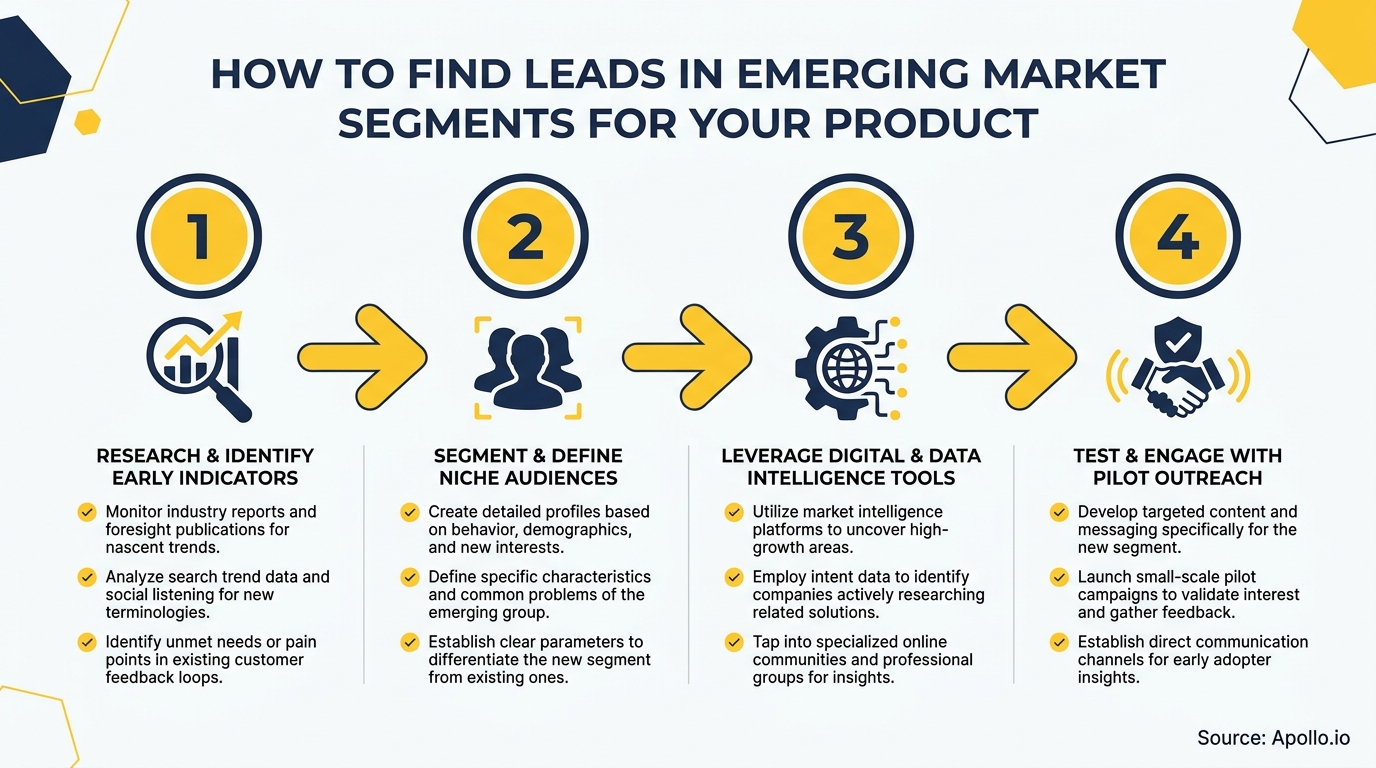
Most B2B teams chase leads in markets they already know. The real pipeline growth lives in emerging segments where competition is thin, buyer intent is forming, and early movers win.
The challenge is that traditional list-buying and SDR-led cold outreach breaks down exactly where it matters most: in new categories where no one has mapped the buyers yet.
This guide gives you a repeatable, data-driven framework to find qualified leads in emerging market segments before your competitors do. Whether you're an SDR prospecting a new vertical or a RevOps leader building a scalable segment-entry playbook, these strategies translate directly into pipeline. For a broader foundation, see how to build a B2B marketing funnel that converts in 2026.

Let Apollo Find Your Buyers Faster
Tired of burning hours on manual research just to hit dead ends? Apollo surfaces verified contacts and scales your outreach automatically. Over 600K companies have stopped guessing and started closing.
Start Free with Apollo →Key Takeaways
- Emerging segments form fastest around technology adoption waves and regulatory shifts — public datasets like Census BFS and BLS projections let you spot them before they show up in CRMs.
- Relevance is a hard gate: buyers in new categories reject outreach that doesn't match their specific context, so message validation must come before volume.
- Signal-based prospecting (intent, behavior, trigger events) outperforms static list-building in segments where firmographic data is sparse.
- Buying groups in emerging categories are larger and less defined — lead discovery means mapping the full committee, not just the economic buyer.
- ABM and intent data have moved from competitive advantages to baseline requirements for entering new segments effectively.
What Is an Emerging Market Segment and Why Does It Matter for Lead Generation?
An emerging market segment is a buyer category that is forming rapidly around a new technology, regulation, business model, or macro shift — one that existing sales motions haven't yet mapped systematically. These segments matter because first-mover advantage in them is measurable: early entrants shape vendor shortlists before procurement processes formalize.
According to Business Research Insights, the B2B lead generation services market is estimated at USD 3.34 billion in 2026 and is expected to reach USD 9.18 billion by 2035 — driven largely by demand to reach new buyer categories faster. The segments fueling that growth aren't legacy verticals. They're categories forming around AI adoption, energy transition, and digital infrastructure expansion.
For SDRs and BDRs, this means the list you bought last quarter may already be stale. You need live signals, not static exports.
How Do You Identify Emerging Segments Using Public Data?
Identifying emerging segments starts with three public datasets that most sales teams ignore: U.S. Census Bureau Business Formation Statistics (BFS), BLS Employment Projections, and NAICS industry codes.
| Data Source | What It Signals | How to Use It |
|---|---|---|
| Census BFS | New business formation surges by geography and industry | Filter by NAICS code to find fast-forming verticals in specific metro areas |
| BLS Employment Projections | Industries with fastest projected headcount growth (2024–2034) | Target industries adding roles — they're buying new vendor categories |
| NAICS Micro-Verticals | 6-digit codes that reveal niche sub-industries within broad categories | Build precise ICP filters rather than broad vertical targeting |
The BLS projects that computing infrastructure, data processing, and web hosting employment will grow over 20% by 2034 — these industries spawn new vendor needs and partner ecosystems you can map now. Cross-reference these growth pockets with your existing customer base to find adjacent segments where your product already solves the same core problem.
Struggling to find qualified leads in these new verticals? Search Apollo's 230M+ contacts with 65+ filters to zero in on the exact NAICS codes and job titles forming in your target segment.
How Do SDRs Find Leads in Segments Where No List Exists?
SDRs find leads in unmapped segments by switching from list-based prospecting to signal-based prospecting — tracking behavior and intent rather than buying pre-built contact lists.
As noted by Martal, ABM along with intent data is moving from a competitive advantage to a baseline requirement. In emerging segments, this shift is non-negotiable: there often is no established list, so intent signals are the only early indicator that a company is entering your category.
Practical signal sources for emerging-segment SDRs:
- Job postings: Companies hiring for roles that require your product category are in-market before they contact any vendor.
- Review site activity: Accounts researching competitors or adjacent tools on G2 and Capterra are evaluating the category.
- Community and forum activity: Emerging buyers congregate in Slack groups, subreddits, and niche newsletters before they appear on any list.
- Trigger events: Funding rounds, executive hires, product launches, and regulatory filings signal segment entry.
- Content consumption: Topic-level intent data shows which accounts are consuming content about problems your product solves.
For a deeper look at how to surface better contacts once you've identified the right signals, see what buyer leads are and how to find better ones.
Turn Funnel Gaps Into Qualified Pipeline
Pipeline forecasting a guessing game because quality leads never convert? Apollo surfaces in-market buyers with verified contact data so your funnel fills with real opportunities. Over 600K companies stopped guessing and started closing.
Start Free with Apollo →What Is the Emerging-Segment Relevance Filter?
The Emerging-Segment Relevance Filter is a scoring framework that evaluates whether an account is ready for outreach in a new category — before you send a single message. It prevents the relevance problem that kills new-segment campaigns: according to research cited in Gartner's 2025 survey, 73% of B2B buyers actively avoid suppliers who send irrelevant outreach.
Score each account on four criteria before outreach:
- Segment fit (0–3): Does the account's NAICS code, headcount, and tech stack match the emerging segment profile?
- Trigger recency (0–3): Has a qualifying trigger event (funding, hire, product launch) occurred in the past 90 days?
- Intent signal strength (0–3): Is the account actively consuming content in your category?
- Buying committee visibility (0–3): Can you identify at least two stakeholders (champion + economic buyer)?
Accounts scoring 8 or above are ready for personalized outreach. Scores of 5–7 go into a nurture sequence. Below 5 stay in monitoring. This prevents the volume trap that SalesHivehighlights: 45% of B2B companies struggle to generate enough leads, and 48% struggle to convert them — often because outreach volume isn't matched to account readiness.

How Do AI Adoption Signals Create Lead Pools in New Categories?
AI adoption creates identifiable lead pools because companies at different stages of AI maturity have distinct vendor needs — and those needs are trackable through job postings, tech stack data, and content consumption patterns.
Segment accounts into two pools based on AI readiness:
- AI-ready accounts: Have data infrastructure, dedicated ML/AI roles, and active AI deployments. These buyers move fast and respond to ROI-focused messaging about integration and scale.
- Data-debt accounts: Have the intent to adopt AI but face governance and integration challenges. These buyers respond to implementation-focused content and risk-reduction messaging.
This segmentation lens is actionable because it maps directly to the messaging your outreach needs. AI-ready accounts want benchmarks and speed-to-value. Data-debt accounts want checklists, risk reviews, and proof that implementation is manageable. Tailor your B2B marketing tools and content assets to match each pool's buying readiness.
How Do Proof-Based Assets Unlock Emerging-Segment Pipeline?
Proof-based assets unlock emerging-segment pipeline by reducing the perceived risk that stalls buying decisions in new categories. When buyers lack peer references and category benchmarks, they rely on spec sheets, transparent pricing logic, and implementation checklists to build internal confidence.
Research from MarketingProfs shows that hyper-personalization — tailoring content across geography, vertical, and role — makes B2B companies 84% more likely to be market share winners. In emerging segments, personalization means proof assets calibrated to the specific segment's context, not generic case studies.
Essential proof-based assets for emerging-segment outreach:
- Segment-specific benchmarks: Data showing outcomes for companies with similar profiles, not just broad industry averages.
- Implementation checklists: Step-by-step onboarding paths that make the "how do we actually do this?" question answerable before the call.
- ROI calculators: Self-serve tools that let the champion build the internal business case without waiting for a proposal.
- One-pagers for internal champions: Shareable summaries designed for the stakeholder who will present to the economic buyer.
These assets also serve your inbound and outbound marketing simultaneously — they pull in self-serve researchers and give your SDRs something concrete to send in follow-up sequences.
Ready to build outreach sequences around these assets at scale? Automate multi-channel sequences with Apollo's sales engagement platform and deliver the right proof asset to the right account at the right stage.
How Do You Turn Emerging-Segment Leads Into Predictable Pipeline?
Turning emerging-segment leads into predictable pipeline requires treating the segment as a GTM experiment with defined metrics, not a one-off prospecting push. Set entry criteria, track conversion rates by segment, and iterate messaging based on what the data shows — not assumptions.
Key operational steps:
- Define the segment's ICP with NAICS code, headcount range, tech stack indicators, and trigger event types.
- Build a 30/60/90-day signal monitoring cadence using job posting alerts, funding databases, and intent platforms.
- Track account-level engagement (not just MQLs) to measure buying committee activation across the full group.
- Review segment conversion rates monthly and kill or double down based on pipeline velocity data.
RevOps leaders building this infrastructure should pair it with a structured go-to-market strategy that defines how segment learnings flow back into ICP refinement and quota planning. Also see top market intelligence tools for B2B to build the monitoring stack that keeps your segment radar current.

Start Finding Leads in Emerging Segments Today
Emerging market segments reward preparation over volume. The teams that win in new categories are the ones who map the segment before they pitch it: they use public data to find the formation signal, intent data to qualify readiness, and proof-based assets to convert champions into closed deals.
Apollo consolidates the prospecting, enrichment, engagement, and pipeline management your team needs to execute this framework without stitching together five separate tools. As Cyera put it: "Having everything in one system was a game changer."
Start free with Apollo and build your first emerging-segment lead list using 230M+ verified contacts and 65+ search filters — no credit card required.
Prove Pipeline ROI Before Next Quarter
ROI pressure killing your tool budget before it even starts? Apollo delivers measurable pipeline impact fast — with 46% more meetings using AI. 600K+ companies justified the spend and never looked back.
Start Free with Apollo →Don't miss these
Sales
Inbound vs Outbound Marketing: Which Strategy Wins?
Sales
What Is a Sales Funnel? The Non-Linear Revenue Framework for 2026
Sales
What Is a Go-to-Market Strategy? The 2026 GTM Playbook
See Apollo in action
We'd love to show how Apollo can help you sell better.
By submitting this form, you will receive information, tips, and promotions from Apollo. To learn more, see our Privacy Statement.
4.7/5 based on 9,690 reviews
