
How to Enrich Leads With Data From Public Data Sources or APIs in 2026
Your CRM is full of leads missing the context your team needs to close them. Incomplete firmographics, stale job titles, and missing compliance signals slow down routing, personalization, and outreach before a single email gets sent. Learning how to build a data enrichment strategy using public data sources and APIs gives your team a lower-cost, higher-provenance alternative to brokered lists — especially critical as regulatory pressure on data brokers intensifies in 2026.
According to Martal, sales reps waste 27.3% of their time chasing bad or incomplete data. Public APIs like SEC EDGAR, SAM.gov, and USAspending can fill those gaps with verifiable, audit-ready signals — without a broker agreement in sight.

Build Pipeline Faster With Apollo
Tired of hours lost to manual research and dead-end contact data? Apollo surfaces verified prospects so your team sells instead of searches. Nearly 100K paying customers use Apollo to scale pipeline without scaling headcount.
Start Free with Apollo →Key Takeaways
- Public data sources (SEC EDGAR, SAM.gov, USAspending) add firmographic depth and compliance signals without brokered data risk.
- Hybrid enrichment — combining real-time API calls with nightly bulk ingestion — balances speed, cost, and freshness.
- California's DROP platform and JEC scrutiny of data brokers in early 2026 make source provenance a top GTM priority.
- RevOps teams that measure enrichment by cost-per-sales-ready-record, not records purchased, see stronger downstream ROI.
- For most B2B GTM teams, a unified enrichment platform like Apollo consolidates public and proprietary data without custom API engineering overhead.
What Are the Best Public Data Sources for Lead Enrichment?
The best public data sources for lead enrichment are government and regulatory databases that expose verified firmographic, financial, and compliance signals via open APIs. Three stand out for B2B GTM use cases:
| Source | Key Fields | Best For |
|---|---|---|
| SEC EDGAR | SIC code, fiscal year, revenue, filings history, CIK | Public company identity, financial signals, industry classification |
| SAM.gov Entity API | UEI, NAICS codes, business type, registration status, POCs, addresses | GovCon eligibility, regulated workflow validation, entity verification |
| USAspending API | Contract awards, award amounts, agency relationships, recipient DUNS/UEI | Government buyer/supplier signals, contract-readiness scoring |
SEC EDGAR submissions are typically available in under one second via real-time API endpoints and also publish nightly bulk ZIPs (companyfacts.zip, submissions.zip), enabling both instant lookups and scheduled batch refreshes. SAM.gov exposes entity details including UEI and NAICS codes — essential for validating leads in regulated or government-facing workflows.
How Does a Hybrid Enrichment Architecture Work?
A hybrid enrichment architecture combines real-time API calls at the point of lead capture with scheduled bulk ingestion for ongoing database refresh. This balances latency, cost, and data freshness across your pipeline.
- Real-time enrichment: Trigger on form submit, CRM record creation, or webhook event. Pull identity fields (domain, NAICS, UEI) immediately to enable instant routing and scoring.
- Bulk ingestion: Schedule nightly or weekly jobs to pull updated filings, award data, or entity status changes. Use change-detection logic (hash comparison or timestamp diffing) to write only modified records.
- Cost control: Cache public API responses aggressively (SEC EDGAR recommends respecting rate limits of 10 requests/second per IP). Serve cached responses for records unchanged since last pull.
- Deduplication: Normalize legal entity names to a canonical key (CIK for EDGAR, UEI for SAM.gov) before writing to your CRM to prevent duplicate account records.
A Reddit user shared a firsthand perspectivethat custom API stacks can become hard for sales teams to adopt: "What we need is just something simple to get good leads and send messages [and] generate business." The build-vs-buy decision matters: custom pipelines offer flexibility, but a unified platform often wins on adoption.
What Are the Key Implementation Patterns for Public API Enrichment?
Successful public API enrichment requires server-side data access, structured caching, and normalization pipelines. Key patterns to implement:
- Server-side proxies: SEC EDGAR does not support browser-side CORS requests. All calls must route through a backend service. Build a thin proxy layer that adds User-Agent headers (SEC requires a valid contact email in the UA string) and enforces rate limiting.
- Field normalization: Map EDGAR SIC codes to your internal industry taxonomy. Normalize NAICS codes from SAM.gov to your ICP segment definitions before writing to CRM fields.
- Change detection: Store a hash of the enriched payload per record. On each bulk refresh, compare hashes and update only changed records to reduce CRM write volume and maintain a clean audit trail.
- Audit logging: Log every enrichment event with source, timestamp, field updated, and prior value. This supports deletion/suppression workflows under emerging regulations.
Struggling to find qualified leads without the engineering overhead? Search Apollo's 230M+ contacts with 65+ filters — no custom API pipeline required.
Turn Funnel Guesswork Into Pipeline Wins
Pipeline forecasting a guessing game because leads stall before they ever become opportunities? Apollo surfaces verified, in-market buyers so your funnel fills with prospects that actually convert. 600K+ companies trust Apollo to make revenue predictable.
Schedule a Demo →How Do RevOps Teams Measure Enrichment ROI?
RevOps leaders measure enrichment ROI by tracking cost-per-sales-ready-record, match rate by source, and downstream conversion lift — not total records purchased. This shift in measurement prevents over-investment in low-quality data coverage.
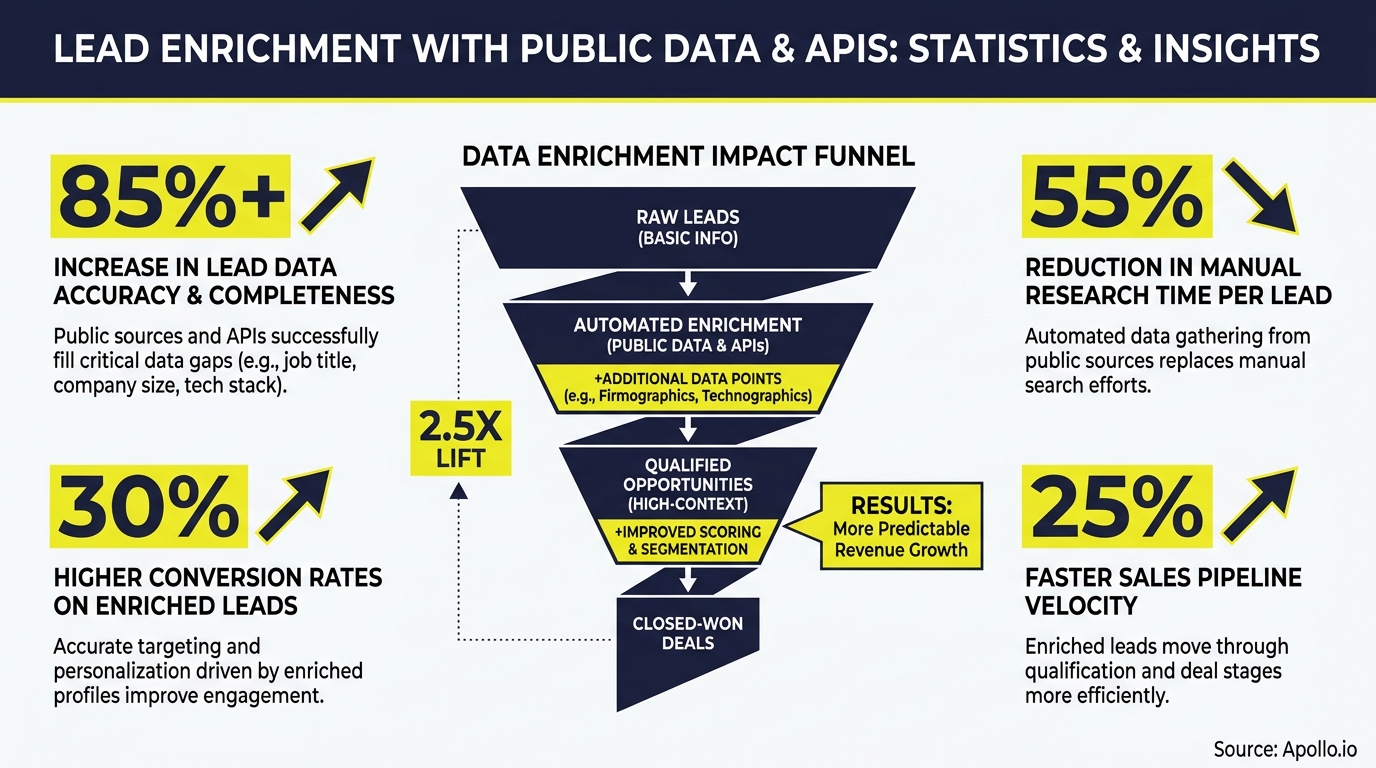
Research from MarketsandMarketsshows enriched leads convert 20-30% better than unenriched ones. A practical RevOps scorecard should track:
- Match rate: % of records successfully enriched per source (public API vs. proprietary vendor)
- Freshness: Days since last enrichment event per record segment
- Routing accuracy: % of leads correctly auto-routed post-enrichment vs. manually reassigned
- Cost per usable record: Total enrichment spend divided by records that progressed past MQL stage
- Conversion lift: Enriched vs. unenriched cohort comparison at each pipeline stage
A commenter added in a Reddit discussion: "If enrichment costs $2-3 per lead and personalization actually converts, it's worth it" — framing enrichment spend as an LTV equation, not a line-item cost.
Data from SalesMotion shows organizations investing in data enrichment report a 25% increase in sales productivity, a 15% jump in marketing ROI, and 80% healthier sales pipelines — reinforcing why enrichment belongs in the GTM budget, not just the data team's backlog.

What Does Compliance-First Enrichment Mean in 2026?
Compliance-first enrichment means building suppression lists, deletion rails, and source provenance into your enrichment pipeline before deploying it — not as a retrofit after a regulatory event. In 2026, this is now a buying criterion, not a legal afterthought.
California's DROP (Delete Request and Opt-out Platform) launched in January 2026 and requires data brokers to begin honoring deletion and opt-out requests starting August 2026. Separately, a Joint Economic Committee report in early 2026 highlighted data brokers allegedly obscuring opt-out pages from search engines — creating reputational and regulatory risk for GTM teams relying on brokered sources. Public data APIs (EDGAR, SAM.gov, USAspending) carry clearer provenance: they originate from government filings and registrations, making deletion/suppression workflows more tractable. For a deeper look at how a responsible enrichment platform handles data governance, see how Apollo protects your data.
For contact data enrichmentthat includes audit-ready sourcing, teams should document: the originating API endpoint, the timestamp of each enrichment event, which fields were updated, and the retention/deletion policy applied per field category.
How Do SDRs and AEs Use Enriched Lead Data to Win More Deals?
SDRs use enriched lead data to prioritize outreach by routing signals — industry, employee count, filing activity, contract awards — rather than working undifferentiated lists. AEs use the same enrichment layer to enter discovery calls with financial context already in hand.
Practical enrichment fields that directly impact pipeline for each role:
- SDRs: NAICS code (ICP fit scoring), USAspending contract awards (buying signal), SAM.gov registration status (active vs. lapsed — a timing signal for outreach)
- AEs: EDGAR revenue and fiscal year data (deal sizing), SIC code (competitive landscape), entity addresses and POCs from SAM.gov (stakeholder mapping)
- RevOps: Parent/child entity relationships (territory assignment), UEI normalization (account deduplication), change-detection alerts on filing status (trigger-based sequences)
Tired of enriching leads manually across disconnected tools? Start free with Apollo's verified B2B contact enrichment— one platform for prospecting, enrichment, and engagement. As Census put it: "We cut our costs in half" by consolidating their GTM stack with Apollo.
For teams evaluating which enrichment fields drive the most pipeline, see which data enrichment tools drive revenue in 2026 and how to compare them by match rate and conversion lift.
Should You Build a Custom Enrichment Pipeline or Use a Unified Platform?
Build a custom enrichment pipeline when you have a specific regulated use case (GovCon validation, EDGAR financial signals) that no off-the-shelf platform covers. Use a unified platform for the majority of B2B GTM enrichment needs — it ships faster, costs less to maintain, and drives better sales team adoption.
The build-vs-buy calculus depends on three factors:
| Factor | Custom Pipeline | Unified Platform |
|---|---|---|
| Time to value | Weeks to months | Days |
| Maintenance burden | High (API changes, rate limits, schema drift) | Low (vendor-managed) |
| Sales team adoption | Requires custom UI/CRM integration | Native CRM sync and workflow triggers |
| Compliance auditability | Custom-built logging required | Platform-level audit trails |
| Best for | GovCon, regulated industries, niche signals | Most B2B GTM teams |
Apollo's waterfall enrichment and CRM enrichment tools combine 230M+ verified contacts with automated enrichment workflows — consolidating what would otherwise require multiple vendor integrations into a single platform. "Having everything in one system was a game changer," noted Cyera after consolidating their GTM stack.

Start Enriching Leads With Better Data Today
Public data sources — SEC EDGAR, SAM.gov, USAspending — give B2B GTM teams verifiable enrichment signals with clear provenance, lower broker risk, and audit-ready sourcing. Pair them with a hybrid real-time + bulk architecture, measure by cost-per-sales-ready-record, and build deletion/suppression workflows before you need them.
For most SDRs, AEs, and RevOps teams, a unified enrichment platform eliminates the engineering overhead of custom API pipelines while delivering the same firmographic and contact-level depth. Apollo's all-in-one GTM platform handles prospecting, enrichment, and engagement in one workspace — so your team spends time selling, not stitching together data feeds.
Start Your Free Trial and enrich your first leads with Apollo's 230M+ verified contacts today.
Prove Pipeline ROI With Apollo
ROI pressure killing your tool budget? Apollo delivers measurable pipeline impact from day one — so you walk into every renewal conversation with numbers, not excuses. Leadium 3x'd annual revenue using Apollo.
Start Free with Apollo →Don't miss these
Sales
Inbound vs Outbound Marketing: Which Strategy Wins?
Sales
What Is a Sales Funnel? The Non-Linear Revenue Framework for 2026
Sales
What Is a Go-to-Market Strategy? The 2026 GTM Playbook
See Apollo in action
We'd love to show how Apollo can help you sell better.
By submitting this form, you will receive information, tips, and promotions from Apollo. To learn more, see our Privacy Statement.
4.7/5 based on 9,690 reviews
