
How to Enrich Leads Using Purchase Intent and Interest Signals
Most B2B teams treat lead enrichment as a one-time data append. They grab a company's firmographics, push the record to a sequence, and wonder why conversion rates stay flat. The problem isn't the data. It's that enrichment without purchase intent signals tells you who a prospect is, not whether they're ready to buy.
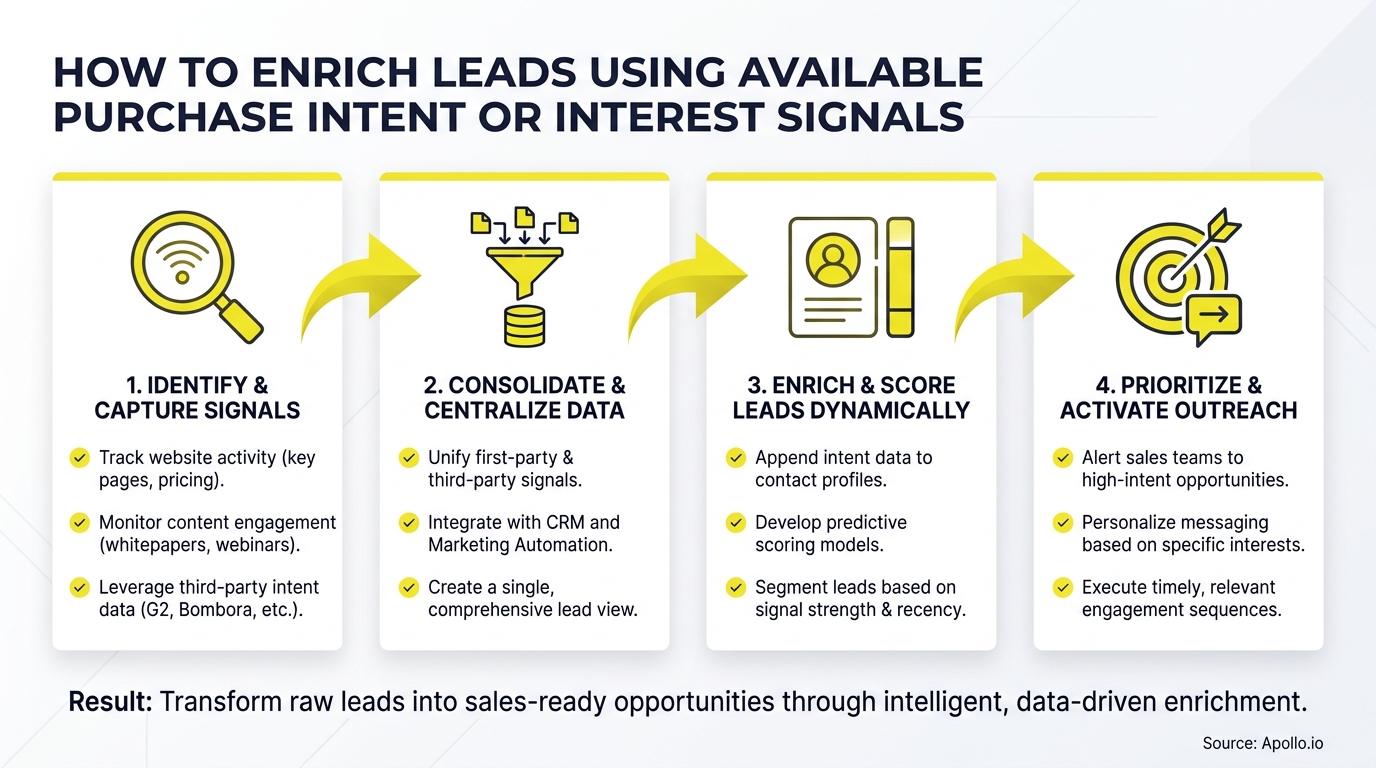
In 2026, the most effective GTM teams are stacking behavioral, firmographic, and third-party intent signals together to prioritize outreach, personalize messaging, and trigger the right play at the right moment. This guide shows exactly how to do that.

Research Less. Pipeline More With Apollo.
Tired of burning hours verifying contacts that go nowhere? Apollo delivers 230M+ accurate business contacts so your reps spend time selling, not searching. Start building pipeline that actually converts.
Start Free with Apollo →Key Takeaways
- Intent signals alone don't predict readiness. Stacking them with firmographic fit and behavioral context produces far more reliable prioritization.
- A significant majority of B2B buyers now prefer self-directed research, making "silent" interest signals (pricing page visits, content depth, comparison behavior) more valuable than form-fills.
- SDRs and RevOps teams that enrich leads continuously, rather than once at creation, catch accounts at the moment they cross a buying threshold.
- Messaging consistency between your website, content, and sales conversations is as important as signal quality. Misalignment actively drives buyers away.
- Thought leadership engagement is a measurable demand-gen signal, not just brand-building.
What Does It Mean to Enrich Leads With Intent Signals?
Enriching leads with intent signals means layering behavioral and third-party research data onto existing contact or account records to reveal when a prospect is actively evaluating a solution, not just who they are. Standard customer data enrichment adds firmographics, job titles, and contact details. Intent enrichment goes further by attaching signals like topic surges, pricing page visits, content consumption patterns, and review-site activity to those same records.
According to MarketsandMarkets, 75% of companies consider lead enrichment essential for their marketing and sales strategies. The shift in 2026 is that enrichment is no longer a one-time event. It's a continuous feed that updates account priority as signals change.
What Types of Intent and Interest Signals Can You Enrich With?
Intent signals fall into three categories that, when combined, give a fuller picture of buying readiness.
| Signal Type | Examples | Funnel Stage |
|---|---|---|
| Third-Party Research Intent | Topic surges, review-site visits, category searches, G2/Capterra activity | Top-of-funnel awareness |
| First-Party Behavioral Signals | Pricing page visits, product page depth, return visits, trial feature usage, webinar attendance | Mid-to-bottom funnel |
| Business Change Signals | Hiring for relevant roles, funding rounds, tech stack installs, leadership changes | Account-level readiness |
A sales professional wrote on Redditthat pricing page visits are consistently underrated: leads who visit a pricing page without booking a meeting convert at significantly higher rates than email-only engagements, and trial users who activate a core feature within 24 hours of signup show close rates far above those who only tour a dashboard.
A recent G2 report from April 2026 found that 51% of B2B software buyers now start their research in AI chatbots. This shifts interest signals upstream into AI-driven discovery, meaning enrichment strategies need to capture comparison behavior and category-level research patterns, not just web visits.
How Do You Build a Signal-Stacking Framework?
A signal-stacking framework combines multiple intent signals into a single confidence score that reflects both fit and readiness. Using one signal in isolation produces noisy prioritization.
Stacking filters out accounts that show curiosity but lack buying conditions.
Step 1: Define your signal tiers
- Tier 1 (High confidence): Pricing page visit + third-party topic surge + relevant hiring signal firing simultaneously
- Tier 2 (Medium confidence): Two or more signals from different categories within a 14-day window
- Tier 3 (Low confidence): Single signal, no recency alignment
Step 2: Apply signal decay
Intent signals degrade over time. A pricing page visit from 60 days ago carries far less weight than one from last week. Set decay windows per signal type: first-party behavioral signals decay in 7-14 days; third-party topic surges in 21-30 days; business change signals in 45-90 days.
Step 3: Map signals to plays
Tier 1 accounts route to SDR outreach with personalized messaging referencing the active signal. Tier 2 accounts enter nurture sequences with relevant content. Tier 3 accounts receive retargeting only.
Research from Martal shows 70% of B2B marketers now use intent data to identify buyer interest signals and time outreach more effectively. The teams outperforming their peers use stacked signals rather than single-source triggers.
Struggling to find accounts showing active buying signals? Apollo's Buying Intent surfaces in-market accounts using behavioral data layered directly onto contact and company records, so your team can act on signals without switching tools.
Turn Funnel Guesswork Into Real Pipeline
Tired of watching marketing leads stall before they ever reach sales? Apollo surfaces in-market buyers the moment they're ready, so your team stops chasing cold leads and starts closing. 600K+ companies trust Apollo to fill their pipeline with confidence.
Start Free with Apollo →How Should SDRs and RevOps Teams Act on Enriched Intent Data?
SDRs should treat intent-enriched records differently from cold outreach lists. The signal context changes the opening message, the channel priority, and the expected response rate.
For SDRs, the most effective approach is to reference the specific signal context without being creepy. If an account surged on a competitor comparison topic, the opener should acknowledge the evaluation moment, not the specific browsing behavior.
For RevOps leaders, the priority is ensuring enriched signals flow into CRM records automatically, so sequences trigger based on live data rather than static segment membership.
A Reddit user shared a firsthand perspectiveon building durable lead generation strategies: after analyzing 20+ closed deals, their team identified five to six repeatable pre-conditions that appeared 60-90 days before signing. They stopped building sequences around firmographics and started building them around those readiness patterns instead.
For Account Executives managing later-stage opportunities, intent signals from existing contacts (return pricing visits, security doc downloads, ROI calculator usage) are strong indicators that internal champions are building a business case. Those signals warrant proactive outreach with deal-closing assets, not generic nurture content.
According to TechInformed, 65% of marketers say intent signals have improved their pipeline forecasting accuracy. RevOps teams that feed enriched intent data into CRM opportunity records give sales leadership a more reliable signal for forecast calls.

How Does Messaging Consistency Affect Intent-Based Enrichment?
Messaging consistency determines whether enrichment efforts convert or backfire. Enriched intent data helps you reach the right account at the right moment, but inconsistent messaging between your website, content, and sales conversations actively destroys trust.
Research from Coalition Technologies indicates that 80% of B2B buyers are more likely to purchase after a highly personalized experience. Personalization fails when the SDR's pitch contradicts what the prospect read on the product page.
Build a simple persona-stage messaging map before activating intent-based sequences:
- Persona: Who is receiving this outreach (economic buyer, technical evaluator, end user)?
- Stage: What does the signal suggest about their buying phase?
- Message: What specific value statement aligns with their likely concern at that stage?
- Asset: What self-serve content closes the confidence gap (ROI calculator, security brief, implementation roadmap)?
To learn more about building a systematic approach to this, see how to build a data enrichment strategy that connects signal inputs to consistent downstream messaging.
How Do You Measure ROI From Intent-Enriched Lead Programs?
Measuring ROI from intent enrichment requires tracking conversion lift at each stage, not just pipeline attribution. The core metrics to monitor are: signal-to-sequence conversion rate (how often Tier 1 accounts respond), signal-to-opportunity rate (how often enriched accounts become qualified pipeline), and signal-to-close rate compared to non-enriched accounts.
Data from MarketsandMarkets shows organizations using intent data report 2-4x ROI through higher conversion rates, shorter sales cycles, and improved efficiency. The teams achieving those results track enrichment impact at the account level, not just the campaign level.
Set a quarterly retrospective cadence: review which signals appeared in closed-won accounts 60-90 days before close, then use those patterns to refine your Tier 1 signal stack. This feedback loop continuously improves signal quality without requiring a new data vendor.
Spending too much time manually researching accounts before outreach? Automate lead enrichment with Apollo and surface verified contact data, firmographics, and buying signals in one unified workspace.
How Does Apollo Help Teams Enrich Leads With Intent Signals?
Apollo consolidates the intent enrichment workflow that typically requires multiple separate tools: a data provider, an intent platform, an engagement tool, and a CRM sync layer. With Apollo, SDRs, RevOps teams, and marketing leaders work from a single platform that combines a 230M+ contact database with built-in buying intent signals, 65+ prospecting filters, and multi-channel engagement sequences.
Teams can enrich inbound leads automatically using Apollo's form optimization and inbound enrichment, append intent context to CRM records, and trigger sequences based on live signal activity, all without exporting static lists between tools. As Cyera's team noted, "Having everything in one system was a game changer."

Start Enriching Leads With Intent Signals That Actually Convert
Intent enrichment works when signals are stacked, scored, and mapped to consistent messaging for the right persona at the right stage. A single-source topic surge is noise.
A pricing page visit combined with a relevant hiring signal and a third-party research surge is a buying moment worth acting on immediately.
The teams winning in 2026 treat enrichment as a continuous system, not a one-time data append. They build decay windows, retrospective signal reviews, and persona-stage messaging maps into their GTM motion from the start.
Ready to put intent-enriched prospecting into practice? Schedule a Demo and see how Apollo's unified platform brings buying intent, contact data, and sales engagement together in one workspace.
Prove Pipeline ROI With Apollo
Budget approval stuck on unclear metrics? Apollo gives revenue teams the measurable pipeline impact leadership demands — faster. Leadium 3x'd annual revenue. Your CFO wants proof. Apollo delivers it.
Schedule a Demo →Don't miss these
Sales
Inbound vs Outbound Marketing: Which Strategy Wins?
Sales
What Is a Sales Funnel? The Non-Linear Revenue Framework for 2026
Sales
What Is a Go-to-Market Strategy? The 2026 GTM Playbook
See Apollo in action
We'd love to show how Apollo can help you sell better.
By submitting this form, you will receive information, tips, and promotions from Apollo. To learn more, see our Privacy Statement.
4.7/5 based on 9,690 reviews
