
How to Determine the Right Message Format for Each Audience Segment
Most B2B messaging fails not because the message is wrong, but because the format doesn't match what the audience needs at that moment. A whitepaper sent to a buyer ready to shortlist vendors, or a product sheet forwarded to a CFO who never talked to sales, both miss the mark.
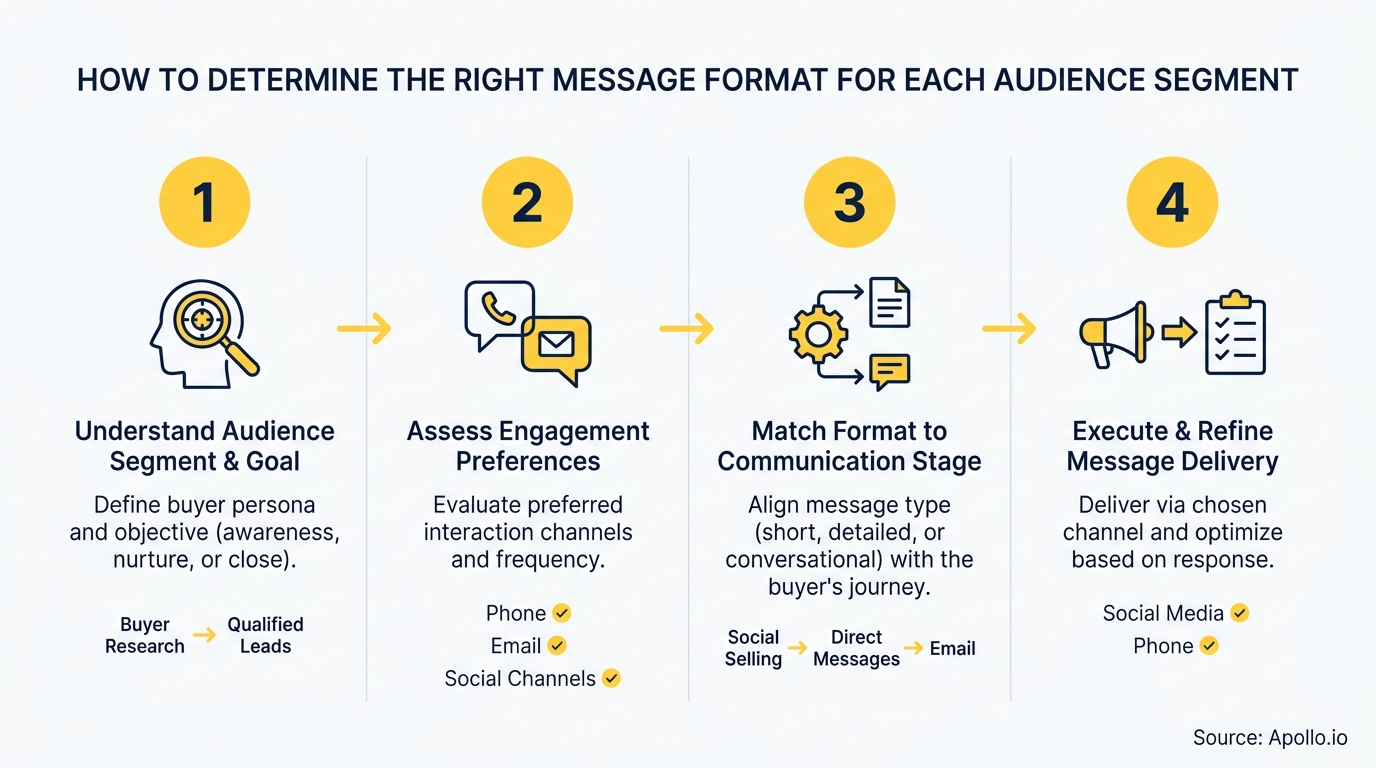
Determining the right message format for each audience segment requires mapping buyer role, buying stage, and intent signals together — not just persona labels.
According to Coalition Technologies, 80% of B2B buyers are more likely to purchase after a highly personalized experience. Format is the first layer of personalization most teams get wrong. For SDRs, AEs, and RevOps leaders building a scalable sales tech stack, format-selection is a repeatable system, not a creative guess.

Research Less, Close More With Apollo
Tired of burning hours verifying contact info that goes nowhere? Apollo delivers verified business contacts so your reps spend time selling, not searching. Join 600K+ companies building pipeline that actually converts.
Start Free with Apollo →Key Takeaways
- Format selection should be driven by buying-stage intent and buyer role — not persona labels alone.
- Audience segmentation dramatically improves revenue outcomes: companies using it see significantly higher email revenue and profitability.
- Buying committees need shareable, role-modular assets — not one-size-fits-all decks.
- With most B2B buyers now preferring a rep-free experience, formats must work independently without a seller in the room.
- AI tools are now part of the buying process, so content must be structured for both human readers and LLM summarization.
Why Does Message Format Matter More Than Message Content?
Format determines whether your message gets consumed, shared, or ignored — before the content even lands. A well-written case study sent to a prospect in the awareness stage creates friction; a punchy explainer video sent to a decision-stage buyer feels shallow.
Research from Britopian shows companies using audience segmentation see a 760% increase in email revenue. And AM World Group reports that organizations excelling at market segmentation generate 10% higher profits than those using generic marketing approaches. The format is the delivery mechanism that makes segmentation pay off.
How Do You Turn Audience Segments into Buying-Stage Intent Scores?
Convert your segment inputs into buying-stage intent by scoring three signals: engagement depth, content type consumed, and decision-role seniority. This gives you a practical framework before selecting any format.
Use this quick scoring worksheet for each segment:
- Engagement signal: Cold outreach target (0) / Opened 1-2 emails (1) / Downloaded an asset (2) / Requested a demo or pricing (3)
- Content consumed: Blog/social (0) / eBook/webinar (1) / Case study/playbook (2) / Comparison page/ROI calculator (3)
- Decision role: Influencer/practitioner (1) / Manager/director (2) / VP/C-suite (3)
Score 0-3: Awareness stage. Score 4-6: Consideration stage. Score 7-9: Decision/shortlist stage. Match your format to the resulting stage, not just the persona label.
Struggling to identify which prospects are at which stage? Apollo's advanced search filters help you segment and prioritize contacts by role, intent signals, and firmographics — so your outreach starts with the right audience already identified.
What Is the Format-Selection Matrix for B2B Audience Segments?
The format-selection matrix maps buying stage and buyer role to recommended message formats, gating rules, and shareability requirements. Use this as your decision framework.
| Buying Stage | Practitioner / SDR Target | Manager / Director | VP / C-Suite | Gating Rule |
|---|---|---|---|---|
| Awareness | Short video, how-to article, social post | Thought leadership article, industry report summary | POV essay, provocative stat card, podcast clip | Ungated |
| Consideration | eBook, on-demand webinar, checklist | Comparison page, ROI calculator, use-case brief | Analyst summary, benchmark report, peer data | Light gate (email only) |
| Decision / Shortlist | Implementation guide, playbook, FAQ doc | Case study, business case template, security brief | Executive summary, customer reference, pricing overview | Ungated or sales-assisted |
Gartner reported in March 2026 that 67% of B2B buyers prefer a rep-free experience. Formats at the decision stage must work without a seller present — which means comparison pages, ROI calculators, and executive summaries need to answer objections on their own. For more on building sequences that support self-directed buyers, see how to use sales automation the right way.

How Should SDRs and AEs Adapt Format by Recipient Role?
SDRs and AEs should select message formats based on the recipient's decision role and how far into the buying journey that contact is likely to be.
For SDRs running cold outreach, the format rule is simple: short, ungated, and frictionless. A 90-second video, a single-insight email referencing a relevant trigger, or a plain-text note with one link outperforms attachments and long-form assets at this stage. For email personalization that drives replies, the format itself signals relevance before the copy does.
For AEs managing active opportunities, format shifts to proof and specificity.
Case studies, business case templates, and security or compliance briefs serve different stakeholders within the same buying committee.
According to Madison Logic, 58% of B2B marketers believe video is the most effective content format — making short customer testimonial clips a strong AE tool at the consideration and decision stages.
Turn Funnel Guesswork Into Pipeline Wins
Pipeline forecasting a guessing game because leads stall before they ever reach your AEs? Apollo surfaces high-intent prospects and moves them faster from first touch to qualified opportunity. Nearly 100K paying customers stopped guessing and started closing.
Start Free with Apollo →What Is the Committee-Shareability Checklist for B2B Message Formats?
A committee-shareable format is one that can be forwarded, summarized, or presented by someone who was not in the original conversation.
B2B buying groups now average more than 10 members, and most hidden decision-makers never speak to sales. Every asset you create should pass this checklist before distribution:
- Executive summary at the top: 3-5 bullet points answering "what is this, why does it matter, what's the ask"
- Role-modular sections: Separate sections or callout boxes for IT, Finance, Operations, and End User concerns
- Standalone value: Each page or section should make sense without context from a prior conversation
- Internal discussion prompts:End with 2-3 questions the reader can bring to their team (e.g., "Ask your IT lead: how does this integrate with your current stack?")
- One clear next step: A single CTA — not three — so the forwarder doesn't have to explain what to do next
This approach connects directly to how RevOps can lead sales transformation — by designing content systems that work across the entire revenue team, not just the rep who sent the first email.
How Do You Structure Message Formats for AI Readability and LLM Summarization?
Structure formats for AI readability by using clear headings, definition-first paragraphs, comparison tables, and explicit claim-and-proof pairings — so LLMs can extract and cite your content accurately.
With 94% of buyers now using LLMs as part of their research process, your content has two audiences: the human buyer and the AI tool summarizing the vendor landscape. Formats that perform well for LLM summarization include: comparison tables with labeled rows and columns, FAQ sections with direct one-sentence answers, original data with attributed sources, and structured "why us / why now / who it's for" sections near the top of each asset.
Avoid formats that bury key claims in long paragraphs, use jargon without definition, or rely on visual-only layouts (infographics without text equivalents). Consistency across channels matters too — data sync issues across business systemscreate the same problem in content: buyers get conflicting messages from your website, sales deck, and email, which erodes trust at exactly the wrong moment.
Spending hours building segmented sequences manually? Apollo's multi-channel sales engagement platform lets you automate format-matched outreach sequences by segment, stage, and role — without stitching together five separate tools.

How Do You Put the Format-Selection Framework into Practice?
Determining the right message format for each audience segment comes down to three repeatable steps: score buying-stage intent, apply the format matrix, and build for shareability and AI readability.
Stop treating format as a creative afterthought. The segment inputs you already have — role, engagement history, content consumed — are enough to score intent and pick the right format before writing a single word. For teams building a modern B2B marketing tool stack, this framework integrates directly into your sequencing and content operations workflow.
Apollo gives B2B GTM teams the contact intelligence, segmentation filters, and multi-channel engagement tools to execute this framework at scale — in one platform, without the complexity of managing separate tools for data, outreach, and analytics. As Cyera put it: "Having everything in one system was a game changer."
Start prospecting smarter with Apollo — free to get started.
Prove Pipeline ROI With Apollo
ROI pressure killing your tool budget approval? Apollo delivers measurable pipeline impact your leadership can actually see. Leadium 3x'd annual revenue — your CFO will notice results like that.
Start Free with Apollo →Don't miss these
Sales
Inbound vs Outbound Marketing: Which Strategy Wins?
Sales
What Is a Sales Funnel? The Non-Linear Revenue Framework for 2026
Sales
What Is a Go-to-Market Strategy? The 2026 GTM Playbook
See Apollo in action
We'd love to show how Apollo can help you sell better.
By submitting this form, you will receive information, tips, and promotions from Apollo. To learn more, see our Privacy Statement.
4.7/5 based on 9,690 reviews
