
How to Determine the Best Day and Time to Contact Prospects in 2026
Most sales reps treat outreach timing like a trivia question: "Is it Tuesday at 10am?" The real answer is more nuanced. Timing is a systems problem, and the best moment to contact a prospect is often determined by buyer signals, industry context, and omnichannel sequencing, not a universal rule. For a deeper channel-by-channel breakdown, see Apollo's guide to the best time to email and call prospects for higher replies.
According to sales-mind.ai, 76% of sales representatives admit to relying on guesswork for determining the best contact times. This article replaces guesswork with a repeatable framework.

Research Less, Pipeline More With Apollo
Tired of burning hours verifying contact info instead of closing deals? Apollo delivers 230M+ accurate business contacts so your team sells from minute one. Start building pipeline today.
Start Free with Apollo →Key Takeaways
- Timing benchmarks (midweek, mid-morning) are starting hypotheses, not universal rules. Industry, persona, and timezone matter more.
- Buyer signals, such as a pricing page visit or demo request, create the highest-value outreach windows. Speed-to-lead SLAs unlock more pipeline than send-time tweaks alone.
- 80% of successful sales require at least five follow-ups, yet most reps quit after one. Sequence depth beats single-touch optimization.
- Omnichannel timing coordination (email, phone, and social together) outperforms optimizing each channel in isolation.
- Measure success by reply rate and meetings booked, not open rate. Open rate data is increasingly unreliable due to email privacy tools.
Why Does Timing Matter, and What Are Its Limits?
Timing improves connect rates and reply rates at the margin, but it cannot fix poor targeting or irrelevant messaging. Data from B2B Rocket shows that 80% of successful sales require at least five follow-ups, yet 44% of reps give up after just one attempt. Timing optimization is meaningless without sequence depth.
According to Sellerscommerce, B2B buyers are typically 57% to 70% through their research before contacting sales. By the time a prospect appears in your CRM, they already have opinions. The strongest timing signal is their own behavior, not the day of the week.
Treat timing benchmarks as starting hypotheses. Validate them against your own audience, vertical, and channel mix before making them policy.
What Are the Best Days and Times to Contact Prospects by Channel?
Midweek windows consistently outperform Monday and Friday across both email and phone outreach. Use the table below as a baseline, then refine by industry.
| Channel | Best Days | Best Time Windows | Source Basis |
|---|---|---|---|
| Cold Calls | Wednesday, Thursday | 11:00 AM, 2:00 PM (prospect local time) | Cognism State of Cold Calling 2024 |
| Cold Email | Tuesday, Thursday | 10:00 AM or 3:00 PM | Efficy/APSIS Email Benchmark 2024 |
| Professional Social | Tuesday, Monday | Morning (role-dependent) | Belkins social outreach Study 2025 |
| Follow-up Calls | Wednesday, Thursday | Match original outreach window | Peak Sales Recruiting B2B Data |
Research from Peak Sales Recruiting confirms Wednesday and Thursday are the most effective days for B2B outreach overall. However, Salesmotion notes that Tuesday through Thursday consistently outperforms the rest of the week as professionals settle into their routines.
Struggling to reach the right contacts at the right time? Automate your sequences with Apollo's multi-channel engagement platform and let timing rules run automatically across email, phone, and social.
How Do SDRs Apply a Timing Decision Framework by Industry and Persona?
SDRs who segment timing by vertical and persona outperform those who apply a single universal schedule. The framework below maps industry and seniority to optimal contact windows.
| Industry / Vertical | Recommended Email Window | Call Window | Persona Notes |
|---|---|---|---|
| Software / SaaS | 2:00–3:00 PM | 11:00 AM or 2:00 PM | ICs responsive later; Directors morning |
| Professional Services (B2B) | 8:00–10:00 AM | 8:30–9:30 AM | Principals often block calendar midday |
| Manufacturing / Operations | 7:00–8:30 AM | Early morning or post-shift | Operations roles start early |
| Finance / CFO | Tuesday 8:00–9:00 AM | Avoid Monday morning and Friday | CFOs are meeting-heavy midday |
| Healthcare | Thursday 1:00–3:00 PM | Post-lunch administrative windows | Clinical staff unavailable mornings |
Always schedule in the prospect's local timezone. Timezone-aware scheduling is now table-stakes for any team running multi-region outreach.
Tools that auto-convert send times to prospect local time remove a consistent source of timing error.
For AEs managing larger deals, persona-based timing also applies to multi-stakeholder sequences. According to SalesHive, modern B2B buyers involve 8 to 13 stakeholders, each with different availability patterns. Aligning outreach timing to each persona's role, not just the primary contact, increases response rates across the buying committee.

How Do Buyer Signals Determine the Best Outreach Moment?
The highest-value outreach window is triggered by buyer behavior, not a calendar rule. Intent signals such as a pricing page visit, demo request, webinar registration, or content download indicate active research and should trigger immediate follow-up.
Speed-to-lead SLA is the single highest-leverage timing variable for inbound and intent-triggered prospects. Reaching out within minutes of a signal dramatically increases connect rates compared to next-day follow-up.
- Inbound / demo request: Target follow-up within 5 minutes during business hours
- Pricing page visit (identified): Same-day outreach, personalized to their stage
- Webinar or event registration: Reach out 24 hours before and within 2 hours after
- Email reply or click: Call or follow-up message within the same business day
- Cold prospect (no signal): Apply the day/time benchmarks from the table above
This shift from calendar-based to signal-based scheduling reflects a broader change in how B2B buying works. See Apollo's guide to sales automation for how to build signal-triggered workflows that respond faster without adding manual work.
Turn Funnel Gaps Into Pipeline With Apollo
Pipeline forecasting a guessing game? Apollo surfaces high-intent prospects and flags sales-ready leads before your team wastes another cycle. Top revenue teams book 46% more meetings using Apollo's AI Research Agent.
Schedule a Demo →How Should SDRs and RevOps Teams Test and Validate Timing?
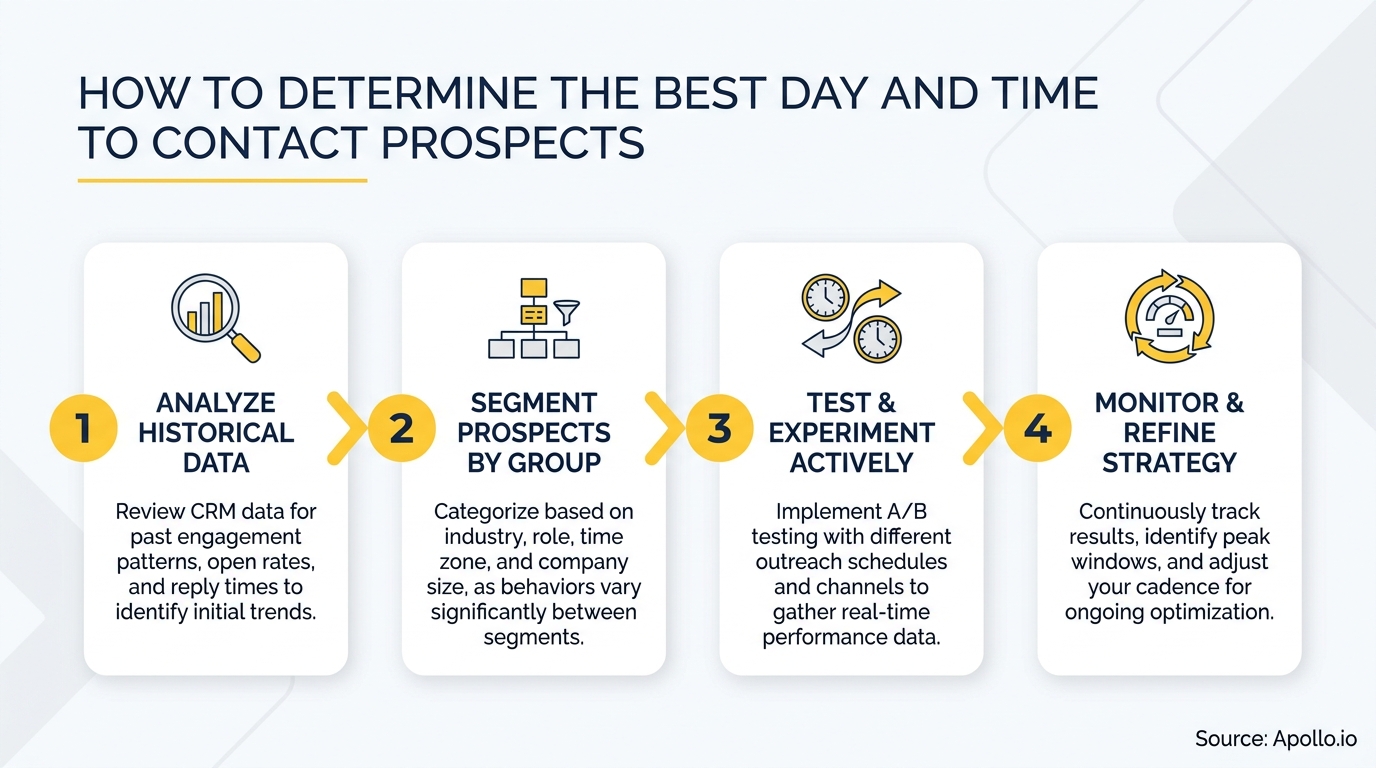
Testing outreach timing requires the right KPIs. Open rate is an unreliable metric due to email privacy tools inflating counts.
Focus on reply rate, meeting-booked rate, and pipeline influenced instead.
A simple A/B timing test structure:
- Hypothesis: Thursday 10 AM will produce a higher meeting-booked rate than Monday 10 AM for SaaS VP-level contacts
- Sample size: Minimum 200 contacts per variant for statistical significance
- Duration: Run for 4 weeks to control for seasonal variation
- Primary KPI: Meeting-booked rate (not open rate)
- Secondary KPI: Reply rate, positive reply rate
- Stopping rule: If one variant reaches 95% confidence or 8 weeks pass, declare a winner
RevOps leaders should own this testing cadence. GrowLeads notes that success in B2B sales often requires an average of eight touchpoints to close a deal. Testing should cover not just send time but touch frequency and channel sequencing to find the optimal cadence for each segment.
Spending hours managing manual sequences and tracking results in spreadsheets? Apollo's AI sales automation runs and tracks multi-touch sequences automatically, so your team can focus on conversations, not logistics.
What Is the Omnichannel Timing Playbook for 2026?
Single-channel timing optimization is a diminishing-returns strategy. B2B buyers use multiple interaction channels in their buying journey, and coordinating timing across channels produces better outcomes than perfecting any one channel in isolation.
A practical omnichannel sequence structure for cold outbound:
- Day 1 (Wednesday): Personalized email, sent 10:00 AM prospect local time
- Day 3 (Friday): Cold call attempt, 11:00 AM or 2:00 PM prospect local time
- Day 5 (Tuesday): Professional social connection request with brief note
- Day 8 (Thursday): Follow-up email referencing prior touches
- Day 12: Final call attempt, then pause or move to nurture
Channel pivoting based on engagement matters as much as initial timing. If an email is clicked but not replied to, a same-day call is more likely to convert than waiting for the next scheduled email step. For AEs managing enterprise accounts, this multi-touch coordination also applies to warm versus cold call strategies within the same account.
Pair your outreach timing with strong subject lines. See Apollo's data-backed guide to the best email subject lines for sales to maximize open and reply rates once your timing is dialed in.
How Do You Build a Repeatable Timing System for Your Team?
A repeatable timing system combines benchmarks, signals, and tested rules into a single operating cadence that any SDR or AE can follow without guesswork.
Three components every team needs:
- A default timing template segmented by industry, persona, and timezone (use the tables above as your starting point)
- Signal-triggered SLA rules that auto-prioritize inbound and intent leads for same-day follow-up
- A quarterly testing cycle where RevOps reviews meeting-booked rate by send time and updates the default template with findings
Apollo's all-in-one GTM platform consolidates prospecting, sequencing, call management, and analytics into one workspace, replacing the need for separate tools for each function. As Cyera put it, "Having everything in one system was a game changer." For teams building or refining their outreach infrastructure, see the full guide to building a sales tech stack that scales revenue.

Start Reaching Prospects at the Right Moment
Timing is a meaningful lever, but only when paired with relevant messaging, quality data, and consistent follow-up. The teams that win in 2026 treat timing as a system: signal-triggered SLAs for high-intent prospects, persona-segmented windows for cold outreach, and omnichannel sequencing that adapts based on engagement.
Stop guessing and start building a timing framework that actually moves pipeline. Start free with Apollo and run your entire outreach, from prospect discovery to sequenced follow-up, in one unified platform.
Prove Pipeline ROI With Apollo
ROI pressure killing your tool budget? Apollo delivers measurable pipeline impact from day one — 46% more meetings with AI Research Agent. Start your free trial and show leadership real numbers fast.
Start Free with Apollo →Don't miss these
Sales
Inbound vs Outbound Marketing: Which Strategy Wins?
Sales
What Is a Sales Funnel? The Non-Linear Revenue Framework for 2026
Sales
What Is a Go-to-Market Strategy? The 2026 GTM Playbook
See Apollo in action
We'd love to show how Apollo can help you sell better.
By submitting this form, you will receive information, tips, and promotions from Apollo. To learn more, see our Privacy Statement.
4.7/5 based on 9,690 reviews
