
How to Create AI-Driven Pipeline Alerts for Deal Closing Signals in 2026
Your buyer has already ranked you before the first sales call. Research by 6sense found that 81% of B2B buyers had already chosen a preferred vendor before speaking with sales, and the winning vendor was on the Day One shortlist 95% of the time. By the time a rep gets a notification from a CRM field change, the deal is often already decided. AI-driven pipeline alerts fix this by detecting closing signals earlier, at every stage from pre-contact intent through negotiation. This article shows you how to build them.
Whether you're an AE managing a large book of business or a RevOps leader trying to lead sales transformation, the goal is the same: surface the right signal, at the right stage, with a clear next action attached.

Build Pipeline Faster With Apollo
Tired of hours lost to manual research and dead-end contact data? Apollo surfaces verified leads and automates outreach so your team spends time selling, not searching. Join 600K+ companies building predictable pipeline.
Start Free with Apollo →Key Takeaways
- Effective AI pipeline alerts map specific closing signals to each buying stage, from pre-contact intent through negotiation, not just a single lead score.
- Buyers complete the majority of their journey before engaging sellers, making silent-signal detection more valuable than rep-entered CRM notes.
- Alert governance (thresholds, false-positive management, audit trails) is what separates reliable deal intelligence from alert fatigue.
- Acting on high-intent signals quickly is the measurable payoff: one team described on Reddit moving from an 18% to 26% win rate in a month after tightening ICP and responding to intent leads within 15 minutes.
- Apollo consolidates signal detection, engagement automation, and deal management into one workspace, reducing the need for multiple disconnected tools.
What Are AI-Driven Pipeline Alerts for Closing Signals?
AI-driven pipeline alerts are automated notifications triggered when a combination of behavioral, firmographic, or conversational signals indicates a deal is progressing toward, or at risk of missing, a close. They differ from basic CRM reminders by analyzing patterns across multiple weak signals rather than relying on a single field update.
The distinction matters. A single pricing-page visit is noise.
A pricing-page visit combined with a returning champion, a new legal stakeholder added to email threads, and a spike in competitor comparison content is a closing signal. AI systems detect that pattern.
Reps and dashboards typically don't.
Gartner reported in 2025 that 61% of B2B buyers prefer a rep-free buying experience, which means the signals that matter most are now silent ones. Building alerts around those silent signals is the core challenge for modern GTM teams.
What Is the Signal Taxonomy by Buying Stage?
Mapping closing signals to buying stages is the foundational design decision for any AI alert system. Different signals fire at different stages, and routing the wrong alert to the wrong team wastes time and creates noise.
| Buying Stage | Example Closing Signals | Alert Trigger | Recommended Action |
|---|---|---|---|
| Pre-Contact / Intent | Multiple stakeholders consuming category content, pricing page visits, review site activity | Intent score threshold crossed | Assign to AE, launch personalized sequence |
| Shortlist / Day One | Champion re-engagement after silence, executive added to thread, competitor comparison viewed | Stakeholder surge detected | Executive outreach, send ROI case materials |
| Proposal / Decision | Legal or procurement contact added, security docs downloaded, proposal opened multiple times | Buying group completeness score change | Alert AE + manager, schedule executive sponsor call |
| Negotiation / Risk | No activity for 7+ days past expected close, champion goes dark, competitor re-enters thread | Deal-stall or risk flag | Manager review, offer concession trigger, escalate |
Norwest's 2025 B2B Benchmark reports stage conversion averages of roughly 37% from lead to SQL and 47% from proposal to win, showing significant drop-off at every stage. Deal-stall alerts at each transition point are where AI intervention creates the most measurable impact.
For Account Executives managing complex deals, the proposal-to-negotiation transition is the highest-risk window. An alert that surfaces "economic buyer has gone silent for 9 days" with a suggested next action is far more actionable than a red pipeline flag in a dashboard.
How Do You Build a Reference Implementation for AI Alert Systems?
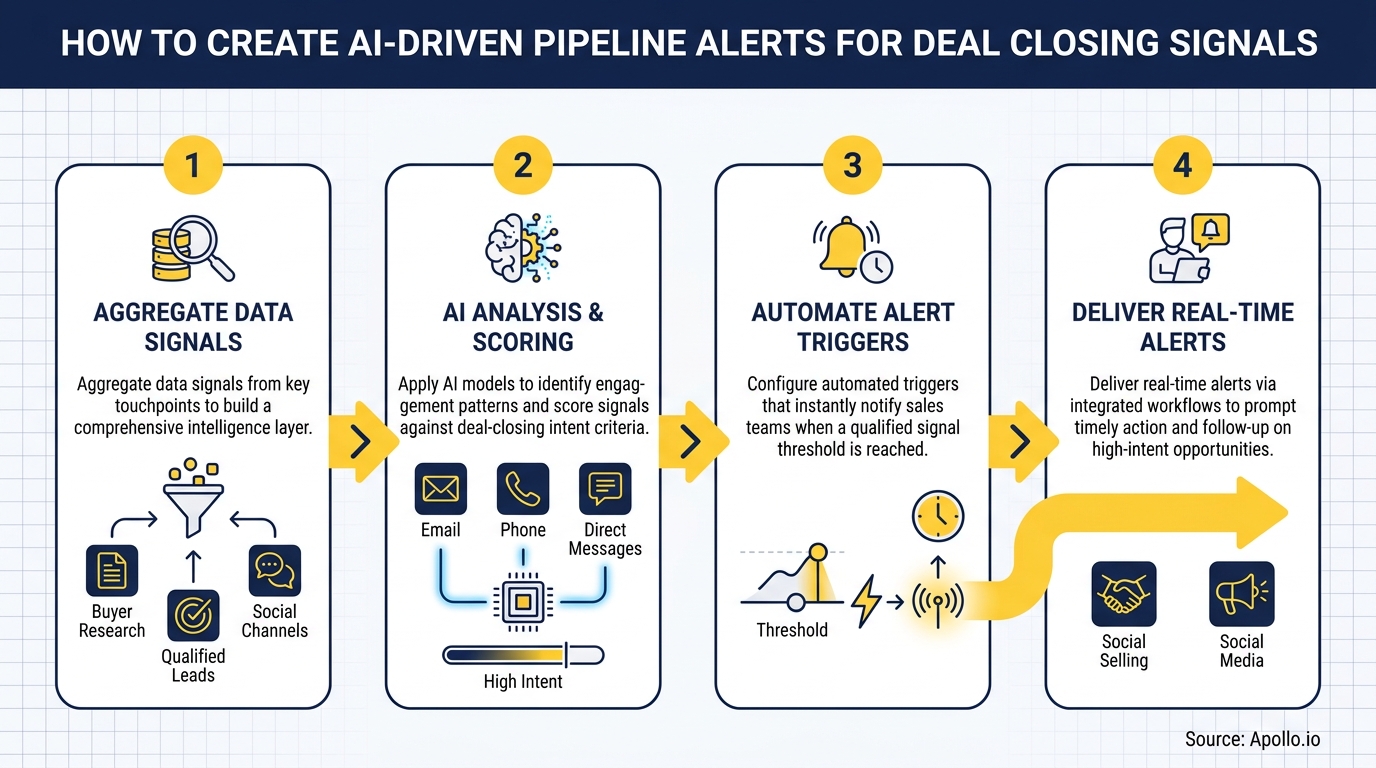
A reliable AI alert system follows a seven-step architecture: data sources, scoring model, confidence thresholds, SLA routing, human review, closed-loop feedback, and audit trail.
- Data Sources: CRM activity logs, email and call transcripts, website intent data, job change feeds, and third-party firmographic signals. Data quality is the prerequisite. Salesforce's 2026 State of Sales notes 74% of sales professionals are prioritizing data cleansing to improve AI returns.
- Scoring Model: Combine multiple weak signals into a composite score. Avoid single-signal triggers. A conversation-data model (call transcripts + email sentiment + stakeholder engagement) outperforms activity-volume models alone.
- Confidence Thresholds: Set minimum confidence levels before an alert fires. Low confidence = research brief only. High confidence = automated routing to rep with suggested action.
- SLA Routing: Define who receives each alert and within what time window. High-intent pre-contact alerts should route to SDRs within minutes, not hours.
- Human Review Layer: Alerts above a deal-size threshold should require manager acknowledgment before automated actions execute.
- Closed-Loop Feedback: Track whether the alert led to an action and whether that action moved the deal. Feed outcomes back into the model.
- Audit Trail: Log every alert, threshold crossed, action taken, and outcome. This is the governance layer that RevOps needs to explain forecast risk to leadership.
A sales professional shared a firsthand perspective on Redditthat captures this well: "Start read-only — alerts and research briefs before any outreach automation. Gives you time to tune without breaking things. The data layer matters more than the model — we spent more time on change detection (comparing website snapshots, tracking job postings, funding rounds) than on the LLM prompt. Garbage in = garbage out, regardless of model."
Struggling to track deals and signals across a fragmented stack? Get complete pipeline visibility with Apollo's deal management and keep every signal in one workspace.
Turn Funnel Guesswork Into Closed Deals
Pipeline forecasting a guessing game while quality leads stall before they ever reach your AEs? Apollo surfaces in-market buyers and moves them forward with precision. Top revenue teams close the gap between lead and opportunity.
Schedule a Demo →How Do RevOps Leaders Manage Alert Governance and False Positives?
Alert governance is the difference between a system reps trust and one they ignore. RevOps leaders report that alert fatigue is the fastest way to kill adoption of any signal system.
Three governance practices that reduce false positives without suppressing real signals:
- Threshold calibration: Start with conservative thresholds. Review the first 30 days of alerts against outcomes and adjust. Most teams set thresholds too low initially, flooding reps with noise.
- "Why at risk" explanations:Every alert should include a plain-language explanation of which signals triggered it. "Deal at risk: no stakeholder activity in 11 days, close date passed, champion last seen 18 days ago" is actionable. "Risk score: 72" is not.
- Alert suppression rules: If a rep has already taken an action on a flagged deal in the last 48 hours, suppress the repeat alert. Acknowledge activity to avoid redundant notifications.
Gartner reports that 69% of sales operations leaders say forecasting is harder than it was three years prior. Governance-grade alert systems directly address this by giving RevOps an explainable, auditable trail for every forecast risk call.
For SDRs and BDRs, governance also means clear escalation paths. When a high-intent alert fires, the handoff protocol needs to be defined: who owns the account, what's the SLA for first contact, and what sequence gets triggered. A sales professional wrote on Reddit that "AI tools close deals when they fix handoffs, not when they just crank out more messages" and described one team jumping on high-intent leads within 15 minutes, moving win rate from 18% to 26% in a month after tightening ICP and alert response protocols.

What Are the Most Important Closing Signals to Monitor in 2026?
The most important closing signals in 2026 combine traditional engagement indicators with newer AI-era behavioral patterns that reflect how buyers now research using generative search and comparison tools.
Salesforce's acquisition of Momentum in early 2026 to feed unstructured call data into agentic workflows signals where the market is headed: alerts built from conversation intelligence, not just CRM fields. Similarly, Demandbase's April 2026 buying-group AI functionality highlights a shift from individual lead scoring to buying-group completeness as a core close signal.
Priority signals to monitor, ranked by stage proximity to close:
- Buying group completeness: economic buyer, champion, legal, and IT all engaged
- Stakeholder surge: 2+ new contacts from the same account engaging within 72 hours
- Late-stage content consumption: security docs, legal templates, implementation guides
- Competitor comparison activity: review site visits, comparison page traffic
- Job change alerts: champion promoted, new economic buyer joins account (see how job change alerts grow your pipeline)
- Meeting velocity: back-to-back meetings scheduled, shortened response times
- Silence signals: no activity 7+ days past expected close date
Apollo's job change alerts and data enrichmentsurface one of the most underused closing signals: when a champion moves to a new account, it creates an immediate warm pipeline opportunity. When a new economic buyer joins an existing account mid-cycle, it triggers a re-engagement alert.
How Do AEs and SDRs Act on AI Pipeline Alerts Effectively?
Acting on AI pipeline alerts effectively requires pairing the alert with a pre-built response playbook, not leaving the rep to decide in the moment what to do.
For AEs managing mid-to-late-stage deals, alerts should link directly to suggested actions: a pre-written executive sponsor email template, a one-page competitive response doc, or a calendar link to schedule a follow-up call.
Apollo's AI-powered messaging tools support this workflow directly.
Teams using Apollo's AI sales automation can trigger personalized sequences the moment a high-intent signal fires, without manual rep intervention.
For SDRs working pre-contact intent signals, speed is the primary variable. The same Reddit discussion cited above confirms that response time within 15 minutes of a high-intent signal is a key driver of win-rate improvement.
Apollo's workflow engine can automate this routing so no high-intent account waits in a queue.
For sales leaders building out their sales tech stack, the risk is alert systems that live in separate tools with no connection to engagement execution. As Cyera noted about Apollo: "Having everything in one system was a game changer." Consolidating signal detection, sequencing, deal tracking, and conversation intelligence into one platform removes the handoff latency that kills alert value.

How Do You Get Started Building AI Pipeline Alerts Today?
Start with the three highest-value alert types before building a comprehensive system. Most teams that try to implement every signal at once create noise faster than insight.
Priority alert build order:
- Deal-stall alert: No activity on an open opportunity past a defined threshold (e.g., 7 days for SMB, 14 days for enterprise). Easiest to configure, immediate impact on forecast accuracy.
- High-intent pre-contact alert: Intent score threshold crossed for an ICP-fit account not yet in pipeline. Routes to SDR with research brief. Highest pipeline-creation upside.
- Buying-group change alert: New stakeholder added to account, or champion changes role. Routes to AE with context on who the new contact is and their likely influence.
Run each alert type in read-only mode for two weeks before automating any actions. Track which alerts led to outcomes.
Adjust thresholds based on signal-to-noise ratio. Only after that baseline is stable should you layer in automated sequence triggers or routing rules.
Apollo's unified platform gives GTM teams the data, engagement tools, and deal management capabilities to build this system without stitching together multiple vendors. "We reduced the complexity of three tools into one," noted Collin Stewart of Predictable Revenue. That consolidation is what makes a real-time alert system operationally sustainable.
Ready to put closing signals to work? Try Apollo free and see how signal detection, engagement, and deal management work together in one platform.
Prove Pipeline ROI With Apollo
Struggling to justify your sales tools when leadership demands hard numbers? Apollo delivers measurable pipeline impact your team feels from day one. Leadium 3x'd annual revenue — see what fast ROI looks like.
Start Free with Apollo →Don't miss these
Sales
Inbound vs Outbound Marketing: Which Strategy Wins?
Sales
What Is a Sales Funnel? The Non-Linear Revenue Framework for 2026
Sales
What Is a Go-to-Market Strategy? The 2026 GTM Playbook
See Apollo in action
We'd love to show how Apollo can help you sell better.
By submitting this form, you will receive information, tips, and promotions from Apollo. To learn more, see our Privacy Statement.
4.7/5 based on 9,690 reviews
