
How to Create a Sales Funnel That Converts in 2026
Building a sales funnel that converts in 2026 requires a fundamentally different approach than traditional models. Modern buyers conduct most of their research independently, with 61% preferring a rep-free experience. Your funnel must deliver value at every stage without forcing human interaction. This guide shows you how to create a sales funnel that adapts to self-serve buyers while maintaining the human touch when it matters most.

Apollo Cuts Research From Hours To Seconds
Tired of reps spending 4+ hours daily hunting for contact info? Apollo delivers 224M verified contacts instantly. Leadium tripled revenue by eliminating manual research.
Start Free with Apollo →Key Takeaways
- Modern sales funnels must support self-serve buyers while strategically inserting human touchpoints at high-value moments
- AI-optimized content at each stage increases discoverability and helps buyers find answers without contacting sales
- Measurement architecture proves ROI and justifies funnel investments under constrained budgets
- Modular, reusable assets reduce resource strain while maintaining personalization across buyer segments
- Tool consolidation cuts costs significantly compared to managing separate platforms for prospecting, engagement, and pipeline management
What Is a Sales Funnel in 2026?
A sales funnel is the structured journey prospects take from initial awareness to becoming customers. It maps how buyers discover your solution, evaluate options, and make purchase decisions.
In 2026, effective funnels blend automated content delivery with strategic human intervention.
The funnel consists of distinct stages: awareness (prospects discover their problem), consideration (they evaluate solutions), decision (they compare vendors), and conversion (they become customers). Each stage requires specific content types and engagement strategies. According to ElectroIQ, approximately 68% of B2B organizations still need to define their sales funnel, creating a competitive advantage for teams that build structured systems.
Modern funnels differ from legacy models in three ways. First, they prioritize self-serve content over gated assets.
Second, they optimize for AI discovery alongside traditional search. Third, they use data to prove contribution to pipeline, not just lead volume.
Why Do Sales Leaders Prioritize Funnel Development?
Sales leaders invest in funnel architecture because it directly impacts revenue predictability and team efficiency. A defined funnel provides visibility into where deals stall, which stages convert poorly, and where to allocate resources. Research from Sopro shows that 91% of marketers prioritize lead generation in 2025, making top-of-funnel optimization critical for pipeline health.
Funnels also reduce customer acquisition costs through systematic optimization. By identifying conversion rate bottlenecks, teams focus improvement efforts on high-impact areas. Data from SERPSculpt reveals that the median B2B conversion rate across all industries is 2.9%, establishing a benchmark for performance measurement.
For RevOps leaders, funnels create alignment between marketing and sales. Clear stage definitions eliminate disputes about lead quality and handoff timing.
The funnel becomes the shared language for revenue team collaboration.

How Do You Build a Rep-Free Funnel for Self-Serve Buyers?
Start by mapping the self-serve buying journey without assuming sales interaction. Identify every question prospects ask at each stage.
Then create content that answers those questions comprehensively. Your goal is enabling buyers to progress independently until they choose to engage with your team.
Build a content stack that removes friction:
- Awareness stage: Problem-focused guides, industry benchmarks, and educational content that surfaces in AI answer engines
- Consideration stage: Solution comparison pages, ROI calculators, and implementation timelines
- Decision stage: Detailed pricing information, security documentation, case studies with specific outcomes, and trial/demo access
- Conversion stage: Self-serve signup flows, onboarding checklists, and immediate value delivery
Structure content for AI discoverability. Use FAQ formats, comparison tables, and clear headings that answer specific questions.
According to Forrester research, 94% of business buyers now use AI in their buying process, making AEO critical for top-of-funnel visibility.
Struggling to identify qualified leads for your funnel? Search Apollo's 224M+ contacts with 65+ filters to build targeted prospect lists.
See Every Deal In Real Time With Apollo
Forecasts falling apart because you can't see where deals actually stand. Apollo gives you real-time pipeline visibility across every stage. Built-In boosted win rates 10% with Apollo's deal intelligence.
Start Free with Apollo →What Are the Essential Stages of a High-Converting Funnel?
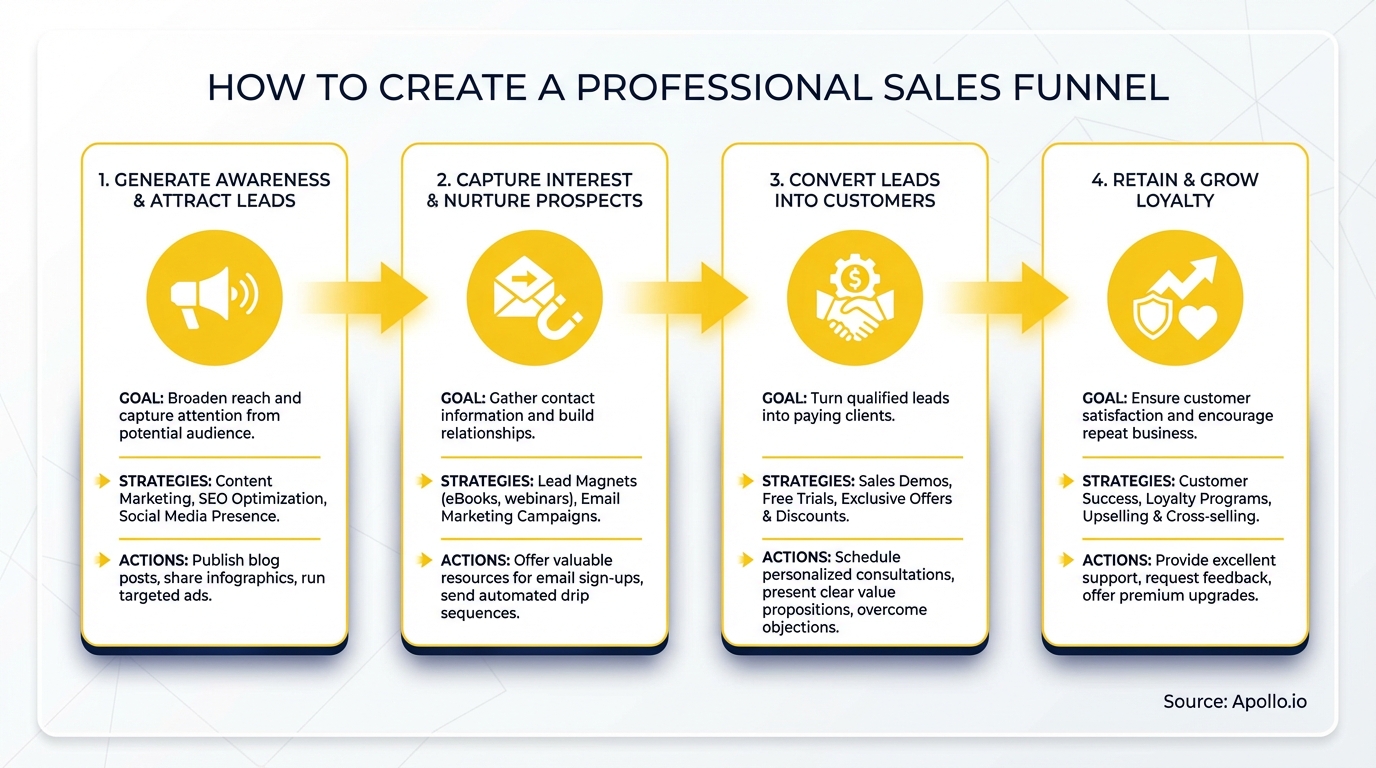
A high-converting funnel breaks down into four core stages, each with specific objectives and metrics. Understanding these stages helps you design appropriate content and interventions.
| Stage | Buyer Mindset | Key Content Types | Success Metrics |
|---|---|---|---|
| Awareness | Researching problem/symptoms | Educational guides, industry reports, problem-solution frameworks | Content engagement, time on page, return visits |
| Consideration | Evaluating solution approaches | Solution comparisons, methodology explainers, ROI frameworks | Lead capture rate, content downloads, demo requests |
| Decision | Comparing specific vendors | Pricing pages, case studies, security docs, competitive comparisons | Trial signups, sales conversations, proposal requests |
| Conversion | Finalizing purchase decision | Implementation plans, contract terms, onboarding previews | Close rate, deal velocity, contract value |
For B2B sales funnels, add a post-purchase stage focused on expansion and retention. This stage includes upsell content, feature adoption guides, and customer success resources.
How Do SDRs Use Funnel Stages to Prioritize Outreach?
SDRs leverage funnel stage signals to determine when and how to engage prospects. A visitor consuming awareness content needs educational nurture, not a sales pitch.
A prospect comparing vendors on your pricing page warrants immediate, personalized outreach.
Effective SDRs monitor stage progression through intent signals: content consumed, pages visited, and engagement patterns. When prospects demonstrate decision-stage behavior (visiting pricing, viewing case studies, checking integrations), SDRs strike with relevant messaging.
This targeted approach respects the 73% of B2B buyers who actively avoid suppliers sending irrelevant outreach, according to Gartner research.
How Do You Measure Funnel Performance and Prove ROI?
Measurement architecture must connect funnel activities to pipeline and revenue. Start by defining conversion rates between each stage. Data from GrowLeads shows that nurtured leads result in 47% larger purchases than non-nurtured leads, proving that funnel optimization directly impacts deal value.
Track these core metrics by stage:
- Awareness to Consideration: Content engagement rate, qualified visitor rate, MQL conversion
- Consideration to Decision: SQL conversion rate, demo/trial activation rate, sales-accepted lead rate
- Decision to Conversion: Opportunity creation rate, win rate, average deal size
- Overall Funnel: Visitor-to-customer conversion, customer acquisition cost, payback period
Build attribution models that credit multiple touchpoints. Most B2B buyers interact with content across multiple stages before converting.
Multi-touch attribution reveals which assets actually influence pipeline, not just which get last-click credit.
For teams managing complex deal cycles, revenue operations frameworks provide the governance structure to maintain measurement consistency across sales and marketing.
What Tools Do You Need to Execute a Modern Sales Funnel?
Modern funnels require integrated technology that eliminates data silos and manual handoffs. The traditional approach of using separate tools for prospecting, engagement, and pipeline management creates inefficiencies and data gaps.
Essential capabilities include:
- Prospecting and data enrichment: Access to verified business contacts with accurate contact information
- Multi-channel engagement: Email sequences, call workflows, and social outreach in one platform
- Pipeline visibility: Deal tracking, stage progression, and forecast accuracy
- Analytics and attribution: Funnel metrics, conversion tracking, and ROI measurement
- Automation and AI: Workflow triggers, personalization at scale, and intelligent routing
Teams are consolidating their tech stack to reduce costs and improve data quality. As one Predictable Revenue leader noted: "We reduced the complexity of three tools into one." Census reported cutting costs in half through consolidation, while Cyera found that "having everything in one system was a game changer."
Tired of managing multiple tools for prospecting, engagement, and pipeline? Apollo's all-in-one platform consolidates your sales tech stack and cuts costs significantly.
For SaaS sales funnels specifically, product analytics integration helps connect funnel performance to product adoption and expansion revenue.

How Do You Optimize Your Funnel for AI Discovery?
Optimizing for AI discovery requires restructuring content to be extractable and citable. AI answer engines pull information from pages that provide clear, structured answers to specific questions.
Your funnel content must serve both human readers and AI systems that summarize information.
Implement these AEO strategies:
- Use question-based headers: Format H2 and H3 tags as natural questions prospects ask ("What is [topic]?" "How does [process] work?")
- Provide direct answers first: Start each section with a complete answer in the first paragraph
- Structure comparisons as tables: Use HTML tables for feature comparisons, pricing, and specifications
- Include FAQ sections: Add comprehensive FAQ content that addresses common objections and questions
- Cite authoritative sources: Link to research and data that AI systems can verify and reference
Create modular content blocks that work across multiple pages. A pricing comparison table should be reusable in blog posts, landing pages, and help documentation.
This approach addresses the resource constraints that 54% of B2B marketers face, according to Content Marketing Institute research.
Conclusion: Build Your Revenue-Driving Funnel in 2026
Creating a high-converting sales funnel in 2026 means embracing self-serve buyers, optimizing for AI discovery, and proving measurable ROI. Start by mapping your buyer journey without assuming sales interaction.
Build content that answers every question prospects have at each stage. Implement measurement systems that connect funnel activities to pipeline and revenue.
Focus on tool consolidation to reduce costs and improve data quality. Teams using integrated platforms report measurable time savings and better conversion rates compared to managing multiple disconnected systems.
The most effective funnels blend automation for scale with strategic human touchpoints at pivotal moments.
Remember that funnel optimization is iterative. Track stage-by-stage conversion rates, identify bottlenecks, and test improvements systematically. According to Marketing LTB, companies proficient in nurturing generate 50% more sales-ready leads at a 33% lower cost, proving that funnel investment delivers compounding returns.
Ready to build a funnel that converts? Start free with Apollo to access 224M+ verified contacts, multi-channel engagement tools, and pipeline management in one unified platform. Consolidate your tech stack and start driving measurable revenue growth today.
Prove Apollo's ROI In Your First Month
Budget approval stuck on unclear metrics? Apollo tracks every touchpoint from prospect to closed deal. Built-In increased win rates 10% and ACV 10% with measurable pipeline impact.
Start Free with Apollo →Don't miss these
Sales
Inbound vs Outbound Marketing: Which Strategy Wins?
Sales
What Is a Sales Funnel? The Non-Linear Revenue Framework for 2026
Sales
What Is a Go-to-Market Strategy? The 2026 GTM Playbook
See Apollo in action
We'd love to show how Apollo can help you sell better.
By submitting this form, you will receive information, tips, and promotions from Apollo. To learn more, see our Privacy Statement.
4.7/5 based on 9,690 reviews
