
How to Automatically Send Follow-Up Sequences Based on Lead Behavior in 2026
Static drip campaigns are losing ground fast. Buyers today interact across an average of 10 channels before making a purchase decision, according to McKinsey's 2024 B2B Pulse Survey, and they expect every touchpoint to reflect what they've already done. Behavior-triggered follow-up sequences solve this by firing the right message the moment a lead takes a meaningful action, not three days later on a fixed timer. If you're still running time-based nurture, you're leaving pipeline on the table. Start with proven prospect nurturing strategies to understand where behavior-triggered logic fits into your overall approach.

Build Pipeline Faster With Apollo
Tired of hours lost to manual research and dead-end contact data? Apollo surfaces verified leads and automates outreach so your team spends time selling, not searching. Over 600K companies trust Apollo to scale pipeline without the busywork.
Start Free with Apollo →Key Takeaways
- Behavior-triggered sequences dramatically outperform generic time-based drips — the gap in engagement metrics is not marginal.
- The failure mode of most automated follow-ups is firing on a fixed timer regardless of what the lead actually did; status-change triggers fix this.
- Every open opportunity needs a dated next step — if there's no task, treat the deal as dead by default.
- Automation should handle nurture; humans should handle intent signals above a defined threshold — know exactly where that line is.
- Clean CRM data and shared MQL-to-SQL governance are prerequisites, not nice-to-haves, for behavior-triggered automation to work.
What Is a Behavior-Triggered Follow-Up Sequence?
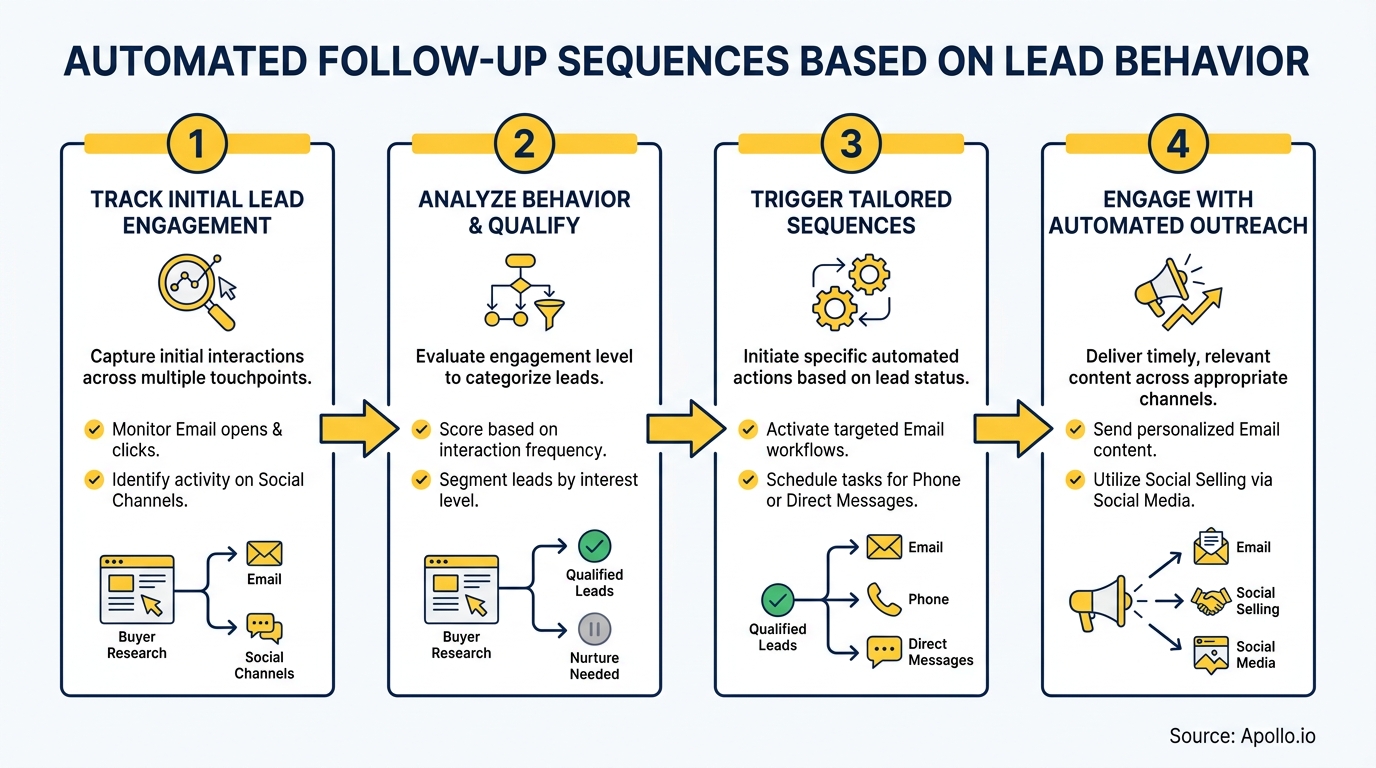
A behavior-triggered follow-up sequence is an automated series of messages that fires based on specific actions a lead takes, not the passage of time. Instead of sending email 2 three days after email 1 regardless of engagement, the system monitors signals like pricing-page visits, demo replays, content downloads, or email clicks and triggers the next message only when a relevant action occurs.
Research from The Digital Bloom shows automated nurturing emails generate 320% more revenue than manual campaigns. The gap widens further when those automated emails are behavior-triggered rather than time-based. According to Venture Harbour, 80% of marketers using automation software generate more leads, and 77% convert more of those leads.
Spending hours on manual outreach? Automate your multi-channel sequences with Apollo's sales engagement platform and trigger follow-ups the moment leads show intent.
What Is the Behavior-Trigger Matrix?
A behavior-trigger matrix maps specific lead actions to the right message content, CTA, timing, and next step. Without this mapping, automation sends noise instead of signal.
| Lead Behavior | Message Content | CTA | Timing | Next Step |
|---|---|---|---|---|
| Pricing page visit (2+ times) | ROI breakdown + case study | Book a call | Within 1 hour | Notify AE for same-day outreach |
| Demo replay (watched 50%+) | Feature deep-dive relevant to their industry | Schedule live demo | Within 2 hours | Escalate to rep if no response in 24h |
| Content download | Related resource + pain-point validation | Read next asset | Same day | Continue nurture sequence |
| Email opened but not clicked | Resend with different subject line | Single clear CTA | 3 days later | Branch to no-response track if still no click |
| No open after 2 sends | Short breakup message | Reply to stay in touch | Day 7 | Move to long-term nurture or suppress |
A sales professional wrote on Redditthat the core problem with most automated sequences is they fire on lead creation and run on a fixed timer regardless of behavior: "The fix is building status-change triggers instead: follow-up step 2 only fires if step 1 was opened or clicked, and a no-response branch fires separately with a different message." This branching logic is the difference between a sequence and a signal engine.
How Do SDRs and RevOps Teams Implement Behavior-Based Automation?
SDRs and RevOps leaders implement behavior-based automation by instrumenting key buyer touchpoints, mapping those signals to CRM fields, and building branching workflows that react to status changes rather than elapsed time.
Implementation checklist:
- Data readiness: Audit CRM fields before building any workflow. Missing or inconsistent data is the top reason automation fails — a 2025 Act-On/Ascend2 study found 44% of B2B marketers cite data quality as a top priority.
- Event instrumentation: Tag all key pages (pricing, demo, case studies) and configure tracking for email opens, clicks, and replies in your engagement platform.
- CRM field mapping: Create lead status fields that capture engagement tier (e.g., MQL, Engaged MQL, High-Intent) so workflows can branch on actual state, not assumptions.
- Shared MQL-to-SQL governance: Marketing and sales must agree on exactly which behaviors constitute a handoff-ready lead. Without this, AEs get flooded with premature escalations.
- Suppression lists: Configure opt-out and unsubscribe suppression before launch. CAN-SPAM compliance requires a working unsubscribe mechanism on every commercial message.
For RevOps leaders, the automated lead generation framework provides a practical starting point for structuring the full pipeline from signal capture to CRM handoff.
Turn Funnel Gaps Into Closed Deals
Tired of watching MQLs stall before they ever reach sales? Apollo surfaces high-intent leads and gives your team real-time pipeline clarity. Nearly 100K paying customers stopped guessing and started closing.
Start Free with Apollo →When Should Automation Hand Off to a Human Rep?
Automation should hand off to a human rep when a lead crosses a predefined intent threshold — not based on elapsed time or sequence completion. The goal is to let nurture run automatically for early-stage and low-intent signals, then escalate high-intent signals to an AE or SDR for same-day follow-up.
Automate these:
- Content engagement sequences (downloads, blog reads, webinar registrations)
- Re-engagement campaigns for leads dormant over 30 days
- Post-demo nurture if no meeting is booked within 48 hours
- Breakup sequences after sustained non-engagement
Escalate to a human rep for:
- Two or more pricing-page visits within 7 days
- Demo replay completions above 60%
- Direct reply to any automated message
- Buying committee member engagement (multiple contacts from same account)
A Reddit user shared a firsthand perspectiveon stopping lost deals: "What fixed it for us wasn't more channels, it was forcing everything into one execution lane and making 'no lead without a next step' a hard rule... every open opp had a dated follow-up task. If there was no task, the deal was 'dead' by default." This discipline — automation plus hard governance rules — is what separates teams that convert from teams that just send volume.
This hybrid approach also addresses a genuine buyer tension: while many B2B buyers prefer self-service research, purchase regret is materially higher in fully rep-free transactions. Keeping humans in the loop at the right moment reduces both churn risk and buyer remorse.

How Do You Measure Whether Behavior-Triggered Sequences Are Working?
Measure behavior-triggered sequences by tracking pipeline contribution and sales-accepted leads, not just open rates and clicks. Engagement metrics tell you the sequence is being seen; pipeline metrics tell you it's driving revenue.
| Metric | What It Measures | Target Benchmark |
|---|---|---|
| Sales-Accepted Lead (SAL) rate | % of automation-sourced leads accepted by sales | Improve quarter-over-quarter |
| Trigger-to-meeting rate | % of triggered sequences that result in a booked meeting | Track per trigger type |
| Pipeline contribution | Revenue value of deals sourced from automated sequences | Growing share of total pipeline |
| Stage progression velocity | Days from trigger to next buyer-stage advance | Decreasing over time |
| Unsubscribe rate per sequence | Compliance health + message relevance | Below 0.5% per send |
Run A/B experiments on trigger timing (immediate vs. 1-hour delay), message length, and CTA type. Use stage progression velocity as your north star — if a triggered sequence isn't moving buyers forward faster than the baseline, it needs revision. For deeper guidance on converting pipeline signals into booked meetings, see the best time to email and call prospects.
Not sure if your sequences are reaching the right contacts? Apollo's AI sales automation lets you build behavior-triggered workflows on top of 230M+ verified contacts, so your sequences fire against accurate data from day one.
What Are the Compliance Requirements for B2B Email Automation?
B2B email automation must comply with CAN-SPAM in the US, CASL in Canada, and GDPR in Europe. Non-compliance exposes your domain to blacklisting and your company to regulatory risk.
Minimum compliance checklist:
- Include a functional unsubscribe link in every commercial message
- Honor opt-out requests within 10 business days (CAN-SPAM requirement)
- Maintain a suppression list and sync it across all sending tools before each campaign
- Include your physical mailing address in every email footer
- Never use deceptive subject lines or misleading sender information
- For GDPR-covered contacts: ensure a lawful basis for processing before adding to any automated sequence
Aggressive automated volume also creates deliverability risk independent of legal compliance. Keep sending reputation healthy by warming domains gradually, monitoring bounce rates, and suppressing contacts who haven't engaged after a defined number of sends.

Start Sending Smarter Follow-Ups Today
Behavior-triggered follow-up sequences outperform static drips because they meet buyers where they are, not where your calendar says they should be. Build your trigger matrix first, define your human escalation thresholds, get your CRM data clean, and measure pipeline contribution from day one.
Apollo brings prospecting, engagement, AI automation, and pipeline tracking into one unified platform. Teams like Cyera found that "having everything in one system was a game changer" — no more stitching together separate tools for signals, sequences, and handoffs. Explore how to find better leads and automate prospecting to build the full pipeline engine that feeds your behavior-triggered sequences.
Ready to replace your static drip with a signal engine? Start Your Free Trial and build behavior-triggered sequences on top of 230M+ verified business contacts.
Prove Pipeline ROI From Day One
ROI pressure killing your tool budget before it even launches? Apollo delivers measurable pipeline impact fast — with automation that teams actually use. Leadium 3x'd annual revenue. Your CFO will notice.
Start Free with Apollo →Don't miss these
Sales
Inbound vs Outbound Marketing: Which Strategy Wins?
Sales
What Is a Sales Funnel? The Non-Linear Revenue Framework for 2026
Sales
What Is a Go-to-Market Strategy? The 2026 GTM Playbook
See Apollo in action
We'd love to show how Apollo can help you sell better.
By submitting this form, you will receive information, tips, and promotions from Apollo. To learn more, see our Privacy Statement.
4.7/5 based on 9,690 reviews
