
How to Automate Updating Sequences When New Data on a Lead Appears
Your sequence went stale the moment that lead changed jobs. Static cadences built on day-one data keep firing messages to the wrong title, wrong company, or wrong buying stage — and buyers notice. According to the American Marketing Association, automated lead nurturing can deliver a 23 percentage point increase in conversion rates — but only when the nurture logic stays current. Learning how to build an automated lead generation system that reacts to new data is now a core GTM competency, not a RevOps luxury.

Build Pipeline Faster With Apollo
Tired of hours lost to manual research and dead-end contact data? Apollo surfaces verified prospects instantly so your reps spend time selling, not searching. Join 600K+ companies generating predictable pipeline.
Start Free with Apollo →Key Takeaways
- Sequence automation should react to data changes (job title, intent, form fill, enrichment) — not just run on a fixed timer.
- A governance-first operating model (Trigger → Validate → Decide → Update → Measure) prevents bad data from triggering wrong actions.
- The decision to pause, re-personalize, reassign, re-enroll, or suppress a lead depends on the type and confidence of the new data.
- SDRs and RevOps teams save the most time when enrichment, deduplication, and sequence routing happen automatically inside one unified platform.
- Measurement matters: tie every sequence-change event to pipeline and revenue outcomes to prove and improve the system over time.
Why Do Static Sequences Fail When Lead Data Changes?
Static sequences fail because they were designed around a single snapshot of a lead, not a living record. When a contact changes jobs, reaches a new buying stage, or fills out a high-intent form, the original cadence keeps firing irrelevant messages — burning the relationship and the deliverability budget simultaneously.
The scale of this problem is significant. A 2024 CRM data-management survey by Validity found that 60% of CRM admins report their company struggles with data-quality issues, with the top culprits being incomplete data, missing fields, and incorrect records. Meanwhile, SalesS0 reports that 91% of company decision-makers are already receiving increasing automation requests from their business teams — yet most sequences still don't update when the underlying data changes.
For SDRs managing hundreds of active contacts, a single job-change trigger that automatically pauses and re-routes a sequence eliminates hours of manual CRM auditing per week. For RevOps leaders, it closes the gap between enrichment runs and outreach relevance.
What Is the Operating Model for Automated Sequence Updates?
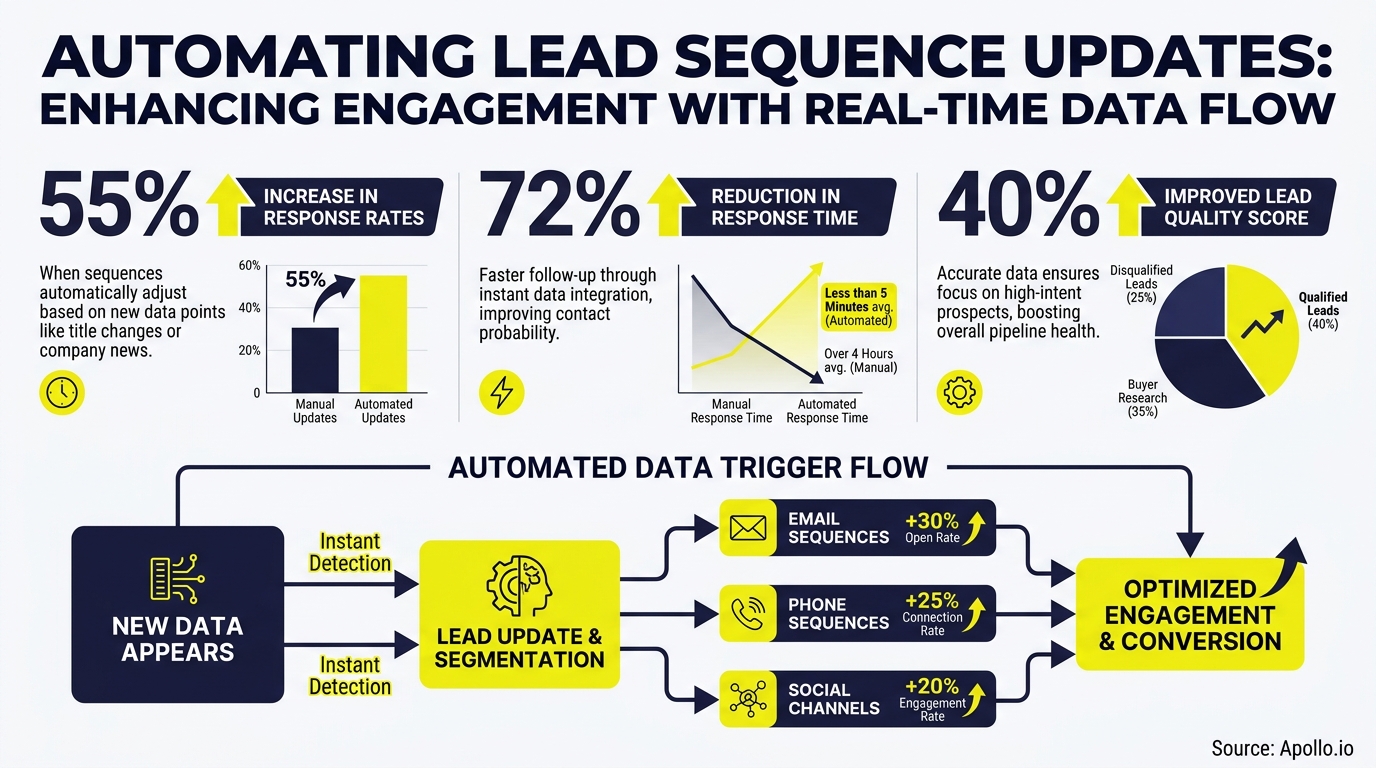
Automating sequence updates requires a five-stage operating model: Trigger → Validate → Decide → Update → Measure. Each stage has a specific function and failure mode.
| Stage | What Happens | Common Failure |
|---|---|---|
| Trigger | New data detected: job change, form fill, intent spike, enrichment update, CRM field change | Trigger fires on noise, not signal |
| Validate | Check data source confidence, deduplicate, confirm field ownership | Bad data passed downstream unchecked |
| Decide | Apply decision matrix: pause / re-personalize / reassign / re-enroll / suppress | Every trigger routes to the same action |
| Update | Modify sequence step, messaging, owner, or exit criteria; log the change event | Update happens with no audit trail |
| Measure | Track sequence-change events against pipeline, reply rate, and revenue outcomes | No attribution; can't prove or improve the system |
Platforms like Apollo have moved toward this model with job-change triggers, form-submission triggers, recurring enrichment cadences, and bounce-risk pausing — all connected inside a single workflow engine rather than requiring multiple point solutions. As Cyera's team noted after consolidating their stack: "Having everything in one system was a game changer."
How Do You Decide Whether to Pause, Re-Personalize, or Suppress a Lead?
The right action depends on the type of new data and its confidence level. Not every data change warrants a full sequence re-enrollment — and triggering too aggressively creates noise for both reps and buyers.
| New Data Signal | Recommended Action | Governance Rule |
|---|---|---|
| Job title change (same company) | Re-personalize next step; update persona tag | Require enrichment source confidence above threshold |
| Company change (new employer) | Pause sequence; reassign or create new contact record | Check for duplicate before creating new record |
| High-intent form fill or pricing-page visit | Accelerate sequence; escalate to AE or add call task | Confirm no open opportunity already exists |
| Email bounce or contactability change | Pause email steps; trigger enrichment to find new address | Do not suppress permanently until re-enrichment confirmed |
| Duplicate record detected | Suppress duplicate; merge to master record | Define source-of-truth priority (CRM beats enrichment) |
| DNC / opt-out flag | Suppress immediately across all active sequences | Log suppression event with timestamp and source |
For Account Executives managing active opportunities, the most critical trigger is a buying-committee change: a new stakeholder added to an account should immediately generate a research task and a tailored outreach step, not wait for the next scheduled sequence email. Understanding how intent data powers smarter B2B sales is essential for setting these triggers correctly.
Struggling to keep sequence messaging aligned with what your leads actually care about? Automate your sequences with Apollo's multi-channel engagement platform and let trigger-based logic handle the routing.
Turn Funnel Guesswork Into Pipeline Clarity
Quota stress keeping you up at night? Apollo surfaces high-intent leads and tracks deal signals in real time so your forecast is finally something you can trust. Nearly 100K paying customers stopped guessing and started closing.
Start Free with Apollo →How Do SDRs and RevOps Teams Implement Trigger-Based Sequence Updates?
Implementation depends on where your data lives and how quickly it needs to flow into sequence decisions. Three patterns cover most B2B GTM teams.
- CRM field-change triggers: When a field (job title, lifecycle stage, territory, score) updates in your CRM, a workflow fires and passes the change to your sequence platform. Best for teams already maintaining clean CRM data.
- Enrichment-driven triggers: A recurring enrichment run refreshes contact records on a schedule. When a field changes during enrichment, the delta triggers a sequence action. This is the pattern Apollo's recurring enrichment cadences use. Learn more about how to build a data enrichment strategy that feeds this loop reliably.
- Behavioral/intent triggers: Web visits, content engagement, event attendance, or intent-platform signals fire a webhook that updates sequence priority, messaging, or step timing in real time.
For SDRs, the practical result is simpler: the system surfaces a notification that a lead's data changed and the sequence was updated, rather than requiring a manual CRM check before every call block. RevOps leaders benefit from the audit trail — every sequence change is logged as an event with a timestamp, data source, and decision rule, which makes governance reviews straightforward.
Reliable triggers require reliable data. Tired of sequences firing on stale contact records? Keep your lead data fresh with Apollo's continuous enrichment across 230M+ verified business contacts.

What Governance Rules Prevent Bad Automation from Causing Damage?
Governance rules are the guardrails that stop a data error from triggering a cascade of wrong sequence actions. Without them, a duplicate record or a low-confidence enrichment update can re-enroll a lead who already converted, suppress an active opportunity contact, or route a high-value account to the wrong rep.
- Source priority hierarchy:Define which data source wins when fields conflict. A common order: direct CRM input beats enrichment beats third-party append.
- Confidence thresholds: Only fire sequence updates when the enrichment confidence score clears a defined minimum. Low-confidence changes go to a review queue, not an automated action.
- Human approval gates: High-stakes actions (suppressing a contact, reassigning an account, re-enrolling a converted lead) require rep or manager approval before executing.
- Rollback capability: Every automated sequence change should be reversible. Log the pre-change state so a rep can undo it with one click.
- Opt-out and DNC enforcement: Suppression rules must be checked before any trigger-based action fires, not after.
Proper data enrichment and cleansing practices are what make governance rules enforceable. Clean inputs mean fewer edge cases, fewer rollbacks, and more rep trust in the automation.
How Do You Measure the Impact of Automated Sequence Updates?
Measuring sequence-update automation means tying specific change events to downstream revenue outcomes. Generic open-rate or reply-rate reporting is not enough — you need event-level attribution.
Track these KPIs for each trigger type:
- Reply rate delta: Compare reply rates for sequences that were updated on a trigger versus sequences that ran without an update.
- Meeting conversion rate: Did trigger-updated sequences generate more booked meetings than static ones for the same ICP segment?
- Stage progression speed: Are trigger-updated leads moving through pipeline stages faster?
- Suppression accuracy: What percentage of suppressed contacts were correctly excluded (no false positives killing active deals)?
- Enrichment ROI: Track how many sequence updates were enabled by enrichment data and what revenue those updated sequences influenced.
Research from Reach Marketing shows companies using AI-powered lead generation tools experience a 35% increase in conversion rates compared to traditional methods — a benchmark worth targeting as you instrument your sequence-update workflows. For deeper context on what good lead data ROI looks like, see how contact data enrichment drives ROI.

Start Automating Sequence Updates with Apollo
Automating sequence updates when new lead data appears is no longer a technical edge case. It is the operating standard for B2B GTM teams that want to stay relevant inside a shrinking buying window.
The teams winning in 2026 are the ones whose systems react to data changes faster than competitors can manually review their CRM queues.
Apollo consolidates the enrichment layer, the trigger engine, and the sequence platform into one workspace — so SDRs, AEs, and RevOps teams stop stitching together separate tools to achieve what should be a single automated loop. As Predictable Revenue's team put it: "We reduced the complexity of three tools into one."
For practical approaches to building this foundation, explore proven prospect nurturing strategies and prospecting tools that boost sales — then see how Apollo connects them end to end.
Schedule a Demo to see how Apollo's trigger-based workflows and continuous enrichment keep your sequences current automatically.
Prove Pipeline ROI Before Next QBR
ROI pressure killing your tool renewal? Apollo delivers measurable pipeline impact fast — with automation and verified data your leadership can actually see. Leadium 3x'd revenue. Your turn.
Start Free with Apollo →Don't miss these
Sales
Inbound vs Outbound Marketing: Which Strategy Wins?
Sales
What Is a Sales Funnel? The Non-Linear Revenue Framework for 2026
Sales
What Is a Go-to-Market Strategy? The 2026 GTM Playbook
See Apollo in action
We'd love to show how Apollo can help you sell better.
By submitting this form, you will receive information, tips, and promotions from Apollo. To learn more, see our Privacy Statement.
4.7/5 based on 9,690 reviews
