
How to Automate List Segmentation Based on Lead Behavior and Attributes
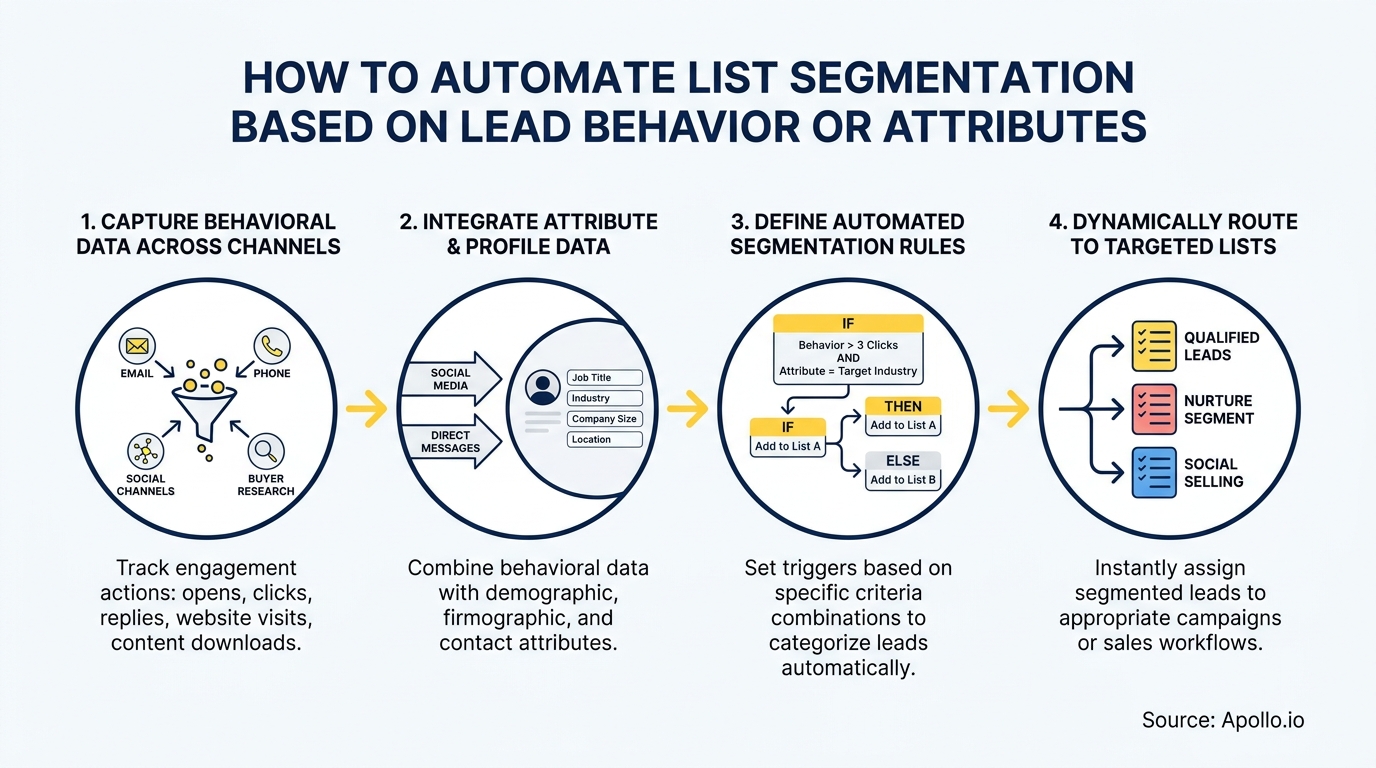
Your lead lists go stale the moment you build them. A prospect who visited your pricing page twice this week is not the same as one who opened a single email six months ago, yet most B2B teams treat them identically. Learning how to automate list segmentation based on lead behavior or attributes is the fix: dynamic rules that move contacts into the right segment the moment their actions or data change, without manual list pulls. If you want a foundation to build from, start with how to build a sales prospecting list that converts before layering automation on top.

Let Apollo Find Leads While You Close
Tired of burning hours on manual research just to hit dead ends? Apollo surfaces verified contacts instantly so your team spends time selling, not searching. Over 600K companies have already made the switch.
Start Free with Apollo →Key Takeaways
- Behavior-triggered segmentation outperforms static firmographic lists because it responds to real buying intent, not just job title or company size.
- Effective automation requires a unified data model covering account, person, and buying-stage fields before any rules fire correctly.
- Buying-group logic (account + multiple contacts) beats single-lead scoring for enterprise deals where committees make the decision.
- Suppression and trigger-decay rules prevent over-messaging and keep segments accurate as behavior changes over time.
- RevOps teams that separate scoring from segmentation maintain cleaner systems and more actionable audience logic.
Why Does Behavior-Based Segmentation Beat Static Lists?
Behavior-based segmentation beats static lists because it captures real-time buying intent rather than assumptions baked in at list-build time. A contact's job title rarely changes week to week, but their engagement with your content, pricing pages, and outreach signals shifts constantly.
According to Amra & Elma, over 76% of companies worldwide use marketing automation tools in 2026, yet most segmentation logic still relies on static firmographics. The teams pulling ahead are the ones replacing those static rules with event-driven triggers tied to actual contact behavior.
A GTM 80/20 analysis found the global marketing automation market was valued at $6.65 billion in 2024 and is projected to reach $15.58 billion by 2030, growing at a 15.3% CAGR. That growth is driven largely by demand for dynamic, behavior-aware audience management. Forrester's April 2026 report reinforces this: collecting behavioral signals is no longer the hard part; operationalizing them into routing and nurture rules is where most teams fall short.
Struggling to find the right contacts to segment in the first place? Search Apollo's 230M+ verified contacts with 65+ filters to build your base list before automating segmentation rules on top of it.
What Data Model Do You Need Before Automating Segmentation?
Automated segmentation requires a three-layer data model: account attributes, person attributes, and buying-stage fields, all consistently populated before any rule fires.
Data Readiness Checklist
- Account layer: Industry, employee count, revenue range, territory, lifecycle stage (prospect, customer, churned).
- Person layer: Job title, seniority, department, email validity, opt-in consent status.
- Buying-stage layer: MQL date, last activity date, lead source, sales stage, open opportunity flag.
- Identity resolution: Deduplicated records with a canonical contact ID that links CRM, MAP, and CDP entries.
- Consent & governance: Consent timestamp, channel opt-in flags, suppression list membership.
- Field governance: Defined picklist values for key fields (no free-text stage names that break filter logic).
Adobe's 2024 B2B study found only 43% of B2B practitioners say their customer data system gives them consistent data. If your data model has gaps, your automation inherits them. Fix field governance before writing a single segmentation rule. For enriching missing firmographic and contact fields at scale, building and segmenting target account lists in Apollo gives RevOps teams a structured starting point.
What Are the Behavior-Triggered Segmentation Rules for B2B?
Behavior-triggered segmentation rules fire when a defined contact event occurs within a specified recency window, then assign that contact to a named segment and trigger a journey action.
| Trigger Tier | Example Events | Segment Label | Journey Action | Decay Window |
|---|---|---|---|---|
| High Intent | Pricing page visit (2+ times in 7 days), demo request, ROI calculator use | Hot: Sales Ready | Immediate SDR alert + priority sequence | 14 days without repeat signal |
| Mid Intent | Webinar attended (live), case study downloaded, comparison page visit | Warm: Evaluating | Enter late-stage nurture track | 30 days without engagement |
| Early Intent | Blog post read (3+ in 14 days), email opened (not clicked), attended on-demand webinar | Engaged: Educating | Enter top-of-funnel nurture | 60 days without engagement |
| Reactivation | Re-opened email after 90+ day silence, returned to website after 60+ days | Re-Engaged: Watch | Trigger re-engagement sequence | 30 days if no further action |
| Suppression | Unsubscribed, competitor employee, open opportunity already in CRM | Suppressed | Remove from all active sequences | Indefinite until status changes |
Decay windows are critical. Without them, a contact who visited your pricing page once in January remains in the "Hot: Sales Ready" segment in July, skewing your outreach and misleading SDRs.
Set a decay rule that downgrades segment membership automatically when the triggering behavior has not recurred within the defined window.
Turn Funnel Guesswork Into Qualified Pipeline
Tired of watching marketing leads stall before they ever reach your AEs? Apollo surfaces high-intent prospects and keeps your pipeline moving with verified contacts. Nearly 100K paying customers stopped guessing and started closing.
Start Free with Apollo →How Does Account-Plus-Person (Buying-Group) Segmentation Automation Work?
Buying-group segmentation ties individual contact behavior to account-level readiness, so a single engaged contact does not trigger a full sales push unless the account meets threshold criteria.
For enterprise B2B, one hot lead rarely represents a closed deal. Adobe's 2026 buying-group blueprint explicitly connects account identification, role coverage, engagement scoring across stakeholders, and account-journey execution as a unified segmentation layer.
The logic works like this:
- Define the buying committee: Required roles (Economic Buyer, Champion, Technical Evaluator) per account tier.
- Score role coverage: Account is "committee-incomplete" until all required roles have at least one identified, engaged contact.
- Aggregate behavioral scores: Sum engagement signals across all contacts at the account. Threshold (e.g., combined score > 80) upgrades the account segment.
- Trigger account-level action: Once threshold met, route to AE with full committee map and engagement summary, not just the single hot contact.
- Apply account suppression: If an open opportunity already exists, suppress all marketing sequences for that account to avoid conflicting outreach.
For SDRs and AEs managing territory accounts, this model eliminates the situation where marketing nurtures a contact whose company already has an active deal in the pipeline. For prospect nurturing strategies that move hesitant leads forward, combine buying-group readiness signals with role-specific content tracks.

How Do RevOps Teams Implement Segmentation Automation Without Breaking Scoring?
RevOps teams implement segmentation automation by keeping scoring and segmentation as separate systems: scoring predicts fit and intent numerically, while segmentation assigns actionable labels that trigger workflows.
Mixing the two creates brittle logic where a score threshold change breaks every downstream sequence. Keep them separated:
- Scoring model: Numerical output (0-100) stored in a CRM field. Updated by weighted events. Used for prioritization and reporting.
- Segmentation rules: Boolean logic based on score ranges, firmographic fields, and behavioral events. Assigns a segment label field. Triggers enrollment in sequences or routing rules.
- CRM/MAP sync: Segment label field syncs bidirectionally. MAP reads label to enroll in nurture. CRM reads label for routing and task creation.
- Validation cadence: Weekly audit of segment population counts. Alert if any segment drops to zero (indicates a broken trigger) or spikes unexpectedly (indicates a misconfigured rule).
According to SQ Magazine, 92% of marketers now use AI tools as part of their marketing workflows. The teams getting the most from that investment are the ones whose underlying CRM field governance and segmentation architecture are clean enough to feed AI reliably. Spending hours manually pulling and updating lists? Apollo's AI sales automation can trigger sequences based on contact attributes and engagement signals without manual intervention, consolidating your outreach and enrichment workflows into one platform.
How to Measure Whether Your Automated Segmentation Is Working
Measure automated segmentation effectiveness by tracking segment-level conversion rates, decay-trigger frequency, and suppression accuracy, not just top-of-funnel volume.
- Segment-to-pipeline rate: What percentage of contacts entering each segment convert to an open opportunity within 30/60/90 days?
- Decay trigger rate: How often are contacts being downgraded due to inactivity? High rates signal your content or outreach is not sustaining engagement.
- Suppression accuracy: Are suppressed contacts appearing in active sequences? Any leakage here means a sync or rule logic failure.
- Buying-group completeness rate: What percentage of target accounts have all required roles identified and engaged?
- Segment drift: Are segment populations stable week over week, or spiking and collapsing? Instability usually points to a misconfigured decay window or a broken event trigger.
Review these metrics monthly with your sales and marketing alignment meeting. For teams building automated lead generation systems, segmentation measurement closes the loop between pipeline outcomes and the behavioral rules driving them. Reference four ways to build better B2B lists to refine the base data feeding your segments.

Start Automating Smarter Segmentation in 2026
Automated list segmentation based on lead behavior and attributes is no longer a nice-to-have: it is the operating standard for B2B GTM teams that want to avoid the revenue penalty of irrelevant outreach and stale lists. Build your data model first, define tiered behavior triggers with decay windows, apply buying-group logic for enterprise accounts, and keep scoring separate from segmentation for clean, maintainable automation.
Apollo gives SDRs, RevOps leaders, and revenue teams a unified platform to prospect, enrich, segment, and engage without stitching together five separate tools. As Census put it: "We cut our costs in half." Ready to put your segmentation on autopilot? Schedule a Demo and see how Apollo consolidates your entire GTM stack into one workspace.
Prove Pipeline ROI Before Next QBR
ROI pressure killing your tool budget? Apollo delivers measurable pipeline impact from day one. Leadium 3x'd annual revenue — see what Apollo's ROI looks like for your team.
Schedule a Demo →Don't miss these
Sales
Inbound vs Outbound Marketing: Which Strategy Wins?
Sales
What Is a Sales Funnel? The Non-Linear Revenue Framework for 2026
Sales
What Is a Go-to-Market Strategy? The 2026 GTM Playbook
See Apollo in action
We'd love to show how Apollo can help you sell better.
By submitting this form, you will receive information, tips, and promotions from Apollo. To learn more, see our Privacy Statement.
4.7/5 based on 9,690 reviews
