
How to Align Email Content With the Recipient's Business Pain Points in 2026
Most B2B emails fail before they're even read. Not because of bad subject lines or poor timing, but because the content doesn't connect to what the recipient actually cares about. Aligning email content with a recipient's business pain points means diagnosing their real operational, financial, or strategic problems and framing your message as the bridge between where they are and where they need to be. Done right, it's the single highest-leverage improvement you can make to outbound. Start by reading how email personalization boosts replies with smarter content before building your pain-point alignment system.

Research Less, Close More With Apollo
Tired of your reps burning hours on manual lead research instead of selling? Apollo surfaces verified contacts instantly so your team spends time closing, not digging. Join 600K+ companies building pipeline faster.
Start Free with Apollo →Key Takeaways
- Pain-point alignment outperforms surface-level personalization: relevance to real business problems drives replies, not just name tokens.
- Buyers now engage with sellers earlier in the journey, meaning your email must address problem-validation and risk framing, not just features.
- Personalized, segmented emails significantly outperform generic outreach on open rates, click-through rates, and transaction rates.
- SDRs and AEs who score ICP fit before writing see measurably better results than those who blast a single template.
- Deliverability and pain-point relevance are now linked: tighter segmentation reduces complaint rates and keeps you in the inbox.
Why Does Pain-Point Alignment Matter More Than Ever in 2026?
Pain-point alignment matters because buyers now engage with sellers earlier in their decision process, which raises the bar for early-stage email content. According to the 6sense 2025 B2B Buyer Experience Report, buyers moved their first seller contact from roughly 69% through the buying journey (2023/2024) to 61% in 2025, about 6–7 weeks sooner. That means your email now needs to validate their problem and frame risk, not pitch features.
Deliverability rules reinforce this shift. Updated enforcement from major inbox providers now penalizes low-engagement sends, making tight ICP targeting and pain-point-specific copy mandatory for sustained inboxing.
Generic outreach doesn't just underperform; it actively hurts your sender reputation.
The data confirms the payoff. According to Instapage, personalized emails achieve 29% higher open rates and 41% higher click-through rates compared to non-personalized emails. Research from SaleSso shows personalized emails deliver six times higher transaction rates in B2B.
What Is the Pain-Point Alignment System?
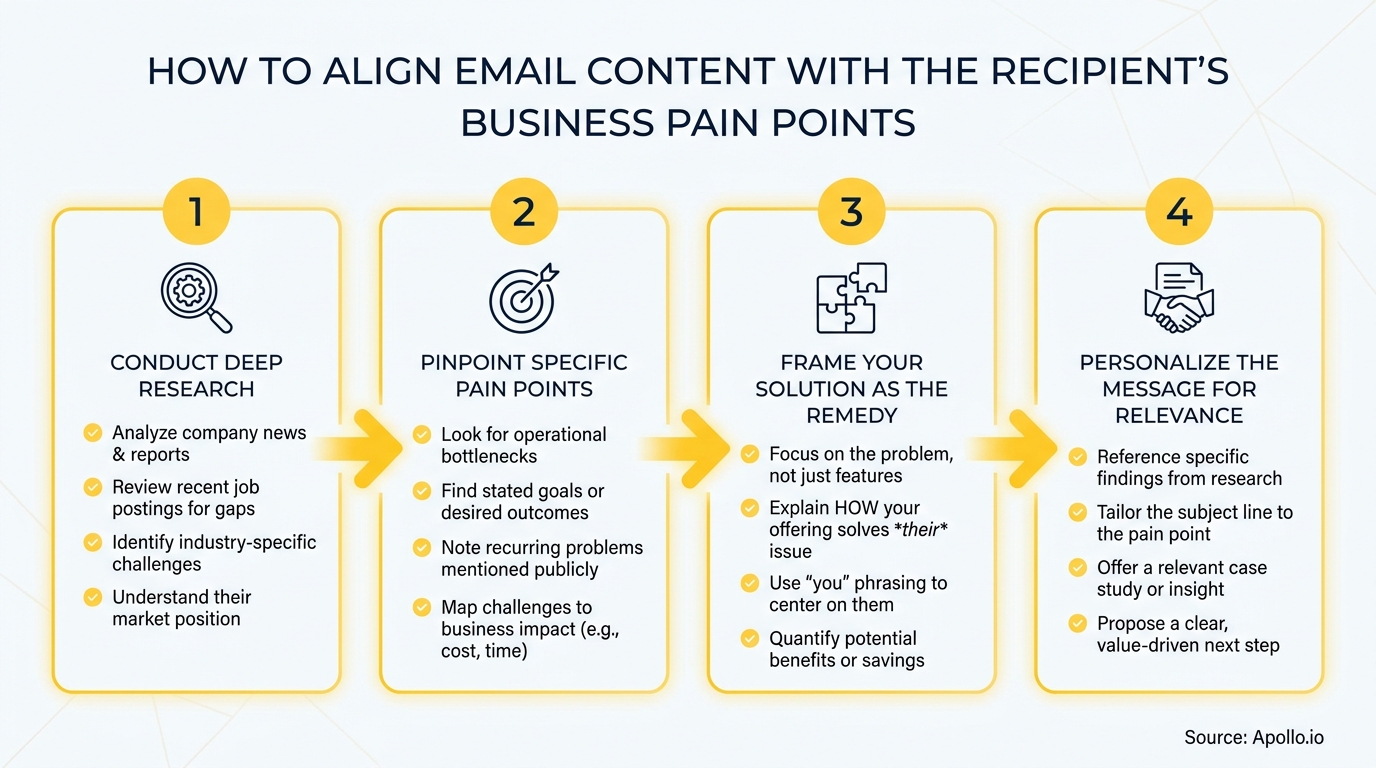
The Pain-Point Alignment System is a repeatable four-step process that translates prospect signals into targeted email content: Diagnose, Hypothesize, Prove, and Send.
| Step | Action | Output |
|---|---|---|
| 1. Diagnose | Collect signals: job postings, funding news, tech stack, recent hires, industry triggers | Pain-point hypothesis (e.g., "scaling sales team without adding headcount") |
| 2. Hypothesize | Map signal to a specific business pain using role-based ICP scoring (0–5 fit scale) | Prioritized segment list with tailored message angle per tier |
| 3. Prove | Attach a proof artifact: benchmark, customer outcome, ROI estimate, or risk framing | One-sentence proof claim grounded in data or evidence |
| 4. Send | Write a short email: problem acknowledgment + proof claim + single low-friction ask | Pain-aligned email with measurable reply rate signal |
A sales professional shared on Reddit that their team prefers relevancy over personalization, scoring each lead on parameters like industry, employee count, and services on a scale of 0–5, then writing separate email scripts for each sub-category. This ICP scoring approach is the foundation of a scalable pain-point system.
Struggling to identify which contacts actually fit your ICP? Use Apollo's 65+ filters to find and segment your ideal prospects before you write a single word.
How Do SDRs and AEs Write Emails That Address Specific Business Pains?
SDRs and AEs who consistently book meetings write to the recipient's role-specific constraints, not to generic personas. The goal is to name a problem the recipient recognizes before they can articulate it themselves.
Use this pain-point mapping by role:
- VP Sales / CRO: Pipeline coverage gaps, rep ramp time, forecast accuracy, cost-per-meeting
- RevOps: Data inconsistency across systems, manual handoffs, attribution gaps
- CFO / Finance: Cost of current tooling, ROI visibility, vendor consolidation pressure
- CTO / CISO: AI governance, data boundary risks, security compliance
- Marketing Leader: Lead quality, inbound conversion rates, attribution clarity
For Account Executives targeting enterprise deals, emails should address buying-committee dynamics. The 6sense report found 58% of buyers engaged earlier specifically to evaluate vendor AI implementation, meaning security and governance pains are now front-of-funnel, not late-stage objections. Frame your proof around those risks early.
For practical guidance on writing sales emails that actually get responses, pair your pain-point hypothesis with a concrete subject line that names the problem directly. See also the best cold email subject lines to boost open rates for subject line formulas that signal relevance before the email is even opened.

Why Do Pain-Point Emails Still Fail to Generate Replies?
Pain-point emails fail when they name the problem but don't connect it to urgency, credibility, or a clear path forward. A practitioner diagnosed the root causes in a Reddit discussion: recipients don't reply because they don't trust you yet, don't see the problem as urgent, can't connect your offer to their specific pain, or don't even know they have the problem you're describing.
Each failure mode requires a different fix:
- No trust: Add a social proof signal in line 2 (named customer, recognizable outcome)
- No urgency: Quantify the cost of inaction or name a time-sensitive trigger (hiring spike, funding round, fiscal quarter)
- Dots not connected:Use a one-sentence bridge: "[Company type] with [signal] typically faces [pain]. We helped [similar company] solve it by [mechanism]."
- Problem not recognized: Lead with an insight or benchmark before introducing your solution
Also critical:improving email deliverability ensures your pain-aligned message actually reaches the inbox. Even the best copy fails if it lands in spam.
Turn Weak Leads Into Pipeline With Apollo
Pipeline forecasting a guessing game because quality leads never materialize? Apollo surfaces in-market buyers at the right moment, so your funnel fills with real opportunities. 600K+ companies stopped guessing and started closing.
Start Free with Apollo →How Do You Scale Pain-Point Alignment Without Losing Relevance?
Scaling pain-point alignment requires tiered personalization, not 1:1 manual research on every contact. Build a three-tier system based on account priority and available signal depth.
| Tier | Account Type | Personalization Depth | Time Investment |
|---|---|---|---|
| Tier 1 | Top 20 target accounts | Custom research: specific pain evidence, stakeholder map, proof artifact | 20–30 min per account |
| Tier 2 | Mid-priority segment | Industry pain matrix + role-based template with signal-triggered variables | 5–10 min per account |
| Tier 3 | Broad ICP | Segment-level pain script (industry + role + company size) | Automated with human review |
A note on the "personalization paradox": a Gartner study published in June 2025 found that over-personalization can actually increase buyer regret and negative outcomes. The shift is toward useful personalization (diagnostics, benchmarks, relevant tradeoffs) rather than trivia-based personalization ("I saw you went to X school"). Prioritize problem-solving relevance over surface-level signals.
Data from Stripo shows emails with personalized elements can boost conversion rates by up to 60%. And according to Tabular, personalized and segmented campaigns can increase revenue by up to 760%, reinforcing why tiered segmentation beats one-size-fits-all outreach at scale.
Spending too much time on manual outreach while managing multiple tools? Automate your pain-point-aligned sequences with Apollo's multi-channel engagement platform and keep your tech stack consolidated in one workspace.
What Does a Pain-Point Aligned Email Actually Look Like?
A pain-point aligned email has four components: a pain-named subject line, a one-sentence problem statement, a proof claim, and a single low-friction ask.
Here's a practical template for an SDR targeting a VP of Sales at a Series B SaaS company:
Subject:
Forecast accuracy at [Company] (quick question)
Body:
Hi [First Name],
Series B teams scaling from 10 to 25 reps typically hit a forecasting wall: CRM data is inconsistent, pipeline coverage looks fine on paper, and missed quarters catch leadership off guard.
We helped [Similar Company] reduce forecast variance by tightening their pipeline data hygiene without adding headcount.
Worth a 15-minute conversation to see if the same approach fits your Q3 build?
Notice what's absent: no feature list, no company overview paragraph, no "I hope this email finds you well." Every sentence maps directly to a problem the recipient has likely experienced. For more on writing effective cold email introductions, see cold email introduction dos and don'ts.

Start Aligning Emails to Pain Points at Scale
Aligning email content with a recipient's business pain points is a system, not a skill. Diagnose signals, score ICP fit, attach proof, and match the message to the recipient's role-specific constraints.
SDRs who segment before writing and AEs who frame emails around buying-committee risks will consistently outperform those who rely on generic templates.
The mechanics of building a B2B email list that converts and keeping your emails out of spammatter too. But the highest-leverage work happens before you write: knowing exactly what problem your recipient is trying to solve and having the evidence to prove you can help.
Apollo gives B2B GTM teams a unified platform to prospect, enrich contact data, build pain-point-aligned sequences, and track pipeline, all without stitching together multiple tools. As Census put it: "We cut our costs in half." Ready to put this system into action? Start a Trial and see how Apollo consolidates your entire outbound workflow in one place.
Prove Pipeline ROI From Day One
ROI pressure killing your tool budget before it even starts? Apollo delivers measurable pipeline impact fast, so justifying the investment is easy. 600K+ companies closed the ROI gap — start free today.
Start Free with Apollo →Don't miss these
Sales
Inbound vs Outbound Marketing: Which Strategy Wins?
Sales
What Is a Sales Funnel? The Non-Linear Revenue Framework for 2026
Sales
What Is a Go-to-Market Strategy? The 2026 GTM Playbook
See Apollo in action
We'd love to show how Apollo can help you sell better.
By submitting this form, you will receive information, tips, and promotions from Apollo. To learn more, see our Privacy Statement.
4.7/5 based on 9,690 reviews
