
How to Adapt Sales Tactics for High-Growth Startups vs. Established Businesses in 2026
Your buyer has already picked a favorite vendor before your SDR ever sends the first email. That reality demands two completely different sales motions depending on whether you're a high-growth startup or an established business. Copy the wrong playbook and you'll either move too slow to survive or too fast to be trusted. This guide gives you a clear tactics selector, a decision matrix, and the collateral requirements for each context — so you can transform your sales motion to match where you actually are.

Let Apollo Find Your Next Buyer
Tired of burning hours on manual research just to hit dead ends? Apollo surfaces verified contacts instantly so your team sells instead of searches. Over 600K companies have already made the switch.
Start Free with Apollo →Key Takeaways
- Startups need founder-led, trigger-based outreach with fast proof-of-value; established businesses need consensus-building, stakeholder-orchestrated sales motions.
- B2B sales cycles continue to lengthen due to cost sensitivity and complex approval processes — but the pressure plays out differently by company stage.
- Self-service is expected by both segments, but established-business buyers face higher purchase regret without guided selling support.
- AI agents now scale startup prospecting without headcount; established firms need governed AI to manage quoting, pipeline, and multi-stakeholder coordination.
- RevOps adoption is accelerating — and high-growth companies that build this function early gain measurable revenue advantages.
What Is the Core Difference Between Startup and Established-Business Sales Motions?
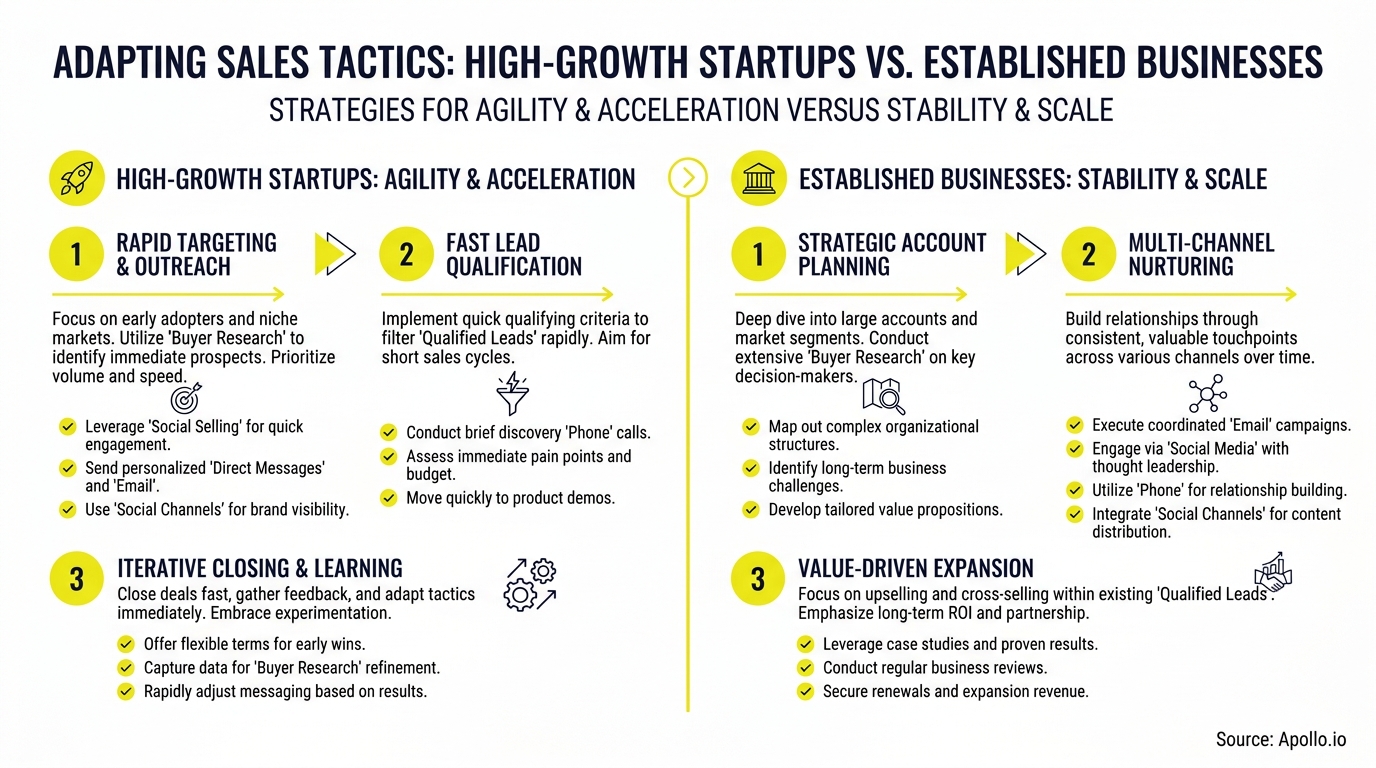
The core difference is speed versus governance. Startups must compress every stage of the buying journey because runway is finite and market windows close.
Established businesses must orchestrate multiple stakeholders, departments, and approval layers because the cost of a wrong decision scales with company size.
According to Spaulding Ridge, B2B sales cycles continue to lengthen due to increased cost sensitivity and complex approval processes — a challenge that hits the two contexts differently. Startups get punished by slow cycles because they run out of time; established companies get punished because deals stall in procurement. The tactics that solve each problem are nearly opposite.
| Dimension | High-Growth Startup | Established Business |
|---|---|---|
| Primary sales motion | Founder-led / AE-led, trigger-based | Committee-orchestrated, multi-threaded |
| Deal complexity | Low-to-mid; fast qualification | High; procurement, security, finance |
| Proof required | Sandbox, pilot, ROI calculator | Business case, compliance docs, case studies |
| ICP focus | Narrow wedge accounts, buying signals | Named accounts, expansion plays |
| AI usage | Prospecting, research, qualification | Quoting, pipeline management, coaching |
| Self-service role | Removes friction, replaces early demos | Supplements reps; reduce regret with guided buying |
How Should SDRs and Founders Adapt Sales Tactics for High-Growth Startups?
SDRs and founders at high-growth startups should run lean, signal-driven outbound with fast proof-of-value at every stage. Generic spray-and-pray outbound is especially dangerous here: Gartner reported that 73% of B2B buyers actively avoid suppliers sending irrelevant outreach. Every touch must tie to a specific trigger or pain.
Struggling to find the right prospects without wasting hours on research? Search Apollo's 230M+ contacts with 65+ filters to surface buying signals and build targeted lists in minutes.
The startup sales playbook breaks into three phases:
- Qualify ruthlessly upfront. Use a tight ICP scorecard. If the prospect doesn't fit on three criteria, disqualify immediately. Time is the startup's scarcest resource.
- Lead with fast proof. Replace long demos with a scoped sandbox or a 14-day pilot. Forrester's 2026 State of Business Buying found 60%+ of buyers now use a trial before purchase — meet them there.
- Codify founder-led wins into repeatable plays. The first 10-20 closed deals contain your actual ICP. Document what worked and hand it to your first AE hires as a sales acceleration formula.
For AI-native startups, position speed-to-value and differentiation in early touches. Buyers know 89% of recent purchases include AI features — make your AI narrative concrete, not vague, before the first call.
Turn Weak Funnels Into Pipeline Gold
Pipeline forecasting a guessing game because quality leads never make it past MQL? Apollo surfaces verified, in-market contacts so your funnel fills with real opportunities. Nearly 100K paying customers stopped guessing and started closing.
Start Free with Apollo →How Should AEs and Revenue Leaders Adapt Sales Tactics for Established Businesses?
AEs at established businesses should shift from pitching to orchestrating. Forrester's 2026 State of Business Buying data shows the typical buying decision now includes 13 internal stakeholders and 9 external influencers, with procurement involved in 53% of cycles.
A single-threaded deal is a stalled deal.
The established-business playbook requires role-specific proof for every stakeholder track:
- Champion/Economic Buyer: Executive business case, ROI model, peer references at comparable company size.
- CFO track: Payback period, total cost of ownership, risk-adjusted ROI. One-pager format preferred.
- IT/Security track: SOC 2 documentation, data handling summary, integration architecture diagram.
- Procurement track: Vendor qualification checklist, standard contract terms, legal FAQs pre-answered.
- End users: Use-case walkthroughs, training timeline, adoption plan.
Research from TryKondo found the average B2B tech sales cycle was 6.5 months in 2023, up from 4.9 months in 2019. For enterprise deals, that number is often longer. A mutual action plan (MAP) shared with the buyer at the start of the deal dramatically reduces stalling by giving both sides a shared definition of next steps and success criteria. Pair your MAP with proven enterprise account strategies to manage the full committee.

How Does Self-Service Fit Into Each Sales Motion?
Self-service should reduce friction for startup buyers and reduce regret for established-business buyers — those are two different design goals. Gartner data shows 61% of B2B buyers prefer a rep-free buying experience, but buyers completing purchases entirely through self-service channels report higher purchase regret than those with rep support.
For startups selling to fast-moving buyers: Use self-serve trials, transparent pricing pages, and an ROI calculator to let buyers qualify themselves. The goal is to remove every reason to delay a yes.
For established businesses selling complex solutions: Self-service assets should support the rep, not replace them. Digital buying rooms, pre-answered security questionnaires, and implementation proof libraries let buyers move forward between calls without waiting for a rep to respond.
The rep's role shifts from information delivery to decision facilitation.
The key escalation trigger: if a self-serve buyer shows high engagement (multiple product page visits, trial activation, pricing page return) but hasn't converted, that's the signal for a rep to reach out with specific context — not a generic follow-up.
How Do RevOps Teams Enable Both Sales Motions at Scale?
RevOps teams enable both motions by building the data infrastructure, process governance, and tooling that lets each sales team operate at its required speed and complexity. Data from Deloitte Digital found B2B organizations using RevOps were 1.4 times as likely to exceed their revenue goals by 10% or more. That advantage compounds when RevOps is purpose-built for the company's growth stage.
For startup RevOps: prioritize a single source of truth for pipeline data, fast CRM setup with minimal fields, and automated lead routing. Keep the stack lean.
As Predictable Revenue put it, "We reduced the complexity of three tools into one" — a principle that applies directly to early-stage teams where complexity kills velocity.
For established-business RevOps: the mandate expands to forecasting accuracy, territory management, compensation design, and cross-functional alignment between sales, marketing, and customer success. According to Captivate Talent, Gartner predicts that 75% of the highest-growth companies will adopt a RevOps model by the end of 2025. Building this function early is a competitive advantage, not an overhead cost. Explore how RevOps can lead sales transformation at your organization.
Spending too much time stitching together disconnected tools? Run your entire sales motion from one platform with Apollo's multi-channel engagement — prospecting, sequencing, and pipeline management in a single workspace.
What Sales Collateral Does Each Motion Require?
The collateral your team needs maps directly to the buyer's stage and the complexity of their buying process. Mismatched collateral (e.g., a 40-slide deck sent to a two-person startup) signals you don't understand your buyer.
| Stage | Startup Collateral | Established Business Collateral |
|---|---|---|
| Awareness | Category explainer, peer review links, community content | Analyst reports, executive thought leadership, ROI benchmarks |
| Evaluation | Sandbox trial, 1-page pricing cues, customer proof | Structured pilot with success criteria, security packet, case studies by industry |
| Decision | Implementation timeline, onboarding checklist | CFO one-pager, mutual action plan, procurement FAQ, legal redlines |
| Expansion | Usage data, product roadmap preview | QBR deck, executive business review, expansion proposal |
Use intent data to determine which collateral to send and when. A prospect researching security compliance is telling you exactly which track they're on — respond with the security packet, not the product overview.
How Should You Build a Sales Tech Stack for Each Context?
Your sales tech stack should match your motion's complexity. Over-engineering a startup stack creates process debt; under-engineering an enterprise stack creates data gaps that kill forecast accuracy. See the full sales tech stack playbook for a stage-by-stage breakdown.
For both contexts, consolidation beats sprawl. Census found that "We cut our costs in half" by moving to a unified platform — a result that matters at every stage.
Cyera noted, "Having everything in one system was a game changer" for cross-functional visibility. Apollo serves B2B GTM teams from early-stage startups through enterprise, combining sales intelligence, multi-channel engagement, AI automation, and deal management in one workspace — so whether you're a three-person founding team or a 200-rep sales org, you're not stitching together five separate tools.

Which Sales Motion Should You Use in 2026?
Choose your sales motion based on your ARR stage, deal complexity, and buyer committee size — not your headcount or funding round. A startup at $2M ARR selling to SMBs needs a completely different motion than an established business at $50M ARR selling to global enterprises.
The gap between those motions is widening in 2026 as AI agents scale startup coverage and buyer AI engines add complexity to enterprise procurement.
The teams winning right now are those that codify their motion early, build the right collateral for each stakeholder, and use a unified platform to execute without adding headcount. Review your sales performance management strategy to make sure your metrics match the motion you're running.
Ready to execute the right sales motion for your stage? Start Prospecting with Apollo — and run your full GTM motion from one platform, whether you're a lean startup or a scaled enterprise team.
Prove Pipeline ROI Before Next QBR
Budget approval stuck on unclear metrics? Apollo delivers measurable pipeline impact fast — so you walk into every QBR with hard numbers, not gut feelings. Leadium 3x'd annual revenue after making the switch.
Start Free with Apollo →Don't miss these
Sales
Inbound vs Outbound Marketing: Which Strategy Wins?
Sales
What Is a Sales Funnel? The Non-Linear Revenue Framework for 2026
Sales
What Is a Go-to-Market Strategy? The 2026 GTM Playbook
See Apollo in action
We'd love to show how Apollo can help you sell better.
By submitting this form, you will receive information, tips, and promotions from Apollo. To learn more, see our Privacy Statement.
4.7/5 based on 9,690 reviews
