
How to Adapt Outreach Campaigns When New Customer Pain Points Arise
Your buyers already have new pain points. Your campaign doesn't know yet. McKinsey's 2026 Global B2B Pulse, published May 28, 2026 and surveying nearly 4,000 decision-makers across 13 countries, found that growth leaders are building around hyperpersonalization and real-time relevance, not quarterly campaign refreshes. The cost of lagging behind is steep: according to HubSpot research cited by WebServicesPros, 75% of people are likely to switch brands if their pressing pain points are not understood.
This guide gives SDRs, AEs, RevOps leaders, and marketing teams a practical framework for detecting new pain points and adapting outreach campaigns within 72 hours, not 72 days. It also covers the email campaign fundamentals and cross-channel governance most playbooks ignore.

Scale Your Team Without the Chaos
Tired of inconsistent outreach and reps reinventing the wheel every quarter? Apollo gives your team verified contacts, automated sequences, and scalable playbooks in one place. Over 600K companies run leaner, faster GTM with Apollo.
Start Free with Apollo →Key Takeaways
- Irrelevant outreach actively damages buyer relationships — adapting fast is a revenue-protection move, not just a conversion tactic.
- Cross-channel message consistency is the most overlooked failure point when pain points shift: email, website, SDR scripts, and decks must update together.
- More personalization is not always the answer — buyers overwhelmed by pressure-heavy messaging are far less likely to convert or return.
- Pain-point adaptation should start before direct outreach: thought leadership, comparison content, and category POV shape buyer shortlists before sellers are contacted.
- Clean, unified account data is the foundation — AI-powered adaptation breaks down without it.
Why Do New Pain Points Break Existing Outreach Campaigns?
New customer pain points break outreach campaigns because the messaging, triggers, and assets were built around old assumptions. When a buyer's priorities shift — due to budget pressure, a new regulation, a leadership change, or a competitor move — generic sequences become irrelevant noise.
Gartner's 2025 sales survey found that 73% of B2B buyers actively avoid suppliers that send irrelevant outreach. That avoidance compounds: once a prospect flags your domain as tone-deaf, re-engagement requires significant trust rebuilding.
The deeper problem is channel fragmentation. Gartner also found that 69% of B2B buyers report inconsistencies between supplier website information and seller-provided information.
When a new pain point emerges and only the email sequence updates, buyers who check your website, talk to an SDR, and read a sales deck get three different stories. That inconsistency kills deals faster than a slow follow-up ever could.
How Do SDRs and RevOps Teams Detect New Pain Points Early?
SDRs and RevOps teams detect new pain points early by monitoring a combination of real-time signals rather than relying on annual persona reviews. The shift from static ICPs to signal-based detection is one of the most important operational changes in modern B2B GTM. Your Ideal Customer Profile is a living document — and the signals that update it should feed directly into campaign triggers.
Key detection signals to monitor:
- CRM notes and call recordings: Repeated objections or new concerns surfacing in discovery calls
- Support ticket themes: Spikes in specific complaint categories signal emerging friction
- Win/loss interviews: Competitors winning on angles you're not addressing
- Intent data spikes: Surges in research around adjacent topics (e.g., security, cost reduction, compliance) — see how intent data powers smarter B2B sales
- Hiring patterns and funding events: Signals of internal priority shifts at target accounts
- Social and community listening: Executive commentary, peer group discussions, industry forum themes
Once a signal cluster appears across three or more accounts in the same segment, treat it as a confirmed pain point shift — not a one-off outlier.
What Is the 72-Hour Pain-Point Response Workflow?
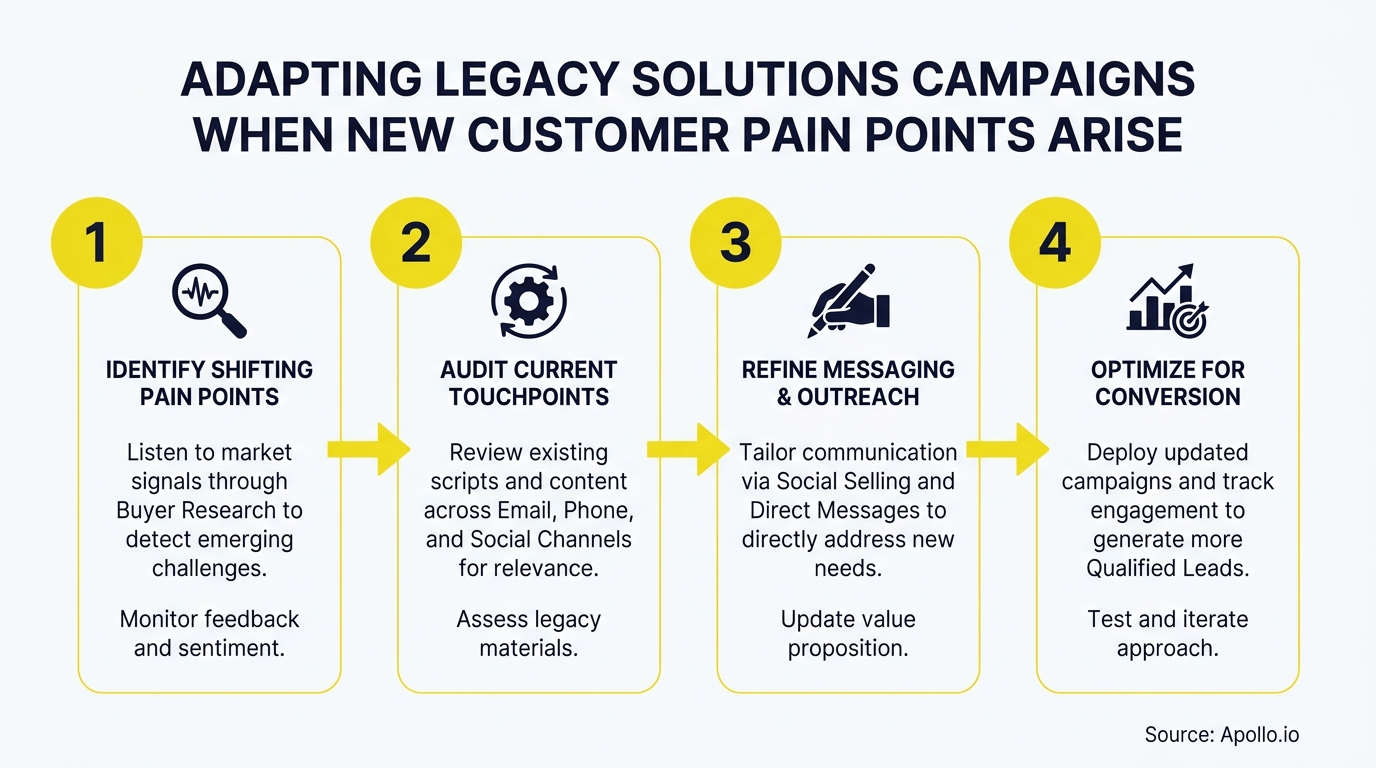
The 72-hour pain-point response workflow is a structured process for pausing, updating, and relaunching outreach campaigns after a new customer pain point is confirmed. It prevents the two most common failures: continuing irrelevant sequences and updating email copy without syncing the rest of the channel stack.
Phase 1: Detect and Triage (Hours 0–12)
- Confirm signal across at least three accounts or data sources
- Score urgency: Is this a broad market shift or a segment-specific trigger?
- Identify which active sequences, segments, and ICPs are affected
Phase 2: Pause and Audit (Hours 12–24)
- Pause affected sequences immediately — do not wait for the next send window
- Run a cross-channel message audit (see checklist table below)
- Flag assets that conflict with the new pain point narrative
Phase 3: Update and Relaunch (Hours 24–72)
- Rewrite subject lines, email body, and CTAs around the new pain point
- Update SDR call scripts and objection-handling guides
- Align website messaging, landing pages, and comparison content
- Brief customer success on the new pain point for renewal and expansion conversations
- Relaunch sequences with a pain-specific proof asset (case study, benchmark, ROI calculator)
Spending hours manually rebuilding sequences from scratch? Automate your multi-channel sequences with Apollo's sales engagement platform so pivoting takes minutes, not days.

What Should the Cross-Channel Message Sync Checklist Cover?
The cross-channel message sync checklist should cover every buyer-facing touchpoint where the old pain point narrative may still exist. Missing even one creates the inconsistency that Gartner's research identifies as a major trust-breaker.
| Channel | What to Update | Owner |
|---|---|---|
| Outbound email sequences | Subject lines, body copy, CTAs, proof links | SDR / Sales Ops |
| SDR call scripts | Opening hook, pain-point framing, objection responses | SDR Manager |
| Website (homepage, use-case pages) | Hero copy, value prop statements, proof points | Marketing |
| Sales decks and one-pagers | Problem slide, differentiator framing, ROI examples | Sales Enablement |
| Paid and nurture content | Ad copy, landing page headlines, nurture email themes | Demand Gen |
| Customer success touchpoints | QBR agendas, renewal narratives, expansion plays | CS Team |
According to The Insight Collective, 83% of B2B buyers prefer email contact from sellers during the purchasing process — making email the highest-stakes channel to update first, but not the only one.
Turn Funnel Gaps Into Pipeline Wins
Tired of watching marketing leads stall before they ever reach your pipeline? Apollo surfaces in-market buyers the moment they're ready, so your team stops guessing and starts closing. Nearly 100K paying customers replaced forecasting anxiety with predictable revenue.
Schedule a Demo →How Do You Personalize Without Overwhelming Buyers?
You avoid overwhelming buyers by personalizing around the buyer's active decision task, not around every available data point. Gartner's research on personalization found that customers exposed to personalization were 2x more likely to feel overwhelmed and 2.8x more likely to feel time pressure.
The goal is reduced cognitive load, not increased volume.
Use this decision framework before adding personalization to an updated campaign:
| Buyer's Task | Right Personalization | What to Avoid |
|---|---|---|
| Problem discovery | Diagnostic content, benchmark data, industry context | Product demos, pricing CTAs |
| Vendor comparison | Comparison pages, proof points, third-party validation | Heavy feature lists, jargon-heavy decks |
| Internal consensus building | Business case templates, ROI calculators, exec summaries | Urgency pressure, scarcity tactics |
| Risk reduction | Implementation guides, security docs, customer references | Aggressive follow-up cadences |
Research from S2M Group shows that B2B decision-makers receive an average of 121 emails per day. Every outreach touchpoint must earn its place by directly addressing what the buyer is trying to accomplish right now — not what your campaign assumed last quarter. For AEs managing complex deals, this means matching your proof assets to where the buying group actually is in the decision process, not just updating the subject line.
How Should Pre-Shortlist Content Be Adapted for New Pain Points?
Pre-shortlist content should be adapted first because most B2B buyers form their vendor shortlist before engaging a sales rep. Adapting only direct outreach misses the majority of the buyer journey.
The practical implication: update thought leadership, comparison pages, and ungated business-case content to reflect the new pain point before relaunching any outbound sequence.
Priority pre-shortlist assets to update:
- Category education content: Blog posts, guides, and B2B marketing funnel assets that frame the problem
- Comparison and alternative pages: Buyers self-research competitors before shortlisting
- Thought leadership: Executive POV content that signals awareness of the new pain point
- Ungated proof: ROI benchmarks, case study summaries, and data-backed claims accessible without a form
Need to identify which accounts are already researching your new pain-point category? Search Apollo's 230M+ contacts with 65+ filters to find and prioritize accounts showing active intent signals before your competitors do.
How Do You Measure Whether the Adapted Campaign Is Working?
You measure campaign adaptation success by tracking pain-point relevance signals, not just volume metrics. Send rates and open rates tell you reach.
Reply rates, meeting acceptance, and objection frequency tell you whether the new message is landing.
Key metrics to track after a pain-point pivot:
- Reply rate delta: Compare new sequence reply rate against the paused sequence baseline
- Objection pattern shift: Are reps still hearing the old objections, or new ones reflecting the updated narrative?
- Asset engagement: Are prospects opening the pain-specific proof assets you included?
- Stage progression rate: Are adapted sequences moving accounts to the next stage faster?
- Customer engagement health: Track customer engagement metrics across the full funnel, not just top-of-funnel sends
Set a two-week checkpoint. If reply rates have not improved, the issue is likely message-market fit — run a rapid A/B test on subject line framing and the core pain-point claim before scaling the sequence further.

Adapt Faster With a Unified GTM Platform
Adapting outreach campaigns when new pain points arise is fundamentally a speed and coordination problem. The teams that respond fastest win the shortlist.
The teams that stay consistent across every channel earn the deal.
Apollo gives SDRs, AEs, RevOps leaders, and marketing teams a single workspace to detect signals, update sequences, enrich account data, and execute multi-channel outreach without juggling five separate tools. Trusted by nearly 100K paying customers including Anthropic, Smartling, and Docusign, Apollo consolidates the entire pain-point response workflow into one platform.
As Collin Stewart from Predictable Revenue put it: "We reduced the complexity of three tools into one."
Stop letting new pain points catch your campaigns flat-footed. Start your free trial of Apollo and build a pain-point response system your entire GTM team can execute in 72 hours.
Prove Pipeline ROI With Apollo
ROI pressure killing your tool budget? Apollo delivers measurable pipeline impact from day one — no guesswork, no waiting quarters to see results. Leadium 3x'd annual revenue. Start yours free.
Start Free with Apollo →Don't miss these
Sales
Inbound vs Outbound Marketing: Which Strategy Wins?
Sales
What Is a Sales Funnel? The Non-Linear Revenue Framework for 2026
Sales
What Is a Go-to-Market Strategy? The 2026 GTM Playbook
See Apollo in action
We'd love to show how Apollo can help you sell better.
By submitting this form, you will receive information, tips, and promotions from Apollo. To learn more, see our Privacy Statement.
4.7/5 based on 9,690 reviews
