
How to Incorporate Social Selling into Your Outreach in 2026
Most outreach fails before it starts. Buyers research vendors in AI tools, private Slack channels, and professional networks long before a rep ever sends a message. By the time your cold email lands, a decision is already forming. Social selling on professional networks gives you a way to show up during that early, invisible research phase, not just after it.
The question isn't whether to add social selling to your outreach. It's how to do it in a way that builds genuine credibility rather than adding noise to an already crowded inbox.

Research Less, Close More With Apollo
Tired of your reps burning hours hunting down contact info instead of selling? Apollo delivers verified contacts instantly, so your team spends time closing — not researching. Join 600K+ companies building pipeline faster.
Start Free with Apollo →Key Takeaways
- Buyers are actively evaluating you on professional networks before they respond to any outreach, making your public presence a critical first impression.
- Social selling works best when it functions as buyer enablement, not pitching: share content that helps prospects self-educate and validate their decision.
- A relevance-first approach to outreach reduces buyer avoidance and increases reply rates across all channels.
- The strongest results come from coordinating social activity with email, phone, and self-serve content, not treating each channel in isolation.
- SDRs and AEs who align their direct messages with their public content expertise see higher engagement than those sending generic outreach.
Why Is Social Selling So Important Right Now?
Social selling matters because professional network usage in the B2B buying process has accelerated dramatically. According to SaleSso, professional networks are the top-rated platform for B2B lead generation, with over 80% of B2B leads sourced through social media originating from these channels. Buyers are not just passively browsing. They are actively using professional platforms to vet vendors, check rep credibility, and compare options before ever engaging with sales.
Research from folk.app shows that 78% of businesses using social selling outperform those that do not, based on professional network data. The gap between companies that formalize this motion and those that treat it as optional is measurable in pipeline and quota attainment.
Struggling to find the right contacts before your social outreach even begins? Search Apollo's 230M+ verified contacts with 65+ filters to identify exactly who to target.
What Is the Relevance Standard for Social Outreach?
The relevance standard is a pre-send checklist that gates every social message or connection request against four criteria: role fit, industry fit, buying-stage signal, and a specific proof asset tied to the prospect's context. Meeting all four criteria before reaching out reduces the chance your message gets ignored or flagged as irrelevant.
Use this checklist before any outreach on professional networks:
- Role fit: Does this person have budget authority or direct influence over the problem your product solves?
- Industry fit: Do you have a case study, customer story, or insight specific to their vertical?
- Buying-stage signal: Have they engaged with relevant content, posted about a pain point, or shown a trigger event (new role, funding, headcount growth)?
- Proof asset: Can you attach or reference something genuinely useful, such as a benchmark, ROI framework, or customer outcome relevant to their situation?
For SDRs building high-volume sequences, applying this standard at the list-building stage, before messages are written, saves significant time and produces higher-quality conversations. Intent data is a practical tool for identifying buying-stage signals at scale.

How Do SDRs and AEs Build a Social Selling Content Presence?
SDRs and AEs who post consistently on professional networks create a credibility layer that makes every direct message land differently. When a prospect receives your connection request and sees relevant, specific content on your profile, your outreach reads as expertise rather than interruption.
Content that works for B2B social selling follows a simple pattern:
- Niche point of view: Share a specific take on a problem your buyers face, not generic industry news.
- Customer proof: Reference outcomes (with permission) that mirror the prospect's situation. Short video clips from happy customers are particularly effective in 2026.
- Decision-stage assets: Post content that helps late-stage buyers, such as ROI frameworks, implementation checklists, or competitive considerations. This is an underserved area: most social content skews toward awareness and ignores decision support.
- Comment-led networking: Engage meaningfully on prospects' posts before sending a direct message. This warms the relationship without any pitch.
According to Twicsy, organizations with formalized social selling processes are 40% more likely to hit revenue goals. The key word is formalized: ad hoc posting produces inconsistent results. AEs managing named accounts benefit especially from coordinating their content calendar with the accounts they are actively pursuing. For more on how one practitioner built a multi-million dollar pipeline through this approach, see how Alex Boyd drives $4.5M through social selling.
What Does an Omnichannel Social Selling Playbook Look Like?
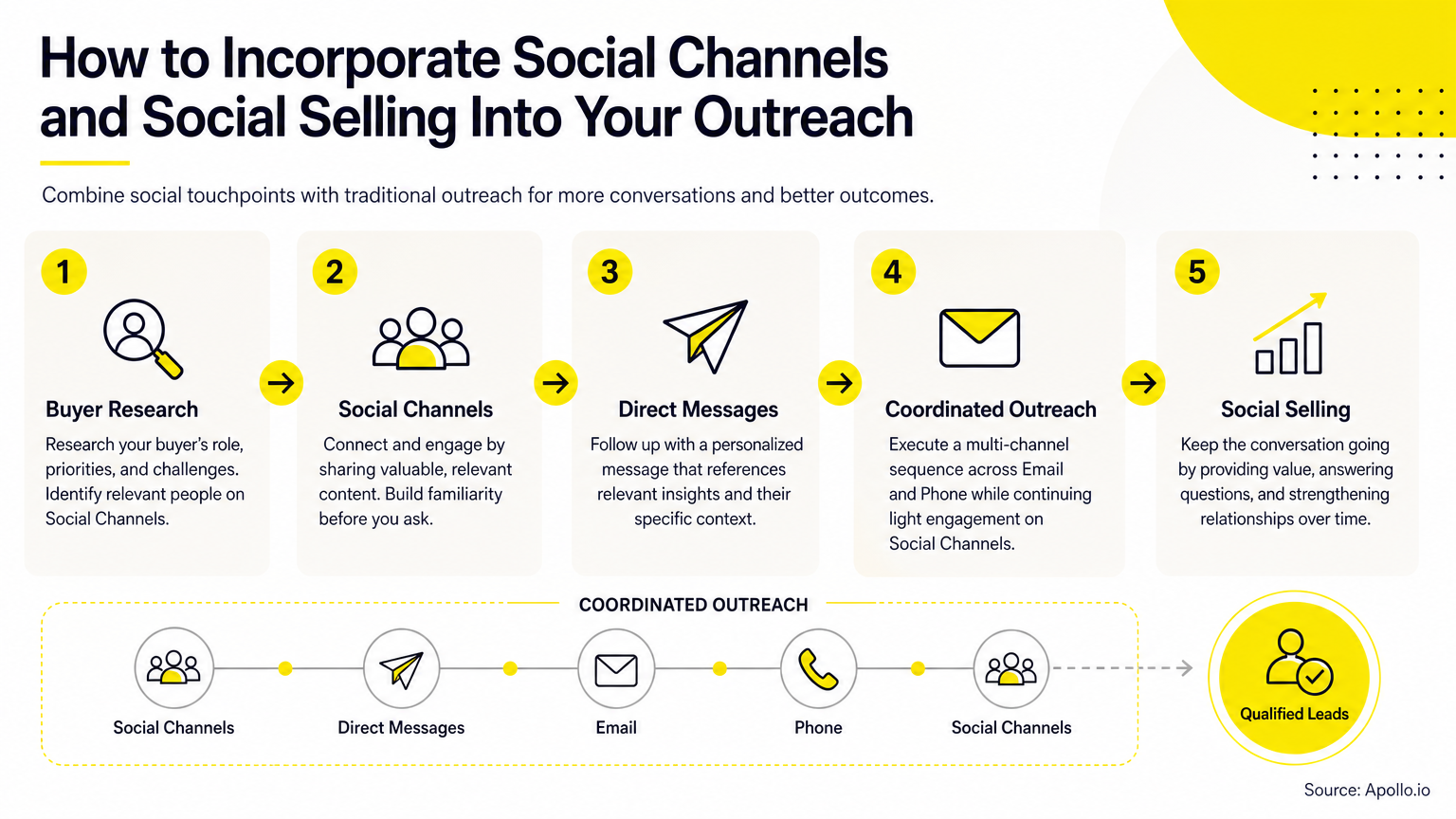
An omnichannel social selling playbook coordinates professional network activity with email, phone, and self-serve content so every channel reinforces the others. Treating social as a standalone motion produces weaker results than integrating it into a sequenced approach.
A practical sequence for B2B outreach in 2026:
| Step | Channel | Action | Goal |
|---|---|---|---|
| 1 | Professional network | Engage with prospect's post or content | Warm the relationship before any DM |
| 2 | Professional network | Send connection request with a specific, non-pitch note | Establish presence; no ask yet |
| 3 | First email referencing the social interaction and a proof asset | Relevance signal; start a conversation | |
| 4 | Self-serve content | Link to a pricing explainer, ROI calculator, or case study | Enable rep-free evaluation |
| 5 | Phone or video | Call or video message referencing prior touchpoints | Escalate engaged prospects to a conversation |
| 6 | Professional network DM | Follow up with a specific resource tied to their stated priority | Keep the thread alive; offer seller-assisted path |
This structure reflects what McKinsey calls the "rule of thirds": B2B buyers split their time roughly evenly across in-person, remote, and digital self-service interactions. No single channel dominates. Sequences that only use email or only use social selling leave significant pipeline on the table. For a deeper look at how to structure multi-channel engagement, explore Apollo's multichannel sales engagement platform.
Spending too much time manually juggling channels? Automate your multi-channel sequences with Apollo and keep social, email, and phone coordinated in one workspace.
Turn Funnel Gaps Into Pipeline Gold
Quota pressure mounting while marketing leads stall before they ever reach sales? Apollo surfaces in-market buyers with intent signals so your team reaches the right prospects at right moment. Over 600K companies trust Apollo to turn funnel gaps into real opportunities.
Start Free with Apollo →What Late-Stage Social Assets Should You Create?
Late-stage social assets are decision-support content shared on professional networks to help buyers who are already evaluating vendors. Most social selling content focuses on awareness.
Late-stage assets address the specific questions buyers ask right before they choose: How does this compare to alternatives? What does implementation look like?
What ROI can I justify to my CFO?
High-impact late-stage asset types:
- Customer outcome posts with specific metrics (always attributed and approved)
- Short "how we think about pricing" explainers that reduce procurement friction
- Implementation timelines or onboarding checklists shared as carousel posts
- Short video testimonials from customers in the same industry as your prospect
- Competitive consideration frameworks that acknowledge alternatives honestly
For Account Executives managing enterprise deals, sharing these assets directly with the buying group on professional networks, rather than only through email, extends reach to stakeholders who may never open a cold email. Pair this with smart content personalization in your emails for a consistent message across channels.
How Should RevOps Teams Measure Social Selling Performance?
RevOps teams should track social selling through pipeline influence metrics rather than vanity engagement metrics. Likes and follower counts tell you nothing about revenue impact.
The metrics that matter connect social activity to pipeline outcomes.
Key KPIs for a formalized social selling program:
- Social-influenced pipeline: Deals where a social interaction preceded the first meeting or email reply
- Reply rate by sequence type: Compare sequences with a social warm-up step versus those without
- Meeting show rate: Social-warmed prospects tend to show up more reliably than cold-only outreach
- Content engagement by account: Track which target accounts are interacting with your team's public content
- Time to first response: Measure whether social priming shortens the time from first contact to first reply
According to pettauer.net, 61% of organizations engaged in social selling report revenue growth. RevOps leaders who instrument these KPIs properly can tie that growth to specific sequence patterns and replicate them across the team. For the full GTM picture, see how a well-built B2B marketing funnel connects social activity to closed revenue.

How Do You Start Incorporating Social Selling Into Your Outreach Today?
Start by auditing your current sequences for social touchpoints, then add one structured warm-up step before your first email. The fastest path to results is not building a massive content library upfront.
It is running a controlled test: take ten target accounts, apply the relevance standard, add a social warm-up step, and compare reply rates against your baseline.
Practical starting points:
- Optimize your professional profile so it reads as a resource for your buyer, not a resume
- Identify the top ten accounts you are actively working and engage with their content for two weeks before sending any direct message
- Create one piece of decision-stage content per week: a short post, a customer outcome, or an implementation insight
- Use the Apollo Chrome Extension to surface verified contact information while researching prospects across the web
- Review the best social selling tools to identify what fits your current stack
Apollo consolidates prospecting, sequencing, and multi-channel engagement in one platform, so your social, email, and phone touches are coordinated without managing three separate tools. As Predictable Revenue put it: "We reduced the complexity of three tools into one." See how Predictable Revenue cut their tech stack costs by consolidating with Apollo.
Social selling is not a replacement for outreach. It is the credibility layer that makes every other channel work harder. Start with relevance, build your presence consistently, and coordinate channels so buyers encounter you everywhere they research. Try Apollo free and run your first social-integrated sequence today.
Prove Pipeline ROI Before Next QBR
Budget approval stuck on unclear metrics? Apollo delivers measurable pipeline impact from day one — so you walk into every QBR with numbers, not excuses. Over 600K+ companies already showing the returns.
Start Free with Apollo →Don't miss these
Sales
Inbound vs Outbound Marketing: Which Strategy Wins?
Sales
What Is a Sales Funnel? The Non-Linear Revenue Framework for 2026
Sales
What Is a Go-to-Market Strategy? The 2026 GTM Playbook
See Apollo in action
We'd love to show how Apollo can help you sell better.
By submitting this form, you will receive information, tips, and promotions from Apollo. To learn more, see our Privacy Statement.
4.7/5 based on 9,690 reviews
