
How Often Should You Refresh Data Enrichment in Your System?
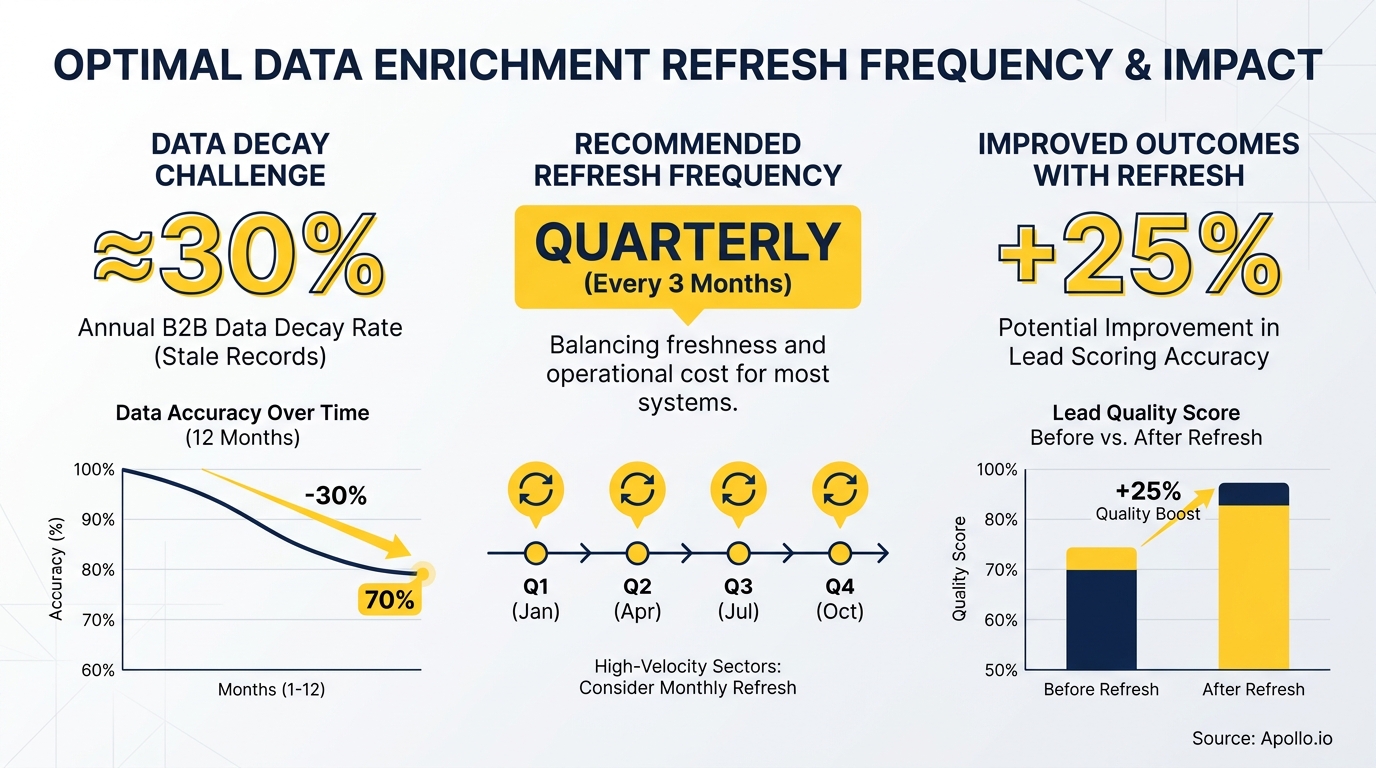
Your CRM data starts decaying the moment a contact changes jobs, gets promoted, or shifts to a new company. According to Landbase, B2B contact databases experience annual decay rates between 22.5% and 70.3%, meaning a quarterly or annual refresh cycle is mathematically guaranteed to leave your outreach targeting stale records. For SDRs, RevOps leaders, and AEs relying on enriched data to personalize outreach, that decay directly translates to missed meetings and wasted effort. Understanding your data enrichment strategy refresh cadence is one of the highest-leverage decisions in your GTM stack.

Apollo Turns Research Hours Into Revenue
Tired of your reps burning the day verifying contact info instead of closing deals? Apollo delivers accurate business contacts instantly, so your team spends time selling. Join 600K+ companies building pipeline faster.
Start Free with Apollo →Key Takeaways
- B2B contact data decays at rates between 22.5% and 70.3% annually, making annual refresh cycles insufficient for most GTM teams.
- Different fields decay at different speeds: email addresses and job titles need more frequent refresh than firmographic data like industry or company size.
- A blended approach combining a baseline monthly or quarterly cadence with event-triggered refreshes (job changes, bounced emails) outperforms calendar-only schedules.
- RevOps leaders should track freshness, accuracy, completeness, and bounce rate as core KPIs to know when to trigger a refresh.
- Apollo consolidates enrichment, job-change alerts, and outreach into one platform, eliminating the need for separate data hygiene tools.
Why Does Data Enrichment Decay So Fast?
B2B contact data decays because people change jobs, get promoted, switch companies, and update contact details constantly. Cleanlist.aireports annual decay rates between 22.5% and 70.3% depending on the fields tracked. Email addresses are among the fastest-changing fields:SalesMotion notes that in November 2024, email decay accelerated to 3.6% in a single month, nearly double the traditional monthly rate of 1.5–2.0%. Firmographic fields like industry classification or company size change more slowly, but job titles and direct emails can go stale within weeks of a hire or departure.
How Often Should You Refresh Data Enrichment by Field Type?
The right refresh frequency depends on the specific data field, not a single universal cadence. High-velocity fields need near-continuous monitoring, while stable attributes can tolerate longer intervals. Cleanlist.ai recommends re-verifying contact data quarterly, or every 90 days, as a minimum baseline.
| Field Type | Typical Decay Rate | Recommended Refresh Cadence |
|---|---|---|
| Email address | High (1.5–3.6%/month) | Monthly or pre-campaign |
| Job title / role | High | Monthly + on job-change signal |
| Phone number | Medium-high | Quarterly |
| Company name / size | Medium | Quarterly |
| Industry / revenue band | Low | Semi-annually |
| Intent signals | Very high | Weekly or real-time |
Tired of chasing stale contacts? Apollo's CRM enrichment tool keeps your records verified with 97% email accuracy across 230M+ contacts.
What Is the Difference Between Batch Refresh and Event-Triggered Enrichment?
Batch refresh runs on a fixed schedule (monthly, quarterly), while event-triggered enrichment fires automatically when a specific signal occurs. The modern best practice is a blended model: maintain a scheduled baseline cadence and layer in real-time triggers for high-impact events.
This approach is especially valuable for Tier-1 accounts in your pipeline where stale data has an outsized cost.
Key event triggers to set up:
- Job change detected: Re-enrich the contact immediately and alert the owning rep
- Email bounce: Flag record for re-verification before the next send
- Intent spike: Pull fresh firmographic and contact data to personalize outreach
- M&A signal: Refresh company hierarchy, headcount, and key stakeholder contacts
- Inbound form fill: Enrich the record at the moment of conversion
Apollo's job change alerts and data enrichment feature automatically detects when contacts move roles, so SDRs and AEs never lose a warm relationship due to stale data.

How Do RevOps Leaders Measure Enrichment Freshness?
RevOps leaders should track four core KPIs to know when enrichment is due and to justify refresh investment to leadership. Without measurement, teams are flying blind on data quality costs.
| KPI | Definition | Refresh Trigger Threshold |
|---|---|---|
| Bounce rate | % of emails returned as invalid | >2% signals re-verification needed |
| Data completeness | % of records with all required fields populated | <85% triggers enrichment run |
| Match rate | % of records successfully enriched by provider | Declining match rate signals database aging |
| Record age | Days since last enrichment update | >90 days for emails, >180 days for firmographics |
Connect these KPIs to your data synchronization workflows so dashboards update automatically and your team gets alerts before data quality degrades outreach performance.
Turn Funnel Gaps Into Qualified Pipeline
Tired of watching marketing leads stall before they ever reach your AEs? Apollo surfaces high-intent prospects and keeps your funnel moving with verified contacts. Nearly 100K paying customers stopped guessing and started closing.
Start Free with Apollo →How Do SDRs and AEs Use Enrichment Cadence to Book More Meetings?
SDRs benefit most from monthly email and job-title refreshes tied to their active outreach sequences. Reaching a contact at a stale role with a generic message kills reply rates.
AEs managing active pipeline should trigger an enrichment check before any discovery call or proposal stage, ensuring the stakeholder map, title, and contact details are current.
Practical cadence for GTM roles:
- SDRs: Enrich prospect lists monthly and re-verify emails before every campaign launch
- AEs: Trigger enrichment on all open opportunities every 30 days and immediately on any job-change signal
- RevOps: Run quarterly full-database audits and maintain monthly KPI reviews against the thresholds above
- Marketing: Verify list before every batch send and enrich all inbound leads at form submission
Struggling to keep prospect data fresh without adding another tool? Apollo combines enrichment, sequencing, and CRM sync in one platform, so your team works from verified data without juggling separate vendors. As Cyera noted, "Having everything in one system was a game changer."
How Does Enrichment Freshness Affect AI Personalization and Deliverability?
AI-powered personalization outputs are only as good as the input data. Stale job titles, wrong industries, or outdated company sizes cause AI to generate mismatched messaging that harms both reply rates and sender reputation. Stricter bulk-sender requirements from major email providers in 2026 mean high bounce rates from stale emails now carry direct deliverability penalties, not just efficiency costs. Teams using contact data enrichment as a continuous process, rather than a one-time import, protect both pipeline quality and domain health.
For teams building intent-based outreach, freshness is especially critical: intent signals expire within days, so enrichment must keep pace with buyer behavior signals to be actionable.
What Is the Right Data Enrichment Refresh Schedule for Your Team?
The right schedule is the one you can operationalize consistently. A tiered approach works for most B2B GTM teams:
- Tier 1 (Active pipeline, ABM targets): Weekly refresh on key contacts plus real-time event triggers
- Tier 2 (Active sequences, recent leads): Monthly refresh on all fields
- Tier 3 (Cold database, historical records): Quarterly audit with selective re-enrichment
Start by auditing your current bounce rate and record age. If bounce rates exceed 2% or records average more than 90 days since last enrichment, begin with a full database refresh before setting your ongoing cadence. Explore the data enrichment tools that drive revenue to find the right fit for your team size and outreach volume.

Start Refreshing Smarter with Apollo
Data enrichment cadence is not a one-time setup decision. It is an ongoing operational commitment that directly determines whether your outreach connects or misses.
Monthly refreshes for high-velocity fields, event-triggered updates for job changes and bounces, and quarterly audits for firmographic data give most B2B GTM teams the coverage they need without over-spending on credits.
Apollo consolidates enrichment, job-change alerts, verified contact data, and outreach sequencing into a single platform, so your team spends less time managing data hygiene across multiple vendors and more time closing deals. Start prospecting with Apollo today and keep your CRM data working as hard as your team does.
Prove Pipeline ROI From Day One
ROI pressure killing your next budget approval? Apollo delivers measurable pipeline impact fast — so you walk into every review with proof, not promises. Nearly 100K paying customers closed the gap between spend and results.
Start Free with Apollo →Don't miss these
Sales
Inbound vs Outbound Marketing: Which Strategy Wins?
Sales
What Is a Sales Funnel? The Non-Linear Revenue Framework for 2026
Sales
What Is a Go-to-Market Strategy? The 2026 GTM Playbook
See Apollo in action
We'd love to show how Apollo can help you sell better.
By submitting this form, you will receive information, tips, and promotions from Apollo. To learn more, see our Privacy Statement.
4.7/5 based on 9,690 reviews
