
How Accurate Firmographic Data Helps SDR Teams Prioritize Outreach
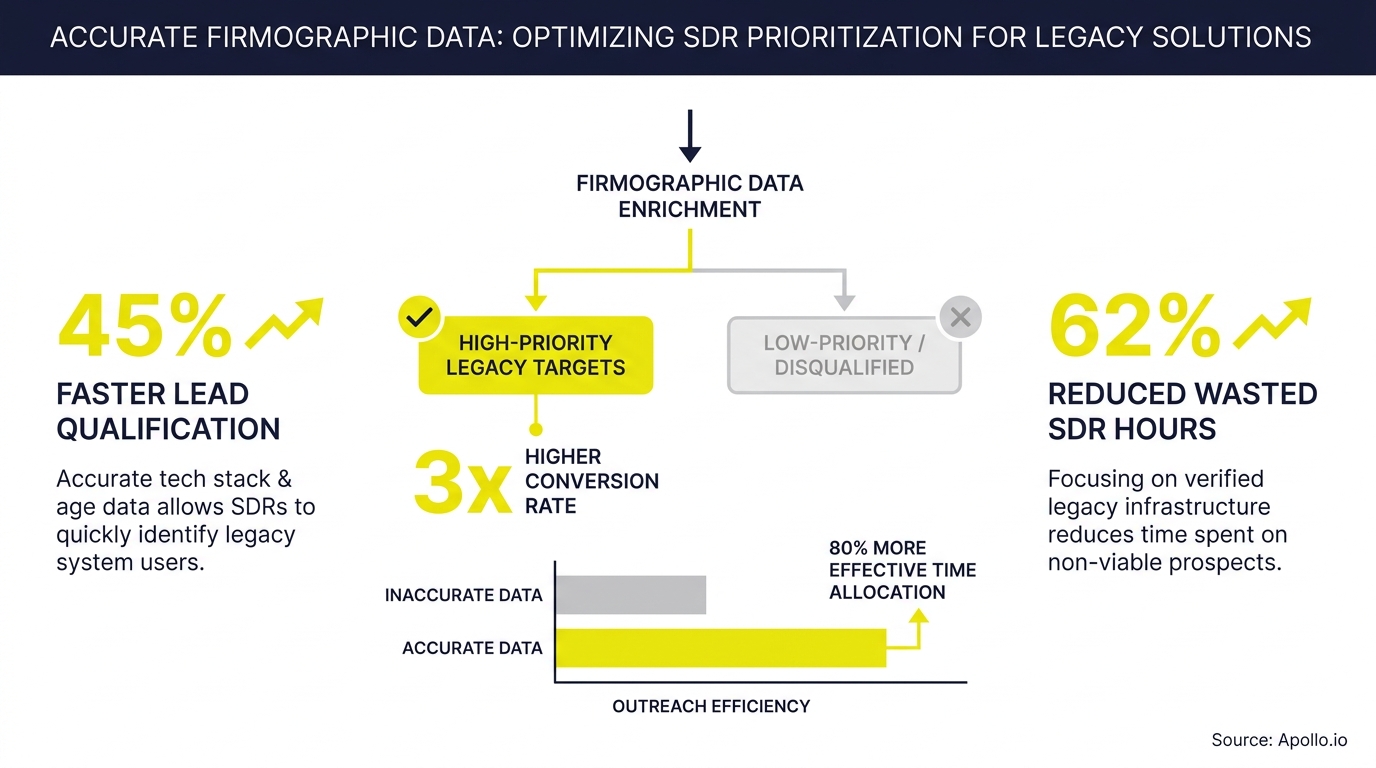
SDR teams that rely on stale or incomplete company data waste significant time chasing the wrong accounts. Accurate firmographic data solves this by giving SDRs a clear, objective signal for which accounts fit their ICP, which territories to own, and which sequences to trigger, before a prospect ever raises their hand. Understanding how contact data enrichment drives ROI is the first step toward building a prioritization engine that actually works.

Research Less, Close More With Apollo
Tired of your reps burning hours hunting down contact info instead of selling? Apollo delivers verified contacts instantly, so your team spends time closing — not digging. Join 600K+ companies building pipeline faster.
Start Free with Apollo →Key Takeaways
- Accurate firmographic data directly determines which accounts SDRs contact first, reducing time spent on low-fit prospects.
- Bad data is a quantified productivity drain: sellers waste over 27% of their time on inaccurate CRM data, leaving SDRs with limited hours for active selling.
- Companies with a strong ICP built on firmographic data achieve significantly higher account win rates than those without one.
- AI-powered scoring and routing tools amplify both accurate and inaccurate firmographics, making data quality a gating factor for AI SDR performance.
- RevOps-owned governance, waterfall enrichment, and regular refresh cycles are the operational levers that keep firmographic data actionable.
What Is Firmographic Data and Why Does It Drive SDR Prioritization?
Firmographic data is the set of company-level attributes, including industry, employee count, revenue range, geography, tech stack, and organizational structure, that define whether an account fits your ICP. SDR teams use these attributes to rank accounts by fit, assign territories, and select the right outreach sequences.
According to SalesO, sellers waste over 27% of their time dealing with inaccurate CRM information and bad data quality. For SDRs already pressed for selling time, that waste is critical: inaccurate firmographics mean misrouted accounts, wrong sequences, and outreach that lands with the wrong message.
The stakes are rising. As AI agents take on scoring and next-best-action recommendations inside CRM platforms, wrong industry or employee-band data does not just mislead one rep.
It systematically misdirects the entire prioritization engine at scale.
How Do SDRs Use Firmographic Data to Build a Prioritization Tier System?
SDRs use firmographic data to sort their account universe into tiers, concentrating effort on accounts with the highest fit scores and deprioritizing or excluding those that fall outside ICP parameters.
| Tier | Firmographic Criteria | SDR Action |
|---|---|---|
| Tier 1 (High Fit) | Target industry, 50–500 employees, HQ in territory | Personalized multi-touch sequence, priority call blocks |
| Tier 2 (Medium Fit) | Adjacent industry, 20–49 or 501–1000 employees | Templated sequence, lower touch frequency |
| Tier 3 (Low Fit) | Out-of-ICP industry or size, missing key fields | Hold for enrichment or exclude from active sequences |
Research from AI-Ark shows that companies with a strong ICP built on firmographic data achieve 68% higher account win rates than competitors. Tighter tiers mean SDRs spend their limited selling hours on accounts that are statistically more likely to convert.
Struggling to find and filter high-fit accounts at scale? Search Apollo's 230M+ contacts using 65+ firmographic filters to build precise, tiered prospect lists in minutes.
Why Does Firmographic Accuracy Matter for AI-Powered SDR Workflows?
Firmographic accuracy is the gating factor for AI scoring, routing, and personalization because every AI recommendation inherits the quality of its input data.
Wrong industry classification triggers the wrong messaging template.
Wrong employee count assigns the account to the wrong territory or sequence. The error compounds silently at scale.
This risk is already visible in enterprise GTM stacks. Microsoft's Dynamics 365 agentic CRM capabilities, designed to surface next-best actions from account data, depend entirely on accurate firmographic fields to route and score correctly.
When those fields are stale, the agent's confidence is high but its output is wrong.
My-Outreach reports that 88% of B2B marketers who personalize messaging by industry, company size, or organizational structure exceeded their revenue goals. AI personalization at scale can only deliver that outcome when the underlying firmographic fields are accurate.
To build AI-readiness into your data foundation, see how to build a data enrichment strategy that governs source-of-truth fields before you scale automation.
Turn Funnel Gaps Into Qualified Pipeline
Tired of watching marketing leads stall before they ever reach your AEs? Apollo surfaces high-intent buyers and moves them faster through your funnel. 600K+ companies stopped guessing and started closing.
Start Free with Apollo →How Should RevOps Teams Own Firmographic Data Governance?
RevOps should own firmographic definitions, refresh SLAs, and source-of-truth architecture, not individual reps or sales managers. When governance is decentralized, ICP definitions drift, industry taxonomies conflict, and routing rules break silently.
A practical RevOps governance model includes:
- Defined field taxonomy: Standardized industry categories, employee band ranges, and revenue tiers agreed across Sales, Marketing, and RevOps.
- Refresh SLAs: Firmographic fields flagged for re-enrichment after a defined time period (commonly 90 days) or after a trigger such as a job change or funding event.
- Source-of-truth hierarchy: A waterfall model that sequences enrichment providers so missing or conflicting fields are resolved by a defined priority order.
- Audit dashboards: Monitoring for field completeness rates, routing exceptions, and sequence assignment errors tied to data gaps.
Teams using B2B data enrichment for smarter routing can automate much of this governance, keeping CRM records current without manual rep research. Waterfall enrichment, which queries multiple providers in sequence, is increasingly the standard approach for reducing unknown fields that block routing and sequence assignment.

How Does Firmographic Data Reduce Wasted SDR Research Time?
Accurate firmographic data reduces the time SDRs spend manually researching accounts before outreach by surfacing company size, industry, and organizational structure directly in their workflow. According to SalesO, SDRs often spend only two hours per day actively selling, with the rest consumed by administrative tasks and research. Firmographic data embedded in the CRM or sales engagement platform reclaims that research time for actual outreach.
Landbase reports that enriched data can increase sales productivity by 25%. For SDR teams already operating under quota pressure, that productivity gain translates directly into more sequences launched, more calls made, and more meetings booked.
Combining accurate firmographics with intent data signals creates a fit-plus-timing model that lets SDRs target the right account at the right moment, before competitors do. This signal-plus-fit approach is replacing static ICP lists as the standard for outbound prioritization in 2026.
Tired of reps burning time on manual account research? Enrich your CRM automatically with Apollo's verified firmographic data and put that time back into active selling.
What Firmographic Fields Matter Most for SDR Outreach Sequencing?
The firmographic fields that most directly determine sequence assignment and messaging selection are industry vertical, employee count, annual revenue range, geography or HQ location, and growth signals such as recent funding or headcount change.
- Industry vertical: Determines the pain-point narrative, case studies referenced, and regulatory context in outreach messaging.
- Employee count: Signals deal complexity, buying committee size, and appropriate product tier.
- Revenue range: Sets expectations for budget authority and sales cycle length.
- Geography: Drives territory assignment, language, and compliance considerations for outreach.
- Growth signals: Funding rounds, headcount growth, or new executive hires indicate active buying windows and increase response likelihood.
For AEs and RevOps leaders managing territory handoffs, job change alerts and data enrichment ensure account records stay current when key contacts move, preventing outreach gaps during transitions. Keeping these fields accurate across the account lifecycle is what separates a prioritization model that holds up from one that degrades within weeks of deployment.
How Can SDR Teams Get Started with Firmographic-Driven Prioritization?
SDR teams can start with firmographic-driven prioritization by auditing their current CRM for field completeness, aligning with RevOps on ICP tier definitions, and implementing an enrichment workflow that keeps key fields current automatically.
A practical starting checklist:
- Audit your CRM: measure the percentage of accounts missing industry, employee count, or revenue fields.
- Define ICP tiers: align Sales, Marketing, and RevOps on the firmographic criteria that define Tier 1, 2, and 3 accounts.
- Implement enrichment: use a multi-source enrichment workflow to fill gaps and resolve taxonomy conflicts at the account level.
- Connect enrichment to sequencing: configure your sales engagement platform to auto-assign sequences based on firmographic tier.
- Set refresh SLAs: flag records for re-enrichment on a defined schedule or when trigger events occur.
Apollo consolidates prospecting, enrichment, sequencing, and analytics into one platform, eliminating the need to stitch together separate tools for each step. As Cyera noted, "Having everything in one system was a game changer." Learn more about which data enrichment tools drive revenue in 2026 to find the right fit for your stack.

Start Prioritizing Smarter with Apollo
Accurate firmographic data is not a nice-to-have for SDR teams. It is the foundation of every routing decision, sequence assignment, and personalization choice your team makes.
Without it, even the best AI tools and outreach playbooks will target the wrong accounts with the wrong message.
Apollo gives SDR and RevOps teams a unified platform for firmographic data, enrichment, prospecting, and multi-channel engagement, so prioritization is built into the workflow rather than bolted on after the fact. Trusted by nearly 100K paying customers including Anthropic, Smartling, and Redis, Apollo helps B2B GTM teams from startups through enterprise compete on fit, not just volume.
Start Free with Apollo and build a firmographic-driven prioritization engine that gives your SDRs a clear signal on every account they touch.
Prove Pipeline ROI With Apollo
Budget approval stuck on unclear metrics? Apollo delivers measurable pipeline impact from day one — so you walk into every renewal conversation with proof, not promises. Join 600K+ companies that stopped guessing and started growing.
Start Free with Apollo →Don't miss these
Sales
Inbound vs Outbound Marketing: Which Strategy Wins?
Sales
What Is a Sales Funnel? The Non-Linear Revenue Framework for 2026
Sales
What Is a Go-to-Market Strategy? The 2026 GTM Playbook
See Apollo in action
We'd love to show how Apollo can help you sell better.
By submitting this form, you will receive information, tips, and promotions from Apollo. To learn more, see our Privacy Statement.
4.7/5 based on 9,690 reviews
