
How Do SDR Teams Use Buying Signals to Trigger Personalized Outreach at the Right Moment
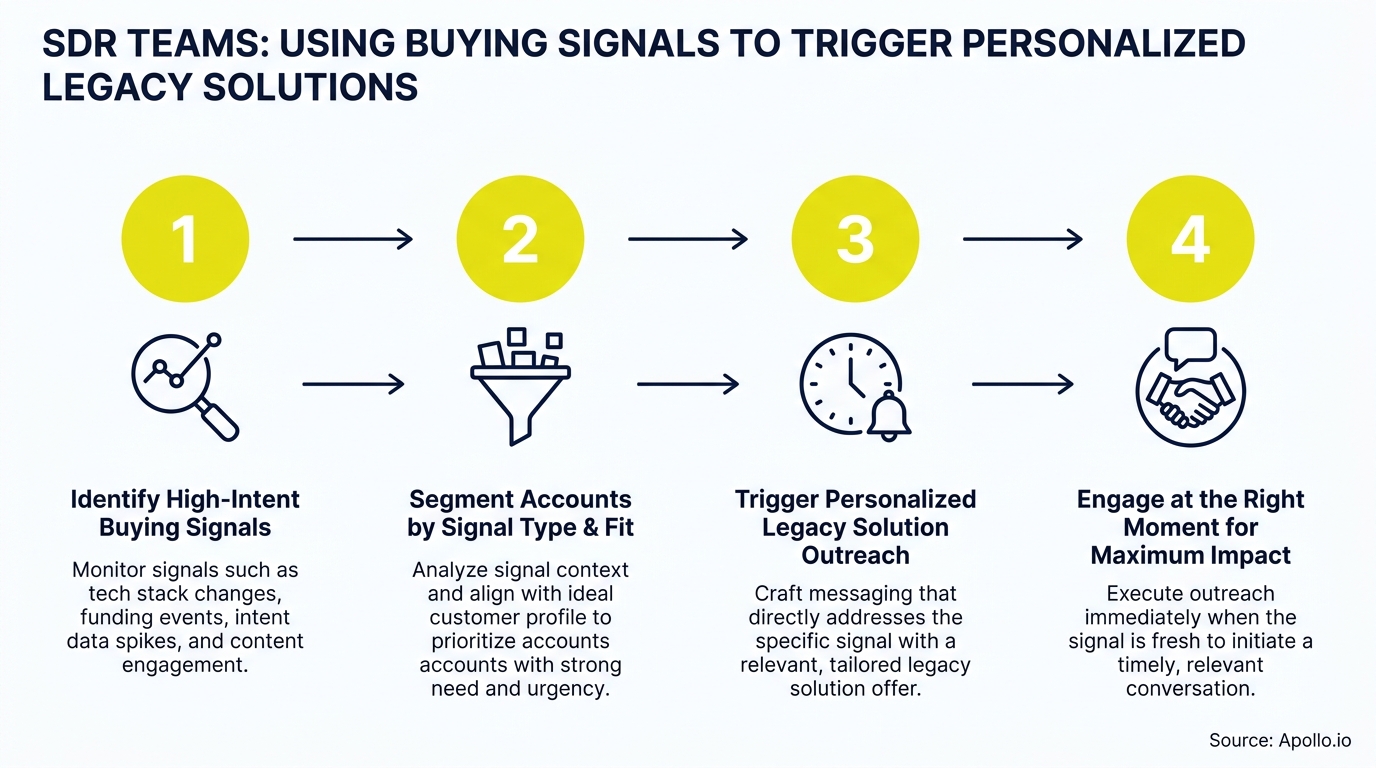
Buying signals are only valuable when paired with a structured playbook. Without one, SDRs drown in noisy intent feeds, fire off generic sequences, and burn the very prospects they were trying to reach. The shift happening in 2026 is from static drip cadences to event-driven, signal-triggered outreach, where the right message fires at the exact moment a prospect shows intent. Understanding how sales automation supports this is the first step to building a repeatable system.

Research Less, Close More With Apollo
Tired of your reps burning hours hunting down contact info that bounces? Apollo delivers verified emails and business numbers so your team spends time selling, not searching. Join 600K+ companies building real pipeline.
Start Free with Apollo →Key Takeaways
- Buying signals require a triage layer before reaching SDRs, or alert fatigue kills adoption.
- Signal-based personalization dramatically outperforms cold outreach in reply rates.
- The "dark funnel" (anonymous research) is now addressable with composite signal bundling.
- Buying groups require persona-based routing, not single-contact sequencing.
- Apollo consolidates signal detection, contact data, and outreach execution in one platform, replacing multiple tools.
What Are Buying Signals and Why Do SDRs Need Them?
Buying signals are behavioral or firmographic events that indicate a prospect or account is actively researching, evaluating, or ready to purchase. SDR teams need them because generic outreach is increasingly penalized: according to SalesHive, 73% of B2B buyers actively avoid irrelevant outreach.
Signals fall into two broad categories:
- Behavioral signals: Pricing-page visits, content downloads, demo requests, keyword intent spikes, job-change alerts, and product usage thresholds.
- Firmographic signals: New funding rounds, executive hires, technology stack changes, and headcount growth.
The critical insight for 2026: a single signal is rarely enough. High-performing SDR teams now use signal bundling, requiring a combination of triggers (e.g., new VP of Sales hire + pricing page visit + category intent spike) before activating outreach. This raises confidence and reduces false positives that waste rep time.
How Do SDRs Build a Signal-to-Play Matrix?
A signal-to-play matrix maps each trigger to a specific, minimum-friction outreach response. It prevents SDRs from over-reaching on weak signals or under-responding to strong ones.
| Signal Type | Confidence Level | Outreach Play | Channel |
|---|---|---|---|
| Pricing page visit (2+ times) | High | Direct, value-focused email + same-day call | Email + Phone |
| Category keyword intent spike | Medium | Educational content offer, no hard pitch | |
| Executive hire (VP Sales/Revenue) | Medium-High | Congratulatory outreach + pain-point hook | Email + Social |
| Funding announcement | Medium | Timely congratulations + growth angle | |
| Demo request / form fill | Very High | Immediate personalized follow-up + meeting link | Email + Phone |
Research from G2 found that one signal-based selling platform enabled a customer to generate 90% of their pipeline from just 25% of leads, while another reported a 60% increase in sales opportunities. The matrix is what makes that selectivity operational.
Spending hours researching accounts before every outreach? Apollo's 65+ filters surface signal-ready prospects instantly, so SDRs act on intent instead of guessing.
How Do SDRs Engage the Dark Funnel Before Buyers Surface?
The dark funnel refers to anonymous research activity that happens before a buyer ever fills out a form or replies to an email. SDR teams can engage this window using first-party and intent data before prospects self-identify.
Practical dark funnel activation plays include:
- Anonymous visitor identification: Use IP-resolution tools to flag companies researching your category, then activate account-level sequences targeting known contacts at those firms.
- Content retargeting triggers: When a target account downloads gated content, trigger a persona-matched sequence within 24 hours.
- Consented first-party signals: Event attendance, interactive assessments, and in-product behavior provide high-confidence triggers without relying on third-party cookies.
The urgency here is real. Intent data shows that most buyers choose a preferred vendor before speaking with any sales rep. SDRs who wait for inbound hand-raisers are entering the conversation too late to influence vendor preference.
Turn Funnel Guesswork Into Pipeline Wins
Tired of watching quality leads stall before they ever become opportunities? Apollo surfaces in-market buyers with precision targeting so your pipeline reflects reality, not wishful thinking. 600K+ companies trust Apollo to fill the funnel right.
Start Free with Apollo →How Do SDRs Orchestrate Outreach Across Buying Groups?
Buying groups require SDRs to route signals to multiple personas simultaneously, not just follow up with one contact. Most B2B purchases involve multiple stakeholders, and a single-threaded sequence leaves deals vulnerable.
Effective buying-group orchestration works like this:
- Champion contact: Receives educational, value-forward content mapped to their functional pain.
- Economic buyer: Receives ROI-focused messaging and business case assets.
- Technical evaluator: Receives integration guides, security documentation, and product depth materials.
- End users: Receive use-case proof points and peer testimonials.
For RevOps leaders building this infrastructure, the routing logic lives in the CRM and sales engagement platform. Apollo's CRM integration and outreach capabilities allow teams to manage multi-stakeholder sequences from a single workspace, eliminating the fragmentation that comes from running prospecting, enrichment, and engagement across separate tools. As Cyera noted, "Having everything in one system was a game changer."

How Do SDRs Use AI to Activate Signals at Scale?
AI enables SDR teams to process signals in real time and personalize outreach at a volume no manual workflow can match. The key architectural principle: signals should flow directly into execution tools, not just dashboards.
A practical AI-enabled signal stack looks like this:
- Signal ingestion: Intent data, CRM events, firmographic triggers, and behavioral data feed into a scoring layer.
- Triage and scoring: AI filters high-confidence signals and suppresses low-confidence noise before creating rep tasks. This is now a mandatory operational layer, as raw intent feeds without scoring lead directly to alert fatigue and rep disengagement.
- Personalized message generation: AI drafts context-aware outreach referencing the specific trigger event.
- Sequence activation: The appropriate play fires automatically across email, phone, and social channels.
Data from SalesEsso confirms campaigns using advanced personalization driven by buying signals can achieve reply rates up to 18%, versus the 5.1% average for generic cold emails. Apollo's AI sales automation handles signal-to-sequence activation in one platform, consolidating what most teams previously managed across three or more separate tools.
How Do SDRs Measure Whether Signal-Based Outreach Actually Works?
Measurement for signal-based outreach must go beyond reply rates to demonstrate revenue uplift. Correlation ("we reached out and they converted") is not the same as uplift ("signal-triggered outreach caused conversion at a higher rate than baseline").
Key metrics SDR teams and RevOps leaders should track:
- Signal-to-meeting rate: What percentage of triggered plays result in a booked meeting?
- Signal-to-pipeline rate: What percentage of triggered accounts enter active pipeline within 30/60/90 days?
- Signal type performance: Which signal categories produce the highest-quality pipeline?
- False-positive rate: What percentage of triggered plays result in no engagement after three touches? Use this to refine your triage layer.
Tracking customer engagement metrics at the signal level, not just the campaign level, is what separates teams that iterate from teams that guess. Run A/B tests by signal type to isolate which triggers genuinely predict purchase intent versus casual browsing.

Start Activating Buying Signals with Apollo
Signal-based outreach works when the data, the play, and the execution live in the same system. Fragmented stacks create latency, and latency kills timing. Apollo consolidates signal detection via built-in buying intent data, verified contact enrichment, and multi-channel sequence execution in one platform. Teams like Predictable Revenue describe it as reducing "the complexity of three tools into one."
SDRs who act on the right signal at the right moment with the right message book more meetings and build better pipeline. The framework is clear: classify your signals, build your plays, triage before activating, orchestrate across the buying group, and measure uplift by signal type.
Ready to put buying signals to work? Start a free trial with Apollo and run your first signal-triggered sequence today.
Prove Pipeline ROI Before Next Quarter
Budget approval stuck on unclear metrics? Apollo delivers measurable pipeline impact so you can justify every dollar — fast. Teams like Built-In saw +10% win rates and +10% ACV after switching.
Start Free with Apollo →Don't miss these
Sales
Inbound vs Outbound Marketing: Which Strategy Wins?
Sales
What Is a Sales Funnel? The Non-Linear Revenue Framework for 2026
Sales
What Is a Go-to-Market Strategy? The 2026 GTM Playbook
See Apollo in action
We'd love to show how Apollo can help you sell better.
By submitting this form, you will receive information, tips, and promotions from Apollo. To learn more, see our Privacy Statement.
4.7/5 based on 9,690 reviews
