
How Do Sales Leaders Evaluate the Total Cost of Ownership of a Sales Engagement Platform?
Most SEP buying decisions fail not because leaders chose the wrong platform, but because they priced the wrong things. License fees are visible. Implementation drag, rep adoption gaps, AI add-on overages, and tool redundancy costs are not. Sales leaders who build a rigorous total cost of ownership (TCO) model before signing close that gap and negotiate from a position of strength. If you're comparing options, start with the Apollo vs. Outreach vs. Salesloft platform comparison to benchmark what each vendor actually includes.

Scale Your Team Without the Chaos
Tired of watching reps burn hours on manual research instead of selling? Apollo standardizes your prospecting playbook across every rep — so your whole team performs like your top closer. Start free today.
Start Free with Apollo →Key Takeaways
- SEP TCO extends well beyond license fees: implementation, integration, training, AI add-ons, and ongoing admin are all real cost lines.
- Platform consolidation is the clearest CFO-friendly savings story: retiring overlapping tools often offsets most or all of the SEP subscription cost.
- Adoption success determines whether ROI materializes. Change management costs must be budgeted, not assumed.
- TCO models are shifting from seat-based pricing to license + AI credits + data consumption, requiring multi-scenario forecasting.
- Sales leaders who tie TCO to measurable revenue outcomes (close rates, meetings booked, pipeline velocity) win CFO approval faster.
What Is SEP TCO and Why Does It Matter in 2026?
Sales engagement platform TCO is the full three-year cost of owning, running, and extracting value from a platform, covering every expense beyond the initial license quote. The license line is typically the smallest part of the true cost envelope. According to G2's 2024 Buyer Behavior Report, 57% of buyers expect positive ROI within three months of purchasing sales software. That expectation only holds if implementation, training, and integration costs are scoped accurately upfront.
TCO matters more than ever because AI-driven packaging has added new line items: seat licenses now sit alongside credit pools, AI assistant add-ons, and consumption-based data fees. Sales leaders who model only the base subscription routinely face budget surprises at renewal.
What Are the Five Core SEP TCO Cost Buckets?
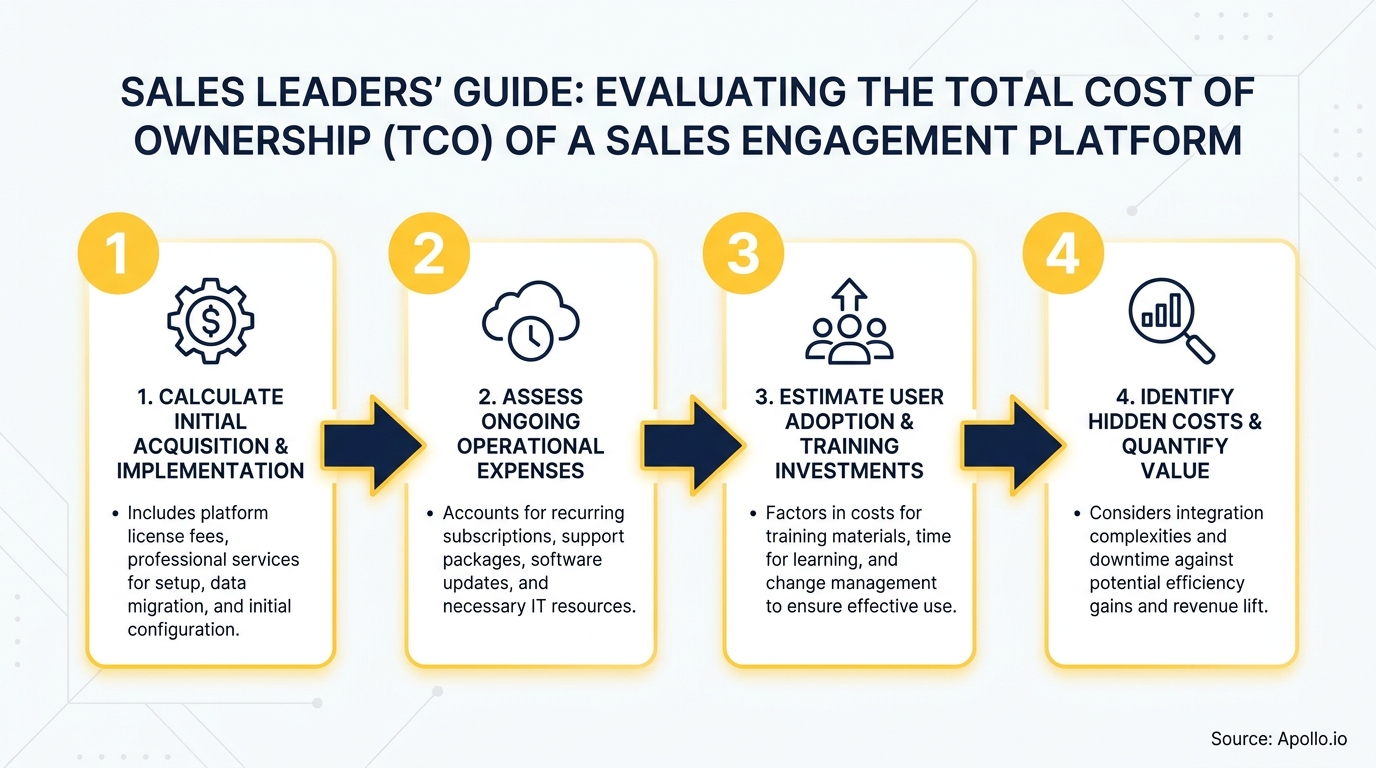
A rigorous SEP TCO framework separates costs into five buckets across a three-year horizon. This structure maps directly to how CFOs and procurement teams evaluate software investments.
| Cost Bucket | What to Include | Common Oversight |
|---|---|---|
| 1. Subscription & Licensing | Per-seat fees, AI add-ons, credit pools, data packages | Annual uplift clauses, overage rates |
| 2. Implementation & Integration | Professional services, CRM sync setup, API work, migration | Internal engineering hours often excluded |
| 3. Enablement & Change Management | Rep onboarding, admin training, workflow redesign, ongoing coaching | Productivity drag during ramp period |
| 4. RevOps & Ongoing Admin | Sequence governance, CRM hygiene, reporting maintenance | Treated as absorbed cost, rarely budgeted |
| 5. Tool Displacement Savings | Retired subscriptions (dialer, enrichment, conversation intelligence) | Often the largest positive line item, frequently omitted |
Research from Everstage shows automation has helped top-performing B2B sales organizations free up approximately 20% of sellers' capacity and improve productivity by up to 30%. Quantifying that reclaimed capacity in dollar terms is how sales leaders translate TCO into a CFO-ready ROI case.
Spending too much time managing disconnected tools? See how Apollo's AI sales automation consolidates your tech stack into one workspace.

How Do RevOps Leaders Model Adoption and Change Management Costs?
RevOps leaders treat adoption costs as a hard budget line, not a soft assumption. A platform that sits unused for 60 days post-launch delivers zero ROI while the license meter runs. Trykondo's B2B Sales Report found that 66% of reps feel overwhelmed by the number of tools, and 94% of sales organizations planned to consolidate their tech stack. Overwhelmed reps don't adopt new platforms fully, which means adoption risk must be risk-adjusted in any TCO model.
Key adoption cost inputs to model:
- Ramp time: Estimate weeks to full productivity per rep, multiplied by average quota value per week.
- Training hours: Initial onboarding plus ongoing coaching sessions, priced at loaded labor cost.
- Admin governance: Sequence management, permission structures, and CRM hygiene hours per month.
- Workflow redesign: Any SDR or AE process changes required to use the platform effectively.
Platforms that reduce tool complexity accelerate adoption. As Predictable Revenue found after switching to Apollo: "We reduced the complexity of three tools into one." Read the full Predictable Revenue cost reduction story for a real-world consolidation model.
Turn Funnel Guesswork Into Real Pipeline
Pipeline forecasting a guessing game? Apollo surfaces high-intent leads and tracks deal momentum in real time. Nearly 100K paying customers stopped flying blind — and started hitting quota.
Schedule a Demo →How Does Stack Consolidation Affect SEP TCO?
Stack consolidation is the single largest TCO lever available to most sales teams. The savings line comes from retiring tools the SEP replaces: standalone dialers, separate data enrichment subscriptions, conversation intelligence platforms, and basic sequencing tools. According to SuperAGI, companies using SEPs with robust analytics and reporting capabilities report an average increase of 25% in sales productivity and a 15% increase in revenue growth.
To build the consolidation math:
- List every tool the SEP overlaps with (enrichment, dialer, sequences, analytics, meeting scheduling).
- Sum the annual cost of those displaced tools.
- Subtract migration and re-enablement costs.
- Net savings = displaced tool spend minus transition costs.
Census ran this math and found: "We cut our costs in half." Cyera reached the same conclusion: "Having everything in one system was a game changer." For sales leaders building a scalable sales tech stack, consolidation is both the strongest ROI argument and the clearest budget justification.
How Should Sales Leaders Frame TCO for CFO Approval?
CFOs approve SEP investments when the model connects platform cost to revenue outcomes, not just productivity gains. The most effective framing ties three inputs together: reclaimed selling time, conversion rate improvement, and tool retirement savings.
A practical CFO-ready TCO summary includes:
- Baseline: Current state cost (existing tools + admin burden + lost selling time)
- Investment: Full 3-year TCO across all five cost buckets
- Return: Pipeline generated from reclaimed capacity + revenue lift from improved conversion + tool displacement savings
- Payback period: Month when cumulative return crosses cumulative cost
- Risk adjustment: Apply a 20-30% discount to projected benefits to account for partial adoption scenarios
For sales leaders managing team performance and quota attainment, anchoring the TCO case in measurable outcomes (meetings booked, opportunities created, close rate) makes the investment defensible at the board level. A Forrester analysis found that 36% of first-line sales managers and directors believe streamlining sales processes will significantly impact their ability to achieve or exceed sales quotas.
Struggling to show pipeline ROI from your current outreach tools? Explore Apollo's multi-channel sales engagement platform and see how unified prospecting, sequencing, and analytics change the TCO equation.
How Does Apollo Simplify SEP TCO for B2B GTM Teams?
Apollo reduces SEP TCO by consolidating prospecting, sequencing, dialing, enrichment, and analytics into a single platform. Instead of budgeting for five separate tools with five renewal cycles, RevOps teams manage one contract and one integration layer. Per Apollo's official pricing page, plans start at $0 (Free), with paid tiers at $49 (Basic), $79 (Professional), and $119/user/month (Organization, min 3 users), all billed annually. Choosing annual billing saves 20% compared to monthly.
| Plan | Price (Annual) | Credits/User/Year |
|---|---|---|
| Free | $0 | 900 |
| Basic | $49/user/mo | 30,000 |
| Professional | $79/user/mo | 48,000 |
| Organization | $119/user/mo | 72,000 |
SDRs and AEs get prospecting, multi-channel sequences, and call intelligence in one workspace. RevOps gets a single source of truth for pipeline data. Enterprise teams on the Organization tier get advanced routing, governance, and security controls. Apollo serves B2B GTM teams from early-stage through enterprise, making it a viable TCO optimization play at every scale. Explore Apollo's enterprise sales solutions for larger team configurations.
How Do Sales Leaders Build a TCO Procurement Checklist?
A structured procurement checklist prevents TCO surprises at renewal and keeps evaluations objective. Use this as a pre-signature gate for any SEP decision.
- Have all five cost buckets been modeled for years 1, 2, and 3?
- Are AI add-on costs and credit consumption rates confirmed in writing?
- Is annual uplift capped in the contract?
- Has tool displacement savings been netted against transition costs?
- Is there a defined pilot success metric before full rollout?
- Has adoption/ramp productivity drag been included in the ROI model?
- Are CRM integration costs (engineering hours + maintenance) budgeted?
- Is there a true-down or seat flexibility clause for headcount changes?
For teams building or optimizing their outbound motion, the Apollo sequence-building guide shows how to operationalize the platform quickly, shortening the ramp period that inflates early-stage TCO.

Make Your Next SEP Decision a TCO Decision
The leaders who win CFO approval and see real ROI from their sales engagement platform share one habit: they model the full cost picture before signing, not after. That means five cost buckets, a three-year horizon, risk-adjusted returns, and a clear consolidation savings line.
Platforms that consolidate more capability into fewer contracts give teams a structural TCO advantage from day one.
Apollo gives nearly 100,000 paying customers a single platform for prospecting, engagement, enrichment, and analytics, replacing the fragmented stacks that inflate TCO and slow adoption. Schedule a Demo and see how Apollo changes your TCO math.
Prove ROI Before the Next Budget Call
ROI pressure killing your tool adoption? Apollo delivers measurable pipeline impact from day one — so your next budget conversation leads with wins, not guesses. Leadium 3x'd their revenue. You're next.
Start Free with Apollo →Don't miss these
Sales
Inbound vs Outbound Marketing: Which Strategy Wins?
Sales
What Is a Sales Funnel? The Non-Linear Revenue Framework for 2026
Sales
What Is a Go-to-Market Strategy? The 2026 GTM Playbook
See Apollo in action
We'd love to show how Apollo can help you sell better.
By submitting this form, you will receive information, tips, and promotions from Apollo. To learn more, see our Privacy Statement.
4.7/5 based on 9,690 reviews
