
How Do RevOps Teams Calculate the Cost Per Verified Contact from Different Data Providers?
Your CRM says you bought 10,000 contacts. Your deliverability data says you actually received 6,500 usable ones. That gap is where budget disappears silently. RevOps leaders increasingly track Cost per Verified Contact (CPVC) as their primary unit-cost metric for data provider decisions, and the teams getting this right are spending less while generating more pipeline. Contact data enrichment ROI starts with knowing what you're actually paying per usable record.
According to Datamaticsbpm, poor data quality costs U.S. businesses an estimated $3.1 trillion annually. The CPVC framework turns that abstract cost into a provider-by-provider number your finance team can act on.

Research Less, Pipeline More With Apollo
Tired of burning hours verifying contact info instead of closing deals? Apollo delivers 230M+ verified contacts so your team sells from day one. Join 600K+ companies building pipeline on autopilot.
Start Free with Apollo →Key Takeaways
- CPVC includes provider fees, enrichment costs, ops labor, and MAP/CRM tier costs — not just the vendor's list price.
- Only contacts that pass all verification gates count in the denominator, making the verification pass rate a critical cost driver.
- Hidden MAP/CRM costs from loading unverified contacts can make a cheap provider more expensive than a premium one.
- Waterfall enrichment across multiple providers lowers blended CPVC by routing lookups to cheaper sources first.
- RevOps leaders in 2026 are reporting a Data Integrity Score to their CRO alongside pipeline metrics, making CPVC a board-level concern.
What Is Cost Per Verified Contact (CPVC)?
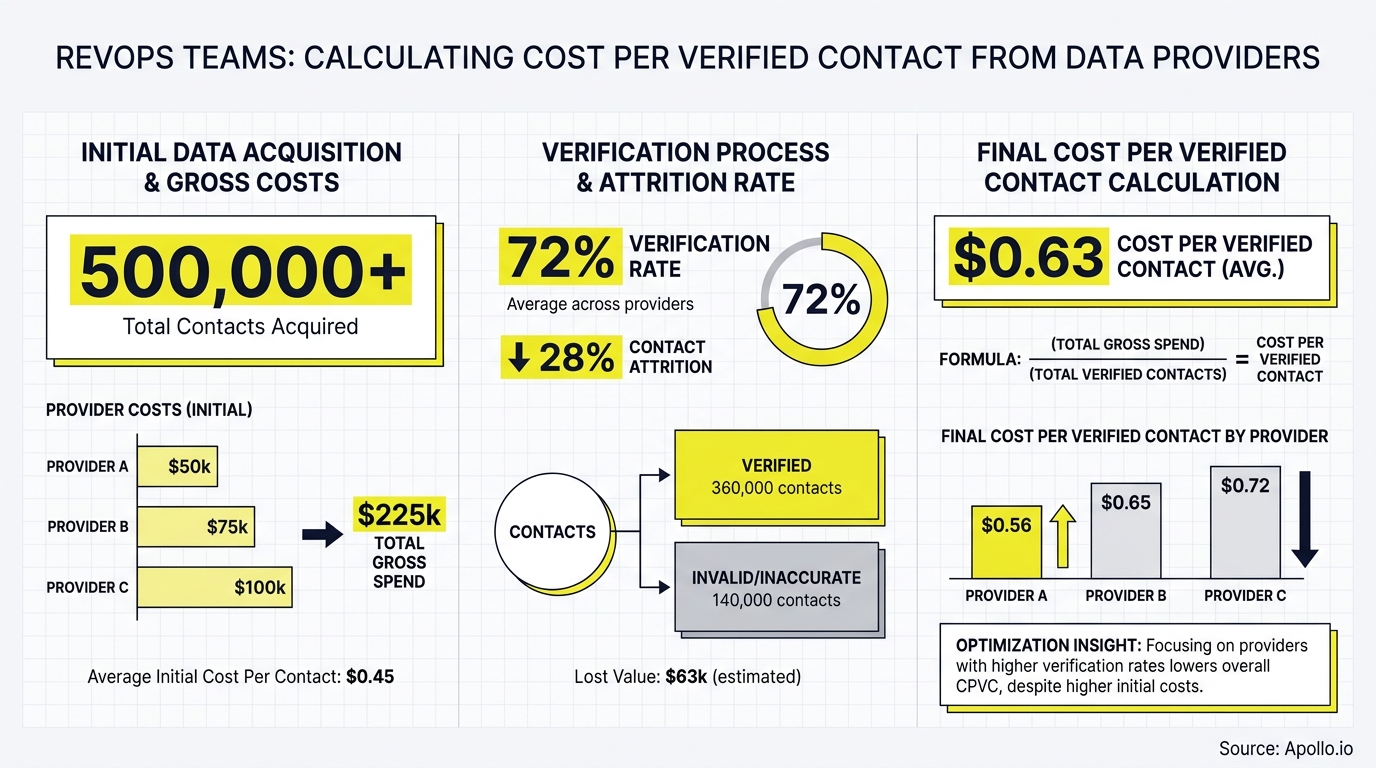
CPVC is the total all-in cost to produce one contact that passes your team's verification and usability standards. The formula is straightforward:
CPVC = (Provider Fees + Enrichment/Verification Fees + Ops Labor + Downstream System Costs) ÷ Number of Contacts That Pass All Verification Gates
The critical word is verified. A contact that bounces, fails an ICP-fit check, or triggers a compliance flag does not count in the denominator. This distinction separates CPVC from simple cost-per-record calculations that providers quote on their pricing pages.
In 2026, leading RevOps teams are reporting a "Data Integrity Score" to their CRO alongside pipeline metrics, according to Landbase. CPVC is the unit-economics foundation beneath that score.
What Are the Four CPVC Cost Components RevOps Must Include?
Most RevOps teams undercount CPVC because they only track the provider invoice. Four cost buckets belong in every calculation.
| Cost Component | What to Measure | Common Miss |
|---|---|---|
| Provider Fees | Seat licenses + credit costs + overage charges | Counting list price only, ignoring per-action credit burn |
| Enrichment & Verification | Verification tool fees + re-verification cycles | One-time verification cost, ignoring data decay re-runs |
| Ops Labor | RevOps/MOps hours for list hygiene, suppression, routing | Treating internal labor as "free overhead" |
| MAP/CRM Tier Costs | Cost of contact tiers created by loading unverified records | Not counting the cost of bad contacts in the marketing database |
The MAP/CRM component is the most commonly missed. Loading unverified contacts into your marketing platform inflates your contact tier and monthly bill.
Teams that gate contacts through verification before promoting them to "marketing contact" status keep their platform costs controlled and their CPVC lower.
Tired of paying for contacts that never convert? Start free with Apollo's verified B2B contact database and know exactly what you're getting before you pay.

How Do RevOps Teams Define a "Verified" Contact?
A verified contact is one that passes every gate in your team's multi-step verification framework, not just a syntax check. Modern RevOps teams use a four-gate model.
- Gate 1 — Deliverability: Email is syntactically valid and passes a verification tool check. Contacts that fail this gate never enter the denominator.
- Gate 2 — ICP Fit: Contact matches firmographic and role criteria (industry, company size, seniority, department). A valid email at the wrong company is still waste.
- Gate 3 — Compliance/Provenance: Contact record has documented sourcing, opt-out suppression applied, and regional regulatory requirements met. Provenance requirements add real process cost to CPVC.
- Gate 4 — Engagement Risk: Contact is not on a suppression list and shows no prior hard bounce or spam complaint history. This gate protects sender reputation.
A research report from MarketingOps.com found that bad data leads to inefficient pipeline management for 48% of professionals. Running all four gates before a contact reaches the denominator directly addresses this failure mode.
Understanding what data enrichment is and how it works helps RevOps teams build verification gates that catch failures before they hit the CRM.
Turn Funnel Guesswork Into Pipeline Clarity
Tired of watching marketing leads stall before they ever reach your pipeline? Apollo surfaces high-intent prospects so your team works deals that actually close. Nearly 100K paying customers stopped guessing and started growing.
Start Free with Apollo →How Do RevOps Leaders Compare CPVC Across Data Providers?
RevOps leaders normalize CPVC across providers by applying the same verification gates to each provider's output and calculating blended cost using a consistent ledger template.
| Provider Scenario | Raw Contacts Purchased | Verification Pass Rate | Verified Contacts | All-In Cost | CPVC |
|---|---|---|---|---|---|
| Provider A (high volume, lower cost) | 10,000 | 60% | 6,000 | $3,000 | $0.50 |
| Provider B (curated, higher cost) | 5,000 | 90% | 4,500 | $3,500 | $0.78 |
| Waterfall (A then B) | 10,000 | 80% blended | 8,000 | $4,200 | $0.53 |
The waterfall scenario illustrates why RevOps teams are adopting multi-source enrichment strategies. By routing lookups through a lower-cost provider first and escalating to premium sources only on failure, teams improve both yield and blended CPVC. This approach also surfaces the true cost differential between providers that list pricing hides. Learn more about building a data enrichment strategy that accounts for provider mix and verification rates.
How Does Waterfall Enrichment Lower Blended CPVC?
Waterfall enrichment lowers blended CPVC by routing contact lookups sequentially through multiple sources, paying premium provider rates only when cheaper sources cannot fulfill a record. Instead of committing full budget to one monolithic database, RevOps builds a stepwise cascade: Provider A attempts the lookup, passes on failure to Provider B, and so on until a verified result is returned or the record is flagged as unresolvable.
The blended CPVC formula for a waterfall is: total spend across all provider steps ÷ contacts that passed verification at any step. This rewards high fill-rate providers with more lookups and automatically limits spend on low-quality sources. Apollo's waterfall enrichment automates this routing logic, so RevOps teams capture the cost benefit without manual orchestration.
What CPVC Benchmarks Should RevOps Teams Use in 2026?
CPVC benchmarks vary by segment, channel, and verification standard, so RevOps teams should build internal baselines before comparing externally. The most reliable governance approach is tracking three metrics alongside CPVC.
- Verification Pass Rate: The percentage of purchased contacts that clear all four gates. This is the primary quality signal for any provider.
- Data Decay Rate: How quickly contacts go stale and require re-verification. A low first-purchase CPVC combined with a high decay rate produces a high lifetime CPVC.
- Credit Burn Efficiency: For credit-based providers, the effective cost per verified contact by workflow type (bulk list build vs. on-demand enrichment). This reveals where credit spend is producing returns.
Research from Upcell shows that individual organizations lose an average of $12.9 million to $15 million per year due to poor data quality. Tracking CPVC by provider and setting re-verification SLAs turns that aggregate loss into a controllable line item. Explore which data enrichment tools drive revenue in 2026 to benchmark your current stack.
Paying for contacts you can't use? Apollo's enrichment platform verifies contacts at 97% email accuracy so your verified denominator stays high.
How Do RevOps Professionals Govern CPVC Across Teams?
RevOps professionals govern CPVC by establishing shared verification standards, suppression SLAs, and cross-functional ownership between marketing ops, sales ops, and IT. Without governance, each team applies different pass/fail gates, making provider comparisons meaningless and CPVC metrics inconsistent.
A practical CPVC governance model includes three elements:
- Verification SLA: Define the maximum time from contact acquisition to verification completion. Contacts that age past the SLA require re-verification before use.
- Suppression Cadence: Schedule regular suppression list updates to catch opt-outs, role changes, and domain shutdowns that invalidate previously verified contacts.
- Provider Scorecard: Review each provider's CPVC, pass rate, and decay rate quarterly. Reallocate budget toward providers with improving CPVC trends.
Sales leaders and RevOps managers who align on these standards find that CPVC becomes a reliable input to revenue operations planning rather than a post-mortem metric. For SDRs and BDRs, this governance means the contact lists they work are pre-screened, reducing time spent on dead records and increasing meeting conversion rates.

How Does Apollo Help RevOps Teams Reduce CPVC?
Apollo reduces CPVC by consolidating prospecting, enrichment, verification, and engagement into one platform, eliminating the tool sprawl that inflates ops labor costs. With 230M+ verified contacts, 97% email accuracy, and built-in waterfall enrichment, RevOps teams get a higher verification pass rate without paying for separate verification tools on top of a data provider subscription.
Apollo's data sync capabilities also prevent the duplicate-contact and stale-record problems that inflate MAP/CRM tier costs. Trusted by nearly 100,000 paying customers including Anthropic, Smartling, and Redis, Apollo gives GTM teams from startups through enterprise a single workspace for contact discovery, enrichment, and outreach.
See Apollo's full plan options at apollo.io/pricing, starting with a free tier that lets RevOps teams validate data quality before committing budget.
Ready to lower your CPVC with a unified GTM platform? Request a Demo and see how Apollo consolidates your data stack into one workspace.
Prove Pipeline ROI With Apollo
ROI pressure killing your tool budget approval? Apollo delivers measurable pipeline impact from day one — so you walk into every budget conversation with numbers, not guesses. Leadium 3x'd their revenue. You're next.
Start Free with Apollo →Don't miss these
Sales
Inbound vs Outbound Marketing: Which Strategy Wins?
Sales
What Is a Sales Funnel? The Non-Linear Revenue Framework for 2026
Sales
What Is a Go-to-Market Strategy? The 2026 GTM Playbook
See Apollo in action
We'd love to show how Apollo can help you sell better.
By submitting this form, you will receive information, tips, and promotions from Apollo. To learn more, see our Privacy Statement.
4.7/5 based on 9,690 reviews
