
How RevOps Teams Build a Data Enrichment Workflow for CRM Accuracy
Poor CRM data is a silent revenue killer. A 2025 study by Validity and Teamgate found that 37% of CRM users reported losing revenue as a direct consequence of poor data quality. For RevOps teams, building a structured data enrichment workflow is the difference between a CRM that drives pipeline and one that creates noise.

Research Less, Pipeline More With Apollo
Tired of burning hours verifying contacts that go nowhere? Apollo delivers accurate business data so your reps spend time selling, not searching. Join 600K+ companies building predictable pipeline from day one.
Start Free with Apollo →Key Takeaways
- Nearly 4 in 10 CRM users have lost revenue directly due to poor data quality — enrichment workflows are a revenue imperative, not an admin task.
- Effective RevOps enrichment treats CRM data as a continuous supply chain: inputs, validation, enrichment, identity resolution, and publish-back.
- Governance rules (overwrite logic, survivorship, SLAs) prevent enrichment from creating new data problems.
- AI readiness now requires auditable data lineage and field-level provenance — not just complete records.
- Apollo consolidates prospecting, enrichment, and CRM sync into one platform, replacing multiple point tools.
Why Do RevOps Teams Struggle to Keep CRM Records Accurate?
CRM records degrade continuously because contacts change jobs, companies merge, and inbound data arrives incomplete. According to a 2025 report from Revenue Wizards based on 180 professionals across 28 countries, five times more respondents rate their data quality as poor versus excellent. The core problems RevOps teams face fall into predictable categories:
- Incomplete records: Missing job titles, phone numbers, or company size fields that block routing and segmentation.
- Duplicate contacts: Multiple records for the same person inflate pipeline counts and confuse attribution.
- Expired data: Job-change drift means titles and emails decay within months of entry.
- Incorrect data: Form typos and self-reported errors that never get validated on the way in.
Each of these issues compounds over time. Without a systematic workflow, manual cleanup cycles can't keep pace with the volume of new records entering the CRM.
What Does a CRM Data Enrichment Workflow Actually Look Like?
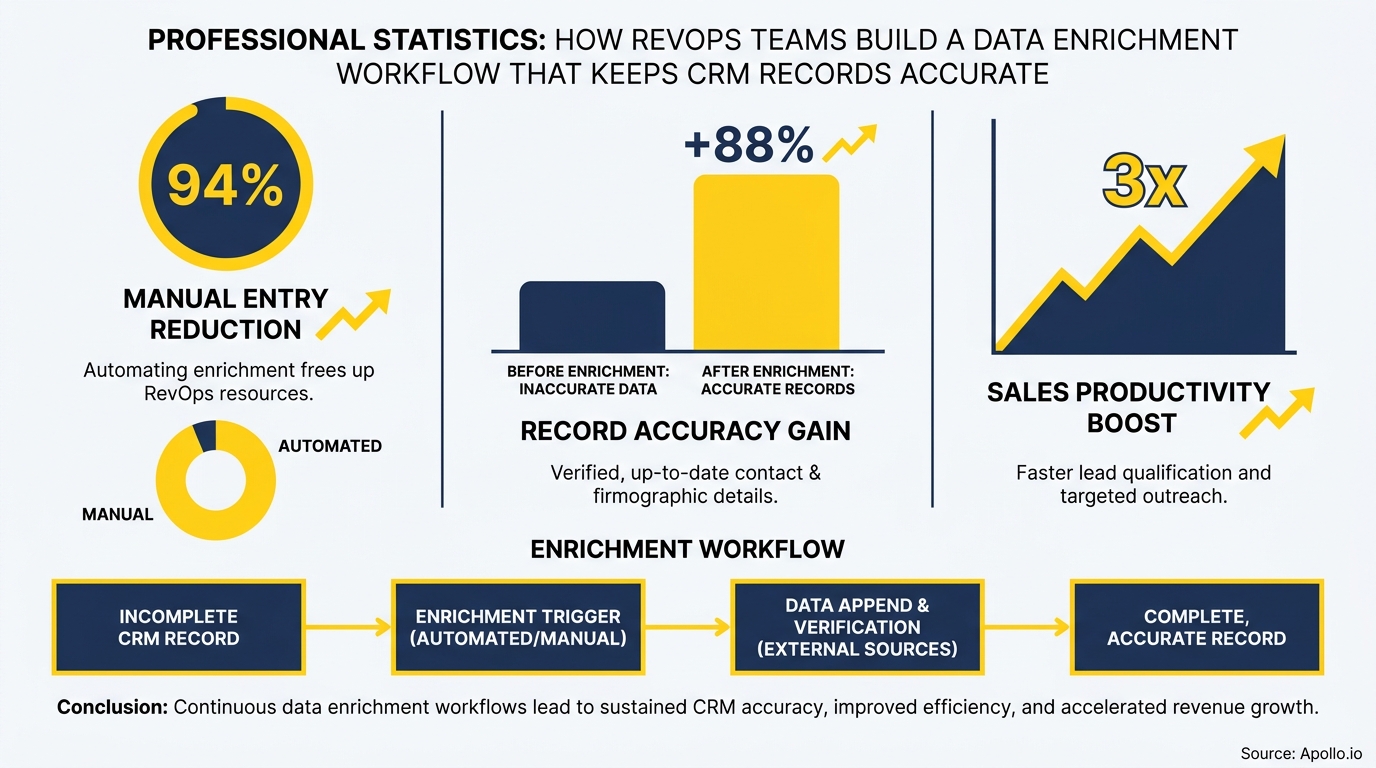
A RevOps enrichment workflow is a structured data supply chain with five sequential stages: Inputs → Validation → Enrichment → Identity Resolution → Publish-Back. Each stage has a defined purpose and quality gate.
| Stage | What Happens | Key Action |
|---|---|---|
| Inputs | New records enter via forms, imports, or prospecting tools | Capture source metadata and timestamp |
| Validation | Email format checks, domain verification, required field flags | Reject or quarantine invalid records |
| Enrichment | Append missing firmographics, titles, phone numbers from verified sources | Apply waterfall enrichment across multiple providers |
| Identity Resolution | Match and merge duplicate records using deterministic rules | Apply survivorship logic to keep the best field values |
| Publish-Back | Write verified, enriched data back to CRM fields | Log provenance (source + timestamp) per field |
Waterfall enrichment — sequencing multiple data sources and accepting the first confident match — is becoming the standard approach. It improves match rates and reduces blind spots that any single provider has on titles, employment status, and firmographics. Learn more about how to do data enrichment the right way for a deeper breakdown of each stage.
Tired of stale CRM records hurting your outreach? Start enriching with Apollo's 230M+ verified business contacts.

How Do RevOps Leaders Set Up Governance and Quality Gates?
Governance rules prevent enrichment from creating new data problems. Without explicit overwrite logic and ownership assignments, automated enrichment can corrupt high-quality first-party data with lower-confidence third-party values.
Core governance decisions every RevOps team needs to document:
- Overwrite rules: Never overwrite a manually entered field unless the incoming confidence score exceeds a defined threshold. First-party form data takes precedence.
- Survivorship logic: When merging duplicates, define which record's fields win (typically: most recent, most complete, or highest-confidence source).
- Data ownership: Assign a named owner per data domain (e.g., RevOps owns firmographic fields; marketing ops owns email consent status).
- SLAs for freshness: Define how often key fields must be re-verified (e.g., job titles refreshed every 90 days, emails verified on every outbound send).
- Exception queues: Route records that fail validation to a review queue rather than silently dropping or passing them through.
Research from Konnectify shows that organizations with acceptable data quality are 50% more likely to use automatically integrated platforms and 60% more likely to implement custom solutions — a strong signal that governance unlocks automation investment.
How Do RevOps Teams Make Their CRM Data AI-Ready?
AI-ready CRM data requires more than complete fields — it requires auditable lineage, consent documentation, and continuous monitoring. As CRM platforms tie AI agents to unified customer data, RevOps teams must prove data freshness and accuracy before activating AI-driven workflows.
Salesforce's acquisition of Informatica in 2025 signals that platform-level data governance is becoming a prerequisite for AI-driven selling — not a nice-to-have hygiene task. For RevOps teams, this means building three additional layers into your enrichment workflow:
- Field-level lineage: Store the source and timestamp for every enriched value. This enables audits and supports internal trust when pipeline reports are questioned.
- Consent and usage constraints: Tag records with consent status and restrict which enriched fields can be used in specific activation contexts (e.g., outbound vs. paid audiences).
- Continuous monitoring: Track enrichment match rates, field fill rates, and bounce rates on a dashboard. Declining match rates signal vendor drift or data decay — both require action before they affect AI model outputs.
For SDRs and AEs, AI-ready data means sequences and scoring models are working from current information — not six-month-old titles and bouncing emails. Explore job change alerts and data enrichment to keep contact records current automatically.
Turn Funnel Guesswork Into Pipeline Clarity
Tired of watching marketing leads stall before they ever reach your pipeline? Apollo surfaces high-intent prospects and arms your team with the signals to act fast. 600K+ companies stopped guessing and started closing.
Start Free with Apollo →How Should RevOps Measure Enrichment Workflow Success?
Enrichment workflow success is measured by field-level accuracy rates, duplicate reduction, and downstream revenue impact — not by the volume of records enriched. Track these KPIs on a recurring cadence:
| KPI | What It Measures | Target Benchmark |
|---|---|---|
| Field Fill Rate | % of required fields populated per record | >90% for ICP fields |
| Email Bounce Rate | % of outbound emails hard-bouncing | <2% for enriched lists |
| Duplicate Rate | % of contacts with duplicate records | <3% of total database |
| Enrichment Match Rate | % of records successfully enriched per run | Track trend over time; declining = vendor issue |
| Routing Accuracy | % of leads routed to correct owner on first attempt | >95% |
Better measurement also reduces attribution disputes. When RevOps leaders can prove which records are enriched, verified, and deduplicated, pipeline and revenue reporting becomes more reliable. This directly addresses the trust gap many revenue teams face when leadership questions forecast accuracy. For a deeper look at the ROI side, see how contact data enrichment drives ROI.
How Does Apollo Help RevOps Teams Build This Workflow?
Apollo consolidates the enrichment workflow, CRM sync, and prospecting into one unified platform — replacing the fragmented stack of point tools most RevOps teams currently manage. Instead of stitching together a separate enrichment vendor, a dedupe tool, a verification service, and a CRM integration layer, Apollo handles each stage in a single workspace.
- 230M+ verified business contacts with 97% email accuracy as the enrichment source
- Waterfall enrichment via Apollo's enrichment engine that sequences multiple data sources for higher match rates
- Native CRM integrations with Salesforce and HubSpot for bidirectional data sync — see how to connect Apollo with your CRM
- 65+ filters for segmentation and routing logic built directly into prospecting workflows
- Job change alerts that automatically flag and update contacts who have moved roles
As Cyera noted after consolidating their GTM stack: "Having everything in one system was a game changer." RevOps leaders find that fewer integrations to maintain also means fewer failure points in the enrichment pipeline.

How Do You Get Started Building a CRM Enrichment Workflow in 2026?
Start with a data audit before building any automation. Identify your highest-decay fields (job title, direct phone, email), your primary record sources, and your current duplicate rate.
Then sequence the workflow stages outlined above — validation before enrichment, identity resolution before publish-back.
A practical starting checklist for RevOps teams:
- Audit current field fill rates for your top 10 ICP fields
- Define overwrite rules and survivorship logic in writing before activating any enrichment tool
- Set up a waterfall enrichment sequence with at least two data sources
- Assign a data owner for each field domain and document SLAs for freshness
- Build a monitoring dashboard tracking the five KPIs listed above
- Schedule a quarterly enrichment review to catch vendor drift and decay trends early
Building a data enrichment strategy from the ground up is faster when your enrichment source, CRM integration, and engagement tools live in the same platform. Apollo gives RevOps teams the verified data, automation, and CRM connectivity to run this workflow without managing five separate vendors.
Ready to clean up your CRM and keep it accurate? Schedule a Demo and see how Apollo consolidates enrichment, prospecting, and CRM sync into one workspace.
Prove Pipeline ROI With Apollo
ROI pressure making every tool renewal a battle? Apollo delivers measurable pipeline impact your leadership can see from day one. Leadium 3x'd their revenue — your CFO conversation just got easier.
Start Free with Apollo →Don't miss these
Sales
Inbound vs Outbound Marketing: Which Strategy Wins?
Sales
What Is a Sales Funnel? The Non-Linear Revenue Framework for 2026
Sales
What Is a Go-to-Market Strategy? The 2026 GTM Playbook
See Apollo in action
We'd love to show how Apollo can help you sell better.
By submitting this form, you will receive information, tips, and promotions from Apollo. To learn more, see our Privacy Statement.
4.7/5 based on 9,690 reviews
