
How RevOps Leaders Decide Which GTM Workflows to Automate with AI Agents
AI agents are reshaping how GTM teams operate, but not every workflow is ready for autonomous execution. RevOps leaders face a critical judgment call: automate too little and leave pipeline on the table; automate too much and risk costly errors in customer-facing or financial processes.
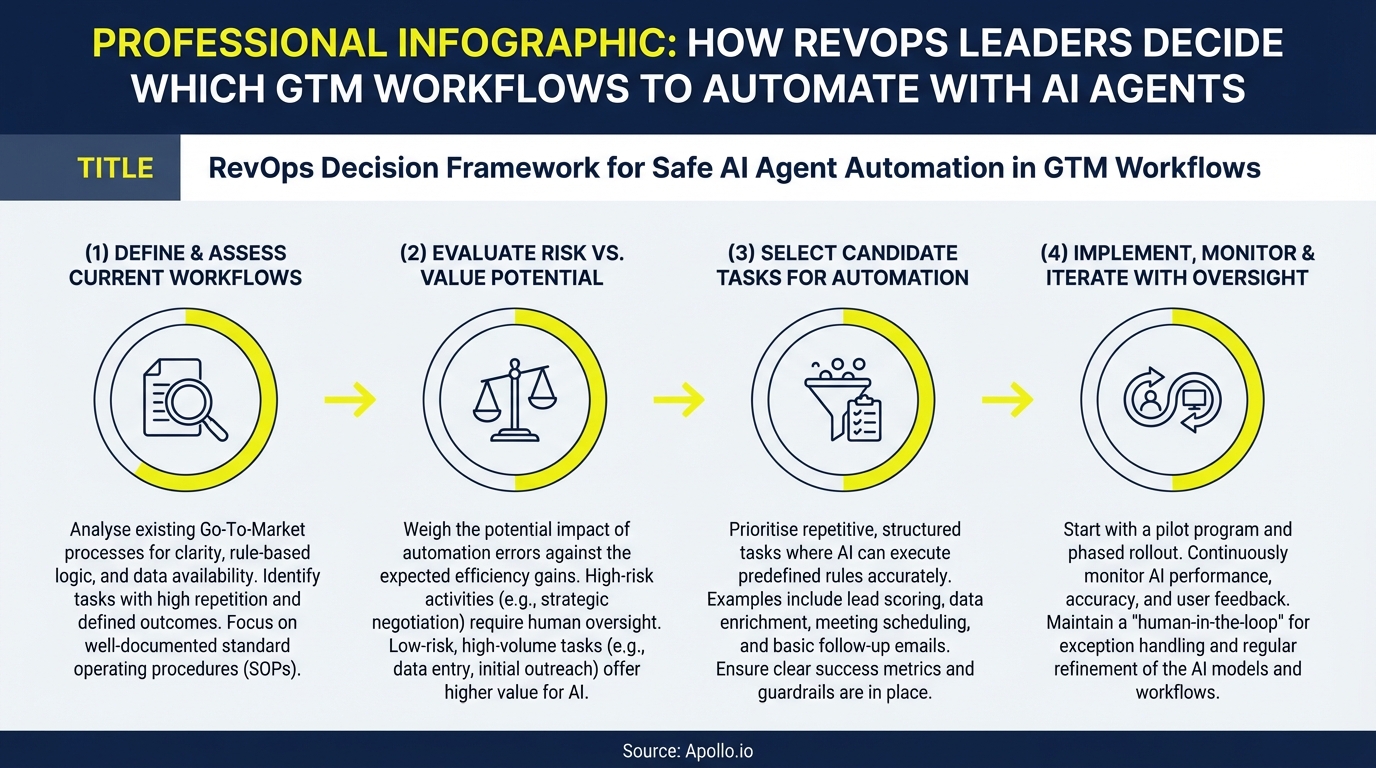
The answer lies in a governed, staged approach grounded in risk tiers, data trust, and explicit controls.
If you're building or refining your sales transformation strategy, this framework gives you a practical decision model for which GTM workflows are safe to hand to AI agents today, and which still need a human in the loop.

Apollo Turns Research Hours Into Revenue
Tired of your reps burning half their day verifying contact info instead of closing deals? Apollo delivers 230M+ accurate business contacts instantly, so your team spends time selling. Start building real pipeline today.
Start Free with Apollo →Key Takeaways
- RevOps leaders evaluate GTM workflows by blast radius, data trust, and reversibility before greenlighting AI agents.
- Governance maturity is the strongest predictor of how far an organization can safely automate, not just technology readiness.
- The Autonomy Ladder maps four stages: Draft, Recommend, Execute with Approval, and Autonomous, each with clear go/no-go criteria.
- CRM-write workflows (lead routing, pricing approvals) require human checkpoints until data quality and audit controls are verified.
- Human-in-the-loop is not a compromise; it is a risk-control mechanism that protects pipeline integrity while automation scales.
What Makes a GTM Workflow Safe to Automate?
A GTM workflow is safe to automate when it is high-volume, rule-based, reversible, and does not trigger customer-facing financial commitments without a human review step. Three criteria define the boundary:
- Blast radius: What breaks if the agent makes an error? Low blast radius (enriching a contact record) is safer than high blast radius (sending a pricing quote).
- Data trust: Is the underlying CRM data clean enough to drive autonomous decisions? Routing and forecasting workflows require verified, structured inputs.
- Reversibility: Can a human undo the action quickly? CRM-read actions are almost always reversible; CRM-write actions that trigger downstream commitments often are not.
According to Demand Gen Report, Gartner predicts that by 2028, AI agents will execute 75% of RevOps tasks across workflow management, data stewardship, revenue analytics, and RevTech administration. The path there runs through governance, not speed.
How Do RevOps Leaders Use the Autonomy Ladder?
The Autonomy Ladder is a four-stage framework that maps each GTM workflow to its current readiness for AI execution. RevOps leaders move workflows up the ladder as governance controls, data quality, and audit mechanisms mature.
| Stage | AI Role | Human Role | Example GTM Workflow |
|---|---|---|---|
| 1. Draft | Generates output for review | Approves before any action | Email copy, call summaries |
| 2. Recommend | Scores and ranks options | Selects from recommendations | Lead scoring, territory assignment |
| 3. Execute with Approval | Executes after human sign-off | Reviews and approves gate | Lead routing, renewal triggers |
| 4. Autonomous | Acts end-to-end with monitoring | Monitors exceptions only | Contact enrichment, meeting scheduling |
Workflows reach Stage 4 only when audit logs, rollback mechanisms, and least-privilege access controls are fully operational. Highspot notes that a dedicated framework is crucial to guide AI tool use from day one, a principle that applies directly to how RevOps stages automation rollouts.
Why Does Governance Maturity Determine Which Workflows Are Greenlit?
Governance maturity is the go/no-go gate for safe GTM automation because it determines whether the organization has the controls, accountability structures, and rollback mechanisms to catch and correct agent errors. Without it, automation creates liability, not leverage.
Forrester's 2026 B2B predictions flagged that ungoverned generative AI poses significant financial risk at scale, making governance a board-level concern, not just an IT consideration. RevOps leaders who build governance infrastructure first can automate more aggressively and with greater confidence.
A practical governance checklist for any GTM workflow before greenlighting automation:
- Is there an audit log for every agent action?
- Does the agent operate with least-privilege data access only?
- Is there a documented rollback or kill-switch procedure?
- Has a RACI been assigned for exception handling?
- Are bias and data quality checks embedded in the workflow?
As Nutshell highlights, responsible AI in sales necessitates humans to review, validate, and override AI recommendations, especially where decisions affect customer relationships or revenue commitments.

Which GTM Workflows Are Ready for AI Agents in 2026?
The safest GTM workflows to automate today are those that are data-rich, high-volume, and do not directly generate customer-facing financial commitments. The riskiest are those involving pricing, contract language, or personalized outreach without review.
| Workflow | Autonomy Stage | Key Guardrail |
|---|---|---|
| Contact enrichment | Autonomous | Data source audit, field-level permissions |
| Meeting scheduling | Autonomous | Calendar access scoped to rep only |
| Lead scoring | Recommend | Model transparency, override logging |
| Lead routing | Execute with Approval | CRM-write approval gate, exception queue |
| Outbound email drafting | Draft | Rep review before send |
| Pricing approvals | Draft / Recommend | Finance sign-off required, no autonomous send |
Struggling to keep your pipeline data clean enough to trust AI-driven routing? Apollo's contact enrichment keeps CRM records verified and current, so your automation decisions are built on accurate data from the start.
Turn Funnel Guesswork Into Pipeline Wins
Tired of watching marketing leads stall before they ever reach your pipeline? Apollo surfaces in-market buyers with precision targeting so your team stops chasing dead ends. Nearly 100K paying customers trust Apollo to build real pipeline — not just fill a spreadsheet.
Start Free with Apollo →How Do RevOps Leaders Apply Human-in-the-Loop Controls?
Human-in-the-loop controls are structured approval or review steps inserted at the point where an AI agent would otherwise act autonomously on a customer-facing or financially consequential action. They are not a fallback for bad AI; they are a deliberate design choice.
RevOps Coop practitioners emphasize that full automation is not the goal; thoughtful implementation is, with human-in-the-loop still mattering for any workflow that touches customer commitments. For RevOps leaders, this means designing approval queues that are fast, not burdensome.
Effective human-in-the-loop patterns for GTM workflows:
- One-click approval queues: Agent drafts the action; rep approves in a single click inside the CRM or engagement platform.
- Exception-only review: Agent executes within defined parameters autonomously; outliers route to a human queue automatically.
- Staged confidence thresholds: High-confidence agent outputs execute; low-confidence outputs pause for review before proceeding.
For RevOps teams driving sales efficiency, the goal is to make human checkpoints fast enough that they add control without creating bottlenecks in the pipeline.
How Can SDRs and AEs Benefit From Governed AI Automation?
SDRs and AEs benefit most from AI agents handling research, enrichment, and scheduling, while humans retain control over messaging tone, pricing discussions, and relationship-sensitive decisions. This split preserves rep judgment where it matters most and eliminates manual work where it does not.
For SDRs, safe automation includes:
- Auto-enriching prospect records before outreach sequences launch
- Scoring and prioritizing leads based on fit and intent signals
- Scheduling follow-up tasks and meeting reminders without manual entry
For AEs managing active deals, governed automation supports:
- Pulling pre-meeting account intelligence summaries automatically
- Flagging deal risk signals based on engagement pattern changes
- Drafting renewal outreach for rep review before sending
According to Revenue Wizards, 46% of organizations cite revenue gains as the primary benefit of AI in sales, a shift that goes beyond efficiency into measurable commercial impact. The teams capturing that upside are the ones pairing AI speed with human judgment at the right decision points.
Spending too much time on manual outreach prep? Apollo's AI sales automation handles the research and sequencing so reps focus on conversations, not admin.

How Should RevOps Leaders Start Their First AI Agent Pilot?
Start with a single, high-volume, low-blast-radius workflow that has clean data, a clear success metric, and an easy rollback path. This gives you a proof point without exposing the business to significant risk.
A practical five-step pilot checklist:
- Select the workflow: Choose contact enrichment or meeting scheduling as your first candidate.
- Audit data quality: Confirm the underlying CRM data meets the accuracy threshold needed for the agent to operate reliably.
- Define the kill switch: Document exactly how to pause or reverse the agent if outputs degrade.
- Set a monitoring cadence: Review agent outputs weekly during the pilot; move to monthly once stable.
- Measure before you scale: Establish a baseline metric (time saved, routing accuracy, enrichment match rate) before expanding to additional workflows.
For teams building a broader automated lead generation system, the pilot workflow becomes the template for governance controls applied to every subsequent automation.
How Do RevOps Leaders Scale Safely Beyond the First Pilot?
RevOps leaders scale AI automation safely by applying the same governance controls from the pilot to each new workflow, raising the autonomy stage only after the previous stage has demonstrated stability over a defined monitoring period.
The scale-up sequence follows a clear pattern: prove the control model on a low-risk workflow, then apply it to progressively higher-stakes processes with the same audit and approval infrastructure already in place.
Each new workflow inherits the governance template; only the risk tier and approval gates change.
Apollo's unified GTM platform consolidates prospecting, enrichment, engagement, and pipeline management in one workspace, giving RevOps a single source of truth for the data quality and activity signals that AI agents depend on. As Census noted, "We cut our costs in half" by consolidating tools, and that same consolidation reduces the data fragmentation that makes AI agents unreliable. Explore how a unified go-to-market platform simplifies the data foundation your AI agents need to operate safely at scale.
For a deeper look at how to structure the AI selling process across your team, the Apollo guide to selling with AI covers practical implementation patterns from prospecting through close.
What Is the Right Framework for RevOps Leaders in 2026?
RevOps leaders who will win in 2026 are not the ones who automate the most, they are the ones who automate the right workflows with the right controls in place. The Autonomy Ladder gives you a structured path from supervised assistance to full autonomy, anchored by governance maturity, data trust, and explicit human checkpoints where the stakes are highest.
Start narrow. Prove the control model. Then scale. That sequence is what separates durable automation programs from the projects that get canceled when the first error surfaces.
Apollo gives RevOps teams the unified data, engagement, and pipeline visibility needed to run AI-assisted workflows without stitching together five separate tools. Ready to build a governed automation foundation? Try Apollo free and see how a consolidated GTM platform simplifies safe AI automation from day one.
Prove Pipeline ROI With Apollo
Budget approval stuck on unclear pipeline metrics? Apollo gives sales leaders measurable results fast — 46% more meetings with AI Research Agent. Nearly 100K paying customers justify the investment with real numbers.
Start Free with Apollo →Don't miss these
Sales
Inbound vs Outbound Marketing: Which Strategy Wins?
Sales
What Is a Sales Funnel? The Non-Linear Revenue Framework for 2026
Sales
What Is a Go-to-Market Strategy? The 2026 GTM Playbook
See Apollo in action
We'd love to show how Apollo can help you sell better.
By submitting this form, you will receive information, tips, and promotions from Apollo. To learn more, see our Privacy Statement.
4.7/5 based on 9,690 reviews
