
How to Use Technographic Data to Target Companies with Specific Technologies in 2026
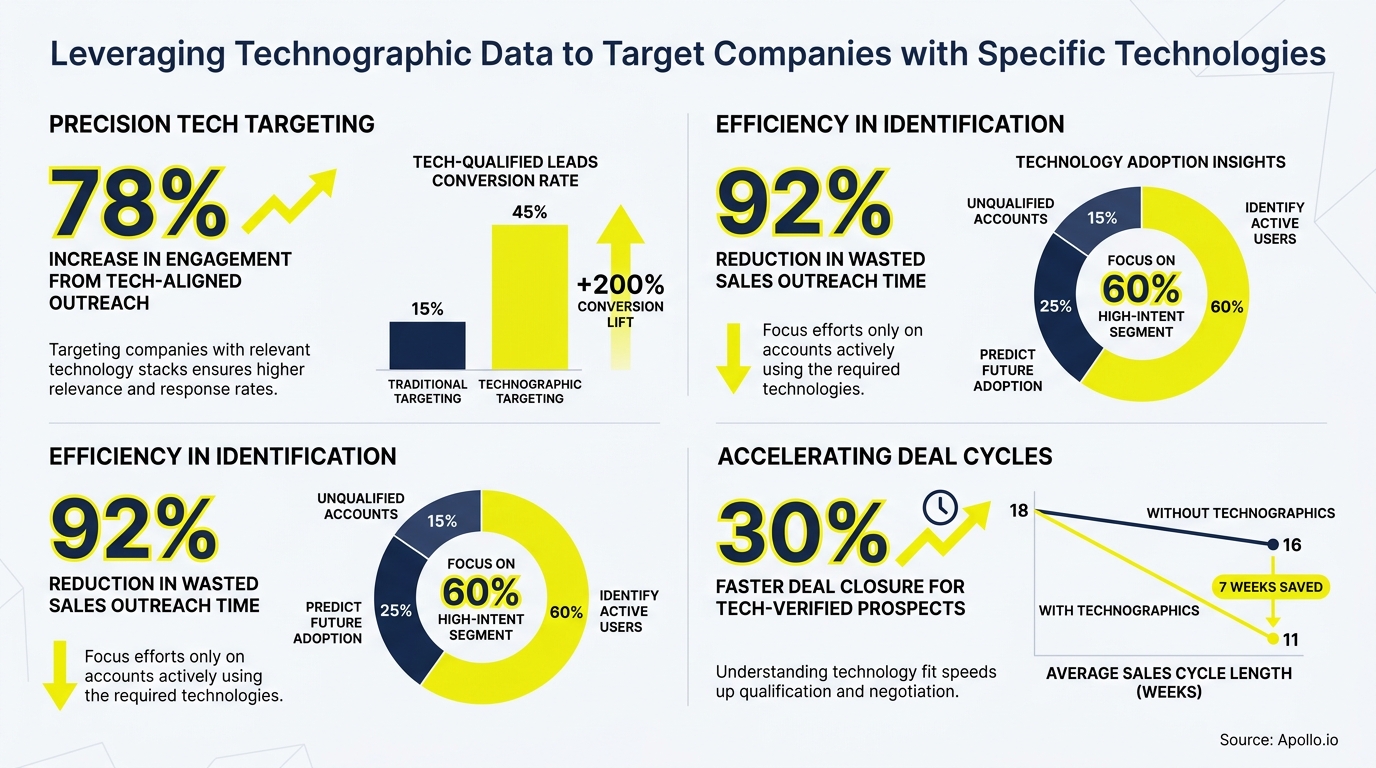
Technographic data tells you exactly which software and infrastructure a company runs, turning a generic prospect list into a precise, fit-scored account set. For SDRs, AEs, and RevOps teams under budget pressure, this means spending outreach time only on accounts that can actually buy. According to Landbase, companies leveraging technographic data are 50% more likely to exceed revenue goals compared to those using traditional targeting methods. Learning how to build a data enrichment strategy that incorporates technographics is one of the highest-ROI moves a GTM team can make in 2026.

Research Less, Close More With Apollo
Tired of burning hours on manual lead research and data entry instead of selling? Apollo delivers verified contacts instantly, so your team spends time closing—not hunting. Join 600K+ companies building pipeline faster.
Start Free with Apollo →Key Takeaways
- Technographic data identifies which specific technologies a target company uses, enabling precise fit-scoring before any outreach begins.
- Layering technographics with intent signals separates high-fit accounts from high-fit-and-in-market accounts, a meaningful difference for prioritization.
- Data quality gating prevents costly mis-personalization: single-source technographic signals should always be cross-verified before triggering automated sequences.
- Displacement plays (targeting users of a competitor or adjacent tool) produce stronger conversion lift than generic persona targeting.
- SDRs and RevOps leaders who operationalize technographics into their prospecting filters report measurably higher connect and conversion rates.
What Is Technographic Data and Why Does It Matter?
Technographic data is information about the software, platforms, and infrastructure a business currently uses or has recently adopted. It covers CRM platforms, marketing automation tools, cloud providers, analytics stacks, security vendors, and more. Datamaticsbpm reports that 66% of B2B marketers use technographics to identify competitive opportunities and target accounts not yet using their products or services.
The core value is fit qualification at scale. Instead of guessing whether a prospect's stack is compatible with your product, you verify it before the first touch. This is especially powerful for displacement plays: SuperAGI notes that Gartner predicts over 60% of software purchases are replacement buys, making stack-aware targeting a primary GTM motion rather than a niche tactic.
How Do SDRs and AEs Use Technographic Filters to Prioritize Accounts?
SDRs and AEs use technographic filters to build prospect lists scoped to accounts already running compatible or complementary tools, eliminating low-fit noise before any outreach. A sales professional wrote on Reddita practical multi-source verification workflow: start with a tool like BuiltWith or Wappalyzer for the initial list, then cross-reference with job postings (if they're hiring for a technology, they're using it) and G2 reviews (companies that review a tool are obviously using it). This layered approach compensates for the accuracy gaps in single-source data.
For AEs managing enterprise accounts, technographics support pre-meeting research: knowing a prospect runs Salesforce and Snowflake lets you tailor integration talking points before the first call. RevOps leaders use the same signals to configure routing rules, sending Salesforce-native accounts to reps with relevant implementation experience.
Struggling to find qualified leads filtered by tech stack? Search Apollo's 230M+ contacts with 65+ filters including technographic attributes.

How Do You Verify and QA Technographic Data Before Activating It?
Technographic data quality degrades quickly as companies switch vendors, migrate to new platforms, or sunset legacy tools, so a verification step before personalization is non-negotiable. MarketingOps reports that 75% of RevOps professionals cite data inconsistencies as the most frustrating part of their tech stack. Sending a Salesforce-specific migration pitch to a company that switched to HubSpot six months ago does real damage to sender reputation and conversion rates.
A practical QA framework includes three gates before a technographic signal triggers personalization:
- Recency check: Flag any install signal older than 90 days as unverified. Prioritize sources with known refresh cadences.
- Cross-source confirmation: Require at least two independent signals (e.g., a detection tool plus a job posting or a product review) before triggering stack-specific messaging.
- Confidence threshold: Assign a confidence score (high/medium/low) and gate personalized sequences to high-confidence accounts only. Use generic sequences for medium-confidence until signals are confirmed.
This matters especially when automating. Mis-personalization at scale, sending "we noticed you use [wrong tool]" to hundreds of accounts, actively erodes trust. Pair your technographic enrichment with a data cleansing and enrichment workflow to keep signals fresh and accurate.
Turn Funnel Guesswork Into Real Pipeline
Tired of watching marketing leads stall before they ever reach your pipeline? Apollo surfaces high-fit buyers the moment they're ready to engage. Top revenue teams close more with less guesswork.
Start Free with Apollo →How Do You Build a Technographic-Driven Outreach Playbook?
A technographic outreach playbook maps specific tech stacks to tailored messaging, content assets, and sequences for each target segment. The playbook structure below covers the three most common GTM motions:
| GTM Motion | Technographic Signal | Outreach Angle | Key Content Asset |
|---|---|---|---|
| Displacement | Uses a direct competitor | Migration value, cost comparison, feature gap | Migration guide, ROI calculator |
| Complement/Integration | Uses a tool you integrate with | Native integration, workflow efficiency, shared data | Integration how-to, reference architecture |
| Stack Expansion | Uses adjacent tools in a category | Consolidation, reduced tool sprawl, single pane | Stack audit template, consolidation case study |
Personalized email campaigns built on technographic insights produce measurably higher engagement. Research from Reach Marketing shows that personalized email campaigns result in a 29% higher open rate and a 41% higher click-through rate compared to non-personalized outreach. The key is matching the personalization to a verified, fresh signal, not a guess.
A sales professional shared a firsthand perspective on Reddit that filtering by companies running AWS or GCP and specific frameworks eliminated wasted outreach on organizations that would never buy, and their connect rate on tech prospects approximately doubled as a result.
How Do You Layer Technographics with Intent Data for Tighter Targeting?
Layering technographics with intent data identifies accounts that are both a strong fit (right stack) and actively researching a solution (right timing). Technographic fit alone tells you who could buy. Intent data tells you who is evaluating now. Combined, they define your highest-priority outreach segment.
This combination is becoming the default in 2026. HG Insights launched an AI-driven Revenue Growth Intelligence platform in March 2026 that unifies technographics, intent signals, IT spend, and contact data into automated account prioritization workflows.
The direction is clear: static technographic lists are giving way to dynamic scoring models that trigger plays automatically when fit and timing align.
For teams building this without a dedicated ABM platform, a simple scoring model works:
- +3 points: High-confidence technographic match (uses a tool you displace or integrate with)
- +2 points: Active intent signal on relevant topic (researching your category)
- +1 point: Firmographic fit (size, industry, revenue band)
- Priority threshold: Score of 5+ triggers a personalized sequence immediately
Learn more about combining signals in Apollo's overview of how intent data powers smarter B2B sales.
How Does Apollo Help GTM Teams Operationalize Technographic Targeting?
Apollo consolidates technographic filtering, contact data, enrichment, and outreach sequencing into one platform, eliminating the tool sprawl that makes technographic targeting operationally complex. Instead of stitching together a detection tool, a data provider, an enrichment layer, and a sequencing platform, teams run the full workflow from filter to first touch in one workspace. "Having everything in one system was a game changer" (Cyera).
Apollo's sales intelligence and lead database includes technographic filters alongside 65+ other attributes, so SDRs can scope lists to accounts running specific technologies and immediately enrich them with verified contact data. RevOps leaders use B2B data enrichment for smarter routing to keep CRM records current as stacks change. The result is a tighter loop between signal detection and outreach execution.
Spending hours building technographic lists manually? Apollo's data enrichment surfaces tech-stack-verified contacts automatically, so your team focuses on conversations, not list building.

Start Targeting Smarter with Technographic Data
Technographic data converts broad prospect lists into high-fit account sets. The teams that win with it in 2026 are the ones who verify signals before activating them, layer technographics with intent for prioritization, and build stack-specific playbooks that match each account's existing environment. Bookyourdata notes that by 2026, 65% of B2B sales organizations will transition from intuition-based to data-driven decision-making. Technographic targeting is a core part of that shift.
Apollo gives GTM teams, from SDRs booking their first meetings to RevOps leaders building automated workflows, the technographic filters, enriched contact data, and sequencing tools to act on these signals without managing five separate platforms. Request a demo and see how Apollo's unified platform helps your team target, enrich, and engage the right accounts faster.
Prove Pipeline ROI With Apollo
Budget approval stuck on unclear metrics? Apollo surfaces measurable pipeline impact from day one, so you walk into every review with hard numbers. Leadium 3x'd annual revenue — your CFO will notice.
Start Free with Apollo →Don't miss these
Sales
Inbound vs Outbound Marketing: Which Strategy Wins?
Sales
What Is a Sales Funnel? The Non-Linear Revenue Framework for 2026
Sales
What Is a Go-to-Market Strategy? The 2026 GTM Playbook
See Apollo in action
We'd love to show how Apollo can help you sell better.
By submitting this form, you will receive information, tips, and promotions from Apollo. To learn more, see our Privacy Statement.
4.7/5 based on 9,690 reviews
