
How to Use Technographic Data to Prioritize Outbound Prospecting Targets in 2026
Sending outbound to anyone who fits your firmographic profile is no longer enough. In 2026, buyers shortlist vendors before they ever talk to a rep, and reaching the right account at the wrong stack moment means you never make the list. Effective outbound prospecting now starts with one question: what does this account's tech stack tell me about their readiness to buy?
Technographic data answers that question. It tells you which tools an account runs, what they're replacing, and where your product fits.
Used correctly, it transforms a broad target list into a short, high-conviction queue your SDRs can work with confidence.

Research Less, Close More With Apollo
Tired of your reps burning hours hunting down contact info instead of selling? Apollo surfaces verified prospects instantly, so your team spends time closing — not researching. Join 600K+ companies building pipeline faster.
Start Free with Apollo →Key Takeaways
- Technographic data reveals stack fit, replacement signals, and integration opportunities that firmographics alone cannot surface.
- Buyers finalize their vendor shortlist before engaging sellers, so stack-based targeting must happen early in the account selection process.
- The strongest prioritization model layers firmographic, technographic, and intent signals together, not any one dataset alone.
- Data quality and refresh cadence determine whether your technographic filters help or hurt, stale signals create irrelevant outreach that actively damages pipeline.
- SDRs and RevOps teams that operationalize technographic scoring inside their CRM route higher-quality accounts and spend less time on low-probability conversations.
What Is Technographic Data and Why Does It Matter for Outbound?
Technographic data is information about the software, platforms, and tools a company uses in its tech stack. For outbound prospecting, it answers three critical questions: Does this account already use a complementary tool that makes us a natural fit?
Are they running a competitor product we can displace? Do they have the technical environment our integration requires?
According to Crustdata, technographic data helps identify competitive displacement opportunities (companies using competitor products), integration selling opportunities (companies using complementary tools), and greenfield opportunities where no incumbent exists. Each scenario calls for a different message and a different level of urgency.
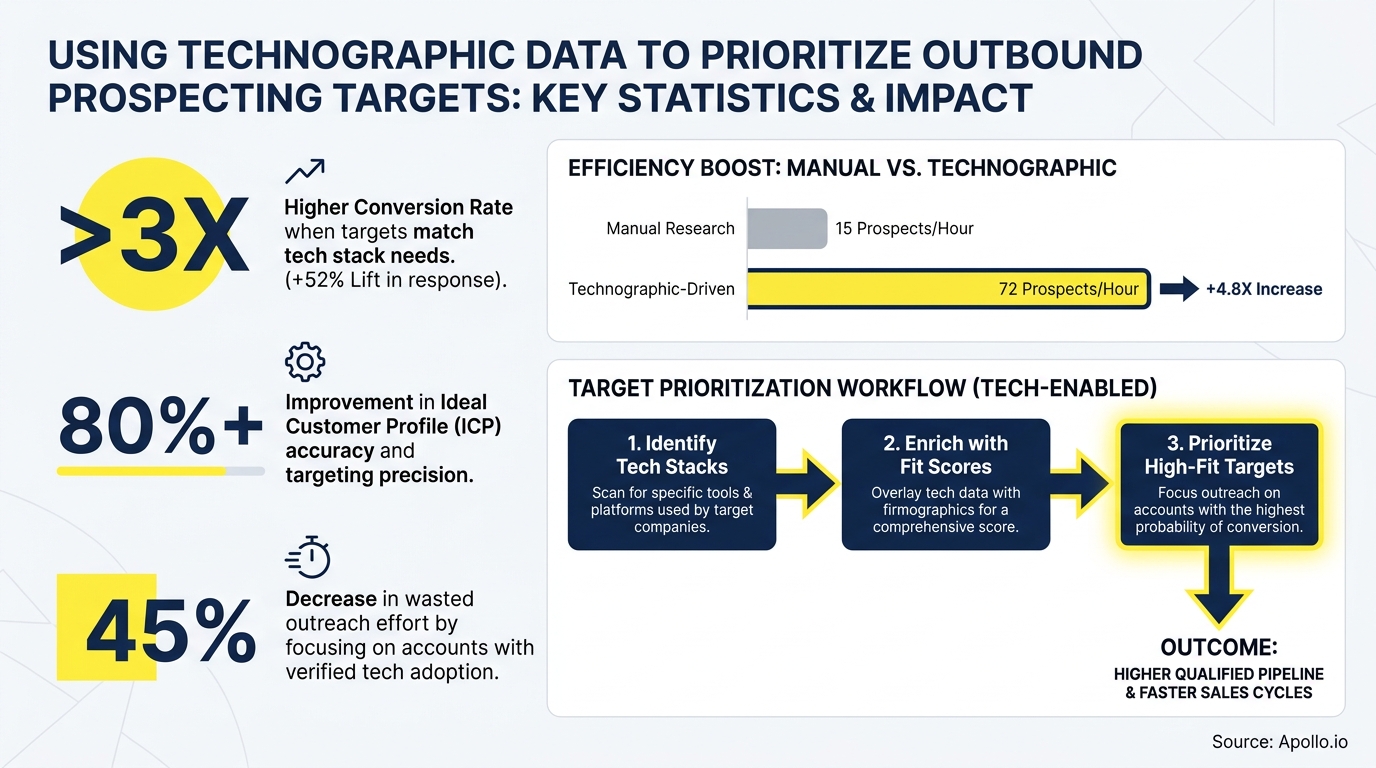
Research from Landbase shows companies leveraging technographic data achieve 28% higher conversion rates in B2B campaigns compared to those using traditional targeting methods. The gap comes from relevance: a pitch that references the prospect's actual stack lands differently than one that doesn't.
Struggling to filter your target list by tech stack? Search Apollo's 230M+ contacts using technographic and 65+ other filters to build a list your team can actually work.
Why Do Buyers Shortlist Vendors Before You Call?
Buyers now complete a significant portion of their evaluation before initiating contact with any vendor, which means the accounts on your outbound list may already be mentally committed to a shortlist that doesn't include you. Technographic signals help you identify accounts showing stack-fit before they finalize that list.
A SuperAGI report found that 60% of companies utilizing technographic data have reported an increase in sales-qualified leads. The mechanism is straightforward: filtering for stack fit removes accounts that would never convert regardless of outreach volume, leaving a list where every touch has a genuine reason to exist.
This also connects to a shift in purchase behavior. SuperAGI notes that over 60% of software purchases are replacement buys, emphasizing the importance of targeting companies already using similar or competitive technologies. Replacement cycles are your highest-probability outbound trigger.

How Do SDRs Build a High-Priority Target List Using Technographics?
SDRs build high-priority technographic target lists by applying a three-layer scoring model: firmographic fit first, technographic signals second, and behavioral intent signals third. Accounts that score across all three layers move to the top of the queue.
Here is a practical scoring rubric SDRs and RevOps teams can implement immediately:
| Signal Layer | What to Look For | Priority Weight |
|---|---|---|
| Firmographic | Company size, industry, revenue range, headcount growth | Baseline qualifier |
| Technographic | Competitor tools, complementary integrations, stack recency | High (stack fit = relevance) |
| Intent | Buying signals, job postings for relevant roles, content consumption | Highest (timing indicator) |
Accounts hitting all three layers get immediate outreach. Accounts hitting only firmographic fit go into a nurture sequence.
This prevents SDRs from burning time on contacts that look right on paper but show no signs of readiness.
For Account Executives managing named accounts, technographic data also informs pre-call research. Knowing an account runs a specific data warehouse or CRM lets AEs walk into discovery with a stack-specific hypothesis instead of a generic pitch, which shortens the path to a second meeting.
Learn more about data-driven prospecting strategies that help sales teams work smarter, not harder.
How Do You Maintain Data Quality for Technographic Targeting?
Technographic data quality degrades faster than firmographic data because tech stacks change constantly. A governance framework with defined refresh intervals and confidence tiers prevents your filters from routing reps to accounts based on outdated signals.
Data from The Insight Collective shows 74% of B2B marketing leaders cite maximizing data value and comprehending its insights as their top data challenge. Without a refresh process, technographic data becomes a liability rather than an asset.
A practical governance framework includes three tiers:
- High confidence: Signals confirmed within 90 days via job postings, product reviews, or API data. Route directly to SDRs.
- Medium confidence: Signals 90-180 days old. Include in sequences but flag for manual verification before calls.
- Low confidence / suppress: Signals older than 180 days or from a single unverified source. Remove from active targeting until refreshed.
RevOps leaders find that pairing technographic enrichment with a quarterly data enrichment strategy review keeps confidence tiers accurate and prevents stale signals from inflating outreach volume without improving conversion.
Want cleaner contact and account data without building a separate governance workflow? Apollo's data enrichment tools keep your CRM accurate with 97% email accuracy so your technographic filters work on verified records.
Turn Funnel Gaps Into Pipeline Gold
Tired of watching marketing leads stall before they ever reach your pipeline? Apollo surfaces high-intent prospects with precision targeting so every rep works a list worth calling. Join 600K+ companies building predictable pipeline.
Start Free with Apollo →What Are the Technographic Signal Types That Trigger Outbound?
Not all technographic signals carry equal weight. The highest-value triggers indicate active change in an account's stack, not just passive ownership of a tool.
- Competitive displacement signals: Account runs a direct competitor product. Prioritize accounts with known renewal windows or job postings seeking alternatives.
- Integration fit signals: Account uses tools your product natively connects to. Lead with the integration in your outreach as the hook.
- Stack change signals: Account recently added or removed a technology. New hires in a technical role, contract end dates, or migration job postings all indicate an open evaluation window.
- AI adoption signals: Account is hiring for AI/ML roles or adopting AI-adjacent tools. This segment grew significantly as a targeting category in 2025-2026 as buyers began evaluating AI implementation as a purchase criterion.
Stack change signals are the most time-sensitive. A company posting for a Salesforce Admin or a new data engineer is often mid-evaluation. Reaching them within days of that signal appearing is the difference between making the shortlist and being contacted too late. Pair these signals with intent data to confirm buying activity before your SDR makes the first touch.
How Do You Operationalize Technographic Targeting in Your CRM?
Operationalizing technographic targeting means embedding signal-based scoring directly into your CRM so account prioritization happens automatically, not manually. The goal is a system where the highest-fit accounts surface to the top of every rep's queue without requiring individual research.
Core implementation steps:
- Enrich accounts on ingest: Every new account record gets technographic attributes appended at the point of entry. See how contact data enrichment drives ROI at scale.
- Build score fields in CRM: Create a technographic score field (0-10) populated by your enrichment layer. Map each signal type to a point value based on historical win-rate correlation.
- Set routing rules by score: Accounts above a threshold route immediately to SDRs. Accounts below threshold enter a nurture track until signals strengthen.
- Alert on change signals: Configure alerts when a monitored account adds or removes a key technology. SDRs receive same-day notification and can act within the relevance window.
This setup replaces manual list-building with a system that continuously surfaces the best accounts. It also gives RevOps a clean feedback loop: win rates by technographic segment show which stack combinations predict revenue, and that data sharpens scoring weights over time.

How Do You Measure Whether Technographic Targeting Is Working?
Technographic targeting effectiveness is measured by comparing conversion rates and pipeline velocity between technographic-filtered accounts and unfiltered accounts. The delta tells you whether your signal selection is accurate and whether your data quality is sufficient.
Key metrics to track by segment:
| Metric | What It Measures | Target Direction |
|---|---|---|
| SQLs per technographic segment | Which stack combinations produce qualified pipeline | Increase over baseline |
| Meeting rate by signal tier | Whether high-confidence signals convert to meetings | Higher for Tier 1 vs. Tier 3 |
| Win rate by tech segment | Which stack environments predict closed-won | Identify top 2-3 segments |
| Days to first response | Whether stack-specific messaging shortens engagement time | Decrease vs. generic outreach |
Run a 90-day cohort analysis comparing outreach sent to technographic-scored accounts vs. unscored accounts. If scored accounts show meaningfully better meeting and pipeline rates, expand the scoring model.
If results are flat, audit your signal selection and data freshness before increasing volume.
Start Prioritizing Outbound with Technographic Intelligence
Technographic data transforms outbound from volume-based to conviction-based. SDRs stop working lists that were built on company size alone and start working accounts where the stack signals a genuine reason to reach out.
RevOps teams get a scoring system that routes the best accounts automatically. AEs walk into discovery calls with stack-specific context that compresses the path to qualified pipeline.
The teams seeing the strongest results in 2026 are not running technographic filters in isolation. They layer stack signals with intent data and firmographic qualifiers, enforce a data governance cadence that keeps confidence tiers accurate, and operationalize scoring inside their CRM so prioritization happens continuously, not manually.
Apollo brings together the verified contact data, technographic filters, enrichment workflows, and sales engagement tools your GTM team needs in one unified platform. As Cyera put it, "Having everything in one system was a game changer." Schedule a Demo to see how Apollo helps your team prioritize the accounts most likely to convert.
Apollo Proves Its ROI From Day One
Budget approval stuck on unclear pipeline metrics? Apollo delivers measurable wins fast — 46% more meetings with AI, +10% win rates, +10% ACV. See the numbers your CFO needs to say yes.
Start Free with Apollo →Don't miss these
Sales
Inbound vs Outbound Marketing: Which Strategy Wins?
Sales
What Is a Sales Funnel? The Non-Linear Revenue Framework for 2026
Sales
What Is a Go-to-Market Strategy? The 2026 GTM Playbook
See Apollo in action
We'd love to show how Apollo can help you sell better.
By submitting this form, you will receive information, tips, and promotions from Apollo. To learn more, see our Privacy Statement.
4.7/5 based on 9,690 reviews
