
How to Use Intent Data to Prioritize Outbound Prospecting Targets in 2026
Most outbound teams have access to intent data. Few have an operating model to act on it. A Forrester report published in April 2026 called intent data "ubiquitous and consistently underutilized" — not because the signals are weak, but because teams lack a structured framework to convert them into prioritized outbound queues. This article gives you that framework, with scoring rubrics, time-horizon tiers, and practical SLAs you can implement immediately.
If your team is still prospecting from static lists, you're competing blind. Learn how intent data is collected and how it works before building your prioritization system on top of it.

Let Apollo Find Your Leads Instantly
Tired of burning hours verifying contact info that goes nowhere? Apollo surfaces accurate, ready-to-work leads so your reps spend time selling — not searching. Join 600K+ companies building pipeline faster.
Start Free with Apollo →Key Takeaways
- Intent data is only valuable when paired with a scoring model and routing rules — signals without action don't move pipeline.
- Not all intent means "ready to buy now" — time-horizon tiers (0–30, 31–90, 91–180 days) let you match sequences to research stage.
- Multi-signal fusion (third-party topic research + first-party engagement + firmographic fit) dramatically reduces false positives vs. single-source intent.
- SDRs and BDRs using intent-based prioritization contact accounts already researching solutions, making every outreach touch more relevant.
- Measuring pipeline contribution from intent-scored accounts — not just activity volume — proves ROI and justifies budget investment.
What Is Intent-Based Outbound Prioritization?
Intent-based outbound prioritization is the practice of ranking prospecting targets by behavioral signals that indicate active research or buying interest, then routing the highest-fit, highest-intent accounts to reps first. Rather than working a flat list by territory or company size, your team works accounts in order of purchase likelihood.
According to nrich.io, 69% of respondents in one study reported using intent data for lead and account prioritization — making it the most common use case. Yet most implementations stop at "seeing" the signal in a dashboard. The teams winning pipeline actually route it into rep workflows automatically.
For a deeper primer, see how intent data powers smarter B2B sales.
How Do You Build an Intent Scoring Model?
Build your intent scoring model by assigning weighted point values to signals across three categories: third-party topic research, first-party engagement, and firmographic or technographic fit. Combine all three to produce a composite account score that feeds your outbound queue.
| Signal Category | Example Signals | Suggested Weight |
|---|---|---|
| Third-Party Intent | Topic research spikes, competitor keyword searches, pricing page visits (external) | 40% |
| First-Party Engagement | Website visits, webinar attendance, demo requests, content downloads | 35% |
| Fit (Firmographic / Technographic) | ICP industry, headcount, tech stack match, hiring signals | 25% |
One critical nuance: weight by intent type, not just engagement volume. High-volume signals like eBook downloads often reflect curiosity, not purchase intent. Signals tied to problem/solution research, competitor comparisons, or pricing topics carry significantly higher predictive value for near-term buying activity.
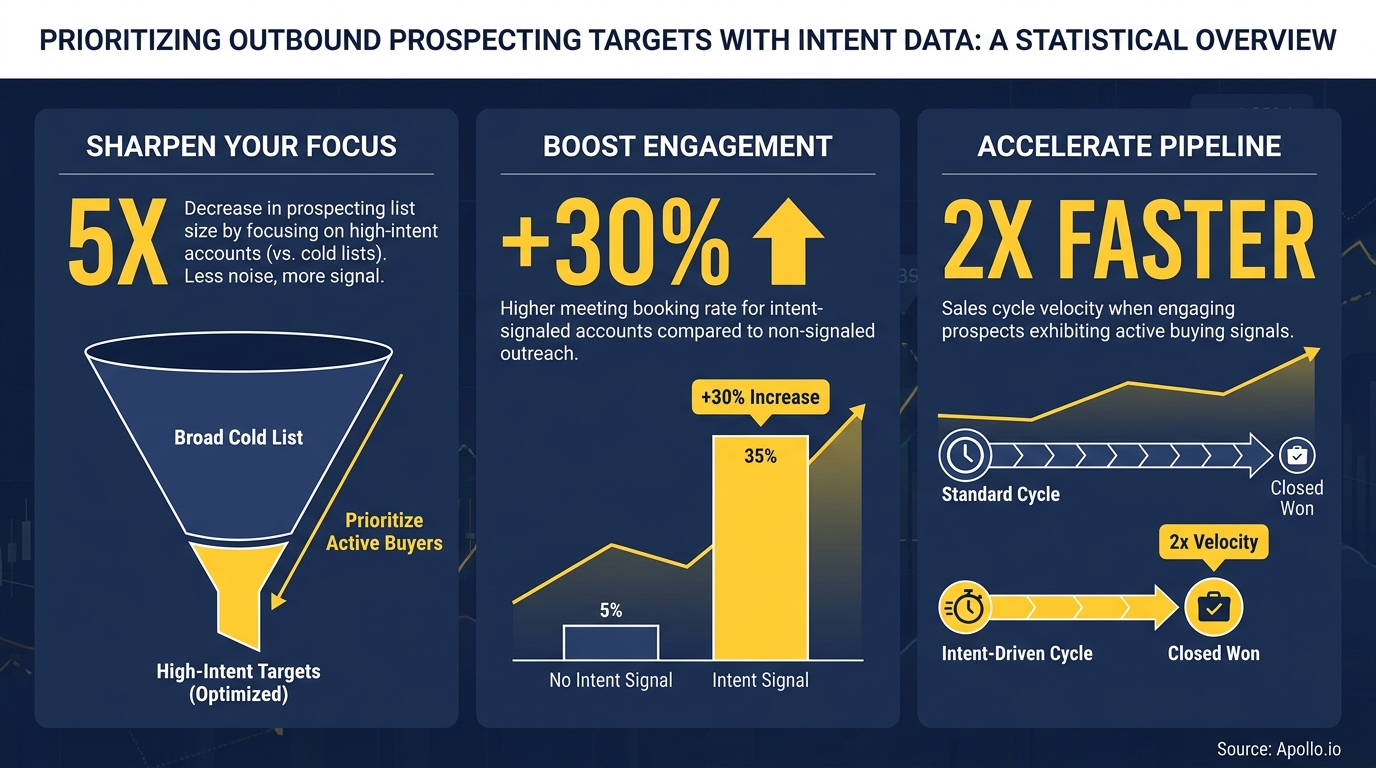
Research from MarketsandMarkets shows organizations using intent data typically see 2–4x ROI within the first year, including 25–35% higher conversion rates and 30–40% shorter sales cycles — outcomes that only materialize when scoring is tied to structured activation.

How Do SDRs and BDRs Use Intent Tiers to Prioritize Their Day?
SDRs and BDRs use intent tiers to sort their daily outbound queue into three time-horizon buckets, each with a different sequence type and cadence velocity. This prevents the most common mistake: treating every intent signal as "call immediately."
| Tier | Time Horizon | Signal Profile | Recommended Play |
|---|---|---|---|
| Tier 1: Hot | 0–30 days | Pricing research, demo requests, competitor comparisons | High-touch: call + email + social within 24 hrs |
| Tier 2: Warm | 31–90 days | Problem/solution topic spikes, webinar registration | Value-first sequence: 3 touches/week, insight-led |
| Tier 3: Nurture | 91–180 days | Early-stage category research, general awareness content | Low-frequency: 1–2 touches/week, educational |
The Tier 2 (Warm) bucket is where most teams leave pipeline on the table. Mid-term intent signals (3–6 months) are increasing in volume as buyers extend their self-education phase before engaging sellers.
Mapping your nurture-to-outbound handoff SLA to this window ensures you don't miss accounts that are in-market but not yet urgent.
Struggling to build your outbound list around these tiers? Search Apollo's 230M+ contacts with 65+ filters to find and segment accounts by intent, firmographic fit, and buying signals in one workspace.
Turn Funnel Guesswork Into Pipeline Clarity
Pipeline forecasting a guessing game because quality leads never materialize into real opportunities? Apollo surfaces in-market buyers the moment they're ready, so your funnel fills with deals — not dead ends. Nearly 100K paying customers stopped guessing and started closing.
Schedule a Demo →What Does Multi-Signal Fusion Mean in Practice?
Multi-signal fusion means combining data from at least two distinct signal sources — such as third-party intent platforms, your CRM engagement history, and technographic data — to produce a single composite account score before assigning it to a rep. Single-source intent has a high false-positive rate because one data point rarely confirms buying intent on its own.
A practical fusion workflow looks like this:
- Collect: Pull third-party topic research data + first-party site/content engagement + CRM history into a central scoring layer (your CRM, MAP, or sales engagement platform).
- Score: Apply the weighted model from the section above. Flag accounts that cross your threshold (e.g., 70+ composite score).
- Gate: Run a fit check — does the account match ICP on industry, size, and tech stack? Disqualify low-fit accounts even with high intent scores.
- Route:Push gated accounts into rep queues automatically with context: which topics triggered the score, which contacts to target, and which tier they belong to.
Account-level scoring also outperforms contact-only intent because buying decisions are made by buying groups, not individuals. Coordinating outreach to multiple stakeholders at the same account — economic buyer, champion, and technical evaluator — converts intent signals into actual pipeline more reliably than single-contact sequences.
How Do RevOps Teams Measure Intent Data ROI?
RevOps teams measure intent data ROI by tracking pipeline contribution from intent-scored accounts separately from non-scored accounts, then comparing conversion rates, deal velocity, and win rates between the two cohorts.
Key KPIs to instrument from day one:
- Intent-to-Meeting Rate: What percentage of Tier 1 accounts convert to a booked meeting within 14 days of scoring?
- Pipeline from Intent Accounts: What share of total pipeline originated from accounts that had an intent score above threshold before first outreach?
- Outreach Waste Rate: What percentage of rep activity (calls, emails) is going to accounts with zero intent signals? Reducing this directly improves team efficiency.
- Score-to-Close Velocity: Do intent-scored accounts close faster than non-scored accounts? Track average days from first touch to closed-won by tier.
Data from IntentAmplify found that B2B businesses using intent data experienced a 36% improvement in conversion rates from outbound campaigns — a benchmark worth setting as a target when building your measurement baseline.
For RevOps leaders, connecting intent scoring to your contact data enrichment strategy ensures the accounts in your scoring model have accurate, complete records — preventing wasted outreach due to stale data.
How Do You Activate Intent Data Inside Your Outbound Workflow?
Activate intent data by embedding scoring outputs directly into your CRM as a field or tag, triggering automated sequence enrollment based on tier, and giving reps a standardized call prep view that surfaces the specific signals that triggered each account's score.
A practical activation checklist:
- Define intent score thresholds for each tier (e.g., Tier 1 = 80+, Tier 2 = 50–79, Tier 3 = 30–49)
- Set SLAs: Tier 1 accounts must receive first outreach within 24 hours of scoring; Tier 2 within 72 hours
- Build sequence templates for each tier with messaging matched to the buyer's research stage (problem awareness vs. solution evaluation vs. vendor comparison)
- Route Tier 1 accounts to senior AEs or senior SDRs; Tier 3 to automated nurture tracks
- Review scoring model accuracy monthly: compare predicted vs. actual conversion rates and adjust weights
The shift happening across GTM teams in 2026 is from "intent dashboards" to "intent activation" — where signals automatically create tasks, enroll contacts in sequences, and surface rep-ready context without manual interpretation. Teams not yet using structured outbound prospecting workflows spend disproportionate time on manual list building instead of actual selling.
Spending too much time building lists manually instead of working accounts? Automate your intent-triggered sequences with Apollo's multi-channel sales engagement platform.

Start Turning Intent Signals Into Booked Meetings
Intent data delivers ROI only when it feeds a working system: a scoring model, time-horizon tiers, multi-signal fusion, and rep-ready routing. Without those components, signals accumulate in dashboards while competitors call the same accounts first.
Apollo brings buying intent signals, contact data, and multi-channel outreach into one unified platform — so your SDRs and AEs spend time on accounts that are actually in-market, not guessing from static lists. "Having everything in one system was a game changer," said the team at Cyera. Apollo's buying intent data and sales prospecting list tools give you the foundation to build this system without adding more vendors to your stack.
Start Prospecting with Apollo — free.
Prove Pipeline ROI Before Next QBR
ROI pressure killing your tool budget before it even gets approved? Apollo delivers measurable pipeline impact from day one. Leadium 3x'd annual revenue — see your own numbers with a free trial.
Start Free with Apollo →Don't miss these
Sales
Inbound vs Outbound Marketing: Which Strategy Wins?
Sales
What Is a Sales Funnel? The Non-Linear Revenue Framework for 2026
Sales
What Is a Go-to-Market Strategy? The 2026 GTM Playbook
See Apollo in action
We'd love to show how Apollo can help you sell better.
By submitting this form, you will receive information, tips, and promotions from Apollo. To learn more, see our Privacy Statement.
4.7/5 based on 9,690 reviews
