
How to Build an Agentic Prospecting Workflow Without Rebuilding Your Entire Stack (2026)
Most sales teams don't have a model problem. They have a data and tool sprawl problem. You can layer AI agents onto a fragmented stack and get chaos, or you can layer them onto clean, connected workflows and get results. The good news: you don't need to rip and replace anything. The shift to sales automation is about augmenting what already works, not starting over.
According to the Salesforce State of Sales (7th edition, 2026), sales professionals spend only 40% of their time actually selling. The other 60% goes to manual tasks that agents can handle.
That's the real ROI case for agentic prospecting in 2026.

Research Less, Close More With Apollo
Tired of burning hours manually hunting down contact info that's already outdated? Apollo surfaces verified leads instantly so your team spends time selling, not searching. Join 600K+ companies building pipeline on autopilot.
Start Free with Apollo →Key Takeaways
- Start with data hygiene and workflow mapping before activating any AI agents — dirty data produces automated noise, not pipeline.
- Agentic prospecting works best as an assistive layer: agents handle research, enrichment, and first-draft outreach while humans own relationship-building and deal judgment.
- The biggest time-reclaim opportunity is automating repetitive manual steps (research, CRM updates, follow-up scheduling) that currently consume the majority of a rep's day.
- Trust-first outreach outperforms volume-first outreach: B2B buyers rate peers and existing vendors as their most trusted sources, so route warm signals before cold sequences.
- Tool consolidation is a prerequisite for agentic success — tech silos actively limit what agents can do.
What Is an Agentic Prospecting Workflow?
An agentic prospecting workflow uses AI agents to autonomously execute repeatable prospecting steps — signal monitoring, contact enrichment, outreach drafting, and CRM logging — within your existing tools, without human intervention at each step. It is not a fully autonomous system that replaces your reps.
It is an always-on assistant that handles the manual work so reps focus on conversations and closing.
The distinction matters: Gartner projects that by 2030, 75% of B2B buyers will prefer sales experiences that prioritize human interaction over AI. Agentic prospecting should be assistive, not autonomous.
Why Does Tool Sprawl Block Agentic Prospecting?
Tool sprawl blocks agentic prospecting because agents need unified data to make reliable decisions — fragmented systems produce fragmented outputs. The Salesforce State of Sales (2026) found that 51% of sales leaders with AI say tech silos delay or limit their AI initiatives, and 42% of reps are overwhelmed by too many tools.
Agents can't enrich a contact in one system, trigger a sequence in a second, and log the outcome in a third without custom integrations that break constantly. The practical fix is consolidation before automation. As Predictable Revenue put it: "We reduced the complexity of three tools into one" — a prerequisite that unlocked their automation gains. Read their full story in how Predictable Revenue reduced tech stack costs by 50%.
Struggling to find qualified leads across a fragmented stack? Search Apollo's 230M+ contacts with 65+ filters — all in one place, no migrations required.

How Do You Build an Agentic Prospecting Workflow Phase by Phase?
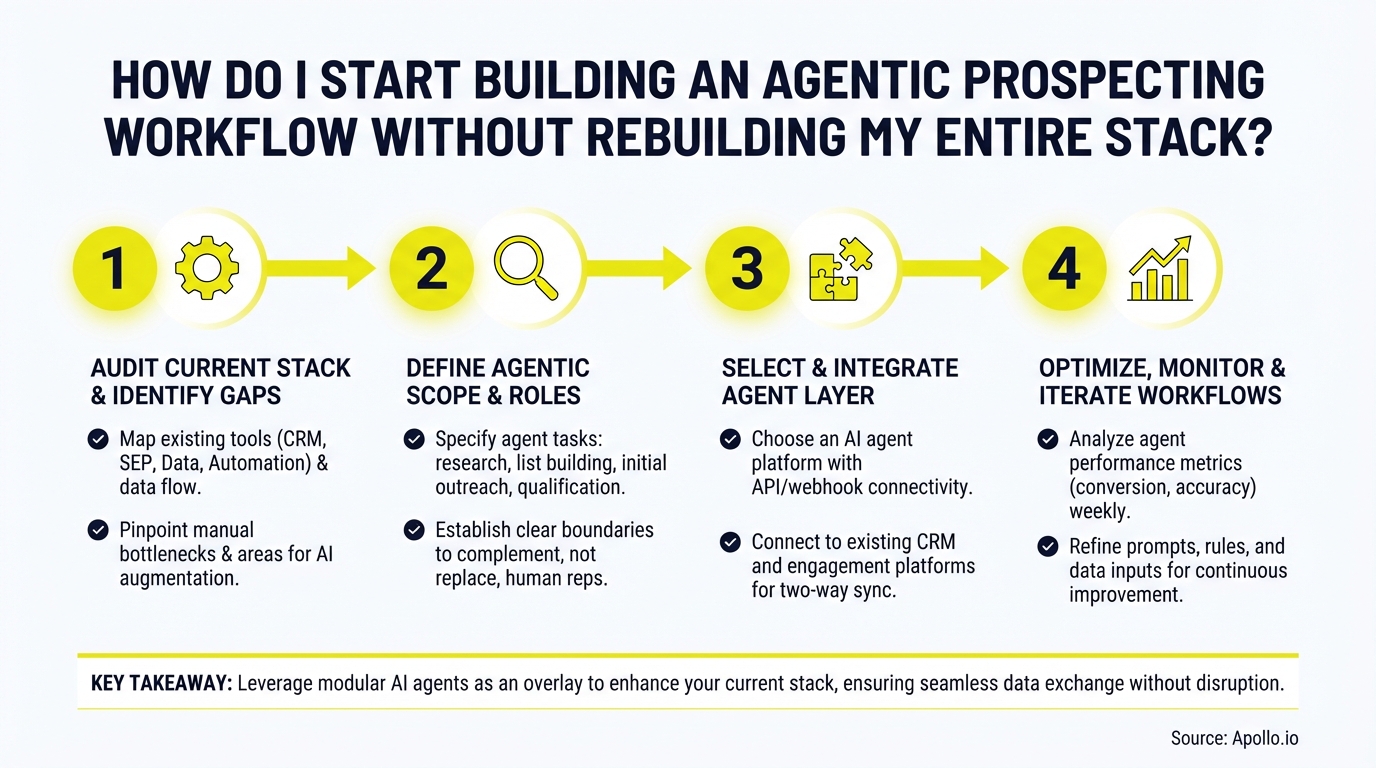
Build an agentic prospecting workflow in four phases, each with a defined outcome before moving to the next.
| Phase | Focus | Measurable Outcome |
|---|---|---|
| Phase 0: Readiness | Audit data quality, map manual steps, define ICP | Clean CRM, documented workflow gaps |
| Phase 1: Enrich + Signal | Automate contact enrichment and intent signal monitoring | Verified contact data, prioritized prospect lists |
| Phase 2: First Touch | Agent drafts personalized outreach; rep reviews and sends | Faster send times, consistent messaging quality |
| Phase 3: Follow-Up + CRM Logging | Automate follow-up cadences and activity logging | Time reclaimed from manual CRM updates and scheduling |
Phase 0 is non-negotiable. The Salesforce State of Sales (2026) found that 74% of sales teams with AI are actively prioritizing data hygiene to support it.
Skipping readiness means automating bad data at scale.
For a deeper look at building the sales tech stack that supports this kind of automation, map each phase to the tools already in your stack before adding new ones.
What Does a Trust-First Outreach Playbook Look Like?
A trust-first outreach playbook routes prospects through warm signals before cold sequences, prioritizing buyers who already have a relationship with your company or team. Forrester research (March 2025) found that 82% of B2B buyers cite coworkers or management as trusted sources, and 79% trust vendors they already work with.
Cold volume does not compete with that.
Prioritize outreach in this order:
- Warm re-engagement: Former customers, open opportunities, and existing account contacts showing new intent signals.
- Peer-referred pathways: Contacts connected to your current customers or champions.
- Intent-triggered cold outreach: Net-new prospects showing active buying signals, reached with highly relevant, context-specific messaging.
Agents are most effective at steps 1 and 3 — monitoring signals and drafting context-aware first touches. Human reps own peer-referred outreach because those conversations require relationship judgment. Pair this with strong email personalization strategies to make every agent-drafted message feel human.
Turn Funnel Guesswork Into Pipeline Wins
Quota stress keeping you up at night? Apollo surfaces in-market buyers the moment they're ready, turning weak top-of-funnel leads into real opportunities. Nearly 100K paying customers stopped guessing and started closing.
Start Free with Apollo →How Do SDRs and RevOps Leaders Implement This Without Breaking What Works?
SDRs implement agentic workflows by identifying the three to five manual steps that consume the most time each day, then automating exactly those steps inside existing tools. RevOps leaders enable this by establishing measurement baselines first: track time-per-task, contact data quality scores, and sequence performance before any automation goes live.
Key governance checkpoints to set up before scaling:
- Audit trail: Every agent action (enrichment pull, sequence enrollment, CRM update) should be logged with a timestamp and source.
- Human review gates: First-touch messages drafted by agents require rep approval before sending — especially for high-value accounts.
- Data lineage tracking: Know where every contact record originates and when it was last verified.
- Experiment design: Run agentic and manual workflows in parallel for 30 days before full rollout. Measure reply rates, meeting bookings, and CRM data quality.
For SDRs specifically: use intent data as the trigger layer for your agentic workflow. When a prospect hits a signal threshold, the agent enriches the record, drafts the outreach, and queues it for SDR review — all before the SDR opens their laptop.
Spending hours on manual outreach and CRM updates? Automate the manual work with Apollo's AI sales automation — built to work inside your existing workflow, not replace it.
What Tools and Integrations Support Agentic Prospecting In 2026?
The best tools for agentic prospecting in 2026 are platforms that embed agents where reps already work, rather than requiring workflow migration. The market trend is clear: CRM and sales engagement vendors are shipping embedded agents (Salesforce Agentforce, HubSpot Breeze Agents) specifically because stack replacement has a near-zero adoption rate.
Evaluate tools against these criteria:
- Native CRM embedding: Can it surface prospecting actions inside your CRM without a tab switch?
- Multi-channel sequencing: Does it coordinate email, phone, and social outreach in one workflow?
- Enrichment depth: Can it verify and update contact data automatically when records go stale?
- Workflow automation: Does it trigger next-best-action steps based on prospect behavior?
Apollo's workflow automation engine handles enrichment, sequencing, and CRM updates in one platform, consolidating what most teams currently manage across three or more separate tools. As Cyera noted: "Having everything in one system was a game changer."
For outbound prospecting specifically, look for platforms that support signal-triggered enrollment — automatically adding a contact to a sequence when they hit a defined intent or firmographic threshold.

How Do You Start Building an Agentic Prospecting Workflow Today?
Start building an agentic prospecting workflow today by completing Phase 0 this week: audit your CRM data quality, document your three most time-consuming manual prospecting tasks, and identify which of your current tools already support workflow triggers or agent actions.
Your week-one checklist:
- Audit CRM for duplicate, outdated, or incomplete contact records
- Map the manual steps from prospect identification to first send
- Identify which steps have no human judgment requirement (these are automation candidates)
- Set baseline metrics: time-per-task, reply rates, meeting bookings
- Choose one workflow to automate first — enrichment is the lowest-risk starting point
- Build a human review gate for any agent-drafted outreach
Most teams find that automating enrichment and CRM logging alone reclaims meaningful selling time before any outreach automation is live. Add complexity one phase at a time. Build your prospecting list with verified data as the foundation, then layer agent-driven signals and sequences on top.
The goal is not a fully autonomous prospecting machine. The goal is a workflow where agents handle the repeatable work and reps focus on the conversations that actually close deals. That's what sales workflow automation looks like when it's done right — and it starts with what you already have.
Ready to build your agentic prospecting workflow without touching your existing stack? Start Prospecting with Apollo free and activate enrichment, sequencing, and workflow automation from one platform.
Prove Pipeline ROI With Apollo
Budget approval stuck on unclear metrics? Apollo delivers measurable pipeline impact from day one — so you walk into every renewal conversation with proof. Leadium 3x'd annual revenue. Your turn.
Start Free with Apollo →Don't miss these
Sales
Inbound vs Outbound Marketing: Which Strategy Wins?
Sales
What Is a Sales Funnel? The Non-Linear Revenue Framework for 2026
Sales
What Is a Go-to-Market Strategy? The 2026 GTM Playbook
See Apollo in action
We'd love to show how Apollo can help you sell better.
By submitting this form, you will receive information, tips, and promotions from Apollo. To learn more, see our Privacy Statement.
4.7/5 based on 9,690 reviews
