
How to Segment Your Leads Into Different Lists or Campaigns (2026 Playbook)
Sending the same message to every lead is the fastest way to get ignored. According to DynaPictures, 77% of B2B buyers will not make a purchase without personalized content. Segmentation is how you deliver that personalization at scale. Whether you're building your first campaign list or overhauling a 15,000-contact database, this playbook covers every segmentation method you need in 2026. Start by reading our guide on lead lists that actually convert to make sure your raw data is solid before you slice it.

Apollo Turns Hours of Research Into Minutes
Tired of burning your best selling hours on manual lead research and dead-end contact data? Apollo surfaces verified contacts instantly so your team spends time closing, not searching. Join 600K+ companies building pipeline faster.
Start Free with Apollo →Key Takeaways
- Static firmographic lists are no longer enough: behavior-based and buying-group segmentation drive meaningfully higher engagement.
- A large share of qualified leads are not ready to buy right now, making nurture-track segmentation essential for pipeline health.
- Suppression lists and re-qualification rules are as important as the segments themselves — irrelevant outreach actively damages pipeline.
- Intent signals should determine which segment a lead enters, not just what industry they work in.
- AI-generated segments are replacing brittle rule-based lists, but human governance is still required to validate and activate them.
What Are the Core Segmentation Dimensions for B2B Leads?
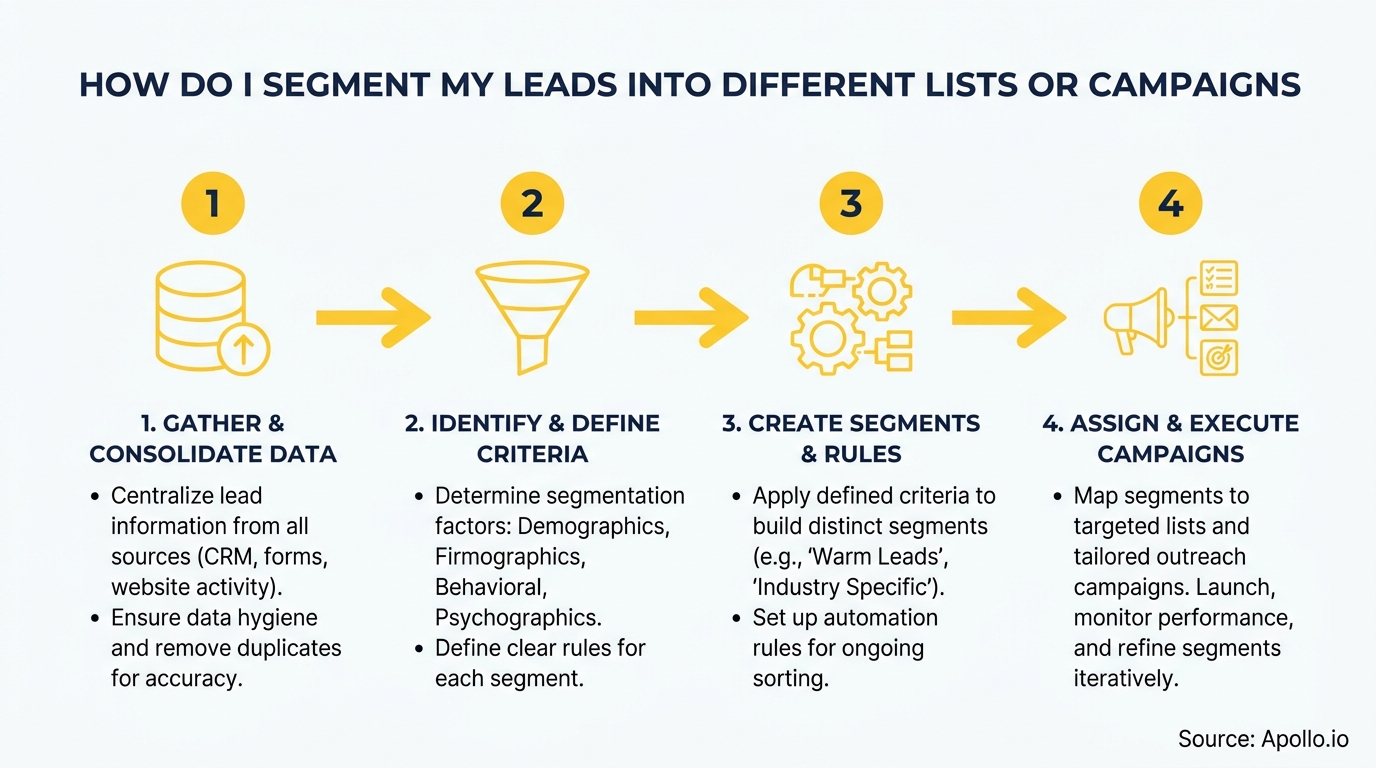
Lead segmentation means dividing your contact database into smaller, homogeneous groups so each group receives messaging matched to their situation. The four core dimensions are firmographic, behavioral, intent-based, and buying-stage.
| Dimension | Examples | Best Used For |
|---|---|---|
| Firmographic | Industry, company size, revenue, geography | Initial list building and ICP filtering |
| Behavioral | Email opens, content downloads, site visits, demo requests | Engagement scoring and nurture routing |
| Intent-Based | Third-party topic surges, competitive research signals | Hot-account routing to SDRs |
| Buying Stage | Awareness, evaluation, decision, post-sale | Campaign content matching and cadence timing |
A practitioner shared in a Reddit discussion that for large verified lists, grouping by specific industry, company size, or tech stack first makes it far easier to write a highly relevant hook for each group instead of sending a generic blast. That logic applies equally to email sequences and paid campaigns.
Struggling to find the right contacts to segment in the first place? Search Apollo's 230M+ verified contacts with 65+ filters to build pre-segmented lists from the start.
How Does Buying-Group Segmentation Work?
Buying-group segmentation organizes contacts by their role within a purchase committee rather than treating each lead as an isolated individual. Forrester's Buyers' Journey Survey found that an average of 13 people are involved in a B2B buying decision and 89% of purchases involve two or more departments.
Segmenting only by persona misses the committee entirely.
Use this buying-group framework when building campaign lists:
- Economic Buyer: VP or C-suite approver — receives ROI and business-case content.
- Technical Evaluator: IT, Security, or RevOps — receives integration, security, and implementation detail.
- End User / Champion: SDR, AE, or Marketing Manager — receives workflow and productivity content.
- Influencer / Procurement: Finance or Legal — receives compliance, pricing, and contract content.
Map every contact in a target account to one of these roles. Route the account into a campaign only when you have coverage across at least two roles. This prevents single-threaded outreach, which is a common reason deals stall. For a deeper look at building account-level lists, see our guide on building and segmenting target account lists in Apollo.
How Do SDRs and RevOps Teams Use Behavior-Based Segmentation?
Behavior-based segmentation routes leads into different lists based on what they have done, not just who they are. Despite its proven impact, it remains underused: CDP Institute research found that only 37% of B2B marketers segment by behaviors like content requests, while the majority still rely on static attributes like account type or named account status.
SDRs benefit most from behavior-triggered routing. When a prospect visits a pricing page, downloads a comparison guide, or attends a webinar, that signal should automatically move them from a nurture list into an SDR-owned sequence.
RevOps teams can set these routing rules once and let automation handle the handoff.
A practical three-tier behavior model for campaign lists:
- Engaged (Hot): Multiple high-intent actions in the past 14 days. Route to SDR sequence immediately.
- Warm: Occasional opens, one content download. Place in automated nurture campaign with educational content.
- Inactive: No engagement in 60+ days. Move to a re-engagement campaign or suppression list.
A commenter added in a Reddit discussion that the bigger win is making sure each segment gets content that matches their interest level, not sending the same email to everyone. Inactive contacts in particular need short re-engagement emails or occasional offers to pull them back in. This three-group model is a reliable starting point for any list size.
Research from Belkins shows that 40-75% of qualified leads are not ready to buy at any given moment, which means your nurture-track segments are just as strategically important as your hot-routing lists.
Turn Funnel Guesswork Into Pipeline Wins
Quota stress keeping you up at night? Apollo surfaces high-intent prospects and fills your funnel with leads that actually convert. Nearly 100K paying customers stopped forecasting on hope — and started closing on data.
Start Free with Apollo →What Are Suppression Rules and Why Do They Matter?
Suppression rules exclude specific contacts from receiving outreach, preventing irrelevant or harmful messaging. They are the anti-segmentation layer that protects deliverability, sender reputation, and buyer trust.
Gartner reports that 73% of B2B buyers actively avoid suppliers who send irrelevant outreach, making suppression logic a revenue protection measure, not just a hygiene task.
Build these suppression lists before launching any campaign:
- Current customers: Exclude from new-business sequences; route to expansion or success campaigns instead.
- Active opportunities: Suppress from marketing automation while an AE owns the relationship.
- Recent unsubscribes or opt-outs: Apply globally across all campaign types immediately.
- Frequency-capped contacts: Anyone who has received more than X touches in the past 30 days enters a cool-down list.
- Disqualified leads: Contacts who do not fit ICP after enrichment get moved to a dormant list, not deleted.
Set re-qualification rules so contacts can exit suppression. A dormant lead who visits your pricing page again, or whose company shows intent signals, should trigger an automatic re-evaluation and re-entry into the appropriate active segment. See how intent data powers smarter B2B sales for more on using signals to re-activate dormant segments.

How Do You Build an Intent-First Segmentation System?
Intent-first segmentation assigns contacts and accounts to campaign lists based on their research behavior, not their job title alone. According to The Insight Collective, 98% of marketers consider intent data essential for their marketing and sales journeys, yet most teams still default to firmographic filters when building lists.
A tiered intent routing model:
- High intent (score 80-100): Account is actively researching your category. Route to SDR for immediate outreach. Add all known contacts at that account to a priority sequence.
- Medium intent (score 50-79): Account shows topic interest but no urgency signals. Enroll in a multi-touch nurture campaign with case studies and comparison content.
- Low intent (score below 50): Minimal signal. Place in awareness campaigns — content-led, low frequency.
Layer intent signals with firmographic fit to avoid wasting SDR time on high-intent but low-fit accounts. Only accounts that score well on both dimensions should enter priority outreach lists. Pair this with these four ways to build better B2B lists to keep your segmented data clean and actionable.
Need to automate intent-triggered campaign enrollment? Apollo's multi-channel sales engagement platform lets you set behavioral and intent triggers that automatically enroll contacts into the right sequence without manual list management.
How Does AI Change Lead Segmentation in 2026?
AI-driven segmentation replaces brittle, rule-based lists with dynamic audiences that update continuously based on new signals. Instead of manually defining every segment rule, teams use AI to propose segments, predict fit and propensity to buy, and refresh audience membership automatically. According to Dring.ai, AI-driven lead scoring uses behavioral data, demographic information, and engagement metrics to rank leads by their likelihood to convert, which is the foundation of any AI-assisted segmentation model.
Practical AI segmentation applications for GTM teams:
- Lookalike segments: AI identifies contacts that match your best-performing closed-won accounts and creates a new prospecting list automatically.
- Churn-risk suppression: AI flags customer accounts showing disengagement signals and removes them from expansion campaigns until a CSM intervenes.
- Propensity scoring: AI ranks every contact in your database by likelihood to convert this quarter and dynamically adjusts campaign priority.
- Content-fit matching: AI recommends which campaign sequence each segment should enter based on past engagement patterns.
Human governance remains essential. AI-proposed segments should be reviewed by a RevOps leader before activation to catch misclassifications, ensure suppression rules are applied, and validate that segment definitions align with current ICP criteria. For a broader look at automation in your sales process, read our guide on how to use sales automation the right way.
How Do You Measure Whether Your Segmentation Is Working?
Segmentation effectiveness is measured by comparing engagement and conversion rates across segments, not just overall campaign averages. If your segments are meaningful, each should show a distinct performance profile.
| Metric | What It Tells You | Action If Low |
|---|---|---|
| Open rate by segment | Subject line and timing relevance | Test new subject lines per segment |
| Reply rate by segment | Message-to-audience fit | Rewrite copy for that segment's pain points |
| Meeting booked rate | SDR routing accuracy | Tighten intent threshold for SDR routing |
| Nurture-to-SDR conversion | Nurture campaign effectiveness | Add more behavior triggers to accelerate handoff |
| Suppression list growth rate | Outreach relevance and frequency | Audit frequency caps and ICP filters |
Run A/B tests within segments, not across them. Testing a subject line between your hot-intent segment and your cold-awareness segment produces meaningless results. Segment-level testing isolates the variable you are actually trying to optimize. Pair segmentation metrics with pipeline data from your prospect nurturing strategy to see how each segment contributes to closed revenue.

Start Segmenting Smarter With Apollo
Effective lead segmentation is the difference between campaigns that generate pipeline and campaigns that generate unsubscribes. The framework is clear: start with firmographic and intent filters to build your initial lists, layer in behavioral triggers for dynamic routing, apply suppression rules to protect deliverability, and use AI-assisted scoring to keep segments current without manual effort.
Apollo consolidates prospecting, enrichment, segmentation, and multi-channel engagement into a single workspace, so you are not stitching together five separate tools to execute this playbook. As Cyera put it, "Having everything in one system was a game changer."
Get Leads Now and start building smarter, behavior-driven segments inside Apollo today.
Prove Pipeline ROI Before Next Review
ROI pressure killing your tool budget? Apollo delivers measurable pipeline impact your leadership can see — fast. Leadium 3x'd annual revenue. Get results worth defending in every budget conversation.
Start Free with Apollo →Don't miss these
Sales
Inbound vs Outbound Marketing: Which Strategy Wins?
Sales
What Is a Sales Funnel? The Non-Linear Revenue Framework for 2026
Sales
What Is a Go-to-Market Strategy? The 2026 GTM Playbook
See Apollo in action
We'd love to show how Apollo can help you sell better.
By submitting this form, you will receive information, tips, and promotions from Apollo. To learn more, see our Privacy Statement.
4.7/5 based on 9,690 reviews
