
How to Run a Quarterly Outbound Performance Review for Your SDR Team (2026)
Most quarterly SDR reviews grade the wrong things. If your review still opens with total dials and emails sent, you're measuring effort when you should be measuring impact. According to Gartner, 61% of B2B buyers now prefer a rep-free buying experience — which means the entire framework for evaluating SDR performance needs an upgrade. This guide gives you a repeatable, modern outbound QBR structure built for 2026.

Let Apollo Find Contacts While You Close
Tired of your reps burning hours on manual research instead of selling? Apollo surfaces verified contacts instantly, so your team spends time closing — not hunting. Join 600K+ companies building pipeline faster.
Start Free with Apollo →Key Takeaways
- Shift your QBR from activity counts (dials, emails) to quality funnel math: connect rate, meeting-to-opportunity conversion, and pipeline created per SDR.
- Grade relevance — ICP fit, trigger coverage, and personalization quality — because irrelevant outreach drives buyer avoidance, not pipeline.
- Include a time-to-output audit each quarter: admin load and tool friction suppress SDR productivity more than coaching gaps.
- Score omnichannel orchestration and SDR-to-AE handoff quality, not just single-channel KPIs.
- Segment benchmarks by ICP, ACV, and channel — one universal scorecard produces false positives and false negatives across your team.
Why Do Most SDR Quarterly Reviews Fail?
Most SDR QBRs fail because they treat activity as a proxy for performance. Research from SalesS0 shows 83.4% of SDRs fail to consistently hit their quota each month — and reviewing dials won't fix that. The root causes are almost always structural: wrong ICP targeting, poor trigger coverage, sequence irrelevance, or tool friction eating into selling time.
A modern outbound QBR must answer three questions per rep: Are they reaching the right people? Are they saying the right things?
Are they converting interest into qualified pipeline? Everything else is diagnostic, not evaluative.
What Metrics Should a Sales Leader Review Each Quarter?
Sales leaders should evaluate SDRs across four metric tiers: volume (diagnostic), quality (evaluative), pipeline (outcome), and efficiency (operational). The table below shows exactly what belongs in each tier.
| Tier | Metrics to Review | Why It Matters |
|---|---|---|
| Volume (Diagnostic) | Sequences launched, contacts touched, dials made | Context only — don't grade on these alone |
| Quality (Evaluative) | ICP-fit rate, trigger coverage %, personalization score, reply rate by segment | Relevance predicts pipeline, not volume |
| Pipeline (Outcome) | Meetings set, meeting-to-opportunity rate, pipeline $ created per SDR | The real business output of outbound |
| Efficiency (Operational) | Admin time %, list-build time, tool-friction score, cost-per-meeting | Identifies leverage opportunities beyond coaching |
Data from Crunchbase confirms that SDRs are responsible for generating 30% to 45% of new revenue in many companies — which makes outcome-tier metrics non-negotiable in every review.
Spending too much time chasing pipeline visibility? Get complete pipeline visibility with Apollo's sales pipeline tools — built for sales leaders who need one source of truth, not five dashboards.
Turn Weak Funnels Into Quota Wins
Pipeline forecasting a guessing game because quality leads never convert? Apollo surfaces in-market buyers at the right moment, so your funnel fills with opportunities — not noise. Join 600K+ companies building predictable revenue.
Start Free with Apollo →How Should SDRs and Sales Leaders Structure the QBR Meeting?
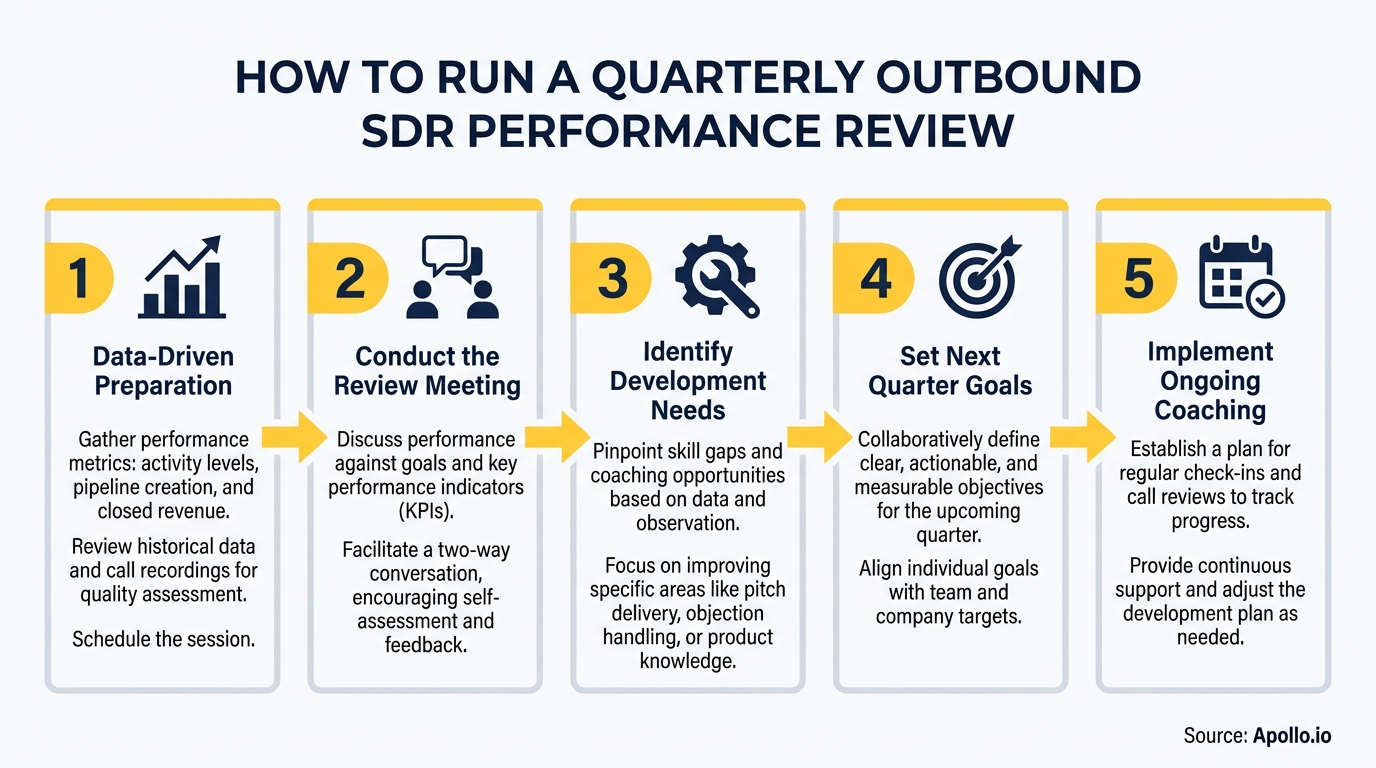
Run the quarterly outbound review in three phases: data review (30 min), root-cause analysis (20 min), and coaching plan (10 min). Each SDR presents their own scorecard first — this builds ownership and surfaces self-awareness gaps faster than top-down reviews.
Use this agenda structure:
- Phase 1 — Funnel Math Review: Walk through connect → conversation → meeting → qualified opportunity conversion rates by segment. Flag any stage where drop-off exceeds your team benchmark.
- Phase 2 — Relevance Audit: Review ICP-fit rate and trigger coverage. Score 5 sequences on personalization quality (1-5 rubric). Identify suppression failures (outreach sent to wrong personas or timing).
- Phase 3 — Coaching Plan: Assign one primary focus for Q+1. Tie it to a specific metric, a sequence change, or a channel adjustment — not a vague "improve outreach quality" directive.
For a deeper framework on structuring team performance conversations, see what sales performance management actually looks like in practice.

How Do You Grade Relevance and Buyer Fit During the Review?
Grade relevance by scoring each SDR's sequences against three criteria: ICP-persona alignment, situational trigger usage, and suppression rule adherence. Trigger-based outbound — outreach anchored to hiring signals, funding rounds, or technology changes — consistently outperforms generic personalization in 2026.
Use this quick rubric per sequence (score 1-3 on each):
- Persona match: Does the message speak directly to this buyer's role and priorities?
- Trigger relevance: Is there a clear situational signal driving the outreach timing?
- Call-to-action fit: Does the CTA match where this buyer is in their journey — or is it demanding a meeting too early?
A Gartner survey of 632 B2B buyers found that 73% actively avoid suppliers who send irrelevant outreach. Relevance scoring in your QBR directly reduces this buyer avoidance risk. For outbound prospecting best practices that embed trigger logic from the start, review your sequence-build process before the next quarter.
What Does a Time-to-Output Audit Look Like for SDR Teams?
A time-to-output audit measures how much of an SDR's day is consumed by non-selling tasks: list building, CRM data entry, manual research, and tool switching. This is an operational review layer that most QBRs skip entirely — and it's often where the biggest productivity gains hide.
Run the audit by asking each SDR to log their time across one representative week in the quarter. Then categorize each activity:
- Selling time: Calls, emails, sequences, conversations
- Research time: Account research, contact lookup, trigger identification
- Admin time: CRM updates, reporting, scheduling, tool management
If admin and research time exceed selling time, the solution isn't coaching — it's consolidation. Teams that consolidate their prospecting, sequencing, and data into one platform reduce tool-switching friction immediately. As Cyera noted: "Having everything in one system was a game changer." Explore how a unified sales tech stack changes what productivity looks like for SDR teams.
Spending hours on manual list-building and research? Automate your sequences and reclaim selling time with Apollo's multi-channel sales engagement platform.
How Do You Benchmark SDR Performance Without Misleading Your Team?
Benchmark SDR performance by segment, not by a single universal scorecard. A rep working enterprise accounts with 6-month sales cycles should not be measured against the same meeting-rate target as a rep working SMB with 30-day cycles.
Applying one benchmark produces false negatives for reps in hard segments and false positives for reps in easy territories.
Segment your benchmarks by at minimum:
- ICP tier (SMB / mid-market / enterprise)
- Primary channel (email / phone / social outreach)
- ACV band (sub-$20K / $20K-$100K / $100K+)
Research from Gradient Works found that 76% of sellers missed their quota in H1 2025 — a number that means nothing without segment context. Use team-level benchmarks as floors, then build rep-specific targets based on territory and ICP. For a broader view on what actually drives sales performance, territory design and ICP fit rank above rep activity in most analyses.
How Should Sales Leaders Act on QBR Findings?
Act on QBR findings by translating each identified gap into one specific change for the next quarter — not a list of improvements. One focused coaching priority per rep, one sequence adjustment per segment, and one operational fix per team-level friction point is the right cadence.
Post-QBR action checklist for sales leaders:
- Update ICP filters and suppression lists based on relevance audit findings
- Reassign or rebuild sequences with low trigger-coverage scores
- Escalate tool-friction issues to RevOps with time-audit data as evidence
- Set one leading indicator target per rep for Q+1 (e.g., trigger coverage rate, not just meetings set)
- Schedule a mid-quarter check-in at week 6 — don't wait for the next QBR to course-correct
For sales leaders managing larger teams, Apollo for Sales Leaders gives you the team-level visibility and coaching infrastructure to act on QBR outputs at scale — without adding another tool to your stack.

Run Better Reviews. Build Stronger Pipeline.
A quarterly outbound performance review that grades relevance, efficiency, and pipeline quality — not just activity volume — gives SDR leaders a genuine coaching tool instead of a backward-looking audit. The teams that upgrade their QBR frameworks in 2026 will surface coaching opportunities faster, reduce wasted outreach, and connect SDR output directly to revenue.
Start with the scorecard structure above, segment your benchmarks, and add the time-to-output audit this quarter.
Ready to give your SDR team the data and tools to back up every QBR conversation? Get Leads Now and see how Apollo consolidates prospecting, sequencing, and performance data into one workspace — so your next QBR starts with clean, complete numbers.
Prove Pipeline ROI With Apollo
Budget approval stuck on unclear metrics? Apollo surfaces measurable pipeline impact from day one, so you can justify every dollar spent. Join 600K+ companies turning tool spend into revenue proof.
Start Free with Apollo →Don't miss these
Sales
Inbound vs Outbound Marketing: Which Strategy Wins?
Sales
What Is a Sales Funnel? The Non-Linear Revenue Framework for 2026
Sales
What Is a Go-to-Market Strategy? The 2026 GTM Playbook
See Apollo in action
We'd love to show how Apollo can help you sell better.
By submitting this form, you will receive information, tips, and promotions from Apollo. To learn more, see our Privacy Statement.
4.7/5 based on 9,690 reviews
