
How Do I Manage Personalization Tokens in Email Sequences? A 2026 Governance Playbook
Personalization tokens are the variables — {{first_name}}, {{company}}, {{job_title}} — that pull CRM data into your email sequences automatically. But sloppy token management is now a deliverability risk, a data-quality problem, and a revenue leak all at once. McKinsey's May 2026 Global B2B Pulse found that more than 90% of organizations already personalize content, meaning basic merge fields no longer differentiate your outreach. The teams winning in 2026 treat token management as relevance engineering, not just mail merge. Start by reading our guide on email personalization for sales to understand the strategic layer before diving into the operational one.

Research Less, Pipeline More With Apollo
Tired of burning hours verifying contacts that go nowhere? Apollo surfaces accurate, ready-to-act leads so your team sells instead of searches. Nearly 100K paying customers stopped the manual grind — and started hitting numbers.
Start Free with Apollo →Key Takeaways
- Token management is a RevOps and data-quality problem, not just a copywriting task — broken fields cause broken emails.
- Every token in your sequence needs a defined source, owner, completeness threshold, and fallback value before you launch.
- Advanced tokens (persona, lifecycle stage, intent signals) outperform basic name/company fields when data is clean and governed.
- Privacy pressure means you should personalize from consented first-party signals, not unverifiable third-party attributes.
- Measure token performance with reply rate, unsubscribe rate, and A/B tests — not just open rate.
What Is a Personalization Token and Why Does Token Governance Matter?
A personalization token is a dynamic variable in an email template that is replaced with a contact's actual CRM data when the sequence sends.
Token governance is the system of rules that determines which tokens are approved, where their data comes from, what fallback text renders when a field is empty, and who owns data quality for each field.
Governance matters because broken tokens — rendering as {{company}} or "Hi ," — immediately destroy trust and signal bulk automation to mailbox providers. Zembula reports that companies investing in personalizing email outreach can earn 40% more than competitors — but that uplift requires tokens that actually resolve correctly.
HubSpot's personalization-token documentation, updated May 12, 2026, reinforces a "fallback-first" approach: every token must have a fallback value set so blank CRM fields never produce broken emails. This makes token governance a shared responsibility between RevOps (data integrity) and sales/marketing (copy and sequencing).
How Do I Build a Token-to-Data Matrix for My Sequences?
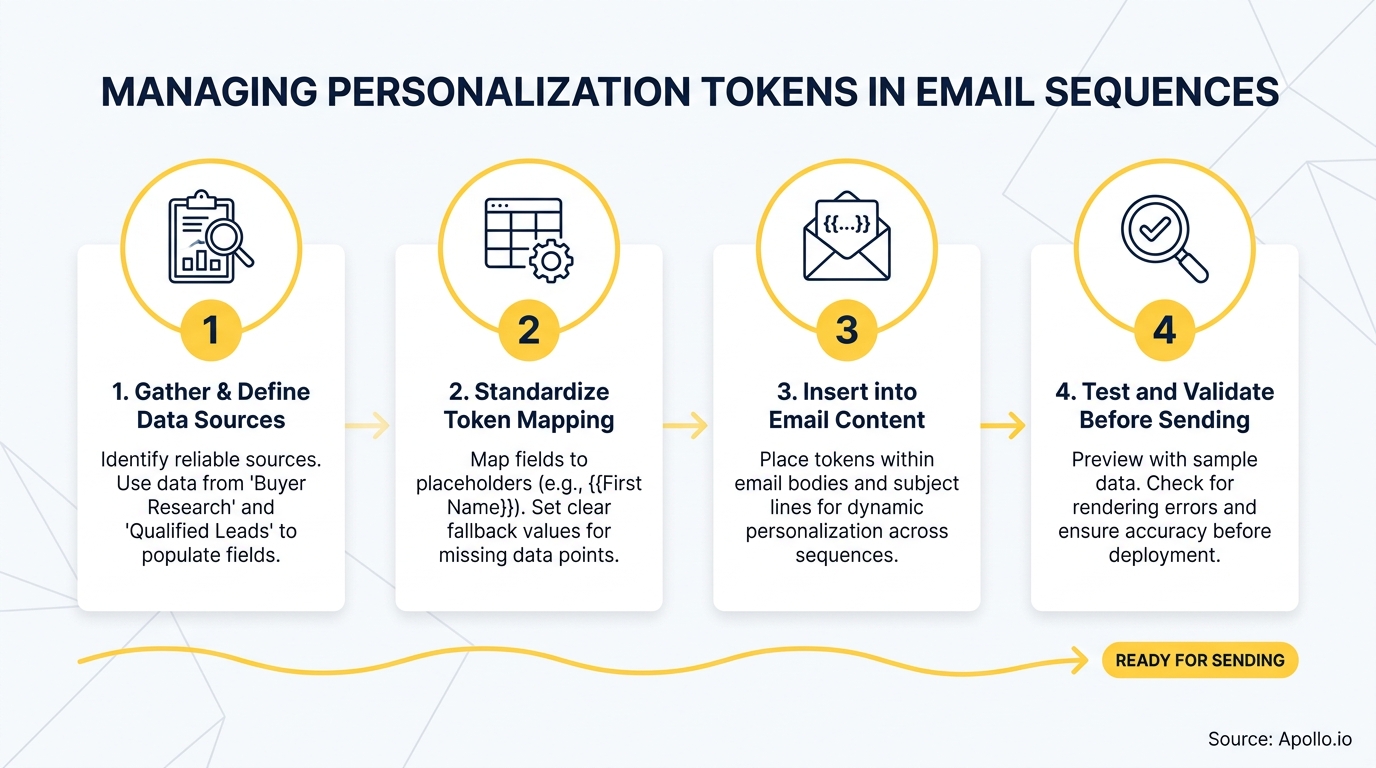
A token-to-data matrix maps every token in your sequence library to its source field, owner, acceptable completeness threshold, refresh cadence, and privacy sensitivity. Build it before writing a single email step.
| Token | Source Field | Owner | Min. Completeness | Fallback Value | Privacy Sensitivity |
|---|---|---|---|---|---|
{{first_name}} | CRM Contact | SDR / Import | 100% | "there" | Low |
{{company}} | CRM Account | RevOps | 100% | "your team" | Low |
{{job_title}} | CRM Contact / Enrichment | RevOps | 80% | Omit sentence | Medium |
{{recent_funding}} | Intent / News Feed | Data Ops | 60% | Omit step or use generic hook | Medium |
{{renewal_date}} | CRM Deal / DateTime field | AE / RevOps | 90% | Suppress enrollment | High |
HubSpot's April 2025 DateTime breaking change — where DateTime CRM properties in marketing emails began including both date and time — is a reminder that token formatting must be reviewed whenever a platform updates its field behavior. Assign a RevOps owner to audit the matrix quarterly.
What Is a Sequence QA and Fallback Playbook?
A sequence QA and fallback playbook is a pre-launch checklist that verifies every token resolves correctly, every fallback renders gracefully, and suppression rules exclude contacts with critical missing data. Run it before activating any new sequence.
Five-step QA checklist:
- Preview with test contacts: Use records with intentionally blank fields to confirm fallbacks render — not raw token syntax.
- Check completeness thresholds: If
{{job_title}}requires 80% fill rate, run a CRM report before enrolling the list. Suppress contacts below threshold or trigger enrichment. - Validate DateTime formatting: Any token pulling a date or time field must be reviewed for timezone, format (MM/DD vs. DD/MM), and whether it now includes a timestamp.
- Test subject-line tokens separately: Subject lines with broken tokens are especially damaging for email deliverability — spam filters treat erratic subjects as signals of bulk automation.
- Set suppression rules: Contacts missing required tokens (e.g., no company name for an account-specific sequence) should be excluded from enrollment automatically, not manually.
Struggling to keep your sequences clean while also scaling outreach? Automate your sequences with Apollo's multi-channel engagement platform — built-in sequence diagnostics flag token issues before they reach inboxes.
Turn Funnel Gaps Into Qualified Pipeline
Pipeline forecasting a guessing game because marketing leads never convert? Apollo surfaces high-intent prospects at the right moment, so your funnel fills with opportunities — not noise. Nearly 100K paying customers stopped guessing and started closing.
Start Free with Apollo →How Do SDRs and RevOps Teams Go Beyond First Name Tokens?
SDRs and RevOps teams move beyond {{first_name}} by using persona, lifecycle, account, and behavioral tokens that signal genuine research — not just mail merge. According to the American Marketing Association, well-personalized emails can increase revenue by up to 5.7 times, but that level of uplift requires context-rich signals, not just name insertion.
Token types by personalization depth:
- Tier 1 (Basic):
{{first_name}},{{company}},{{industry}}— universally available, low differentiation in 2026. - Tier 2 (Role/Persona):
{{job_title}},{{department}},{{team_size}}— lets you tailor value props to an AE versus a VP of Sales. - Tier 3 (Account/Lifecycle):
{{recent_funding}},{{tech_stack}},{{account_stage}},{{renewal_date}}— signals genuine account research and timing awareness. - Tier 4 (Behavioral/Intent):
{{last_content_downloaded}},{{webinar_attended}},{{product_feature_used}}— highest relevance, lowest volume, requires clean first-party data.
For RevOps leaders, Tier 3 and 4 tokens require CRM hygiene investments before they can scale. Tier 4 tokens in particular should only pull from consented, first-party signals — webinar attendance, product usage, or previous engagement — not unverifiable enrichment attributes, given rising privacy scrutiny. Our sales messaging framework shows how to structure value statements around these deeper signals.
For SDRs building outbound sequences: start with clean Tier 2 tokens, add one Tier 3 signal per sequence, and reserve Tier 4 for high-priority accounts. This approach keeps data requirements manageable while still differentiating your outreach from the 90%+ of senders already using basic personalization.

How Do I Measure and Optimize Personalization Token Performance?
Measure token performance by tracking reply rate, click rate, unsubscribe rate, and booking rate — not just open rate — broken down by which token set each sequence uses. This reveals whether a specific token is driving replies or inflating unsubscribes.
What to A/B test in token-driven sequences:
- Fallback vs. suppression: Does sending a graceful fallback outperform not sending at all when a key field is missing?
- Token placement: Subject line vs. opening line vs. call-to-action — test where the personalized signal has the most impact.
- Token depth: Tier 2 (job title) vs. Tier 3 (recent funding) — does more specific context improve reply rate for your ICP?
- Personalization density: One token per email vs. three — more tokens can feel intrusive if data quality is inconsistent.
Revalidation cadence: Audit token completeness monthly for active sequences. Quarterly, review the full token-to-data matrix for field changes, CRM updates, or new enrichment sources. Annually, retire tokens with consistently low fill rates or poor performance correlation.
Data from Instapage shows segmented and personalized emails generate 58% of all email-driven revenue — a strong argument for investing in the measurement infrastructure that tells you which token segments are actually producing results.
Tired of managing token data across disconnected tools? Keep your contact data fresh and complete with Apollo's enrichment — so your tokens always resolve with accurate, verified information.
What Are the Privacy Rules for Choosing Personalization Tokens?
Privacy-safe token selection means using consented, first-party, or clearly professional signals — and avoiding tokens that pull sensitive, unverifiable, or creepy-feeling attributes. Google's sender guidelines explicitly warn against deceptive display-name personalization and purchased-list outreach, both of which can trigger spam complaints and inbox filtering.
Approved token sources: CRM fields populated by the contact themselves (form fills, event registrations), verified firmographic data, product-usage signals from your own platform, and previous engagement history.
Avoid as token sources: Unverified third-party enrichment attributes with no clear provenance, sensitive personal details unrelated to the professional context, and fields with low confidence scores or high staleness risk.
The practical test: would the recipient find the token reference helpful and relevant, or would it feel surveillance-like? If the answer is the latter, replace it with a Tier 1 or Tier 2 token and improve relevance through better B2B email marketing segmentation instead.

Start Sending Sequences That Actually Convert
Managing personalization tokens well is a systems problem: clean data, governed token libraries, QA checklists, privacy-safe sourcing, and measurement cadences working together. SDRs get more replies.
RevOps gets fewer broken-sequence escalations. AEs get sequences that feel like genuine outreach, not automation in disguise.
Apollo consolidates your contact database, enrichment, sequencing, and analytics in one workspace — so your tokens always have verified data to pull from and your sequences have the diagnostics to prove what's working. As Cyera put it, "Having everything in one system was a game changer."
Ready to build sequences where every token resolves correctly? Start Prospecting with Apollo — free.
Prove Pipeline ROI From Day One
ROI pressure killing your tool budget before it even starts? Apollo delivers measurable pipeline impact fast — with 35% more bookings from AI-powered messaging. Nearly 100K paying customers justified the spend. Yours will too.
Start Free with Apollo →Don't miss these
Sales
Inbound vs Outbound Marketing: Which Strategy Wins?
Sales
What Is a Sales Funnel? The Non-Linear Revenue Framework for 2026
Sales
What Is a Go-to-Market Strategy? The 2026 GTM Playbook
See Apollo in action
We'd love to show how Apollo can help you sell better.
By submitting this form, you will receive information, tips, and promotions from Apollo. To learn more, see our Privacy Statement.
4.7/5 based on 9,690 reviews
