
How to Know If Your Team Is Ready for an All-in-One GTM Platform
Your team is juggling a prospecting tool, a sequencing platform, a dialer, a data enrichment service, and a CRM — and none of them talk to each other cleanly. If that sounds familiar, you're not alone. According to Bird, the average enterprise uses over 400 applications, with only 45% of them actively used. The result: fragmented data, wasted budget, and a GTM motion that slows down instead of scales up.
The question isn't whether consolidation makes sense in the abstract. The question is: is your team ready right now? This guide gives you a practical readiness framework to answer that — and a phased migration path if the answer is yes. If you're evaluating what an all-in-one GTM platform could look like for your team, start here.

Research Less, Pipeline More With Apollo
Tired of burning hours verifying contacts that go nowhere? Apollo surfaces accurate, ready-to-work leads so your reps spend time selling — not searching. Join 600K+ companies building predictable pipeline.
Start Free with Apollo →Key Takeaways
- Tool underutilization and integration debt are the clearest signals your team is ready to consolidate.
- RevOps leaders are best positioned to lead platform migration decisions — not IT or marketing alone.
- A governance-first approach (clean data, aligned definitions, permissions) prevents failed migrations.
- Companies using integrated systems grow measurably faster than those managing fragmented stacks.
- AI features underperform in fragmented environments — consolidation is now a prerequisite for effective AI.
What Are the Warning Signs That Your Stack Is Holding You Back?
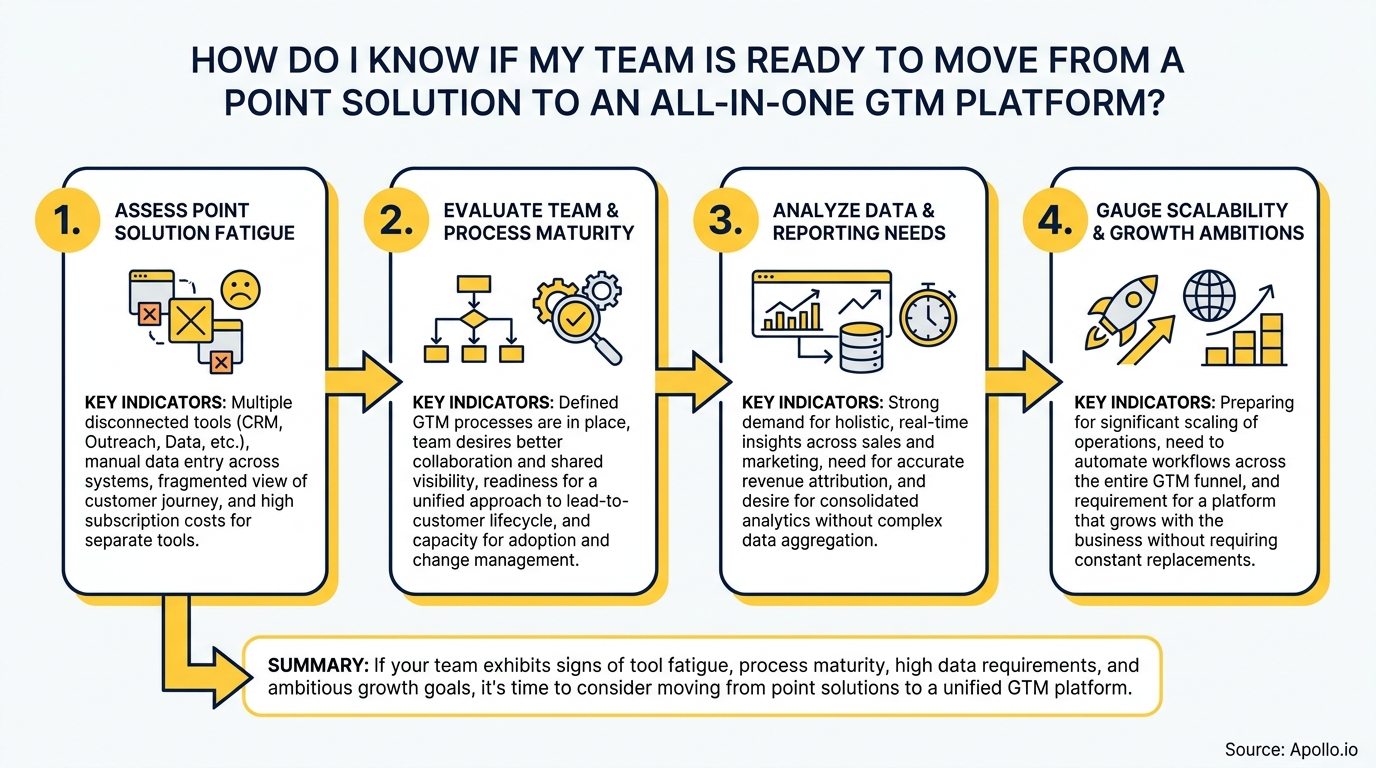
Your team is likely ready to consolidate when manual data reconciliation, duplicate contacts, and inconsistent reporting become routine problems — not occasional ones. These are structural symptoms of point-solution sprawl, not user error.
Watch for these specific signals:
- Tool overlap: Two or more tools doing the same job (e.g., two enrichment sources, two sequencing tools)
- Integration maintenance: Your RevOps team spends significant time managing Zapier workflows or API connectors just to keep data in sync
- Attribution gaps: You can't confidently answer which channel or touchpoint drove a closed deal
- Onboarding drag: New SDRs and AEs take weeks to become productive because the toolchain is complex
- AI underperformance: You've added AI point tools but results are inconsistent — a sign of fragmented data inputs
Research from Forecastio found that companies using integrated systems grow approximately 19% faster than those managing fragmented tool stacks. That gap compounds over time.
How Do You Score Your Team's Readiness for GTM Platform Migration?
A readiness scorecard helps you move from gut feel to a structured decision. Rate your team on each dimension below (1 = low, 5 = high).
| Readiness Dimension | What to Assess | Your Score (1–5) |
|---|---|---|
| Tool Utilization | What % of your current tools are actively used? | |
| Data Quality | Is your contact and account data clean and deduplicated? | |
| Definition Alignment | Do sales and marketing agree on MQL, SQL, and pipeline stage definitions? | |
| Integration Debt | How much RevOps time goes to maintaining tool connections? | |
| Governance Maturity | Are there documented data ownership rules and permission structures? | |
| Executive Alignment | Is there C-suite buy-in for a consolidation initiative? |
Scoring guide: 24–30 = Ready to migrate now. 15–23 = Ready with prerequisites. Below 15 = Fix governance and alignment first.
A 2025 Forrester C-Suite Alignment Survey, cited by Forrester, revealed that only 16% of C-level executives plan to design the right GTM approaches to help their organization reach its top business objective — a signal that misalignment at the top is a major migration risk to address before switching platforms.
Turn Funnel Guesswork Into Pipeline Clarity
Forecasts feeling like fiction while quality leads stall before they ever reach your pipeline. Apollo surfaces in-market buyers with precision so your team converts faster. Nearly 100K paying customers stopped guessing and started closing.
Schedule a Demo →What Does a Governance-First Migration Look Like in Practice?
A governance-first approach means establishing clean data structures, shared definitions, and access rules before migrating workflows — not after. Skipping this step is the most common reason platform migrations stall or fail.
Follow this three-phase sequence:
- Phase 1 — Unify data: Deduplicate contacts and accounts. Agree on a single source of truth for firmographic data. Align on MQL/SQL definitions across sales and marketing. This is where RevOps leaders earn their impact.
- Phase 2 — Consolidate workflows: Migrate sequencing, engagement, and pipeline tracking into the unified platform. Retire redundant point tools one at a time. Validate data flows before decommissioning any tool.
- Phase 3 — Activate AI: Once data is clean and workflows are unified, activate AI features. AI performs best with consistent, governed data — not fragmented inputs from disconnected systems.
This sequencing matters because, as noted above, fragmented data is the primary reason AI tools underperform. Consolidation is now a prerequisite for effective AI — not just a cost-efficiency play. If you're building out your sales tech stack, governance sequencing should be your starting point.

How Do RevOps Leaders and SDRs Experience the Transition Differently?
The impact of consolidation varies by role — and so does the resistance. Understanding both helps you build internal consensus before migration begins.
For RevOps leaders: Consolidation eliminates integration maintenance and creates a single reporting layer. Pipeline visibility improves immediately. The tradeoff is migration effort upfront — data cleanup, workflow mapping, and user training.
For SDRs and BDRs: A unified platform removes tool-switching friction. Instead of bouncing between a prospecting database, a sequencing tool, and a dialer, everything lives in one workspace. Ramp time for new reps shortens significantly. As Cyera put it: "Having everything in one system was a game changer."
For AEs and Account Executives: Pre-meeting intelligence, deal tracking, and conversation history all surface in one place. Deals move faster when context isn't scattered across tools. Census found the consolidation benefit so clear they noted: "We cut our costs in half."
Struggling to keep your pipeline visible across a fragmented stack? Get complete pipeline visibility with Apollo's deal management — one workspace for prospecting, outreach, and closing.
How Do You Build the ROI Case for Platform Consolidation?
The ROI case for moving to an all-in-one GTM platform has two sides: costs avoided and revenue enabled. Map both before presenting to leadership.
| ROI Category | What to Measure |
|---|---|
| License consolidation | Sum of all point-solution subscription costs vs. unified platform cost |
| Integration maintenance | RevOps hours per month spent managing connectors and syncs |
| Rep ramp time | Weeks to productivity for new SDRs/AEs with current stack vs. unified platform |
| Pipeline velocity | Average days from first touch to closed-won (benchmark: 192 days per Dreamdata) |
| Attribution clarity | % of closed deals with a traceable, multi-touch attribution path |
Frame consolidation as a revenue-risk initiative, not just a cost-cutting exercise. Fragmented tools create buyer-journey gaps that cost deals. Your GTM strategy should reflect the full revenue impact of unifying your stack.
Spending too much time stitching together outreach workflows across disconnected tools? Automate your sequences with Apollo's multi-channel sales engagement platform and run everything from one workspace.
What Should You Look for in an All-in-One GTM Platform?
The right platform covers prospecting, engagement, data enrichment, and pipeline management in a single unified workspace — without requiring separate modules for each capability. Evaluate platforms on these criteria:
- Database coverage: Verified business contacts with strong email accuracy
- Engagement execution: Multi-channel sequences (email, phone, and social) built natively
- Intent signals: Buyer intent data surfaced within the same platform where you act on it (see how intent data works inside Apollo)
- Pipeline and deal management: Track and manage deals without switching to a separate CRM view
- AI features: Messaging, research, and automation built on governed, unified data
- CRM integration: Bidirectional sync with your existing CRM — not a replacement, a complement
Predictable Revenue summed up what a consolidated platform actually feels like in practice: "We reduced the complexity of three tools into one." That reduction in complexity is the real productivity unlock — not just the cost savings.

Is Your Team Ready? Take the Next Step
Your team is ready to move from point solutions to an all-in-one GTM platform when tool underutilization, integration debt, and attribution gaps are routine — not exceptions. The scorecard above gives you a structured way to confirm readiness.
The three-phase migration sequence gives you a safe path forward.
Apollo brings prospecting, outreach, enrichment, intent signals, and pipeline management into a single workspace trusted by nearly 100K paying customers — including Anthropic, Smartling, and Cyera. If your team is evaluating the consolidation decision, see what the unified platform looks like firsthand.
Request a Demo and see how Apollo consolidates your sales tech stack into one high-performance GTM platform.
Prove ROI Before Budget Asks You To
ROI pressure killing your tool adoption? Apollo delivers measurable pipeline impact from day one — so justifying the investment is easy. Nearly 100K paying customers closed the loop between spend and revenue.
Start Free with Apollo →Don't miss these
Sales
Inbound vs Outbound Marketing: Which Strategy Wins?
Sales
What Is a Sales Funnel? The Non-Linear Revenue Framework for 2026
Sales
What Is a Go-to-Market Strategy? The 2026 GTM Playbook
See Apollo in action
We'd love to show how Apollo can help you sell better.
By submitting this form, you will receive information, tips, and promotions from Apollo. To learn more, see our Privacy Statement.
4.7/5 based on 9,690 reviews
