
How to Identify Decision-Makers at Any Prospect Company
Most sales reps waste time chasing a single title. But buying decisions in 2026 are made by groups, not individuals. According to Gradient Works, the average B2B deal involves 6–10 stakeholders, with enterprise deals reaching 17 or more cross-functional decision-makers. If your outbound prospecting strategy targets one name, you're already behind.
This playbook shows you how to map the full buying group, find the right entry point, and reach every stakeholder who can say yes — or sink your deal.

Research Less, Close More With Apollo
Tired of your reps burning hours on manual lead research instead of selling? Apollo surfaces verified contacts instantly so your team spends time closing, not digging. Join 600K+ companies building pipeline faster.
Start Free with Apollo →Key Takeaways
- B2B buying decisions involve multiple stakeholders across multiple departments — targeting one title is a losing strategy.
- Procurement now enters deals earlier and holds decision authority more often, so your outreach map must go beyond the business sponsor.
- Director-level champions are often the best first contact — going too high too early frequently backfires.
- Sales teams typically reach only a fraction of actual decision-makers, creating a significant pipeline gap.
- Apollo consolidates the prospecting, enrichment, and outreach tools you need to identify and engage full buying groups from one platform.
Why Is Identifying Decision-Makers So Hard in 2026?
Buying groups have grown significantly in size and complexity, making stakeholder identification harder than ever. Attainment Labs notes this represents a sharp increase from 6.8 decision-makers in 2017 and just 5.4 in 2015. Meanwhile, Forrester's 2026 State of Business Buying report found that procurement professionals are now decision-makers in 53% of buying cycles and engage from the very start — not just at contract review.
Two structural shifts are making this worse. First, GenAI features are now included in the majority of B2B software purchases, which is expanding buying groups further by adding new evaluators: AI governance, security, legal, and risk teams. Second, Databar.ai reports that sales teams typically reach only 31% of the actual decision-makers in their target accounts. That gap is where deals stall and go quiet.
What Roles Make Up a Typical B2B Buying Group?
A B2B buying group is not a single org-chart row — it spans multiple functions with distinct priorities. Use this framework to map who you need to identify at every prospect account.
| Role | Function | Primary Concern | When They Enter |
|---|---|---|---|
| Economic Buyer | Finance / CFO / VP | Budget, ROI, risk | Late stage (or early at enterprise) |
| Champion | Director / Manager | Day-to-day impact, career risk | Early — your best entry point |
| Technical Evaluator | IT / Security / Engineering | Integration, compliance, architecture | Mid stage |
| End Users | Individual contributors | Usability, workflow fit | Demo / trial phase |
| Procurement | Vendor management / Legal | Contract terms, vendor risk | Earlier than ever in 2026 |
| AI / Risk Evaluator | Compliance / Governance | Data use, AI policy, liability | New role — present in most AI-inclusive deals |
For mid-sized firms (100–500 employees), Kondo's B2B benchmarks indicate an average of 7 people are involved in buying decisions. At enterprise scale, that number climbs significantly higher.
Turn Funnel Gaps Into Closed Deals
Pipeline forecasting a guessing game because your leads never convert? Apollo surfaces high-intent prospects the moment they're ready to buy. 600K+ companies finally have a funnel they can trust.
Start Free with Apollo →How Do SDRs and AEs Find Decision-Makers Before Outreach?
SDRs and AEs should build a stakeholder map for each target account before sending a single message. The goal is to identify at least 3–5 contacts across different functions before beginning outreach sequences.
A sales professional wrote on Reddit that when building a sales program for a cybersecurity company targeting SMEs, going too high in the chain too early backfired. The CISO or CIO wasn't close enough to day-to-day pain. The better approach was establishing a director-level champion first, knowing that person would eventually pull in executive sign-off. That insight scales across most B2B deals: start with the function head, not the C-suite.
Practical pre-outreach research steps for SDRs:
- Search by department + seniority using a prospecting tool with advanced filters to find directors and VPs across IT, Finance, Operations, and the target function.
- Check job postings at the account — open roles signal budget, priorities, and who owns the decision area.
- Review press releases and news for executive hires, product launches, and org changes that reveal new stakeholders.
- Use intent data to infer which functions are actively researching — see how intent data powers smarter B2B sales.
- Ask your champion directly— once you have a first conversation, ask: "Who else will be involved in evaluating this?"
Struggling to find the right contacts at target accounts? Search Apollo's 230M+ contacts with 65+ filters to build your stakeholder map.

How Do You Find Decision-Makers at Scale?
Finding decision-makers at scale requires layering multiple data sources and applying precise title logic by company size. A sales professional shared a firsthand perspectivethat title filtering is where most outbound teams leave pipeline on the table: at small companies, the founder is often the decision-maker; at mid-market, you want the head of the specific function you're selling to. When running outbound at volume, layering multiple data providers against the same company list typically yields 60–70% coverage from one source, with a second provider adding another 15–20%.
This is exactly why Apollo's waterfall enrichment runs contacts through multiple data sources automatically, maximizing coverage without manual stacking. For RevOps leaders managing large account lists, this removes a significant manual bottleneck and gives GTM teams a fuller picture of who exists inside each account.
What Signals Reveal Hidden Stakeholders?
Hidden stakeholders reveal themselves through behavioral and contextual signals, not just form fills. Waiting for inbound hand-raises means missing most of the buying committee — Martal Group reports B2B buyers complete 70% of their journey before engaging with sales. By that point, most committee members have already formed opinions.
Non-form signals that surface buying group members:
- Account-level intent spikes — multiple employees from the same company researching related topics signals active evaluation.
- Job change alerts — a new VP of IT or Head of Procurement joining an account often triggers a new buying cycle.
- Technology installs — a company adopting a complementary or competing tool signals buying activity in your category.
- Hiring patterns — roles posted in your solution's function indicate budget and ownership.
- Funding rounds — new capital creates urgency and new decision authority (often new executives).
Pair these signals with Apollo Buying Intent to identify which accounts are actively in-market and prioritize stakeholder mapping accordingly.
How Do You Engage Multiple Stakeholders Without Losing Control of the Deal?
Engaging a buying group requires sequenced, persona-specific outreach — not the same message blasted to every title. For Account Executives managing complex deals, the goal is to activate your champion while threading in secondary stakeholders before they become blockers.
A practical multi-thread engagement approach:
- Start with your champion (director level) — build the internal case together before escalating to the economic buyer.
- Send role-specific contentto each function: ROI data for Finance, security specs for IT, workflow impact for end users. Email personalization at this level drives meaningful reply rates.
- Use multi-channel sequences — email, phone, and social touches distributed across the committee over 2–3 weeks.
- Map internal conflict early — if Finance and IT have competing priorities, address both explicitly before your demo. Gartner found that buying groups reaching internal consensus are significantly more likely to report a high-quality deal outcome.
- Track engagement by stakeholder — monitor who opens, clicks, and replies to identify who is engaged and who needs attention.
For data-driven prospecting at this level of complexity, Apollo's sales engagement platform lets you run separate sequences for each stakeholder persona within the same account, all from one workspace.
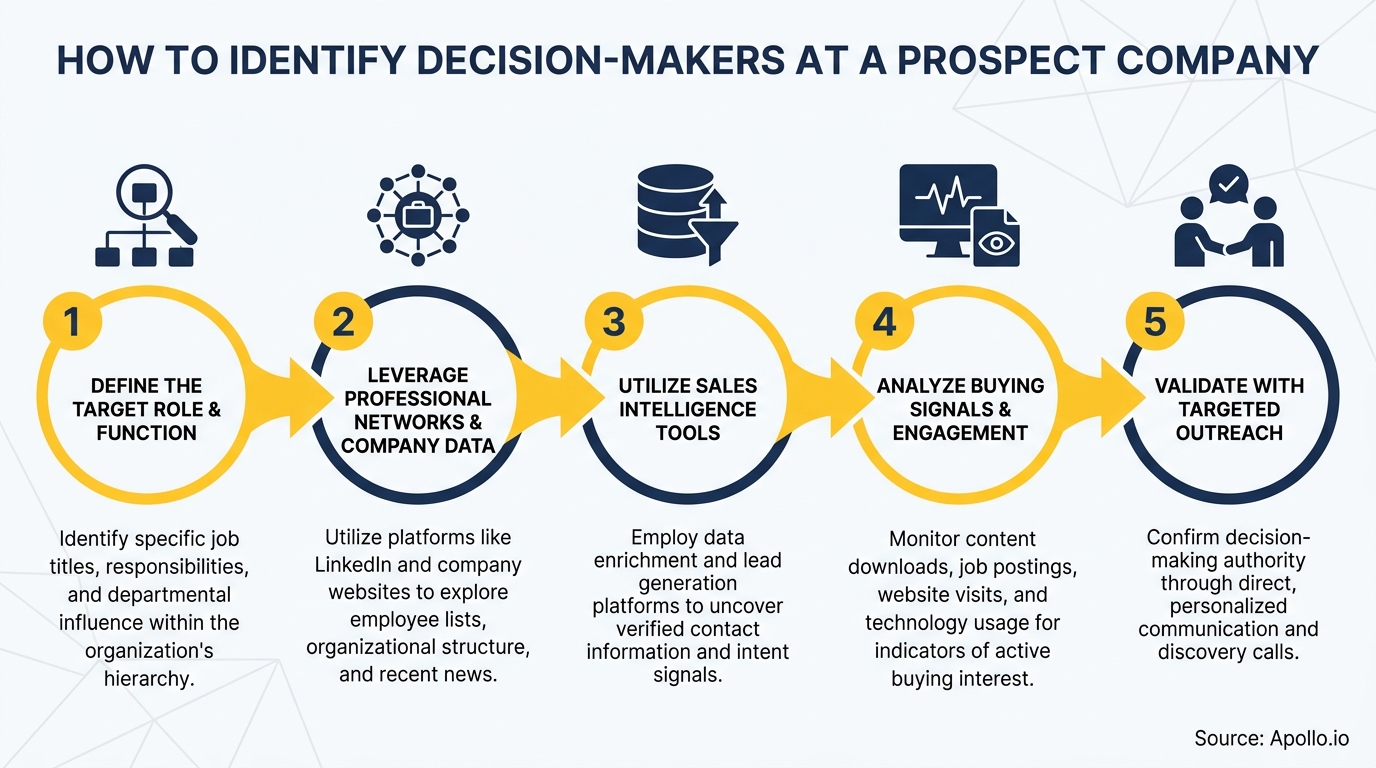
How to Identify Decision-Makers at a Prospect Company: The 2026 Playbook
Identifying decision-makers now means building a buying group map before you send your first message. Here is the repeatable process for SDRs, AEs, and RevOps teams to follow for every target account.
- Define your ICP-specific buying group template — for your deal type, list the 4–6 functions that typically own the decision.
- Search for contacts by function and seniority — use filters for title, department, company size, and location to find the right names.
- Layer intent and signal data — prioritize accounts showing active buying behavior in your category.
- Identify your champion first — target the director or senior manager closest to the problem you solve.
- Enrich your list for completeness — run waterfall enrichment to fill gaps across your stakeholder map.
- Build persona-specific sequences — craft outreach tailored to each role's priorities and concerns.
- Ask discovery questions that surface the committee — "Who else is involved?" and "What does sign-off look like?" are non-negotiable early questions.
"Having everything in one system was a game changer" — Cyera. For GTM teams running this process at scale, Apollo combines the contact database, enrichment, intent signals, and multi-channel sequences in a single platform, eliminating the tool-switching that slows stakeholder mapping down.

Start Mapping Your Buying Groups Today
Identifying decision-makers is no longer about finding one title — it is about mapping a full buying group before your first touch. The teams that reach more stakeholders earlier close more deals and face fewer late-stage surprises.
Apollo gives SDRs, AEs, and RevOps teams everything needed to build stakeholder maps at scale: 230M+ verified contacts, 65+ search filters, waterfall enrichment, intent signals, and multi-channel sequences — all in one workspace. As Predictable Revenue put it, "We reduced the complexity of three tools into one."
Try Apollo free and start identifying every decision-maker at your target accounts today.
Prove Pipeline ROI With Apollo
ROI pressure killing your tool budget? Apollo delivers measurable pipeline impact your leadership can actually see. Leadium 3x'd their annual revenue — start your free trial and show results fast.
Start Free with Apollo →Don't miss these
Sales
Inbound vs Outbound Marketing: Which Strategy Wins?
Sales
What Is a Sales Funnel? The Non-Linear Revenue Framework for 2026
Sales
What Is a Go-to-Market Strategy? The 2026 GTM Playbook
See Apollo in action
We'd love to show how Apollo can help you sell better.
By submitting this form, you will receive information, tips, and promotions from Apollo. To learn more, see our Privacy Statement.
4.7/5 based on 9,690 reviews
