
How Do I Find Companies in a Specific Geographic Region? A 2026 Playbook
Finding companies in a specific geographic region used to mean cold-calling chamber of commerce directories or buying outdated lists. In 2026, the fastest GTM teams combine official government datasets, B2B sales intelligence platforms, and geo-filtered outreach to build precise regional target lists in under an hour. Whether you're an SDR mapping a new territory or a RevOps leader designing county-level ICP segments, this playbook gives you a repeatable, data-backed workflow. And since outbound prospecting effectiveness depends entirely on list quality, getting the geo layer right is non-negotiable.

Research Less, Close More With Apollo
Tired of your reps burning hours hunting down contact info instead of selling? Apollo surfaces verified prospects instantly so your team spends time closing, not researching. Join 600K+ companies building pipeline faster.
Start Free with Apollo →Key Takeaways
- Official government datasets (CBP, QCEW, BEA) let you size a regional market before spending a single outreach credit.
- Combining county-level NAICS filtering with firmographic segmentation dramatically reduces irrelevant outreach and improves reply rates.
- SDRs and RevOps teams that standardize geo search definitions across the team outperform reps who build individual filter stacks from scratch.
- Map-based prospecting is merging with classic B2B databases, making it easier to surface regional SMBs that static lists miss.
- The winning workflow closes the loop: geo discovery, enrichment, and outreach all inside one platform, with no CSV exports required.
What Are the Best Free Sources to Find Companies by Region?
The best free sources for finding companies by geographic region are official government datasets: the U.S. Census Bureau's County Business Patterns (CBP), the Bureau of Labor Statistics Quarterly Census of Employment and Wages (QCEW), and the Bureau of Economic Analysis (BEA) GDP by County data.
- CBP API: Returns establishment counts, employment, and payroll by county, MSA, or ZIP code, filterable down to 6-digit NAICS codes. Use it to size a market before prospecting.
- BLS QCEW: Covers county-level employment and wages by industry. Useful as a universe baseline to cross-check your target count against real-world coverage.
- BEA County GDP: Shows which counties are growing versus contracting. In 2024, real GDP increased in 2,273 U.S. counties and decreased in 809, giving you a data-driven way to rank regions by economic momentum rather than relying on anecdotal city lists.
A government professional with over two decades of state-level experience wrote on Reddit that every business in each U.S. state is typically required to report its name, address, employee count, and NAICS code annually to their state's Workforce Services agency. That data is often publicly accessible and free, making it one of the most underused sources for geographic and industry filtering.
How Do SDRs Build a Regional Target List Fast?
SDRs build regional target lists fastest by combining a geo-filtered B2B database with firmographic criteria, then validating coverage against a public dataset like CBP before launching sequences.
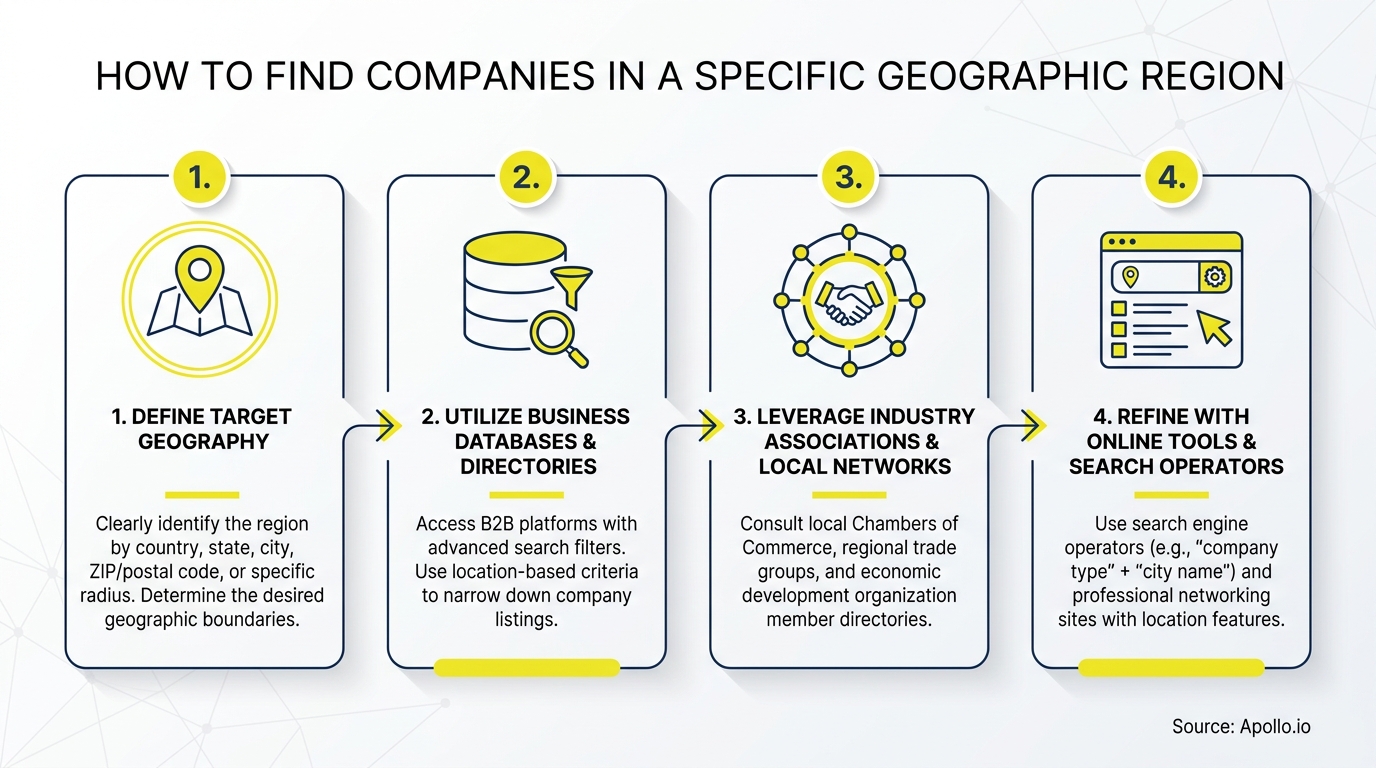
Here is a practical five-step workflow:
- Define the geography precisely. Use county or ZIP code, not just city or state. County-first targeting outperforms city-level lists because it maps cleanly to NAICS and economic data.
- Pull a market size estimate. Query the CBP API for establishment counts in your target county and NAICS code. This tells you how many companies exist before you build your list.
- Apply firmographic filters. Layer in employee count, revenue range, and technology signals to narrow to ICP-fit accounts within the region.
- Enrich and verify contacts. Pull decision-maker contacts with verified business email and phone. Poor contact data kills regional campaigns before they start.
- Sequence without exporting. Launch outreach directly from the platform. Every CSV export introduces data decay and breaks the audit trail.
Struggling to find qualified regional leads without rebuilding your filter stack every time? Search Apollo's 230M+ contacts with 65+ filters, including precise geographic segmentation.
Turn Funnel Guesswork Into Pipeline Wins
Tired of watching marketing leads die before they ever reach your pipeline? Apollo surfaces high-fit prospects with verified contact data so every rep works accounts that actually convert. Nearly 100K paying customers stopped guessing and started closing.
Start Free with Apollo →How Do You Validate Regional Data Quality Before Outreach?
Validate regional data by cross-referencing your prospect list count against CBP establishment figures for the same county and NAICS code. If your list shows 400 companies in a county where CBP reports 120 establishments, you likely have duplicate records or misclassified headquarters.
If your list shows 30 companies where CBP reports 400, your filters are too narrow or your data source has coverage gaps.
Key validation checks to run:
- Suppression awareness: CBP suppresses counts for counties with fewer than three establishments in a NAICS category to protect business privacy. Suppressed cells are marked with a flag code. Do not assume zero means no companies exist.
- HQ vs. location filtering: A national company with a regional office may have its headquarters in a different state. Filter by office location, not just HQ address, when building field-sales or regional-channel lists.
- Cross-check with QCEW: BLS QCEW covers more than 95% of U.S. jobs at the county level. Use it to verify that your target industry is actually employed in the region at scale.
A Reddit user shared a firsthand perspective that Data Axle's Reference Solutions database is accessible for free through many public library systems, including remotely via library cards like NYPL, making it a useful cross-check for regional company lists without any additional software cost.

Why Does Geographic Precision Matter for B2B Outreach?
Geographic precision matters because irrelevant outreach actively damages pipeline. A Gartner survey of 632 B2B buyers found that 73% actively avoid suppliers who send irrelevant outreach, and 61% prefer a buying experience with no sales rep involvement at all.
Sending a generic regional blast to the wrong companies does not just produce zero replies. It generates negative brand signals with buyers who were otherwise reachable.
Research from Sellers Commerce shows that 64% of new-age B2B buyers prefer digital channels over traditional outreach. That means your geo-targeted list needs to be precise enough to support personalized, channel-appropriate messaging rather than spray-and-pray volume.
Pairing geographic filters with intent data signals is the fastest way to prioritize which regional accounts are actively in-market, so you sequence the right companies first.
How Do RevOps Teams Standardize Geographic Prospecting Across Reps?
RevOps teams standardize geographic prospecting by creating shared search definitions that encode the territory's geo filters, NAICS codes, and firmographic criteria, then distributing those definitions to all reps rather than letting each SDR rebuild the logic independently.
In 2026, a key trend is that territory definitions are becoming shareable assets. Instead of every rep learning 30 boolean filters from scratch, teams publish a standardized geo search, sync it to the CRM, and measure performance consistently across the territory.
This also makes coverage gaps visible at the account level rather than only at the rep level.
| Approach | Setup Time | Consistency | CRM Sync |
|---|---|---|---|
| Each rep builds own geo filters | High per rep | Low | Manual |
| Shared search definitions (team-wide) | Low per rep | High | Automated |
| Shared searches + geo enrichment workflow | Minimal | Highest | Automated + auditable |
For Account Executives managing multi-county territories, having a single shared search definition also means pre-meeting intelligence pulls from the same ICP criteria that generated the account, reducing misalignment between prospecting and closing motions. Explore how sales automation can operationalize these shared workflows at scale.
How Does Map-Based Prospecting Work for Regional B2B Discovery?
Map-based prospecting works by using a geographic interface to identify companies within a defined radius or territory boundary, then enriching those results with B2B firmographic and contact data for outreach.
This approach is gaining ground in 2026 because map-first discovery surfaces regional SMBs and local operators that are underrepresented in static B2B databases. Field sales teams, channel account managers, and regional expansion teams benefit most: they can drop a pin, set a radius, and see what accounts exist in a drive zone before ever opening a spreadsheet.
According to MapLabs, "near me" Google mobile searches increased by over 500% in the past two years, indicating that local and geographic intent is a dominant discovery pattern across both consumer and professional contexts. B2B teams that incorporate location-first prospecting into their GTM motion are capturing a discovery surface their competitors are still ignoring.
Ready to turn geographic discovery directly into pipeline without exporting a single CSV? Build your regional pipeline in Apollo's unified GTM platform, where geo search, enrichment, and sequencing live in one workspace.

Start Finding Regional Companies and Closing Deals Faster
Finding companies in a specific geographic region is no longer a manual research task. The teams winning in 2026 combine government market-sizing data (CBP, QCEW, BEA) with a B2B sales intelligence platform to produce validated, ICP-fit regional lists, then sequence directly from the same tool without any data leaving the workflow.
The consolidation advantage matters here. As Cyera noted, "having everything in one system was a game changer." When geo discovery, contact enrichment, and multi-channel outreach live in a single platform, coverage is measurable, ramp time drops, and no accounts fall through the cracks between tools.
Apollo gives SDRs, AEs, RevOps leaders, and founders a single workspace for geographic prospecting across 230M+ contacts and 30M+ companies, with 65+ filters including precise location, industry, and company size. Trusted by nearly 100K paying customers including Anthropic, Smartling, and Redis.
Start Prospecting and build your first regional target list today, free.
Prove Pipeline ROI Faster With Apollo
ROI pressure making budget approvals impossible? Apollo delivers measurable pipeline impact from day one — no lengthy ramp required. Leadium 3x'd annual revenue. See your ROI before the next budget cycle.
Start Free with Apollo →Don't miss these
Sales
Inbound vs Outbound Marketing: Which Strategy Wins?
Sales
What Is a Sales Funnel? The Non-Linear Revenue Framework for 2026
Sales
What Is a Go-to-Market Strategy? The 2026 GTM Playbook
See Apollo in action
We'd love to show how Apollo can help you sell better.
By submitting this form, you will receive information, tips, and promotions from Apollo. To learn more, see our Privacy Statement.
4.7/5 based on 9,690 reviews
