
How to Evaluate Platforms That Support Agentic GTM Workflows
Gartner warned in June 2025 that more than 40% of agentic AI projects may be canceled by end of 2027, citing expectation gaps and governance failures. Yet Forrester's State of Customer Obsession Survey, 2025 found 88% of B2B organizations are either adopting or planning to adopt AI agents. The gap between adoption intent and successful deployment comes down to one thing: how you evaluate platforms before you buy.
If you're a RevOps leader, SDR manager, or GTM executive trying to assess agentic GTM platforms, this framework gives you the criteria, scorecard, and governance questions that prevent costly project failures. Before investing, also review how to build a sales tech stack that scales revenue, since agentic platforms must fit into your existing architecture.

Let Apollo Do The Research For You
Tired of your reps burning hours on manual lead research instead of selling? Apollo surfaces verified contacts instantly, so your team spends time closing — not digging. Join 600K+ companies building pipeline faster.
Start Free with Apollo →Key Takeaways
- Evaluate agentic GTM platforms on orchestration depth, governance controls, and CRM integration, not just AI feature lists.
- ROI timelines are shorter than most expect: measurable results often appear within 30 to 60 days of deployment.
- Governance and auditability are now procurement-level requirements, not IT afterthoughts.
- Tool consolidation is a primary financial justification: fewer platforms mean lower overhead and faster team ramp.
- RevOps leaders and SDR managers should run a structured pilot before full deployment to validate pipeline impact.
What Is an Agentic GTM Platform?
An agentic GTM platform is a system where AI agents autonomously execute multi-step go-to-market tasks, such as prospecting, sequencing, enrichment, and follow-up, without requiring manual triggers at each step. Unlike basic automation tools, agentic platforms make contextual decisions, call external tools, and adapt workflows based on real-time signals.
This is a meaningful distinction from standard sales automation. Standard automation runs predefined rules. Agentic systems reason across data sources, take actions, and escalate to humans only when thresholds are crossed. As you build or refine your go-to-market strategy, understanding this distinction shapes which platform capabilities actually matter for your team.
Why Is Agentic GTM Platform Evaluation Different in 2026?
Agentic GTM evaluation is different because you are effectively procuring a workforce, not a tool. Each agent you deploy makes decisions, sends communications, and affects pipeline.
The evaluation stakes are higher than selecting a CRM integration or email sequencer.
The market reflects this urgency. According to Bayelsa Watch, the global agentic AI workflows market was valued at USD 5.2 billion in 2024 and is projected to reach USD 227 billion by 2034. Vendors are racing to capture this market, which means marketing claims outpace actual capability. A structured evaluation framework is your only protection against overpromising vendors.
Recent platform moves add urgency. In February 2026, Adobe and WPP expanded their partnership around agentic AI workflows for marketing ops.
In March 2026, Microsoft Copilot introduced agent lifecycle management positioning. Salesforce launched Agentforce 360 in October 2025.
Every major platform is repositioning around agentic orchestration, making differentiation harder to assess without a clear scorecard.

How Do RevOps Leaders Score Agentic GTM Platforms?
RevOps leaders evaluate agentic GTM platforms using six core capability dimensions, scored before any vendor demo. Use this scorecard during procurement to force apples-to-apples comparisons.
| Evaluation Dimension | What to Assess | Minimum Requirement |
|---|---|---|
| Orchestration Depth | Can agents chain multi-step tasks with conditional logic? | Yes, with branching and fallback paths |
| Data Quality and Enrichment | Does the platform verify and enrich contact data automatically? | Real-time enrichment with accuracy guarantees |
| Governance and Auditability | Are agent actions logged, reviewable, and reversible? | Full audit trail with human override controls |
| CRM and Stack Integration | Does it sync bidirectionally with your CRM and engagement tools? | Native CRM sync, not webhook-only |
| Pipeline Attribution | Can you trace pipeline influenced by each agent workflow? | Agent-level attribution reporting |
| Consolidation Potential | Does it replace point tools in your current stack? | Eliminates at least one existing tool subscription |
Struggling to build and qualify pipeline while evaluating new platforms? See how Apollo's pipeline tools help GTM teams qualify faster.
Fill Your Funnel With Buyers Who Convert
Running out of qualified leads before the quarter ends? Apollo surfaces in-market prospects aligned to your ICP, so your pipeline stays full — not just busy. Nearly 100K paying customers use Apollo to turn outreach into opportunities.
Start Free with Apollo →What Governance Criteria Should SDR Managers Require?
SDR managers must require governance controls that define what agents can do autonomously and what requires human approval before execution. Without these guardrails, agents can send off-brand messages, contact unqualified prospects, or exceed outreach frequency limits.
Key governance requirements to verify during vendor evaluation:
- Permission levels: Can you restrict agent actions by role, territory, or account tier?
- Approval queues: Does the platform support human-in-the-loop review before high-stakes actions?
- Audit logs: Are all agent decisions timestamped and exportable for compliance review?
- Rate controls: Can you cap outreach volume per agent per day?
- Rollback capability: Can you reverse agent actions if a workflow produces bad outputs?
Governance is not a feature, it is a procurement requirement. Any platform that cannot answer all five questions above with a live product demo should be eliminated from consideration.
How Do You Assess ROI Before Committing to a Platform?
Assess ROI by establishing a pre-deployment baseline across three metrics: average meetings booked per rep per week, pipeline created per SDR per quarter, and cost per qualified lead. Then require vendors to demonstrate platform-enabled deltas against those baselines in a time-bound pilot.
Research from monday.com indicates agentic AI customers typically observe measurable results within 30 to 60 days of deployment, which means a 45-day pilot is sufficient to generate real performance data before a full contract commitment. Meanwhile, data from WalkMe shows 71% of businesses utilizing AI in marketing and sales reported revenue gains, which sets a reasonable ROI benchmark to hold vendors accountable against.
Structure your pilot around a single workflow: for example, inbound lead enrichment and follow-up sequencing. Measure output against your baseline. If the platform cannot demonstrate measurable improvement within the pilot window, do not proceed to full deployment. This pilot-first approach also surfaces integration failures before they affect your full CRM and tech stack. For context on what a high-performing GTM strategy looks like as a comparison baseline, review your current funnel metrics before starting any pilot.
How Does Tool Consolidation Factor Into Platform Selection?
Tool consolidation is a primary financial justification for switching to an agentic GTM platform. Every point tool you eliminate reduces integration maintenance, per-seat licensing costs, and onboarding complexity for new reps.
When evaluating consolidation potential, map your current stack against the platform's native capabilities:
- Does it replace your standalone prospecting tool?
- Does it include native sequencing and multi-channel outreach?
- Does it provide built-in sales automation without requiring a separate vendor?
- Does it enrich and verify contact data natively?
- Does it include conversation intelligence or call management?
Apollo consolidates prospecting, sequencing, enrichment, AI automation, and pipeline management in a single workspace. Customers report measurable stack simplification: "We reduced the complexity of three tools into one" (Predictable Revenue), "We cut our costs in half" (Census), and "Having everything in one system was a game changer" (Cyera).
Spending hours coordinating manual outreach across disconnected tools? See how Apollo's AI sales automation unifies your GTM execution in one platform.
What Does a Practical Agentic GTM Evaluation Checklist Look Like?
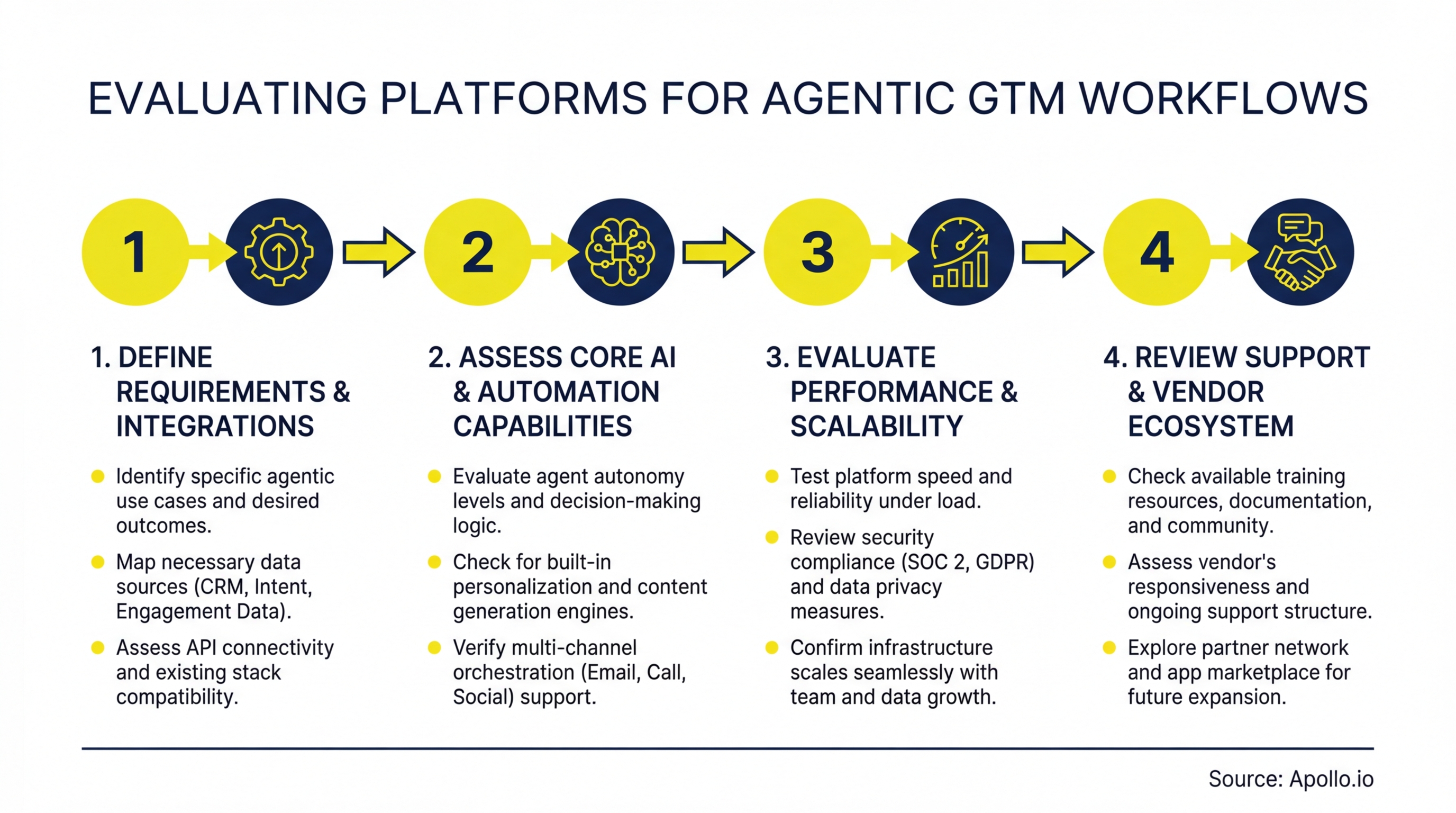
A practical evaluation checklist covers capability, governance, integration, and commercial terms before any purchasing decision. Use this checklist during vendor discovery calls and technical reviews.
Capability
- Agents execute multi-step workflows with conditional branching
- Platform supports tool-calling across CRM, email, and enrichment APIs
- Agents adapt behavior based on prospect signals, not just static rules
Governance
- Full audit log of all agent decisions and actions
- Human-in-the-loop approval for high-risk actions
- Role-based permission controls for agent scope
Integration
- Bidirectional CRM sync (not webhook-only)
- Native connectors to your existing engagement and enrichment tools
- API access for custom workflow extensions
Commercial
- Pilot available before full contract commitment
- Pricing model is transparent and scales predictably
- Vendor provides baseline-to-outcome ROI reporting
For teams refining their outbound execution alongside platform evaluation, review proven approaches to building lead lists that convert to ensure your agent workflows have high-quality inputs to work with.
How Do You Choose the Right Agentic GTM Platform in 2026?
Choose an agentic GTM platform by running a structured pilot against a defined baseline, scoring vendors on the six capability dimensions above, and requiring full governance documentation before signing. The platforms that survive this process are the ones built for production, not demos.
The agentic GTM category is moving fast. Landbase reports that as of 2025, 79% of organizations report some level of AI agent adoption, with 96% planning to expand usage. The question is no longer whether to adopt, it is which platform to trust with autonomous execution of your pipeline.
Apollo's unified platform gives GTM teams prospecting, sequencing, enrichment, AI automation, and pipeline management without stitching together multiple vendors. Nearly 100K paying customers use Apollo to run agentic-ready workflows at scale, and the platform's workflow automation engine supports the multi-step, conditional logic that agentic GTM requires.
Ready to see what agentic GTM execution looks like in a single unified workspace? Try Apollo free and run your first agentic workflow today.
Prove Pipeline ROI Before Next QBR
ROI pressure killing your tool budget before you can scale? Apollo delivers measurable pipeline outcomes your exec team can see. Leadium 3x'd annual revenue — start your free trial today.
Start Free with Apollo →Don't miss these
Sales
Inbound vs Outbound Marketing: Which Strategy Wins?
Sales
What Is a Sales Funnel? The Non-Linear Revenue Framework for 2026
Sales
What Is a Go-to-Market Strategy? The 2026 GTM Playbook
See Apollo in action
We'd love to show how Apollo can help you sell better.
By submitting this form, you will receive information, tips, and promotions from Apollo. To learn more, see our Privacy Statement.
4.7/5 based on 9,690 reviews
