
How to Evaluate Email Verification and Deliverability Features in a Sales Tool (2026)
Your outreach is only as good as your inbox placement. And in 2026, mailbox providers are enforcing authentication and complaint-rate rules more aggressively than ever — meaning the deliverability features in your sales tool are now a security and revenue issue, not just a technical checkbox.
Before you commit to any platform, you need a framework to separate real capability from marketing claims. This guide gives you exactly that, with benchmarks, evaluation criteria, and a buyer's checklist to apply during your next tool review.
Whether you're an SDR sending cold sequences or a RevOps leader standardizing your outbound stack, understanding why emails land in spam and how to fix it starts with choosing a tool built to protect your domain reputation from day one.

Let Apollo Find Your Next Buyer
Tired of burning hours verifying contacts that go nowhere? Apollo surfaces accurate, ready-to-engage prospects so your team sells instead of searches. Over 600K companies have already made the switch.
Start Free with Apollo →Key Takeaways
- Inbox placement rate is the KPI that matters — delivery rate alone masks significant spam-folder risk.
- Email verification is no longer a one-time list-cleaning step; it requires continuous re-verification and automatic suppression.
- SPF, DKIM, and DMARC support are now non-negotiable table stakes enforced by major mailbox providers.
- SDRs and RevOps teams should test vendor claims independently using Google Postmaster Tools, not vendor dashboards alone.
- A consolidated GTM platform that combines verified data, engagement, and deliverability controls reduces tech stack complexity and domain risk.
Why Is Email Deliverability a Security Issue, Not Just a Technical One?
Email deliverability failures cost real revenue and expose your domain to reputational damage that compounds over time. According to Blueoshan, businesses are losing over $500K annually due to emails landing in spam. That figure doesn't account for the pipeline opportunities never generated because prospects simply never saw your message.
The security dimension is equally serious. Mailbox providers have tightened policies precisely because email is a primary vector for fraud and compromise.
Any tool sending volume from your domain inherits that scrutiny. A sales platform without governance controls — authentication visibility, abuse monitoring, complaint dashboards — is a liability, not just a limitation.
Evaluate deliverability features through this lens:does this tool protect my domain, or just help me send more email?
What Is the Difference Between Delivery Rate and Inbox Placement Rate?
Delivery rate measures whether an email was accepted by the receiving server; inbox placement rate measures whether it actually reached the inbox (not spam or promotions). These are fundamentally different metrics, and most vendors report delivery rate because it looks better.
Research from SQ Magazine shows that B2B email deliverability rates averaged 84.3% in 2025 — meaning roughly 1 in 6 legitimate emails never reached an inbox. A tool can report a 98%+ delivery rate while your actual inbox placement sits significantly lower. Always ask vendors to demonstrate inbox placement rates, not just delivery rates, using independent measurement.
Mailreachnotes that B2B cold outreach senders face particular risk: contacting non-subscribers means even small complaint rates can damage domain reputation quickly. This makes verification and suppression features critical for any outbound motion.
What Features Should You Evaluate in a Sales Tool's Verification System?
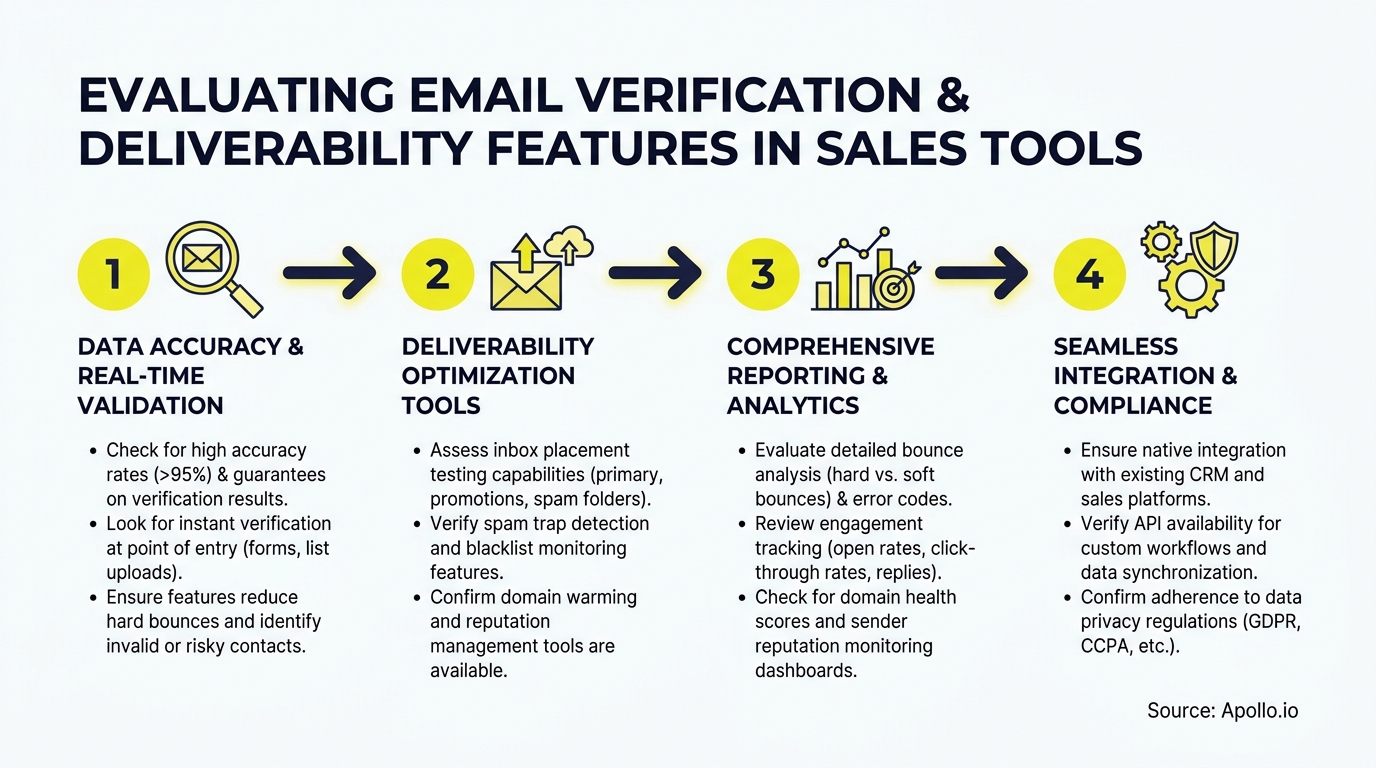
A strong verification system validates contacts continuously, not just at import. Look for these capabilities when assessing any tool:
| Feature | What to Look For | Why It Matters |
|---|---|---|
| Syntax and format validation | Real-time checks before sequences launch | Prevents basic bounce errors |
| MX record verification | Confirms the domain actively receives mail | Filters dead domains before sending |
| SMTP verification | Mailbox-level confirmation without sending | Reduces hard bounces at scale |
| Continuous re-verification | Automatic re-checks on aged contacts | Prevents reputation decay over time |
| Automatic suppression | Removes bounced/complained addresses instantly | Keeps complaint rates below provider thresholds |
| Catch-all domain handling | Flags or segments risky catch-all addresses | Avoids false confidence in unverifiable mailboxes |
For SDRs running always-on outbound sequences, automatic suppression is the highest-leverage feature. A single bad bounce cluster can suppress your domain's sending reputation for weeks. Learn more about how to verify email addresses for B2B sales to understand the full verification stack.
Tired of bounced emails damaging your domain? Start free with Apollo's 230M+ verified business contacts, built with 97% email accuracy.
Turn Funnel Gaps Into Closed Deals
Pipeline forecasting a guessing game because leads stall before they ever become opportunities? Apollo surfaces high-intent prospects and keeps your pipeline honest. Nearly 100K paying customers stopped guessing and started closing.
Start Free with Apollo →How Do SDRs and RevOps Teams Evaluate Authentication and Compliance Controls?
SDRs and RevOps leaders should treat authentication support — SPF, DKIM, and DMARC alignment — as a baseline requirement, not a premium feature. Google and Yahoo enforced bulk sender requirements in early 2024 that made these authentication standards mandatory for high-volume senders.
Any sales tool that doesn't surface authentication status or guide proper domain setup is creating invisible risk for your team.
When evaluating a tool, ask these specific questions:
- Does the platform surface SPF/DKIM/DMARC alignment status in the UI, or require manual DNS checks?
- Does it support custom sending domains with full authentication, or only shared IP pools?
- Does it provide domain warm-up controls and daily sending limits to prevent reputation spikes?
- Can you see spam complaint rates per domain or sending identity — not just aggregate bounce rates?
- Does it integrate with Google Postmaster Tools or equivalent mailbox-provider telemetry?
RevOps leaders managing multi-rep teams face compounded risk: one rep's poorly configured sequence can affect the entire organization's domain reputation. Governance controls — per-user sending limits, sequence approval workflows, suppression list enforcement — are essential at scale. Reference this guide on improving email deliverability with sequence diagnostics for a practical implementation checklist.

How Do You Validate Vendor Deliverability Claims Independently?
Validate vendor deliverability claims by running parallel inbox-placement tests using independent seed-list tools, then cross-referencing with Google Postmaster Tools data from your own domain. Vendor dashboards report what the vendor measures — not necessarily what mailbox providers observe.
A practical three-step validation approach:
- Baseline your current domain reputation in Google Postmaster Tools before switching or adding a tool. This gives you a clean before-and-after comparison.
- Run a pilot sequence through the candidate tool with a small segment (100-300 contacts) and monitor bounce rates, spam complaint signals, and reply rates simultaneously.
- Compare inbox placement via seed testing using a third-party inbox placement tool, not the vendor's built-in reporting. Note that seed tests simulate placement, not actual recipient behavior — treat them as directional, not definitive.
One important caveat: Google Postmaster Tools suppresses data at low send volumes, meaning small pilots may not generate actionable signal. If your program is low-volume, prioritize hard bounce rate, reply rate, and unsubscribe patterns as proxy indicators of deliverability health. Martal notes that a good deliverability benchmark for top performers is 95%+, giving you a concrete target to validate against during any pilot.
What Does a Buyer's Checklist for Deliverability Features Look Like?
Use this checklist when evaluating any sales tool's deliverability and verification capabilities:
- Verification: Real-time SMTP verification, catch-all flagging, continuous re-verification, automatic suppression post-bounce
- Authentication: SPF/DKIM/DMARC alignment surfaced in UI, custom sending domain support, warm-up governance controls
- Complaint management: Spam complaint rate visibility by domain, one-click unsubscribe enforcement, feedback loop integration
- Telemetry: Google Postmaster Tools integration or equivalent, per-domain reputation signals, bounce categorization (hard vs. soft)
- Governance: Per-user sending limits, sequence approval workflows, suppression list enforcement across all users
- Reporting: Inbox placement rate (not just delivery rate), reply rate correlation with deliverability signals, historical trend data
For teams building a scalable outbound motion, these features shouldn't exist in a standalone deliverability tool bolted onto your stack. The most efficient setup consolidates verification, engagement, and analytics in one place. As Cyera put it: "Having everything in one system was a game changer." See how to build a sales tech stack that scales revenue with fewer, more capable tools.
Spending hours managing bounce lists and suppression across disconnected tools? Apollo's sales engagement platform handles verification, sequencing, and deliverability controls in one unified workspace.
How Does Apollo Handle Email Verification and Deliverability?
Apollo combines a 230M+ contact database with 97% email accuracy, built-in sequence diagnostics, and deliverability controls in a single GTM platform. Rather than managing separate tools for data enrichment, email verification, and outreach automation, Apollo gives SDRs, AEs, and RevOps teams one workspace where verified contacts flow directly into governed sequences.
Key deliverability-related capabilities in Apollo include:
- Contact-level email verification before sequences launch
- Automatic bounce suppression and list hygiene
- Sequence-level diagnostics to identify deliverability issues before they escalate
- Multi-channel engagement (email, phone, and social) to reduce over-reliance on any single channel
- CRM integrations that keep suppression lists synchronized across systems
For teams writing outreach that needs to actually reach inboxes, pairing strong deliverability controls with well-crafted messaging is the full equation. See how to write sales emails that get responses once your deliverability foundation is solid. And for personalization that improves engagement signals, email personalization strategies help lift reply rates — a positive signal that reinforces inbox placement over time.

How Do You Make the Final Decision on a Sales Tool's Deliverability Features?
Choose a sales tool based on deliverability and verification features by prioritizing inbox placement transparency, authentication controls, and continuous verification over vanity metrics like delivery rate. Any tool that can't show you domain-level complaint rates, doesn't support custom authenticated sending domains, or treats verification as a one-time import step is a long-term liability for your outbound program.
The strongest evaluation outcome isn't finding the tool with the best marketing claims — it's finding the tool where deliverability, verification, and governance are deeply integrated with the rest of your GTM workflow. That's the difference between protecting your pipeline and unknowingly eroding it.
Ready to run outbound on a platform built with deliverability-first data? Try Apollo Free and see how verified contacts, sequence diagnostics, and engagement analytics work together in one consolidated platform.
Prove Pipeline ROI With Apollo
Budget approval stuck on unclear metrics? Apollo delivers measurable pipeline impact — quantifiable wins your leadership can see fast. Nearly 100K paying customers justified the investment and never looked back.
Start Free with Apollo →Don't miss these
Data
How to Structure a Marketing Team That Actually Drives Revenue in 2026
Data
Solving Data Synchronization Headaches Across Multiple Business Systems
Data
What Marketing Metrics Should B2B Teams Track in 2026?
See Apollo in action
We'd love to show how Apollo can help you sell better.
By submitting this form, you will receive information, tips, and promotions from Apollo. To learn more, see our Privacy Statement.
4.7/5 based on 9,690 reviews
