
How to Evaluate a Sales Intelligence Platform Based on Data Freshness
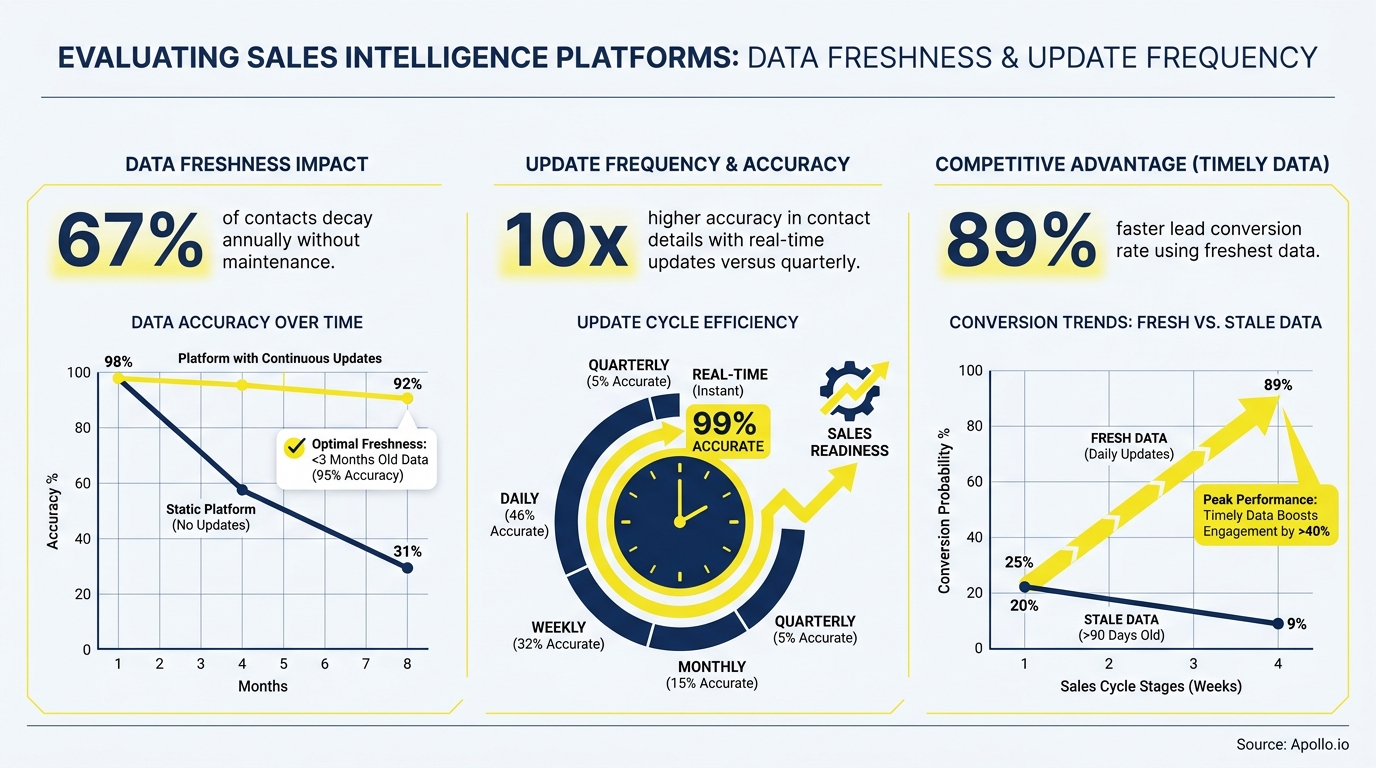
Your sales intelligence platform is only as good as the data inside it. B2B contact data decays faster than most teams realize, and according to SparkDBI, B2B contact data decays between 22.5% and 70.3% annually. That means a database that looked clean at contract signing could be riddled with bad records before your first renewal. When evaluating a sales intelligence platform, data freshness and update frequency are not secondary criteria: they are the primary economic levers that determine whether your investment pays off.

Rich Data. Zero Research. More Pipeline.
Tired of sending generic outreach because your contact data is incomplete? Apollo gives reps verified, enriched business contacts so every message lands with context. Join 600K+ companies prospecting smarter.
Start Free with Apollo →Key Takeaways
- B2B contact data can decay significantly within a single year, making update cadence a core ROI variable, not a feature footnote.
- Demand field-level "last verified" timestamps and written freshness SLAs before signing any vendor contract.
- Different GTM use cases (routing, ABM, outbound) require different freshness thresholds: one update cadence does not fit all workflows.
- Run a structured pilot with your own ICP sample to validate vendor freshness claims before committing at scale.
- Waterfall enrichment across multiple sources is increasingly outperforming single-vendor refresh promises for high-velocity teams.
Why Does Data Freshness Matter for Sales Intelligence?
Data freshness matters because stale records directly reduce pipeline quality, deliverability, and SDR productivity. Zymplify reports that 18% of phone numbers change every year. Multiply that across a database of thousands of contacts and you have a connect-rate problem that no amount of dialer optimization can fix.
The downstream effects compound quickly. Bounced emails damage sender reputation. SDRs calling wrong numbers waste quota capacity. Routing misfires send inbound leads to the wrong rep or territory. For RevOps leaders maintaining CRM hygiene, stale data from a vendor that updates records infrequently erodes every downstream metric. Understanding how contact data enrichment drives ROI starts with understanding how quickly that data decays.
What Is a Data Freshness SLA and Why Should You Require One?
A data freshness SLA is a contractual commitment from a sales intelligence vendor specifying how frequently each data field type is verified and updated. Generic claims like "real-time data" or "continuously updated" are marketing language, not auditable commitments.
Demand specifics broken down by field type.
| Data Field | Minimum Acceptable Re-verification Cadence | Why It Matters |
|---|---|---|
| Work email | Every 30-60 days | Highest decay risk; bounces harm deliverability |
| Job title / seniority | Every 60-90 days | Determines ICP fit and persona targeting |
| Direct phone | Every 90 days | 18% of numbers change annually |
| Company headcount / revenue | Quarterly | Drives firmographic segmentation and scoring |
| Technographics | Quarterly to semi-annual | Informs competitive displacement plays |
Ask vendors to provide sample-level audit logs showing "last verified" timestamps per field, not just per record. If a vendor cannot produce these, treat it as a red flag. MarketsandMarkets notes that the shift from static to real-time data is a defining trend in sales intelligence, making verifiable refresh cadence a baseline expectation rather than a premium differentiator.
How Do SDRs and RevOps Teams Get Burned by Stale Data?
SDRs feel stale data immediately: calls go to disconnected numbers, emails bounce, and personalization breaks because the contact changed roles. RevOps leaders experience it more slowly through degraded CRM match rates, territory imbalances from outdated firmographics, and reporting that no longer reflects the actual addressable market.
Tired of watching bounce rates climb on outbound sequences? Start free with Apollo's 230M+ verified business contacts, backed by 97% email accuracy across a database that is continuously re-verified. For AEs managing high-value accounts, outdated stakeholder maps mean reaching out to contacts who have left, while missing new decision-makers who joined. Freshness is not just an ops concern: it is a revenue concern.
Turn Funnel Guesswork Into Real Pipeline
Pipeline forecasting a guessing game because leads stall before they ever become opportunities? Apollo surfaces high-intent prospects so your funnel fills with deals that actually close. Nearly 100K paying customers stopped guessing and started hitting numbers.
Start Free with Apollo →What Is a Freshness Scorecard for Vendor Evaluation?
A freshness scorecard is a structured scoring framework that converts vendor freshness claims into comparable, quantified ratings before you sign a contract. Use the criteria below to score each vendor on a 1-5 scale, then weight by your team's primary use case.
| Evaluation Criterion | What to Ask the Vendor | Weight (Outbound-Heavy Team) |
|---|---|---|
| Field-level "last verified" timestamps | Can I see a sample export with per-field timestamps? | High |
| Re-verification cadence by data type | How often is each field type re-checked, by region? | High |
| Job-change detection and alerts | Do you surface job-change signals in real time? | High |
| Bounce/suppression propagation SLA | How quickly are bounced emails suppressed across the DB? | Medium |
| Data provenance transparency | What sources contribute to each record, and how are conflicts resolved? | Medium |
| Contractual freshness guarantee | Will you put re-verification cadence in writing? | High |
Platforms like Apollo include job change alerts and continuous data enrichment as core features, so SDRs get notified when a champion moves to a new account without manually monitoring for changes.

How Do Freshness Requirements Vary by GTM Use Case?
Freshness thresholds differ significantly depending on how your team uses the data. Inbound routing demands near-real-time firmographic accuracy.
ABM requires quarterly refreshes of account-level signals. Outbound prospecting sits in the middle, requiring frequent email and title re-verification but more tolerance on slower-moving fields like technographics.
Map your primary use cases to freshness requirements before evaluating vendors. A platform optimized for outbound volume may under-invest in the intent signal refresh rates needed for ABM. According to Landbase, some studies indicate B2B contact data decay can reach 70.3% per year, which means use cases relying on accurate title and company data need vendors with the shortest re-verification windows. Understanding how to build a data enrichment strategy helps you define those thresholds before you enter vendor negotiations.
How Do You Run a Pilot to Validate Freshness Claims?
Run a structured pilot by pulling a stratified sample of 200-500 records from your ICP, submitting them to the vendor for enrichment, and measuring accuracy against known-good ground truth from your CRM within 30 days.
Key pilot metrics to track:
- Email validity rate: What percentage of enriched emails pass verification without bouncing?
- Title accuracy rate: Do enriched titles match your CRM's known contacts?
- Phone connect rate: What percentage of enriched numbers result in a live connection?
- Change detection speed: How quickly did the platform flag known job changes in your sample?
- "Last verified" recency: What is the median age of the timestamp on enriched fields?
Struggling to get clean, verified contact data into your pipeline? Search Apollo's 230M+ contacts with 65+ filters and test data quality against your own ICP before committing. Apollo's sales intelligence and lead database gives teams a single workspace that covers prospecting, enrichment, and engagement, replacing the need to stitch together separate data and outreach tools.
How Does Data Freshness Affect AI-Powered Sales Workflows?
When stale data feeds AI workflows, errors compound: lead scoring misfires, personalization breaks, and routing logic sends opportunities to the wrong queue. As AI adoption in GTM stacks accelerates, the quality of underlying data becomes the single biggest determinant of AI output quality.
Teams evaluating data enrichment tools for 2026 should treat freshness as a prerequisite for any AI feature set. Intent signals are particularly sensitive: a buying signal that is 90 days old is not a signal, it is noise. Demand that vendors disclose intent signal refresh intervals alongside contact re-verification cadence. The two must be evaluated together for AI-assisted routing and scoring to work reliably.
What Should Your Final Vendor Evaluation Checklist Include?
Before signing with any sales intelligence vendor, confirm each of the following in writing:
- Field-level re-verification cadence committed in the contract (not just the sales deck)
- "Last verified" timestamps accessible in exports and via API
- Job-change detection with configurable alert triggers
- Bounce suppression SLA: how quickly are invalid emails removed from the database?
- Data provenance: which sources contribute to each record and how conflicts are resolved
- Pilot rights: the ability to test a sample of your ICP before full commitment
- Waterfall enrichment support: can the platform query multiple sources and return the most recently verified result?
The sales intelligence market is growing rapidly, and vendor claims about data freshness are increasingly difficult to differentiate on marketing language alone. The teams that win are those that operationalize freshness evaluation with scorecards, pilots, and contractual SLAs rather than relying on vendor-supplied accuracy statistics.

Start Evaluating with Verified, Always-Current Data
Data freshness is not a feature: it is the foundation that every other sales intelligence capability depends on. Stale data degrades deliverability, misfires personalization, breaks routing, and undermines AI workflows.
The evaluation framework in this article gives SDRs, RevOps leaders, AEs, and revenue leaders a concrete, auditable process for separating vendors who can prove freshness from those who only claim it.
Apollo's platform combines a 230M+ person database with 97% email accuracy, continuous enrichment, job-change alerts, and a unified workspace that consolidates prospecting, enrichment, and engagement. As Cyera put it: "Having everything in one system was a game changer." Try Apollo free and see how verified, freshly maintained data performs against your current stack.
Prove Pipeline ROI Before Next QBR
ROI pressure killing your tool budget before you can show results? Apollo delivers measurable pipeline impact fast — 46% more meetings with AI, real numbers your leadership can't argue with. Start free today.
Start Free with Apollo →Don't miss these
Sales
Inbound vs Outbound Marketing: Which Strategy Wins?
Sales
What Is a Sales Funnel? The Non-Linear Revenue Framework for 2026
Sales
What Is a Go-to-Market Strategy? The 2026 GTM Playbook
See Apollo in action
We'd love to show how Apollo can help you sell better.
By submitting this form, you will receive information, tips, and promotions from Apollo. To learn more, see our Privacy Statement.
4.7/5 based on 9,690 reviews
