
How to Get Your Sales Team to Actually Use Automation Tools
You bought the tools. You ran the training.
You sent the Slack announcements. And yet, three months later, half your reps still aren't using the automation you paid for.
This is the most common ROI killer in sales leadership, and it has a name: shelfware.
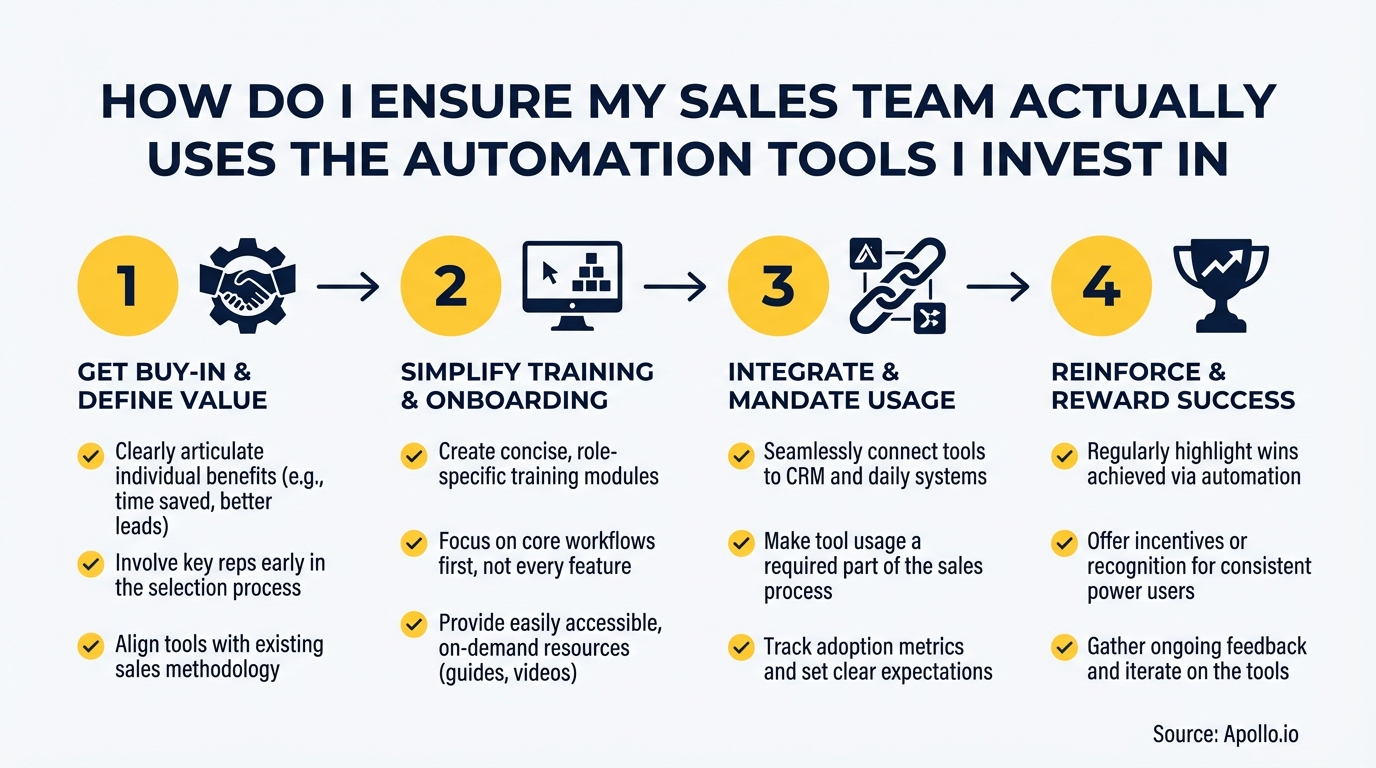
The fix isn't more training or more pressure. Ensuring your sales team actually uses sales automation requires treating adoption like a KPI-driven operating system, not a one-time rollout event.

Research Less, Pipeline More With Apollo
Tired of burning hours on manual lead research instead of closing deals? Apollo surfaces verified contacts instantly so your team sells more and researches less. Join 600K+ companies building predictable pipeline.
Start Free with Apollo →Key Takeaways
- Non-use is the default outcome: nearly one in four SaaS apps goes unused, so your adoption plan must assume resistance and build in structural safeguards.
- Embed automation into required workflows rather than asking reps to add extra steps. Tools that eliminate work get used; tools that create work get abandoned.
- Measure adoption with leading KPIs tied to revenue outcomes, not just login rates or training completion.
- Tool overload is a real adoption killer: consolidating your stack into one platform dramatically reduces context-switching and rep friction.
- Cross-functional governance, not motivation, is what sustains long-term automation usage across SDRs, AEs, and RevOps alike.
Why Do Sales Teams Ignore Automation Tools?
Sales teams ignore automation tools primarily because the tools add friction instead of removing it. Research from TryKondo shows the average sales team uses 10 different tools, with 66% of reps feeling overwhelmed by the number of systems they must navigate daily. When a tool requires context-switching or double entry, reps revert to what they already know.
Three structural failure modes cause most shelfware:
- The tool lives outside the workflow. Reps won't open a separate app to log a call they just handled in another system.
- The output quality is low. If automation produces bad suggestions because CRM data is stale, reps stop trusting it fast.
- There's no consequence for non-use. If managers don't track usage, there's no signal that it matters.
Vertice reported that as of December 2025, 24% of software applications in the average tech stack went entirely unused, up from 18% the prior year. Non-use is the default, not the exception.
Your adoption plan must assume this and design around it.
How Do You Map Automation to the Work Reps Actually Hate?
Automation earns adoption when it visibly eliminates tasks reps already resent doing. Start by auditing where your team's time actually goes before choosing which tools to enforce.
According to Ekfrazo, companies implementing B2B automation strategies report a 14-15% increase in sales productivity within the first year. That uplift only materializes when automation targets the highest-friction activities.
| Non-Selling Activity | Automation Solution | Adoption Trigger |
|---|---|---|
| Manual CRM updates | Auto-logging calls, emails, meetings | Required field auto-populated |
| Follow-up scheduling | Automated sequences with branching | Manager reviews sequence output, not manual emails |
| Contact research | AI-enriched prospect data at point of search | Reps see value in first session |
| Meeting prep | AI call summaries and briefing cards | Pre-call brief delivered automatically |
| Pipeline updates | Deal stage automation triggered by activity signals | Forecast accuracy improves visibly for managers |
Spending hours on manual outreach that never gets done consistently? Automate your sequences with Apollo's multi-channel engagement platform so reps execute consistently without extra steps.
How Do SDRs and AEs Build Habits Around Automation?
SDRs and AEs adopt automation when it's embedded in the daily motions they already perform, not bolted on as an additional task. The key is workflow integration: the tool must live where the work happens.
For SDRs, adoption sticks when automation handles list building, sequence enrollment, and follow-up timing. If an SDR can start their day by reviewing a pre-built prospect list with verified contact data rather than building it manually, the tool earns its place in the routine. Data from Graf Growth Partners indicates sales professionals save an estimated 2 hours and 15 minutes daily using AI and automation tools, with 82% reporting increased time for relationship building.
For AEs, adoption accelerates when automation handles meeting prep, call notes, and CRM updates automatically. AEs managing active pipelines respond to tools that reduce administrative drag during the deal cycle, not tools that require extra configuration. The sales productivity gains are real, but only when automation is embedded at the moment of deal activity.
RevOps leaders play a critical role here: they must configure automation defaults so reps encounter the tool naturally rather than opting into it. Make automation the path of least resistance, not an alternative workflow.

What Governance Model Sustains Long-Term Adoption?
Sustained automation adoption requires cross-functional governance, not periodic training refreshes. A Gartner survey of 227 Chief Sales Officers (August-September 2025) found that sales organizations collaborating on enablement content with other functions are 2.4 times more likely to achieve strong commercial growth.
Adoption is an organizational design problem, not a motivation problem.
Build a lightweight Adoption Operating System (AOS) with these components:
- Ownership: Assign a RevOps or enablement owner per tool with explicit accountability for usage rates.
- Usage KPIs: Track leading metrics (sequences launched, contacts enriched, calls logged) not just logins. Tie these to pipeline-creation targets.
- Manager reinforcement: Coaches review automation outputs in 1:1s. If managers reference tool data, reps learn it matters.
- Shelfware audits: Run quarterly license reviews. Cancel or consolidate tools with under 60% active usage. Unused licenses are a budget signal, not a rep failure.
- Feedback loops: Create a standing channel for reps to flag when automation produces bad outputs. Bad data is the fastest trust-killer.
For guidance on building a sales tech stack that scales, the governance layer is what separates stacks that compound ROI from those that accumulate debt.
Turn Funnel Guesswork Into Pipeline Confidence
Quota stress keeping you up at night? Apollo surfaces verified, in-market prospects so your team stops chasing dead-end leads and starts building a pipeline you can actually forecast. Join 600K+ companies.
Start Free with Apollo →How Do You Build an Adoption Scorecard for Sales Tech?
An adoption scorecard for sales tech measures usage depth, not just surface activity. Login rates are vanity metrics. The metrics that matter connect tool usage to revenue outcomes.
| Metric | What It Measures | Target Signal |
|---|---|---|
| Sequence enrollment rate | % of new contacts added to automated sequences | Above 80% of new prospects |
| CRM auto-log rate | % of calls/emails logged without manual entry | Rising week-over-week |
| Enrichment utilization | % of prospect records enriched before outreach | Correlated with reply rates |
| Follow-up SLA compliance | Time from trigger to automated follow-up sent | Under defined SLA threshold |
| Tool consolidation ratio | Active tools vs. tools purchased | Declining over time (consolidation) |
Review this scorecard in weekly pipeline reviews. When managers reference these metrics publicly, usage becomes a team norm.
Connect each metric to a downstream revenue outcome (pipeline created, meetings booked, deals progressed) so the conversation stays commercial, not operational.
How Does Tool Consolidation Improve Adoption Rates?
Consolidating your sales tech stack into fewer, more integrated platforms directly improves adoption by eliminating the context-switching that causes reps to abandon tools. As adoption data on sales automation types consistently shows, reps use tools that live in their primary workflow.
The compounding problem with fragmented stacks: each tool requires its own login, its own data model, and its own mental model. Reps under quota pressure default to whatever requires fewest steps.
A unified platform removes that friction by design.
Apollo customers describe this shift directly: "We reduced the complexity of three tools into one" (Predictable Revenue), "We cut our costs in half" (Census), and "Having everything in one system was a game changer" (Cyera). These outcomes reflect both cost savings and adoption gains: when reps only need one workspace for prospecting, sequencing, enrichment, and pipeline management, usage rates rise because there's no alternative workflow to default to.
Struggling to get reps to use your prospecting and outreach tools consistently? Apollo's AI sales automation platform consolidates your GTM stack into one workspace SDRs, AEs, and RevOps actually use every day.

How Do You Ensure Adoption Sticks in 2026?
Ensuring your sales team uses the automation tools you invest in comes down to three durable principles: eliminate work instead of adding it, measure usage like a revenue KPI, and consolidate tools until the path of least resistance is the right path.
The landscape has shifted. According to Eubrics, 75% of B2B sales organizations were expected to have integrated AI tools into their workflows by 2025, up from just 15% in 2020. That adoption curve means your competitors are operationalizing automation. The teams winning aren't the ones with the most tools. They're the ones where every rep uses the right tools, every day, without friction.
Start with a workflow audit this week. Identify the top three manual tasks your reps complain about most.
Map automation to those tasks specifically. Assign an owner with a usage KPI.
Run a shelfware audit on everything else. Then consolidate around a platform that covers prospecting, engagement, enrichment, and pipeline in one place.
Ready to build a stack your team will actually use? Start free with Apollo and give your GTM team one unified platform for prospecting, sequencing, and pipeline management.
Apollo Proves ROI Before Day 30
ROI pressure killing your tool budget? Apollo delivers measurable pipeline impact fast — so you walk into every budget review with hard numbers, not gut feelings. Join 600K+ companies with proof.
Start Free with Apollo →Don't miss these
Sales
Inbound vs Outbound Marketing: Which Strategy Wins?
Sales
What Is a Sales Funnel? The Non-Linear Revenue Framework for 2026
Sales
What Is a Go-to-Market Strategy? The 2026 GTM Playbook
See Apollo in action
We'd love to show how Apollo can help you sell better.
By submitting this form, you will receive information, tips, and promotions from Apollo. To learn more, see our Privacy Statement.
4.7/5 based on 9,690 reviews
