
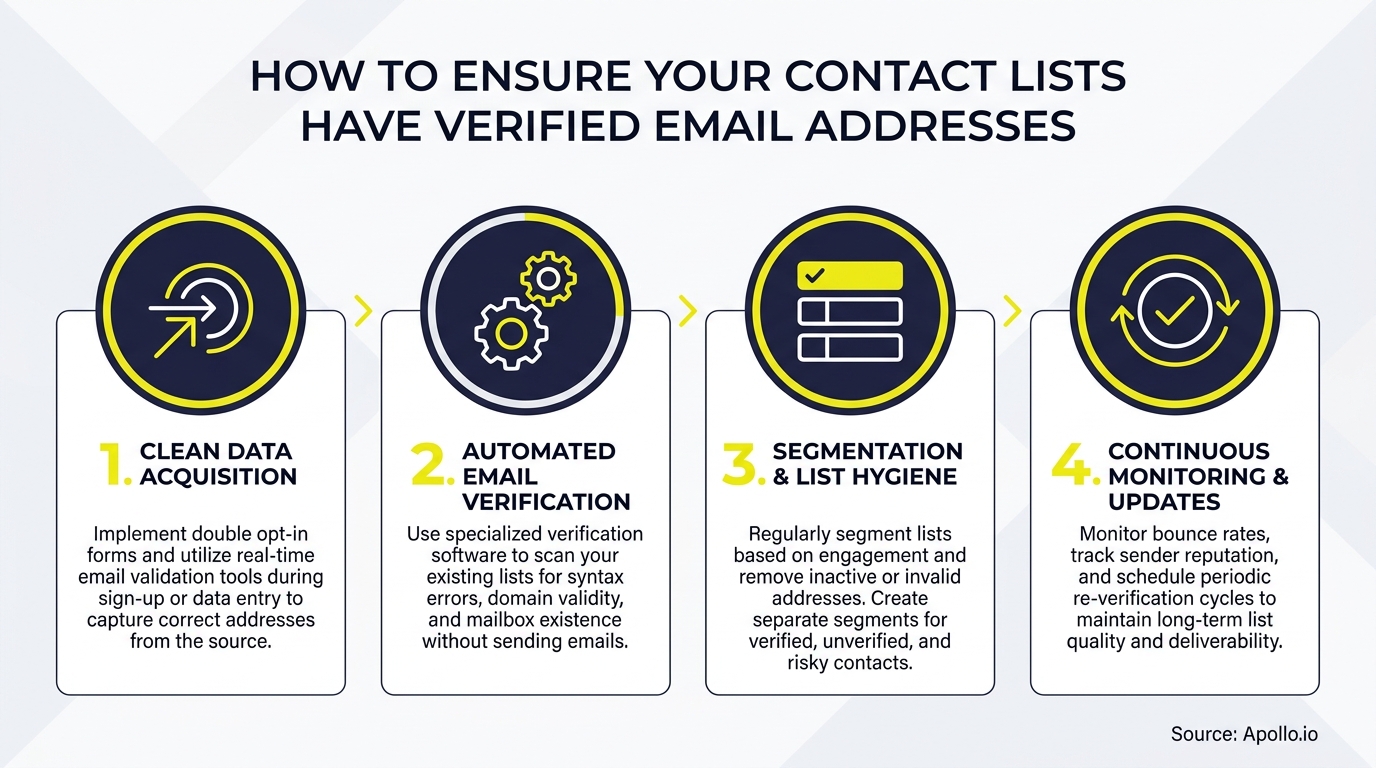
How to Ensure Your Contact Lists Have Verified Email Addresses
Your outreach is only as good as the addresses behind it. A single unverified list can spike your bounce rate, trigger spam filters, and damage the sending domain you've spent months building. In 2026, inbox providers have moved from gentle nudges to hard enforcement: email deliverability is now a governed KPI, not an afterthought.
This guide gives you a governance-first framework for keeping contact lists verified, covering thresholds, authentication, suppression cadences, and the monitoring dashboards that keep your sender reputation intact.

Verified Contacts. More Meetings. Less Grind.
Tired of burning hours chasing bad emails and dead numbers? Apollo delivers 97% email accuracy so your team spends time selling, not searching. Nearly 100K paying customers scaled faster — start free today.
Start Free with Apollo →Key Takeaways
- Verification alone is not enough in 2026: you need verification + authentication (SPF/DKIM/DMARC) + active suppression working together.
- Keep hard bounces below 2% (warning zone: 2-5%; critical: above 5%) and spam complaints below 0.3% to maintain inbox eligibility with major providers.
- B2B email lists decay at 25-30% annually, making re-verification a recurring operational task, not a one-time scrub.
- Only 23.6% of B2B senders verify lists before every major campaign, creating a significant competitive advantage for teams that do.
- SDRs and RevOps teams that start with pre-verified contacts spend less time on list cleanup and more time on pipeline-generating activities.
Why Is Email List Verification Critical in 2026?
Email list verification is the process of confirming that each address on your contact list corresponds to a real, active mailbox before you send. The stakes have risen sharply: according to MailMonitor, U.S. businesses face an average email list decay rate of 25-30% annually, with B2B lists experiencing even higher rates. That means a list you built six months ago could already have a quarter of its addresses gone stale.
Meanwhile, Email on Acid reports that 38.2% of B2B senders rarely or never conduct list hygiene, despite the recommendation to do so at least a couple of times per year. Teams that skip this step are quietly hemorrhaging sender reputation with every campaign they run.
For SDRs and BDRs sending high-volume outbound sequences, a degraded sender domain means fewer replies and wasted quota hours. For RevOps leaders, it means compounding data debt across every tool in the stack.
What Are the Verified Email SLA Thresholds You Should Target?
A verified email SLA defines the measurable thresholds your team commits to maintaining, with clear intervention rules when metrics drift. Treat these as non-negotiable operating standards, not aspirational goals.
| KPI | Target (Green) | Warning Zone | Critical — Act Now |
|---|---|---|---|
| Hard Bounce Rate | <2% | 2-5% | >5% |
| Spam Complaint Rate | <0.1% | 0.1-0.3% | >0.3% |
| List Verification Freshness | Verified within 90 days | 90-180 days | >180 days |
| Unsubscribe Fulfillment | Within 48 hours | 48-72 hours | >72 hours |
Google's bulk sender guidelines establish that senders with a spam complaint rate above 0.3% lose eligibility for deliverability mitigation, and must sustain below 0.3% for seven consecutive days before eligibility returns. Build this 7-day recovery rule into your incident response playbook so your team knows exactly what to do if a campaign triggers a spike.
How Does Email Verification Actually Work (and What Are Its Limits)?
Email verification checks addresses through a layered process: syntax validation, domain MX record lookup, and SMTP-level mailbox probing. However, a developer shared a firsthand perspective on Redditthat highlights a critical limitation: there is no way to fully confirm an address exists without sending a real email and having the recipient take an action. SMTP probing is error-prone because temporary server issues or maintenance windows can make live mailboxes appear offline.
This is why modern verification has evolved beyond pass/fail binary outcomes. The new paradigm, sometimes called Validation 2.0, layers in risk scoring: flagging catch-all domains, role-based addresses (info@, support@), and addresses statistically associated with high complaint rates.
Use risk tiers to guide sequencing decisions, not just suppression.
- Tier 1 (Safe): Verified deliverable, individual mailbox, no risk flags. Include in all sequences.
- Tier 2 (Risky): Catch-all domain or limited SMTP response. Use in lower-volume, personalized sends only.
- Tier 3 (Suppress): Hard bounced, role address, or flagged as high-complaint. Remove immediately.
Struggling to build a clean, tiered prospect list from scratch? Search Apollo's 230M+ verified contacts with 65+ filters and start with data that has 97% email accuracy built in.

How Do Authentication Requirements Affect List Verification?
Authentication (SPF, DKIM, DMARC) and list verification are separate layers of the deliverability stack, and both must be functioning for your emails to reach inboxes. As noted by SalesHive, Gmail, Yahoo, and increasingly Microsoft require SPF, DKIM, DMARC, and one-click unsubscribe for bulk senders as of 2024-2025. A perfectly verified list still fails if your sending domain lacks proper authentication alignment.
A key risk that teams often overlook: DMARC policies can be published and later unpublished, breaking your trust posture without any alert. Monitor your DMARC configuration continuously, not just at setup.
Additionally, tool sprawl creates silent authentication failures. Each CRM, marketing automation tool, and outbound sequencer you add to your stack can introduce SPF lookup limit violations or DKIM misalignment.
RevOps leaders should audit sending domains across every platform quarterly.
Practical authentication checklist:
- Confirm SPF record includes all authorized sending services (stay under 10 DNS lookups).
- Verify DKIM signatures are aligned with your from-domain, not a third-party subdomain.
- Set DMARC policy to at least
p=quarantineand review aggregate reports weekly. - Use separate subdomains for transactional vs. outbound prospecting email to isolate reputation.
- Implement RFC 8058-compliant one-click unsubscribe headers and fulfill requests within 48 hours.
Turn Weak Funnels Into Pipeline Gold
Pipeline forecasting a guessing game because marketing leads never convert? Apollo surfaces high-intent prospects with verified contact data, so your team reaches buyers who are actually ready. Nearly 100K paying customers stopped guessing and started closing.
Start Free with Apollo →How Should SDRs and RevOps Teams Build an Ongoing Hygiene Cadence?
SDRs and RevOps teams should treat list hygiene as a recurring operational workflow with defined owners, not a reactive cleanup triggered by a deliverability crisis. The data makes a compelling case: according to InsightMark Research, only 23.6% of B2B senders verify lists before every major campaign. That gap is your competitive edge if you close it.
A B2B sales professional wrote on Reddit about taking their bounce rate from above 7% down to around 1% by switching to a provider with built-in validation. That kind of improvement directly protects your sender domain and unlocks better inbox placement across your entire sequence library.
Recommended hygiene cadence by role:
- SDRs: Verify any imported or enriched list before loading it into a sequence. Never send to an unverified import.
- RevOps: Run full re-verification on all active lists every 90 days. Purge hard bounces within 24 hours of a campaign completing.
- Marketing Ops: Scrub suppression lists against CRM monthly. Apply re-engagement scoring to contacts inactive for 180+ days before re-mailing.
- Sales Leaders: Review hard bounce and complaint rate KPIs weekly in your sending platform dashboard.
To learn more about building lists that stay clean from the start, see our guide on how to build a B2B email list that converts and understand why buying email lists fails.
Need to enrich and re-verify stale records at scale? Apollo's contact enrichment keeps your CRM data fresh automatically, so your team always sends against current, verified information.
What Does a Verification-First Tech Stack Look Like for B2B Teams?
A verification-first stack integrates address validation at every data entry point, not just as a pre-send batch process. The goal is to prevent bad data from entering your system rather than cleaning it out after the fact.
| Stack Layer | What It Does | When to Apply |
|---|---|---|
| Source-level verification | Verify at data capture (forms, imports, enrichment) | Real-time, at entry |
| Pre-campaign scrub | Batch verify all contacts before sequence launch | Every campaign |
| Post-send suppression | Auto-suppress hard bounces and unsubscribes | Within 24 hours of send |
| Periodic re-verification | Re-check entire active database | Every 90 days |
| Authentication monitoring | DMARC aggregate report review, SPF/DKIM audit | Weekly |
For Account Executives managing active deals, clean contact data means fewer embarrassing bounces when sending follow-up proposals. For founders building outbound from scratch, starting with a verified database eliminates the most common early-stage deliverability mistakes. Explore how to verify email addresses for B2B sales and how to improve email deliverability in 5 easy steps to build out your full operational playbook.
How Do You Maintain Verified Lists Over Time?
Maintaining verified lists requires treating email hygiene as a living process governed by scheduled reviews, automated suppression triggers, and measurable KPIs. Set calendar-based re-verification checkpoints, automate bounce and unsubscribe suppression through your CRM or sequencing platform, and review your SLA thresholds (from the table above) on a weekly basis.
Map your contact data enrichment workflow to your re-verification cadence. As job changes, company pivots, and domain migrations accumulate in your database, enrichment and verification need to run in tandem to keep records accurate and deliverable. The teams that systematize this process stop firefighting deliverability crises and start running predictable, high-performing outreach at scale.

Start Sending to Contacts You Can Trust
Verified email lists are the foundation of every high-performing outbound motion. The framework is clear: establish SLA thresholds, layer verification with authentication and suppression, re-verify on a 90-day cadence, and monitor your KPIs weekly.
Teams that operationalize this process protect their sender reputation, reduce wasted outreach, and give every sequence the best possible chance of reaching the inbox.
Apollo gives SDRs, AEs, RevOps teams, and marketing leaders a unified platform to prospect from a 230M+ contact database with 97% email accuracy, enrich and re-verify existing records, and run multi-channel sequences from a single workspace. Trusted by nearly 100K paying customers, including Anthropic, Smartling, and Redis, Apollo consolidates the tools your team needs to go from verified contact to booked meeting without switching platforms.
Start Prospecting with pre-verified contacts and stop letting bad data slow your pipeline.
Prove Pipeline ROI With Apollo
ROI pressure killing your tool budget approval? Apollo delivers measurable pipeline impact from day one — so you walk into every budget review with numbers, not narratives. Nearly 100K paying customers already made the case.
Start Free with Apollo →Don't miss these
Sales
Inbound vs Outbound Marketing: Which Strategy Wins?
Sales
What Is a Sales Funnel? The Non-Linear Revenue Framework for 2026
Sales
What Is a Go-to-Market Strategy? The 2026 GTM Playbook
See Apollo in action
We'd love to show how Apollo can help you sell better.
By submitting this form, you will receive information, tips, and promotions from Apollo. To learn more, see our Privacy Statement.
4.7/5 based on 9,690 reviews
