
How to Differentiate Between Active and Outdated Leads
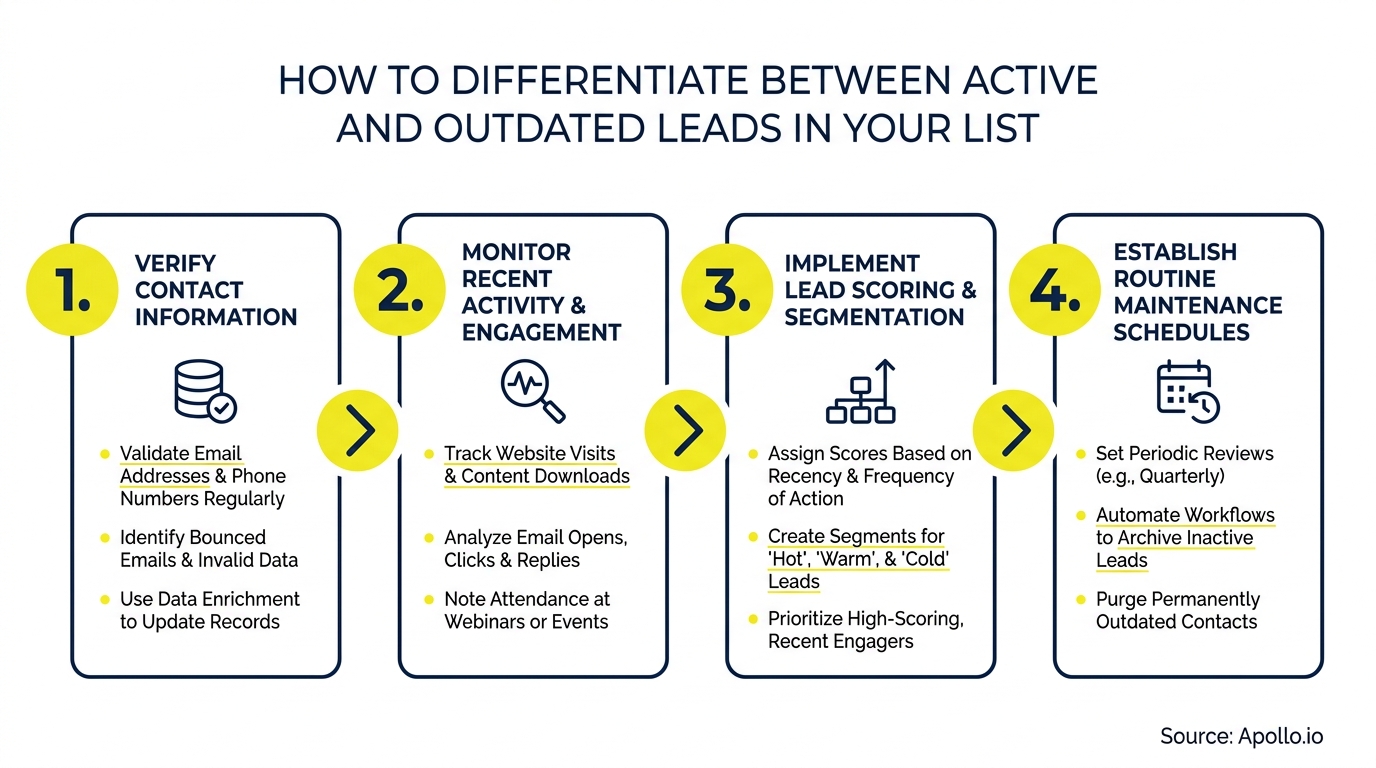
Your lead list is bleeding pipeline and you may not know it. Buyer leads that were warm six months ago can quietly go cold, dragging down conversion rates and burning SDR time on contacts who have changed jobs, gone dark, or simply moved on. Knowing how to differentiate between active and outdated leads is the first step to fixing that.

Research Less, Close More With Apollo
Tired of burning hours verifying contacts that go nowhere? Apollo delivers verified business emails and mobile numbers so your team spends time selling, not searching. Join 600K+ companies building pipeline that actually converts.
Start Free with Apollo →Key Takeaways
- B2B contact data degrades rapidly, meaning a significant share of any static list becomes unreliable within a year without ongoing verification.
- Active leads show recent engagement signals, ICP fit, and verified contact data. Outdated leads lack one or more of these three criteria.
- A Lead Freshness Score combines data age, engagement recency, and ICP fit into a single, actionable number per record.
- SDRs and RevOps teams who apply suppression and enrichment rules before outreach protect sender reputation and improve pipeline quality.
- Buying-group mapping upgrades your classification from individual contacts to account-level readiness, reducing stalled deals.
What Is the Difference Between Active and Outdated Leads?
An active lead is a contact with verified data, recent engagement, and a confirmed fit with your ideal customer profile. An outdated lead has at least one critical failure: stale contact information, zero recent engagement, or a poor ICP match.
The distinction matters because CIENCE reports that 79% of marketing-generated leads never convert to sales, largely because unqualified or outdated contacts inflate pipelines without producing revenue. Meanwhile, data from Landbase shows 67% of lost sales result from inadequate lead qualification. Classifying leads correctly before outreach eliminates both problems at the source.
| Signal | Active Lead | Outdated Lead |
|---|---|---|
| Contact data verified | Within 90 days | Over 180 days ago |
| Engagement activity | Email open, click, or reply in 30 days | No engagement in 90+ days |
| ICP fit | Industry, role, and company size match | Missing or mismatched firmographics |
| Employment status | Confirmed at current company | Role or company changed |
| Buying group presence | 2+ stakeholders mapped at account | Single thread, no committee coverage |
How Do You Build a Lead Freshness Score?
A Lead Freshness Score is a numeric value assigned to each record based on data age, engagement recency, and ICP fit, giving your team a single field to sort, filter, and act on.
Lead scoring best practices, as described by MartechDo, suggest subtracting 10 points for every 30 days of no engagement. Build your score using the same decay logic across three dimensions:
- Data freshness (0-40 pts): Full points if verified within 30 days. Deduct 10 pts per additional 30-day window. Zero points if unverified for 120+ days.
- Engagement recency (0-40 pts): Full points for a reply or meeting booked. Scale down for opens and clicks. Zero for no touch in 90 days.
- ICP fit (0-20 pts): Assign points based on demographic, firmographic, and behavioral factors including industry, title, and company size match.
Records scoring 70+ are active. Scores of 40-69 go into a nurture or re-verification queue. Anything below 40 moves to suppression pending enrichment. This framework connects directly to intent data signals that can further weight the engagement dimension.
Tired of manually tracking which contacts are still valid? Apollo's contact enrichment automatically re-verifies records and surfaces freshness signals so your team works only the leads worth pursuing.
How Do SDRs and RevOps Teams Apply Suppression and Enrichment Rules?
SDRs and RevOps leaders use suppression and enrichment as two complementary levers: suppression removes bad records from active sequences, while enrichment restores salvageable ones to an active state.
Apply these operational rules to keep your list healthy:
- Suppress immediately: Hard bounces, spam complaints, unsubscribes, and any contact with a Freshness Score below 40.
- Enrich before suppressing: Contacts with stale data but strong ICP fit should go through a re-verification pass. If enrichment confirms current employment, restore to active and reset the score.
- Re-verification cadence: Run enrichment on your full list quarterly. For high-velocity segments (e.g., series B+ SaaS companies), run monthly.
- Last-verified date field: Make this a required CRM field. Any record without a last-verified date within 90 days is treated as outdated by default.
RevOps leaders often find that applying these rules before a campaign launch meaningfully reduces bounce rates and protects sender reputation, a concern that has become increasingly urgent as mailbox providers enforce stricter deliverability thresholds in 2026.
Turn Funnel Gaps Into Pipeline Wins
Pipeline forecasting a guessing game? Apollo surfaces in-market buyers the moment they're ready, so your team stops chasing cold leads and starts closing real opportunities. 600K+ companies trust Apollo to fill their funnel with quality.
Start Free with Apollo →How Does Buying-Group Mapping Change Lead Classification?
Buying-group mapping classifies leads at the account level rather than the individual contact level, making it far more accurate for predicting which opportunities will actually close.
A single engaged contact at an account is not the same as an active buying opportunity. Research from Forrester indicates B2B purchases typically involve multiple stakeholders across more than one department, meaning a single-thread lead with no committee coverage is structurally incomplete and should be flagged accordingly.
- Champion present: +15 pts to account score
- Economic buyer identified: +20 pts
- Technical evaluator mapped: +10 pts
- 2+ contacts engaged in last 30 days: Classify account as active
- Single contact, no recent touch: Flag as incomplete, route to awareness nurture
For AEs managing enterprise deals, this framework prevents over-investing in contacts who lack internal authority while ensuring the right stakeholders are covered. Pair it with a structured target account list to keep buying-group coverage systematic.

How Do You Implement Lead Freshness Rules in Your CRM or MAP?
Implement lead freshness rules by creating three custom fields in your CRM:Last Verified Date, Freshness Score, and Lead Status Reason. Then automate the scoring logic with workflow triggers.
| CRM/MAP Action | Trigger | Outcome |
|---|---|---|
| Score decay workflow | 30 days since last engagement | Subtract 10 pts from Freshness Score |
| Enrichment trigger | Score drops below 50 | Send to enrichment queue |
| Suppression workflow | Score below 40 after enrichment | Remove from active sequences |
| Re-activation trigger | High-intent content touch detected | Restore to active, alert SDR |
| Buying-group alert | 2+ contacts at account engage in 14 days | Escalate to AE, flag as hot account |
For teams using sales automation, these workflows can run continuously rather than on a quarterly cleanup cycle. That shift from periodic cleanup to continuous classification is what separates teams with clean pipeline from those constantly chasing bad data.
Want to stop building your outreach on stale records? Search Apollo's 230M+ verified contacts with 65+ filters to build lists that start fresh and stay that way.
How Often Should B2B Lead Data Be Refreshed?
B2B lead data should be re-verified at minimum every 90 days, with higher-priority segments verified monthly. Some sources report that up to 30% of B2B data becomes obsolete annually, which means waiting for a quarterly cycle still leaves a window where records quietly go bad between passes.
Practical cadence by segment:
- Tier 1 accounts (active pipeline): Continuous monitoring via enrichment triggers
- Tier 2 accounts (nurture): Monthly re-verification pass
- Tier 3 accounts (cold/suppressed): Quarterly enrichment before any re-engagement campaign
- Inbound leads: Verify within 24 hours of form submission before routing
Founders and marketing leaders running demand generation programs on flat budgets find that tightening verification cadence reduces wasted spend on contacts who will never receive the message. Data quality is a revenue decision, not just a marketing ops task.

How to Keep Your Lead List Clean and Converting in 2026
Differentiating active from outdated leads requires a repeatable system, not a one-time cleanup. The framework is: score every record using freshness, engagement, and ICP fit; suppress or enrich based on that score; classify at the account level using buying-group signals; and automate the decay-and-refresh cycle so your list stays current without manual effort.
Teams that apply this approach protect sender reputation, improve pipeline accuracy, and give SDRs a focused list of contacts worth calling. As noted in sales prospecting list best practices, quality always outperforms volume when it comes to conversion.
Apollo brings data enrichment, lead search, and sales engagement into one unified platform, so your team stops juggling tools and starts working verified, intent-rich leads from day one. Start free with Apollo and build a lead list that stays active, accurate, and ready to convert.
Prove Pipeline ROI From Day One
ROI pressure killing your tool budget before it even gets approved? Apollo delivers measurable pipeline impact fast — with AI-powered outreach that drives 46% more meetings. 600K+ companies justify the spend. You will too.
Start Free with Apollo →Don't miss these
Sales
Inbound vs Outbound Marketing: Which Strategy Wins?
Sales
What Is a Sales Funnel? The Non-Linear Revenue Framework for 2026
Sales
What Is a Go-to-Market Strategy? The 2026 GTM Playbook
See Apollo in action
We'd love to show how Apollo can help you sell better.
By submitting this form, you will receive information, tips, and promotions from Apollo. To learn more, see our Privacy Statement.
4.7/5 based on 9,690 reviews
