
How to Choose a Platform That Handles Email Deliverability, Sequencing, and Data in One Place (2026)
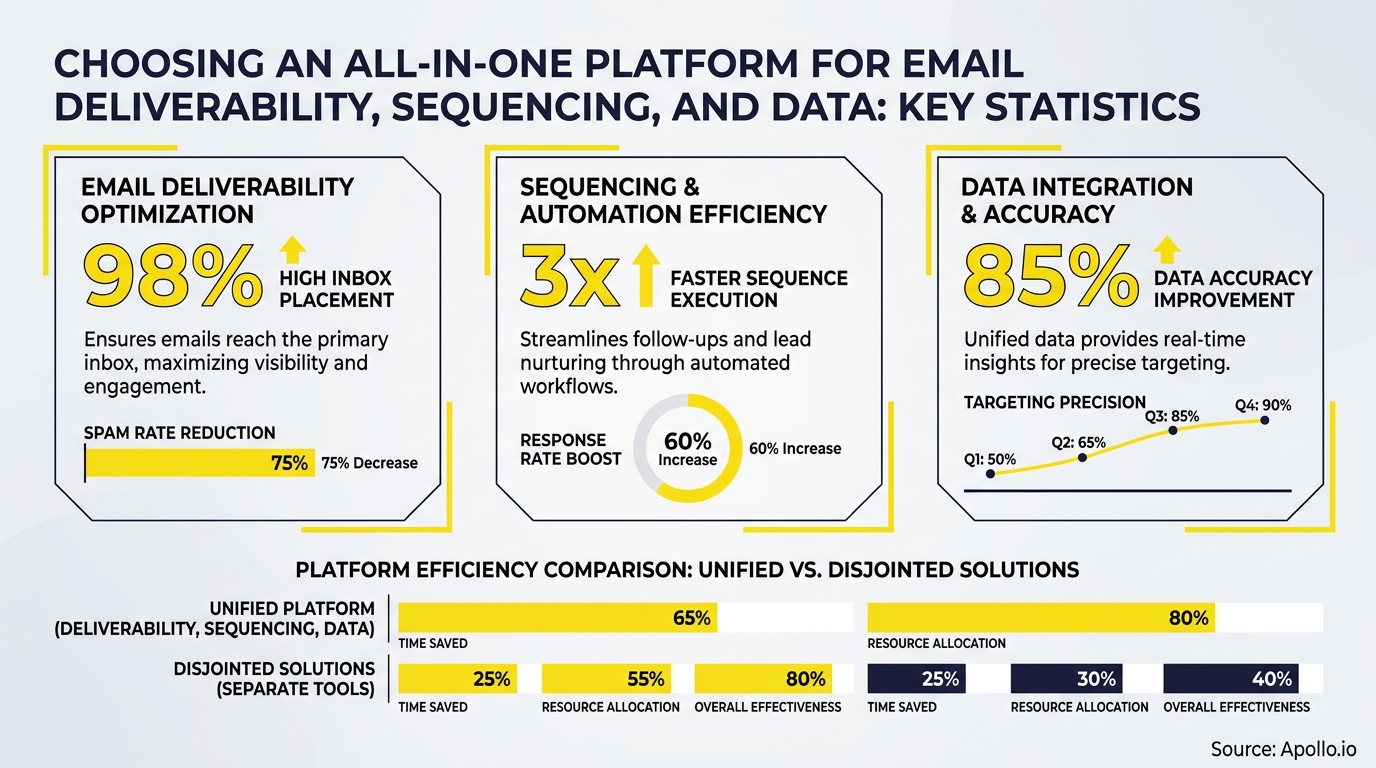
Email remains the backbone of B2B revenue generation. According to Insight Mark Research, around 59% of B2B marketers rate email as their highest revenue-yielding digital channel. Yet most teams are stitching together separate tools for contact data, sequencing, and deliverability monitoring — creating data silos, sync conflicts, and blind spots that kill pipeline. The right all-in-one platform eliminates this friction entirely. If you want to understand the root causes of email deliverability failures, the platform you choose is usually where the investigation starts.

Verified Contacts. Less Research. More Deals.
Tired of burning hours tracking down accurate emails and phone numbers? Apollo surfaces verified business contacts instantly, so your team spends time selling — not searching. Nearly 100K paying customers already made the switch.
Start Free with Apollo →Key Takeaways
- Inbox placement is the metric that matters — delivery rate and inbox placement rate are not the same thing, and most platforms only show you one.
- Gmail (Nov 2025) and Outlook (May 2025) now enforce SPF/DKIM/DMARC compliance at scale, making authentication support a mandatory vendor requirement.
- Data quality is the gating factor: fragmented or unverified contact data degrades both deliverability and sequencing performance simultaneously.
- Security and governance controls are no longer optional — centralized data plus outbound sending creates real risk that must be assessed before consolidating your stack.
- SDRs, RevOps leaders, and sales managers each need different things from a unified platform — your evaluation should map features to those distinct roles.
Why Does Inbox Placement Matter More Than Delivery Rate?
Inbox placement is the true measure of email performance because a delivered email can still land in spam or disappear entirely. Data from Verified.Email shows the overall B2B email delivery rate is around 98.16%, while effective inbox placement drops to near 84.3% in some B2B datasets. That gap represents pipeline that never gets a chance to convert.
When evaluating platforms, demand inbox placement visibility — not just delivery confirmations. The right platform surfaces spam placement rates, bounce classifications, and complaint thresholds in one dashboard so your team can act before domain reputation degrades.
- Delivery rate: Email accepted by the receiving server
- Inbox placement rate: Email landing in the primary inbox (not spam/promotions)
- Missing rate: Email accepted but never shown to the recipient (filtered silently)
What Authentication Requirements Must a Platform Support in 2026?
A platform must natively support SPF, DKIM, and DMARC configuration — and verify alignment before sequences go live. Starting November 2025, Gmail ramped enforcement against non-compliant senders, and Microsoft's Outlook enforced similar rules effective May 5, 2025, issuing hard rejections under error code 550 5.7.515 for high-volume senders without proper authentication.
This means your sequencing platform is now also a compliance tool. Ask vendors these questions before signing:
- Does the platform verify SPF/DKIM/DMARC alignment before activating sequences?
- Does it manage List-Unsubscribe headers automatically?
- Does it monitor spam complaint rates and alert you before you cross thresholds?
- Does it enforce sending throttles and adaptive pacing to protect domain reputation?
According to The Point Company, maintaining a spam complaint rate below 0.3% is crucial — and that threshold becomes nearly impossible to manage without built-in monitoring.
How Do SDRs and RevOps Leaders Evaluate Data Quality in an All-in-One Platform?
For SDRs, poor data means bounced emails, wasted sequences, and missed quota. For RevOps leaders, it means sync conflicts, duplicate records, and broken attribution.
The platform you choose must address both simultaneously.
Struggling to keep your contact data clean and current? Apollo's data enrichment keeps your CRM accurate with 230M+ verified business contacts — so sequences always start from a clean foundation.
Key data quality criteria to evaluate:
| Criterion | What to Demand | Why It Matters |
|---|---|---|
| Email verification | Real-time validation at point of export or sequence enrollment | Prevents hard bounces that damage domain reputation |
| Deduplication | Automated merge logic with configurable rules | Eliminates double-sends and CRM noise |
| Enrichment provenance | Source attribution for each data field | Lets you audit and trust the data behind each outreach |
| CRM sync conflict handling | Field-level merge rules, not full record overwrites | Prevents enrichment from corrupting existing CRM data |
| Suppression list management | Centralized, auto-applied across all sequences | Stops contacts from receiving unwanted outreach |
For a deeper look at how enrichment drives measurable revenue outcomes, see how contact data enrichment drives ROI and how to build a data enrichment strategy that scales with your team.

What Security and Governance Controls Should You Require?
Consolidating sequencing and contact data in one platform increases your blast radius if something goes wrong. Governance and security controls are not a compliance checkbox — they are a financial risk mitigator.
When your data and outbound infrastructure share a single platform, evaluate these controls:
- Role-based access controls (RBAC): Limit who can export contacts, modify sequences, or change sending settings
- Audit trails: Immutable logs of who changed what, and when
- Data encryption: At rest and in transit, with documented key management
- SSO and MFA: Mandatory for enterprise deployments
- Admin sending controls: Ability to set send limits, pause sequences, and revoke access at the team level
These controls also matter for deliverability governance — only authorized users should be able to enroll contacts or change sending domains, reducing the risk of accidental domain burnout from rogue campaigns.
Turn Funnel Guesswork Into Real Pipeline
Pipeline forecasting a guessing game because leads stall before they ever become opportunities? Apollo surfaces in-market buyers with precision, so your funnel fills with prospects that actually convert. Nearly 100K paying customers stopped guessing and started closing.
Start Free with Apollo →What Is the Vendor Shortlisting Framework for a Unified GTM Platform?
Choosing a unified platform requires a structured framework, not a feature checklist. Use this decision model to shortlist vendors across the three capability layers that define a true all-in-one GTM platform.
| Layer | Must-Have Capabilities | Disqualifying Gaps |
|---|---|---|
| Data Layer | Verified contacts, enrichment, intent signals, CRM sync | No native enrichment; requires a separate data vendor |
| Execution Layer | Multi-step sequences, email/phone/social, AI personalization, throttling | Email-only; no adaptive pacing or complaint monitoring |
| Governance Layer | RBAC, audit logs, deliverability dashboards, suppression management | No inbox placement visibility; no admin send controls |
The market is consolidating rapidly. Recent partnership and merger activity signals that buyers want data signals, engagement execution, and revenue governance in one system — not three separate vendor contracts.
Evaluate whether a vendor's roadmap reflects this direction before committing.
Spending hours managing disconnected outreach tools? Apollo's multi-channel sales engagement platform unifies sequencing, data, and deliverability controls in one workspace — trusted by nearly 100K paying customers including Anthropic, Cyera, and Smartling.
For teams building their B2B contact foundation, also review how to build a B2B email list that converts and which data enrichment tools drive revenue in 2026.
How Should You Implement and Migrate to a Unified Platform?
Migration to a unified platform succeeds or fails based on data hygiene and governance setup — not the technical import. Follow this sequence to reduce risk:
- Audit existing data: Identify duplicate records, unverified emails, and stale contacts before migrating. See data enrichment vs. data cleansing best practices to structure this step.
- Map suppression lists: Export all opt-outs and unsubscribes from every previous tool and load them first — before any contacts.
- Configure authentication: Set up SPF, DKIM, and DMARC on all sending domains before activating any sequences.
- Set RBAC before onboarding users: Define who can send, who can export, and who can modify sequences before the team logs in.
- Run a soft launch: Start with a small segment, monitor inbox placement and complaint rates for 2 weeks, then scale.
- Establish weekly rituals: Assign a deliverability owner who reviews bounce rates, complaint rates, and inbox placement weekly — not monthly.

Which Platform Handles Email Deliverability, Sequencing, and Data in One Place?
Apollo is the all-in-one GTM platform built for B2B teams that need verified contact data, multi-channel sequencing, and deliverability controls without managing multiple vendor relationships. With 230M+ verified contacts, 97% email accuracy, and built-in sequence automation, Apollo consolidates what most teams currently split across three or more separate tools.
Customers describe the impact directly: "We reduced the complexity of three tools into one" (Predictable Revenue). "Having everything in one system was a game changer" (Cyera). "We cut our costs in half" (Census).
Apollo serves SDRs and BDRs who need to book more meetings without manual research, Account Executives who need pre-meeting intelligence in the same workspace, and RevOps leaders who need clean data, consistent attribution, and fewer integrations to maintain. Enterprise GTM teams get advanced routing, admin controls, and governance features built for multi-seat, high-volume operations.
Ready to see how a unified platform changes your pipeline? Request a Demo and see Apollo's deliverability controls, sequencing, and data layer working together in one workspace.
Prove Pipeline ROI With Apollo
ROI pressure killing your next budget approval? Apollo delivers measurable pipeline impact from day one — quantifiable wins your leadership actually believes. Join nearly 100K paying customers who stopped guessing and started proving it.
Start Free with Apollo →Don't miss these
Sales
Inbound vs Outbound Marketing: Which Strategy Wins?
Sales
What Is a Sales Funnel? The Non-Linear Revenue Framework for 2026
Sales
What Is a Go-to-Market Strategy? The 2026 GTM Playbook
See Apollo in action
We'd love to show how Apollo can help you sell better.
By submitting this form, you will receive information, tips, and promotions from Apollo. To learn more, see our Privacy Statement.
4.7/5 based on 9,690 reviews
