
How to Build Territory Models for an SDR Team Prospecting Into Mid-Market Accounts (2026)
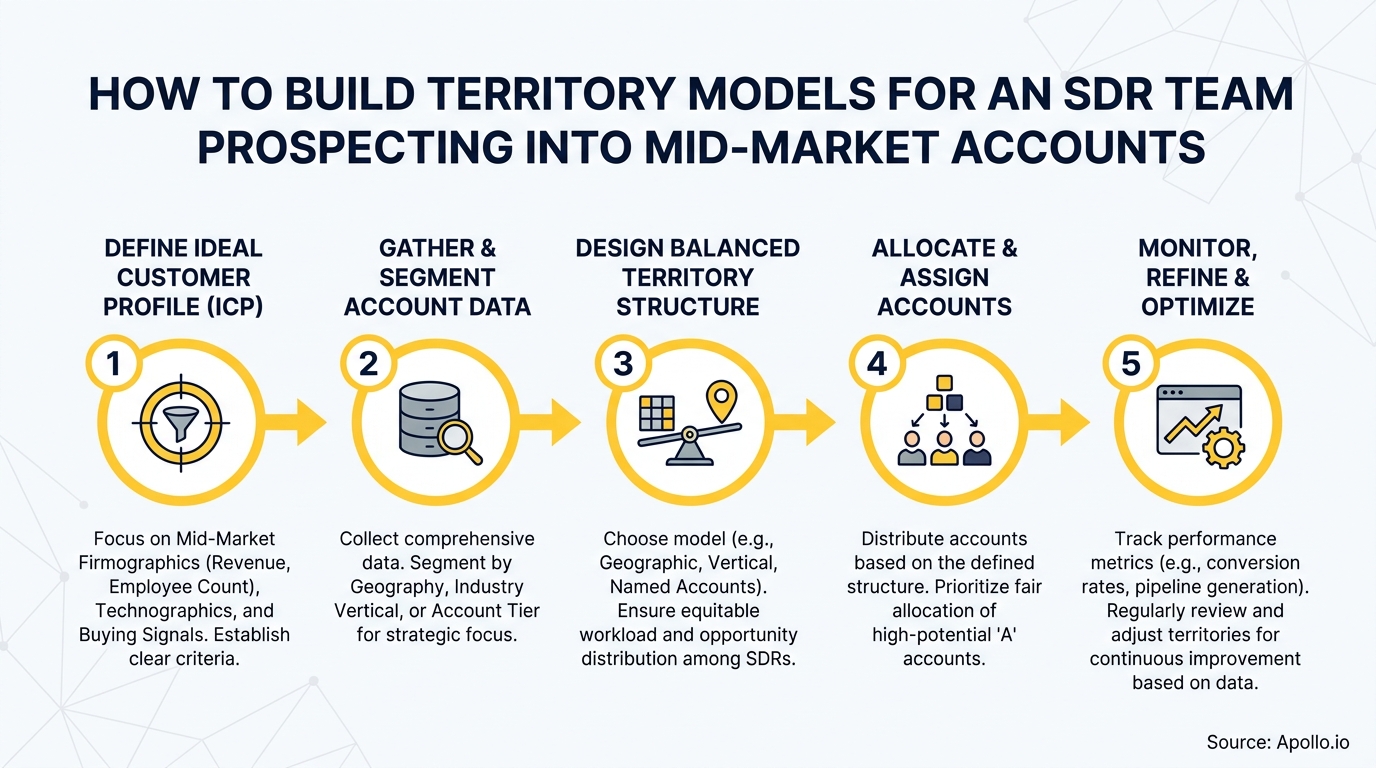
Most SDR territory models fail before the first sequence launches. They assign accounts by geography or alphabet, ignore capacity math, and treat every account the same. The result: SDRs are overwhelmed, high-fit accounts go untouched, and pipeline stalls. Building a territory model that actually works for mid-market prospecting requires a different starting point: buyer access constraints, SDR capacity, and signal-based prioritization. This guide gives you the framework to get there. You'll also want a solid sales prospecting list to feed each territory once your model is live.

Research Less, Pipeline More With Apollo
Tired of your reps burning hours verifying contacts instead of closing deals? Apollo delivers 230M+ accurate business contacts so your team spends time selling, not searching. Start building real pipeline today.
Start Free with Apollo →Key Takeaways
- Effective territory design creates a measurable gap in sales performance versus poorly structured models — making it one of the highest-leverage RevOps investments.
- SDR capacity math must come before account assignment: your account load per rep is constrained by actual selling time, not headcount alone.
- Mid-market territories work best with hybrid segmentation combining firmographics, technographics, and buying signals — not just geography.
- Dynamic, quarterly-reviewed territories outperform annual "set-and-forget" models in volatile markets.
- AI-assisted scoring and routing unlocks prioritization at scale, letting SDRs focus on accounts most likely to convert now.
Why Does Territory Design Matter So Much for Mid-Market SDRs?
Territory design directly determines whether your SDRs spend time on the right accounts or the wrong ones. According to Contiguo, there is a nearly 30% gap in sales objective achievement between companies that design territories effectively and those that do not. That gap is even more pronounced in mid-market, where deal complexity is rising and buyers are harder to reach.
As noted in Fullcast's research, poorly structured sales territory planning leads directly to uneven workloads, missed opportunities, and frustrated sales teams. For SDR teams, uneven territories mean some reps are buried while others cherry-pick — and quota attainment suffers across the board.
How Do You Calculate SDR Territory Capacity Before Assigning Accounts?
Territory capacity is determined by multiplying available selling time by the number of quality touches an SDR can execute per account per week. Start with this math before you assign a single account.
Use this simplified capacity formula as your baseline:
| Input | Benchmark | Notes |
|---|---|---|
| SDR selling time | ~28% of work week | Salesforce State of Sales, 2023 |
| Touches per active account/week | 2–3 quality touches | Phone, email, social |
| Active accounts per SDR | 80–120 for mid-market | Lower than SMB due to deal complexity |
| Buyer access window | 17% of buying journey | Gartner B2B buyer research |
With only 28% of an SDR's week available for actual selling, account loads above 150 are typically unworkable for mid-market. SDRs prospecting into mid-market accounts need fewer accounts, worked deeper — not a sprawling list of 300+ with shallow coverage.
Build your territories around this constraint, not around headcount alone.
Struggling to find the right accounts to fill each territory? Search Apollo's 230M+ contacts with 65+ filters to build precise, capacity-right account pools for every SDR.

How Do You Segment Mid-Market Accounts for Territory Assignment?
Mid-market segmentation works best as a multi-factor model, not a single dimension like geography or company size alone. As noted by SyncGTM, most mid-market teams use a hybrid approach combining multiple segmentation inputs.
Build your ICP scoring model around these four dimensions:
- Firmographics: Employee count (100–1,000 for most mid-market definitions), revenue band ($10M–$250M ARR), industry vertical
- Technographics: Current tech stack — identify accounts using tools your solution integrates with or replaces
- Buying signals: Job postings in relevant departments, leadership changes, funding rounds, product launches
- Intent horizon: Segment accounts into 0–3 month (active outreach), 3–6 month (light nurture), and 6–12 month (digital-only) buckets
This multi-factor approach aligns with the reality that mid-market deals are growing more complex. The more precisely your ICP scoring matches actual buying readiness, the higher the conversion rate per territory — and the more protected your SDRs' limited selling time becomes. For a deeper look at building enriched account profiles, see how to build a data enrichment strategy.
Turn Funnel Guesswork Into Pipeline Confidence
Pipeline forecasting a guessing game because leads stall before they ever reach your AEs? Apollo surfaces high-intent prospects and routes the right contacts at right moment. Top sales teams close more with less wasted effort.
Schedule a Demo →What Coverage Model Should SDRs Use for Mid-Market Territories?
The right coverage model for mid-market SDR territories depends on team size, deal complexity, and how your inbound and outbound motions interact. Three models dominate in practice:
| Model | Best For | Mid-Market Fit |
|---|---|---|
| Named Accounts | High-value, strategic targets | Strong — deeper relationships, clearer ownership |
| Vertical Pods | Industry-specialized SDRs | Strong — better messaging, faster ramp |
| Round-Robin | High inbound volume | Weak alone — leads to cherry-picking without SLAs |
For most mid-market teams, a hybrid of named accounts within vertical pods delivers the best balance of ownership and specialization. Define routing SLAs explicitly: speed-to-lead for inbound should be under 5 minutes; outbound territory accounts should receive first touch within 24 hours of entering an active sequence.
Governance matters too — document exception handling rules so territory disputes don't derail your SDR team's focus.
How Do RevOps Leaders Build Dynamic Territories Instead of Static Annual Plans?
Dynamic territory models replace the annual "set-and-forget" approach with quarterly reviews driven by data. RevOps leaders report that static territories decay quickly as accounts change status, reps turn over, and market conditions shift.
A practical quarterly cadence looks like this:
- Month 1: Audit pipeline coverage by territory — identify white space and over-covered segments
- Month 2: Re-score accounts using updated signals (new funding, hiring surges, tech changes)
- Month 3: Rebalance account loads based on rep capacity and attainment data
As Subskribe recommends, sales operations should review territories quarterly, balancing equity with opportunity and using data on account density, deal size, and sales cycle to right-size territories. Pair this cadence with accurate sales forecasting to anticipate where capacity gaps will emerge before they hurt quota attainment.
How Can SDRs Use AI to Prioritize Accounts Within a Territory?
AI helps SDRs prioritize which accounts to work first within a territory by scoring accounts on fit, intent, and engagement signals simultaneously. This moves territory management from a RevOps-only exercise to a daily workflow for individual reps.
Key AI-enabled territory workflows for SDRs include:
- Automated account scoring: Flag accounts with recent hiring activity, tech stack changes, or intent spikes for immediate outreach
- Enrichment at assignment: Auto-populate contact and company data when accounts enter a territory, eliminating manual research
- Sequence prioritization: Surface the highest-scored accounts in the SDR's daily queue automatically
- Exception alerts: Notify RevOps when accounts cross between intent horizons, triggering reassignment or escalation
The AI SDR tooling market is expanding rapidly, projected to rise from about $4.12 billion in 2025 to $15.01 billion by 2030 according to MarketsandMarkets. Teams that operationalize AI inside territory design — not just email writing — are positioned to capture a durable productivity advantage. Explore how sales automation fits into your outbound motion alongside territory AI.
Spending too much time on manual research inside each territory? Automate account scoring and outreach sequences with Apollo's AI-powered platform so SDRs spend time selling, not researching.
How Do You Launch and Maintain an SDR Territory Model That Scales?
A territory model that scales combines a clean launch process with an ongoing governance rhythm. Companies that optimize their territory plans can experience up to 20% higher total sales within three years, according to Default — but only if the model is maintained, not just set once.
Follow this 90-day launch roadmap:
- Days 1–30: Define ICP scoring criteria, build account pools, assign territories by model type (named/pod/hybrid). Align with cross-functional teams in marketing and RevOps on shared definitions.
- Days 31–60: Activate sequences, set routing SLAs, train SDRs on their territory logic and prioritization queue. Use outbound prospecting best practices to set sequence standards.
- Days 61–90: Review coverage data, identify exceptions, refine ICP scoring based on early conversion signals. Document exception rules before they become political problems.
After launch, assign a RevOps owner to the quarterly review cadence. Territories without an owner decay — and decay means SDRs revert to working familiar accounts rather than the highest-fit ones. Pair territory governance with a strong sales tech stack that surfaces territory data without requiring SDRs to switch between multiple tools.

Build Better Mid-Market Territories Starting Today
Effective mid-market SDR territory models are built on three pillars: capacity math that reflects real selling time, ICP segmentation anchored to buying signals, and dynamic governance that keeps territories aligned to pipeline reality. The performance gap between teams that get territory design right and those that don't is substantial — and in a market where buyers are harder to reach and deals are more complex, that gap only widens.
Apollo consolidates the prospecting, enrichment, scoring, and sequencing your SDR team needs into one workspace — so territory execution doesn't require stitching together five different tools. As Predictable Revenue put it: "We reduced the complexity of three tools into one."
Start Free with Apollo and give your SDR team the account data, AI scoring, and engagement tools to work every territory at full capacity.
Prove Pipeline ROI With Apollo
ROI pressure killing your tool budget? Apollo delivers measurable pipeline impact so your team justifies every dollar — fast. Leadium 3x'd annual revenue after switching. Start your free trial today.
Start Free with Apollo →Don't miss these
Sales
Inbound vs Outbound Marketing: Which Strategy Wins?
Sales
What Is a Sales Funnel? The Non-Linear Revenue Framework for 2026
Sales
What Is a Go-to-Market Strategy? The 2026 GTM Playbook
See Apollo in action
We'd love to show how Apollo can help you sell better.
By submitting this form, you will receive information, tips, and promotions from Apollo. To learn more, see our Privacy Statement.
4.7/5 based on 9,690 reviews
