
How Do I Build an Ideal Customer Profile Using Data from a Sales Intelligence Platform?
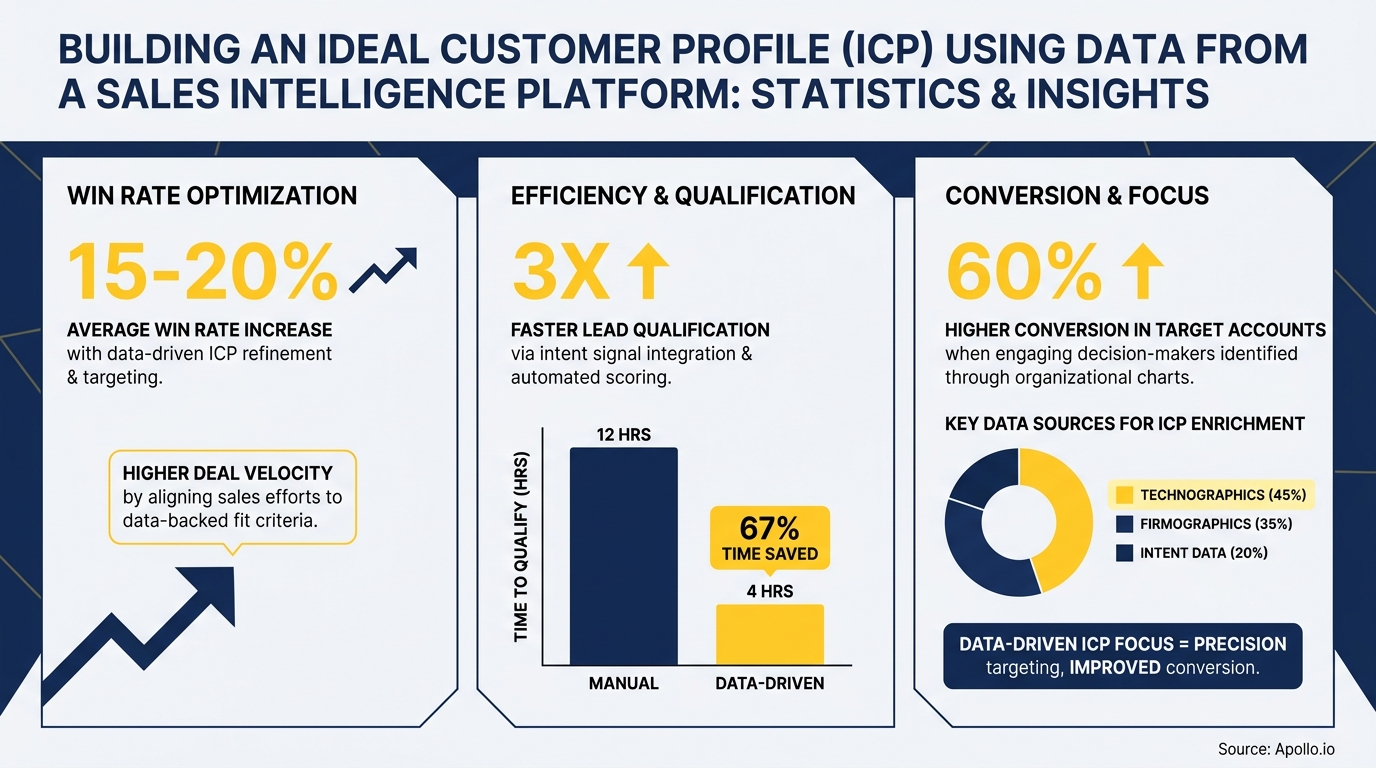
Building an ideal customer profile (ICP) from a sales intelligence platform means using firmographic, technographic, and intent data to define exactly which accounts are most likely to buy, expand, and stay. A static ICP built on gut instinct no longer works. According to IntentAmplify, organizations with a strong ICP achieve 68% higher account win rates compared to those without one. That gap is only growing as buying behavior shifts toward digital self-service and buying committees grow larger.
If you want to understand the full definition before building, start with what an ideal customer profile actually is — then come back here for the data-driven build process.

Research Less, Close More With Apollo
Tired of burning hours verifying contact info instead of selling? Apollo surfaces accurate, ready-to-engage prospects so your team spends time closing, not chasing. Join 600K+ companies building pipeline faster.
Start Free with Apollo →Key Takeaways
- A data-driven ICP combines firmographics, technographics, and intent signals — not just company size and industry.
- Modern B2B purchases involve 6–8 stakeholders on average, so your ICP must account for the full buying committee, not a single persona.
- Bad data wastes significant rep time and revenue — continuous enrichment is not optional.
- Sales intelligence platforms let RevOps and SDR teams filter, score, and activate ICP accounts without manual research.
- An ICP is a living document: validate it quarterly against closed-won data and refresh it with new intent signals.
What Data Does a Sales Intelligence Platform Provide for ICP Building?
Sales intelligence platforms provide firmographic, technographic, and intent data that form the three pillars of a modern ICP. As SalesIntel notes, these platforms integrate all three data types for a deeper understanding of target customers than CRM records alone can provide.
| Data Type | What It Tells You | ICP Use |
|---|---|---|
| Firmographic | Industry, headcount, revenue, location | Define account fit criteria |
| Technographic | Tech stack, integrations, platforms in use | Identify compatibility and displacement signals |
| Intent | Content consumption, keyword research patterns | Prioritize accounts actively in-market |
| Contact/Role | Job titles, seniority, department | Map buying committee stakeholders |
| Engagement | Website visits, email opens, event attendance | Identify warm accounts for faster outreach |
Understanding how intent data powers smarter B2B sales is critical before you build your scoring model. Intent signals tell you not just who fits, but who is ready to buy right now.
How Do You Build an ICP Step by Step Using a Sales Intelligence Platform?
Build your ICP by analyzing your closed-won customers first, then use your sales intelligence platform to find more accounts that match the same profile. Here is the six-step process:
- Pull your closed-won data. Export your last 12–24 months of won deals from your CRM. Note industry, company size, revenue range, tech stack, and sales cycle length.
- Identify patterns across your best accounts. Look for commonalities: Which segments close fastest? Which have highest retention? Which expand most?
- Layer in technographic and intent data. Use your sales intelligence platform to enrich closed-won accounts with tech stack data and intent signals. This reveals hidden fit attributes your CRM never captured.
- Define your ICP criteria. Set specific thresholds: e.g., SaaS companies, 50–500 employees, using a specific CRM, with active intent signals in your category.
- Build your negative ICP. Define accounts you should suppress: wrong industry, too small, wrong tech stack, or geographies you cannot serve. This is as important as the positive ICP.
- Activate and score. Apply ICP criteria as filters in your sales intelligence platform to generate a scored, prioritized target list for SDRs and AEs to work immediately.
Struggling to find accounts that match your ICP? Search Apollo's 230M+ contacts with 65+ filters to surface your best-fit accounts instantly.

How Should SDRs and RevOps Teams Use ICP Data Daily?
SDRs should use ICP scores as their daily prioritization queue, not a quarterly planning document. For RevOps leaders, the ICP becomes the single source of truth that governs list quality, routing rules, and pipeline forecasting accuracy.
- SDRs: Filter prospecting lists to ICP-fit accounts only. Focus outreach on accounts with active intent signals. Use job title filters to reach the right stakeholders in a buying committee.
- AEs: Use ICP data to prepare for discovery calls — technographic data reveals current tools, pain points, and displacement opportunities before the first conversation.
- RevOps: Set routing rules that automatically assign high-ICP-score accounts to senior reps. Use ICP thresholds to flag pipeline that is unlikely to close.
- Marketing: Sync ICP segments to ad platforms and content programs. Suppress non-ICP accounts from campaigns to reduce wasted spend.
Data from Badger Mapping shows that bad data can waste 27.3% of a sales rep's time and cost a business $20,000 annually. Clean, ICP-filtered lists eliminate that waste before it happens.
Turn Funnel Guesswork Into Pipeline Clarity
Tired of watching MQLs stall before they ever reach your pipeline? Apollo surfaces high-fit prospects and buying signals so your team acts on real opportunities. 600K+ companies stopped guessing and started closing.
Start Free with Apollo →How Do You Build a Buying-Committee ICP for Complex B2B Deals?
A buying-committee ICP maps multiple stakeholder personas within a single target account, because modern B2B purchases rarely involve a single decision-maker. B2B buying committees typically average 6–8 people, and can include up to 20 stakeholders in enterprise deals (Demand Gen Report, 2024).
For each ICP account, identify and map these roles using your sales intelligence platform's contact data:
- Economic Buyer: VP or C-level with budget authority. Focus on ROI and strategic impact.
- Technical Evaluator: IT, Security, or Ops. Focus on integrations, security, and implementation.
- End User Champion: Manager or team lead who will use the product daily. Focus on workflow and ease of use.
- Procurement/Legal: Approves vendor contracts. Needs compliance and data provenance documentation.
Your sales intelligence platform should let you filter contacts by job title and seniority within a target account, so SDRs can build multi-threaded outreach sequences that reach all four role types simultaneously. Learn more about how sales intelligence tools support multi-stakeholder prospecting.
How Do You Keep Your ICP Data Accurate Over Time?
Keeping your ICP accurate requires a continuous enrichment cadence, not a one-time build. A 2025 study by Integrate and Demand Metric found that nearly 75% of respondents estimate at least 10% of their lead data is inaccurate, outdated, or non-compliant — meaning your ICP degrades every month without active maintenance.
Use this cadence to maintain ICP data quality:
| Frequency | Action | Owner |
|---|---|---|
| Weekly | Refresh intent signals; update account scores | RevOps / Sales Intelligence Platform |
| Monthly | Re-enrich contact records for job changes, title updates | RevOps |
| Quarterly | Validate ICP criteria against closed-won and churned accounts | RevOps + Sales Leadership |
| Annually | Full ICP audit: adjust firmographic thresholds and scoring weights | RevOps + Marketing + Sales |
Apollo's job change alerts and data enrichment automate the monthly refresh cycle, flagging when contacts at ICP accounts change roles so your team never reaches a dead end. For a full enrichment strategy, see how to build a data enrichment strategy.
Tired of manually cleaning contact records? Enrich your CRM automatically with Apollo's verified contact data and keep your ICP lists accurate without the manual work.
What Makes an ICP a Living Document Instead of a Static List?
A living ICP updates continuously based on pipeline outcomes, intent signal changes, and market shifts — rather than sitting in a spreadsheet that gets reviewed once a year. SalesIntel notes that a data-driven ICP moves beyond assumptions to leverage real insights for targeted sales and marketing efforts, which requires ongoing signal input, not a one-time analysis.
Three practices convert a static ICP into a living one:
- Version control your ICP definition. Track changes to scoring thresholds and criteria so sales teams know which version is active and trust the data they receive.
- Connect ICP scores to CRM outcomes. Measure win rate, deal size, and sales cycle by ICP tier. Adjust scoring weights when the data diverges from predictions.
- Feed intent signals in weekly. Accounts that spike on relevant intent keywords should automatically surface to the top of SDR queues, not wait for the next quarterly review.
Apollo's AI-native workflows (highlighted in its April 2026 release notes) are designed exactly for this: turning ICP scoring into prioritized action lists so reps know which accounts to contact today, not which accounts looked good last quarter.

How Do You Start Building Your ICP with Apollo?
Start building your ICP with Apollo by using its 65+ search filters to define your target account criteria and generate an immediately actionable prospect list. Apollo's database of 230M+ contacts and 30M+ companies means you can validate ICP hypotheses against real market data — not just your existing CRM — before committing to a targeting strategy.
Teams like Cyera have found that "having everything in one system was a game changer," replacing multiple disconnected tools with a single platform for ICP definition, prospecting, enrichment, and outreach. That consolidation matters because an ICP is only as useful as your ability to act on it immediately.
Ready to turn your ICP into a pipeline engine? Start Free with Apollo and build your first data-driven ICP today — no credit card required.
Prove Pipeline ROI From Day One
ROI pressure killing your tool adoption? Apollo delivers measurable pipeline impact fast — 46% more meetings, trackable wins your leadership can see. Join 600K+ companies justifying every dollar spent.
Start Free with Apollo →Don't miss these
Sales
Inbound vs Outbound Marketing: Which Strategy Wins?
Sales
What Is a Sales Funnel? The Non-Linear Revenue Framework for 2026
Sales
What Is a Go-to-Market Strategy? The 2026 GTM Playbook
See Apollo in action
We'd love to show how Apollo can help you sell better.
By submitting this form, you will receive information, tips, and promotions from Apollo. To learn more, see our Privacy Statement.
4.7/5 based on 9,690 reviews
