
How to Build a Sales Automation Shortlist for Your Company Size and Use Case
Most sales automation shortlists fail before they start. Teams evaluate features, ignore integration depth, and end up with tools that sit unused. According to SalesGPT, 89% of sales teams now use some form of sales automation — yet quota attainment keeps dropping. The gap isn't tool availability. It's selection methodology.
This framework gives SDRs, RevOps leaders, AEs, and founders a structured way to evaluate sales automation tools by company size, use case, and integration readiness — not just feature lists.

Get Verified Contacts, Skip the Research
Tired of burning hours hunting down emails that bounce and numbers that go nowhere? Apollo surfaces accurate business contacts instantly, so your team sells instead of searches. Nearly 100K paying customers trust Apollo to keep their pipeline moving.
Start Free with Apollo →Key Takeaways
- Integration compatibility is the single most important filter — most companies fail to realize tool value because of CRM integration gaps, not missing features.
- Reps spend the majority of their week on non-selling tasks; your shortlist should directly target the workflows eating that time.
- Company size determines the right evaluation criteria: SMBs need speed-to-value, mid-market needs CRM depth, and enterprise needs governance and admin controls.
- Agentic AI tools now require governance evaluation — audit trails, admin guardrails, and human-in-the-loop approvals are non-negotiable shortlist criteria in 2026.
- Tool consolidation beats best-of-breed for most GTM teams: fewer integrations mean faster adoption, lower cost, and cleaner data.
Why Do Most Sales Automation Shortlists Fail?
Most shortlists fail because teams evaluate tools by features instead of fit. A Bain 2025 survey of 1,200+ senior commercial executives found 70% of companies struggle to integrate sales plays into CRM and revenue tech — and only about 20% have realized full value from those plays.
That integration gap is the primary shortlist killer.
The second failure mode is ignoring selling-time math. Salesforce's State of Sales research shows reps spend just 33% of their week actually selling.
The right automation tool targets the specific workflows consuming the other 67% — not just the workflows that look impressive in a demo.
Before adding any tool to your shortlist, ask: does it sync bidirectionally with your CRM, does it reduce manual data entry, and can your team adopt it without dedicated IT support?
What Are the Core Criteria for Shortlisting Sales Automation Tools?
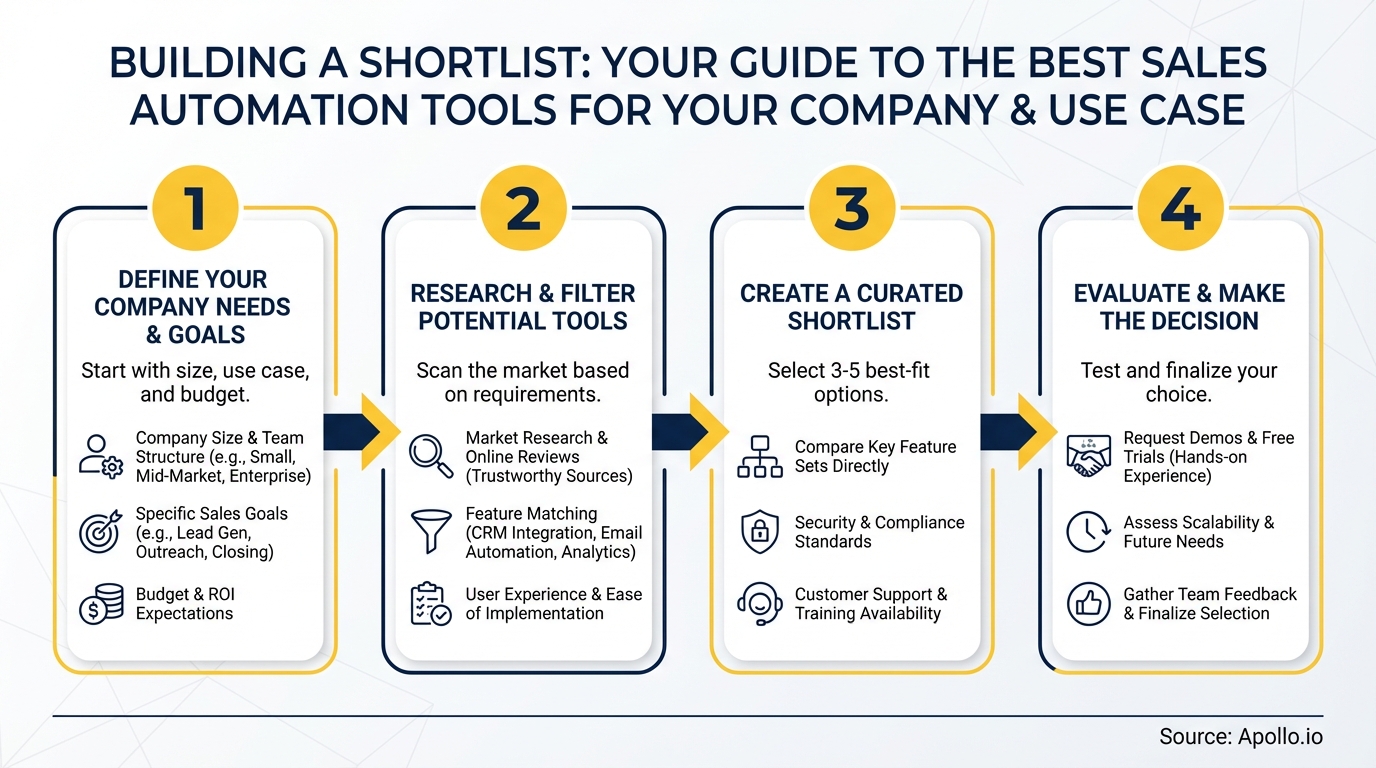
A reliable shortlist uses five weighted criteria, not a feature checklist. Score each vendor 1–5 on each dimension, then weight by company priority.
| Criteria | What to Evaluate | Suggested Weight |
|---|---|---|
| CRM Integration Depth | Bidirectional sync, field-writeback, API reliability | 30% |
| Use-Case Coverage | Prospecting, sequencing, dialing, enrichment — in one place or fragmented? | 25% |
| Data Quality and Governance | Contact accuracy, enrichment coverage, audit trails, admin controls | 20% |
| Total Cost of Ownership | Seat pricing, usage-based add-ons, enrichment costs, agent action limits | 15% |
| Cross-Functional Alignment | Marketing/service collaboration, shared data access, content handoffs | 10% |
Gartner's survey of 227 CSOs (Aug–Sep 2025) found that sales organizations collaborating on enablement content with marketing and service teams are 2.4x more likely to achieve strong commercial growth. Cross-functional alignment isn't a nice-to-have — it's a revenue multiplier worth weighting in your scorecard.
Spending hours evaluating tools manually? See how Apollo consolidates prospecting, sequencing, and enrichment in one platform — so you evaluate one unified tool instead of five.

How Do Company Size and Use Case Change Your Shortlist?
Company size directly determines which criteria matter most and how many tools belong on your shortlist. Research from GTMnow's Sales Tech Stack Report shows small companies (fewer than 250 employees) tend to use 4 or fewer tools, while larger companies (250–1,000+ employees) typically use 5 or more.
| Company Size | Top Priority | Key Shortlist Filter | Watch Out For |
|---|---|---|---|
| SMB (<100 seats) | Speed-to-value, low admin overhead | Self-serve onboarding, free tier or trial | Over-engineering the stack early |
| Mid-Market (100–500 seats) | CRM depth, team workflows | Bidirectional CRM sync, sequence management | Tools that require heavy IT involvement |
| Enterprise (500+ seats) | Governance, security, admin controls | Role-based permissions, audit trails, SSO | Usage-based pricing that scales unpredictably |
For SDRs and BDRs at any company size, the primary use case is prospecting and outbound sequencing. Prioritize tools with verified contact data, multi-channel sequences (email, phone, social), and CRM auto-logging. For AEs, prioritize deal tracking, call intelligence, and meeting automation. For RevOps leaders, the shortlist filter is data cleanliness, deduplication, and a single source of truth — fewer integrations to maintain means fewer data quality issues.
Learn how to build a sales tech stack that scales revenue with the right tools at each growth stage.
Turn Funnel Guesswork Into Pipeline Clarity
Pipeline forecasting a guessing game because leads stall before they ever reach your AEs? Apollo surfaces high-intent prospects and moves them faster from first touch to opportunity. Nearly 100K paying customers trust Apollo to make their pipeline real.
Schedule a Demo →What Is the Agentic AI Governance Test for 2026?
In 2026, any tool with AI agents on your shortlist requires a governance evaluation, not just a feature evaluation. Vendors including major CRM platforms have introduced agent SKUs with new pricing models, action limits, and control layers — meaning procurement now evaluates agent permissions, audit trails, and human-in-the-loop approvals alongside feature depth.
Add these four questions to every AI-capable vendor evaluation:
- Auditability: Can you see what the agent did, with which data, and why?
- Admin controls: Can you restrict which reps or workflows the agent touches?
- Pricing model: Is AI priced per seat, per action, or bundled — and what happens at scale?
- Data residency: Where is enrichment data processed and stored?
According to CloudApps' State of Sales research, AI adoption in sales surged from 39% in 2023 to 81% in 2025. Tools without governance controls create compliance and auditability risk that grows with adoption. Gate any agentic tool on these four answers before it advances on your shortlist.
How Do SDRs and RevOps Leaders Apply This Framework in Practice?
SDRs and RevOps leaders apply the shortlist framework differently — and both approaches are valid starting points depending on who owns the evaluation.
For SDRs and BDRs running the evaluation bottom-up: start with your three highest-friction workflows (typically: finding verified contacts, writing personalized outreach, and logging activity to CRM). Map each workflow to a tool capability. Any tool that doesn't cover all three in one platform adds integration complexity. Check automated sales prospecting tools that unify these workflows before splitting them across multiple vendors.
For RevOps leaders running the evaluation top-down: start with your CRM as the anchor. Every shortlisted tool must pass a bidirectional sync test with your CRM before it advances. Then apply the scoring criteria above. Tools that require custom API work to sync basic fields fail the integration gate.
The consolidation argument matters here. As Predictable Revenue put it: "We reduced the complexity of three tools into one." Fewer tools mean faster onboarding, lower cost, and cleaner pipeline data — all of which RevOps leaders cite as top priorities.
Need to find qualified prospects without adding another data vendor? Search Apollo's 230M+ contacts with 65+ filters — prospecting, sequencing, and enrichment in one workspace.
How Do You Make the Final Shortlist Decision?
Narrow to three finalists using the weighted scorecard, then run a structured pilot on one real workflow. The pilot should last two to four weeks, involve actual reps (not just managers), and measure CRM data quality before and after — not just activity volume.
Three final filters before signing:
- Total cost model: Map seat costs, usage add-ons, enrichment fees, and agent action limits to your projected usage at 2x current scale.
- Migration and lock-in: Can you export your data cleanly? What does offboarding look like?
- Adoption path: Does the tool work inside the surfaces your reps already use (email, calendar, CRM), or does it require a new UI habit?
For teams that want to consolidate prospecting, outreach automation, enrichment, and pipeline management into one platform, review which AI sales tools actually close more deals before finalizing your shortlist.

Build Your Shortlist With Confidence in 2026
The best sales automation shortlist is built on integration fit, use-case specificity, and governance readiness — not on which vendor has the longest feature list. Start with your highest-friction workflows, apply the weighted scorecard, and gate every AI-capable tool on auditability and pricing model before advancing it.
Apollo brings prospecting, outbound sequencing, contact enrichment, and pipeline management into one unified platform — so SDRs, AEs, RevOps, and revenue leaders work from a single source of truth. Trusted by nearly 100K paying customers including Anthropic, Cyera, and Census, Apollo is built for GTM teams that need to move fast without building a fragmented stack. As Census put it: "We cut our costs in half."
Ready to see Apollo in action? Request a Demo and build your shortlist around a platform that consolidates your tech stack from day one.
Prove Pipeline ROI With Apollo
ROI pressure killing your next tool renewal? Apollo delivers measurable pipeline impact from day one — quantifiable wins your leadership can't argue with. Leadium 3x'd annual revenue. You're next.
Start Free with Apollo →Don't miss these
Sales
Inbound vs Outbound Marketing: Which Strategy Wins?
Sales
What Is a Sales Funnel? The Non-Linear Revenue Framework for 2026
Sales
What Is a Go-to-Market Strategy? The 2026 GTM Playbook
See Apollo in action
We'd love to show how Apollo can help you sell better.
By submitting this form, you will receive information, tips, and promotions from Apollo. To learn more, see our Privacy Statement.
4.7/5 based on 9,690 reviews
