
How Do I Build a Qualified Lead List Quickly? A 2026 Framework for B2B Teams
Most sales teams don't have a lead volume problem. They have a lead quality problem. Generating a long list of contacts is easy. Building one where every name belongs there, the data is verified, and the contacts are ready to engage? That's the actual challenge. According to SalesHive, 45% of B2B companies struggle to generate enough qualified leads and 48% face difficulties converting them into revenue. Speed without qualification just accelerates wasted effort. This guide gives you a practical framework for building lead lists that convert faster, with the data governance and automation logic to back it up.

Research Less, Close More With Apollo
Tired of burning hours verifying contact info that still bounces? Apollo delivers 97% email accuracy so your reps spend time selling, not searching. Join 600K+ companies building pipeline that actually converts.
Start Free with Apollo →Key Takeaways
- Define negative ICP criteria (who to exclude) before you start building any list. This single step improves conversion rates faster than adding more contacts.
- Data accuracy is a prerequisite for speed. Bad data slows outreach, destroys deliverability, and wastes rep time.
- Build for automation-first. Lists that include intent signals and buying-stage triggers unlock personalized sequences without manual research.
- Response speed matters. Companies that contact a lead within one hour are 7 times more likely to qualify that prospect than those waiting two hours.
- Consolidating your prospecting, enrichment, and engagement tools into one platform is the fastest way to cut list-building time in 2026.
What Does a Qualified Lead List Actually Look Like?
A qualified lead list is a curated set of contacts and accounts that match your ICP, contain verified contact data, and include enough context to trigger relevant outreach. It's not a bulk export from a database.
Every record should clear three bars: firmographic fit, persona fit, and data accuracy.
| Qualifier | What to Check | Why It Matters |
|---|---|---|
| Firmographic fit | Industry, company size, revenue, geography | Ensures accounts can buy and use your product |
| Persona fit | Job title, seniority, department, buying authority | Targets the right decision-maker, not just any contact |
| Data accuracy | Verified email, direct phone, recent job tenure | Prevents bounce rates and deliverability damage |
| Intent signal | Topic engagement, job change, funding event | Indicates in-market timing for outreach |
Research from Lead-Spot shows B2B buyers complete up to 69% of their journey anonymously before engaging sales. If your list only captures who to contact but not where they are in their journey, you'll reach them with the wrong message at the wrong time.
How Do You Define Your ICP Fast (Including What to Exclude)?
The fastest ICP definition exercise starts with your closed-won data. Pull your last 20-50 customers.
Look for patterns in industry, company size, tech stack, and the title that championed the deal. That's your positive ICP.
Most teams stop there. Don't.
Define your negative ICP criteria explicitly. These are the accounts that look like a fit but never convert, or churn within 90 days. Common exclusions include:
- Companies below a headcount or revenue floor (not enough budget)
- Industries with regulatory blockers for your product category
- Accounts already using a competitor under a long-term contract
- Contacts below the seniority level needed to approve a purchase
- Geographies outside your support or compliance coverage
Negative ICP criteria act as a pre-outreach filter. Apply them before list-building, not after. This is the step most SDRs skip, and it's why their lists fill up with contacts that will never convert. For a deeper look at data-driven prospecting strategies, the pattern is consistent: tighter criteria at the top means better results at the bottom.

How Do SDRs Build a Qualified List Without Wasting Hours on Research?
SDRs building lists manually lose significant research time per prospect. The modern approach flips this: use a platform with advanced filters to build the list first, then enrich in-workflow rather than switching between tools.
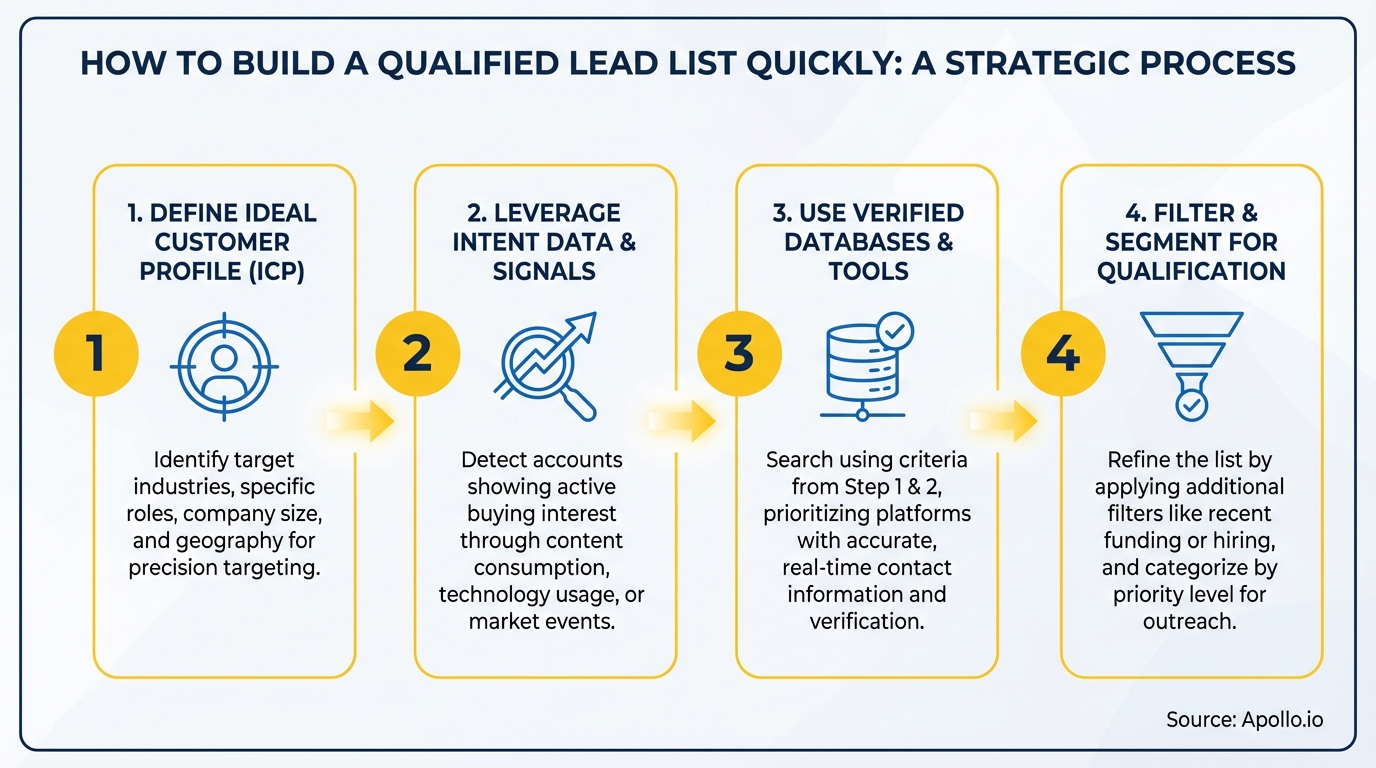
The workflow that works in 2026:
- Filter by ICP criteria using firmographic and technographic data (industry, headcount, tech stack, funding stage)
- Layer in intent signals (job change, hiring surge, content engagement) to prioritize in-market accounts
- Verify contact data before export or sequence enrollment. Never skip this step.
- Enrich missing fields using waterfall enrichment to fill gaps across multiple data sources automatically
- Segment by buying stage so messaging matches where each prospect sits in their journey
Struggling to find verified contacts at scale? Search Apollo's 230M+ contacts with 65+ filters to build ICP-tight lists in minutes, not hours.
Turn Funnel Gaps Into Pipeline Gold
Pipeline forecasting a guessing game because quality leads keep stalling before they convert? Apollo surfaces in-market buyers at the right moment, so your funnel fills with opportunities that actually close. Join 600K+ companies forecasting with confidence.
Start Free with Apollo →Why Does Data Quality Determine How Fast Your List Actually Works?
Data quality is not a secondary concern. It's the rate-limiter on every other part of your outbound motion.
Bounced emails damage sender reputation. Wrong phone numbers waste dial time.
Outdated titles mean your message lands with the wrong person.
Bulk-sender enforcement from major email providers in 2025 and into 2026 made this even more critical. High bounce rates and complaint rates now directly trigger deliverability penalties.
A fast list built on bad data produces worse results than a slower list built on verified contacts.
Data governance minimum standards for every list:
- Email verification before any send (97% accuracy benchmark is achievable with the right tooling)
- Suppression lists applied before export (existing customers, opted-out contacts, competitors)
- Re-verification cadence for contacts older than 6 months
- Waterfall enrichment to fill missing phone, title, or company fields from multiple sources
For a practical look at building a B2B email list that converts, data hygiene is consistently the highest-leverage action teams can take before launching any outbound campaign.
How Do You Build Lists That Feed Automation Instead of Breaking It?
Automation-ready lists require more than clean data. They need segmentation fields that map directly to sequence triggers.
Without this, automation sends the same message to everyone, which is the fastest way to kill engagement.
Segmentation fields that enable automated personalization:
- Buying stage signal: First awareness, active research, or evaluation (drives message angle)
- Trigger event: New hire, funding round, product launch, job change (drives timing and opener)
- Persona pain point: Maps to the problem your product solves for their specific role
- Engagement history: Prior email open, web visit, content download (enables re-engagement sequences)
According to Landbase, companies with strong lead nurturing strategies generate 50% more sales-ready leads at a 33% lower cost. Nurturing only works when your list has the segmentation data to route contacts into the right tracks automatically.
RevOps leaders building automated pipelines find that the list structure is often the blocker, not the automation tool itself. If the fields aren't there, the triggers can't fire. Build lists with automation in mind from the start. Explore how to build an automated lead generation system that connects list quality to pipeline outcomes.

How Do AEs and Revenue Leaders Tie Lead Lists to Pipeline and Revenue?
A lead list only has business value when it connects to measurable pipeline. For Account Executives and revenue leaders, this means defining what a qualified lead is before building the list, not after reviewing why conversion rates are low.
Minimum routing and attribution standards:
- Define MQL, SQL, and PQL criteria in your CRM before any list goes live
- Set a response SLA. Research from SalesGenie confirms that companies contacting a lead within one hour are 7 times more likely to qualify that prospect than those waiting two hours.
- Tag lead source on every record so attribution is clean from first touch
- Route by territory, segment, or account tier immediately on entry, not after the first call
Sales leaders and RevOps teams who treat lead lists as pipeline assets, not just contact exports, close the loop between list quality and revenue outcomes. For teams looking to reduce tool sprawl while gaining this visibility, Apollo consolidates prospecting, enrichment, engagement, and pipeline tracking in one workspace.
As Cyera's team put it: "Having everything in one system was a game changer."
How Do You Build a Qualified Lead List Quickly in 2026?
The answer is a four-step system: define your ICP tightly (including exclusions), verify your data before outreach, segment for automation triggers, and connect list activity to pipeline attribution. Speed comes from eliminating the manual steps between each stage, not from lowering your qualification standards.
Teams that consolidate their prospecting, enrichment, and engagement tools see the biggest gains. "We reduced the complexity of three tools into one," said Collin Stewart of Predictable Revenue. That consolidation is where the speed comes from in 2026: fewer handoffs, fewer data gaps, and faster time from list to booked meeting.
For more practical frameworks, explore outbound prospecting strategies for winning B2B leads and lead lists that actually convert.
Ready to build your next qualified list in minutes? Try Apollo free and access 230M+ verified contacts with 65+ filters, built-in enrichment, and multi-channel sequences in one platform.
Prove Pipeline ROI With Apollo
Budget approval stuck on unclear metrics? Apollo delivers measurable pipeline impact from day one — Leadium 3x'd their annual revenue after switching. Start your free trial and show leadership results, not promises.
Start Your Free Trial →Don't miss these
Sales
Inbound vs Outbound Marketing: Which Strategy Wins?
Sales
What Is a Sales Funnel? The Non-Linear Revenue Framework for 2026
Sales
What Is a Go-to-Market Strategy? The 2026 GTM Playbook
See Apollo in action
We'd love to show how Apollo can help you sell better.
By submitting this form, you will receive information, tips, and promotions from Apollo. To learn more, see our Privacy Statement.
4.7/5 based on 9,690 reviews
