
How to Build a Business Case for Replacing Multiple Point Solutions with an All-in-One Platform
Your consolidation business case is wrong if it only counts license fees. The real cost of running disconnected point solutions includes integration maintenance, admin overhead, data sync failures, and the rep time lost switching between tools. According to Kondo's B2B Sales Report, between 90% and 94% of sales organizations planned to consolidate their tech stack to reduce friction and cost. The momentum is clear. The question is how to build the argument that wins executive approval.
This playbook gives RevOps leaders, sales managers, and founders a step-by-step framework to quantify the cost of fragmentation, calculate consolidation ROI, and present a migration plan that finance and the board will approve. If you're also evaluating how your sales tech stack scales revenue, this framework applies directly.

Scale Pipeline Without the Manual Grind
Tired of watching your team burn hours on research instead of closing deals? Apollo instantly surfaces verified contacts and automates outreach so your reps sell more, not search more. Join 600K+ companies building predictable pipeline.
Start Free with Apollo →Key Takeaways
- A strong consolidation business case goes beyond license savings — it quantifies integration costs, admin overhead, and AI labor leverage.
- Between 90% and 94% of sales organizations have already planned tech stack consolidation, meaning your executive team expects this conversation.
- Buyers overwhelmingly prefer unified platforms: 84% would rather buy one tool for multiple problems than manage separate point solutions.
- RevOps leaders who align people, processes, and technology across teams achieve measurably more revenue and profitability than siloed counterparts.
- A phased migration with clear KPIs and a vendor parity checklist reduces risk and builds internal confidence for the switch.
Why Is Tool Sprawl So Expensive for GTM Teams?
Tool sprawl is expensive because every disconnected point solution adds integration costs, data inconsistency, and cognitive load — not just a line item on the software budget. According to Bird's platform research, over half of organizations are actively consolidating redundant tools, driven by the compounding operational drag of managing separate systems.
For SDRs and AEs, fragmentation is a daily productivity tax. Reps toggle between a prospecting database, a sequencing tool, a dialer, a CRM, and a reporting dashboard — each with its own login, data model, and sync lag.
RevOps leaders spend hours reconciling data discrepancies that a unified platform eliminates by design.
The hidden costs stack up quickly:
- Integration maintenance: API connections break, require updates, and need dedicated engineering time.
- Duplicate data: Contact records diverge across systems, degrading lead quality and attribution.
- Onboarding drag: Every new tool requires separate training, admin setup, and user provisioning.
- Vendor management: Multiple renewal cycles, support escalations, and contract negotiations consume RevOps bandwidth.
Struggling to see the full picture of your pipeline across fragmented tools? Get complete pipeline visibility with Apollo's deal management.
How Do You Quantify the ROI of Platform Consolidation?
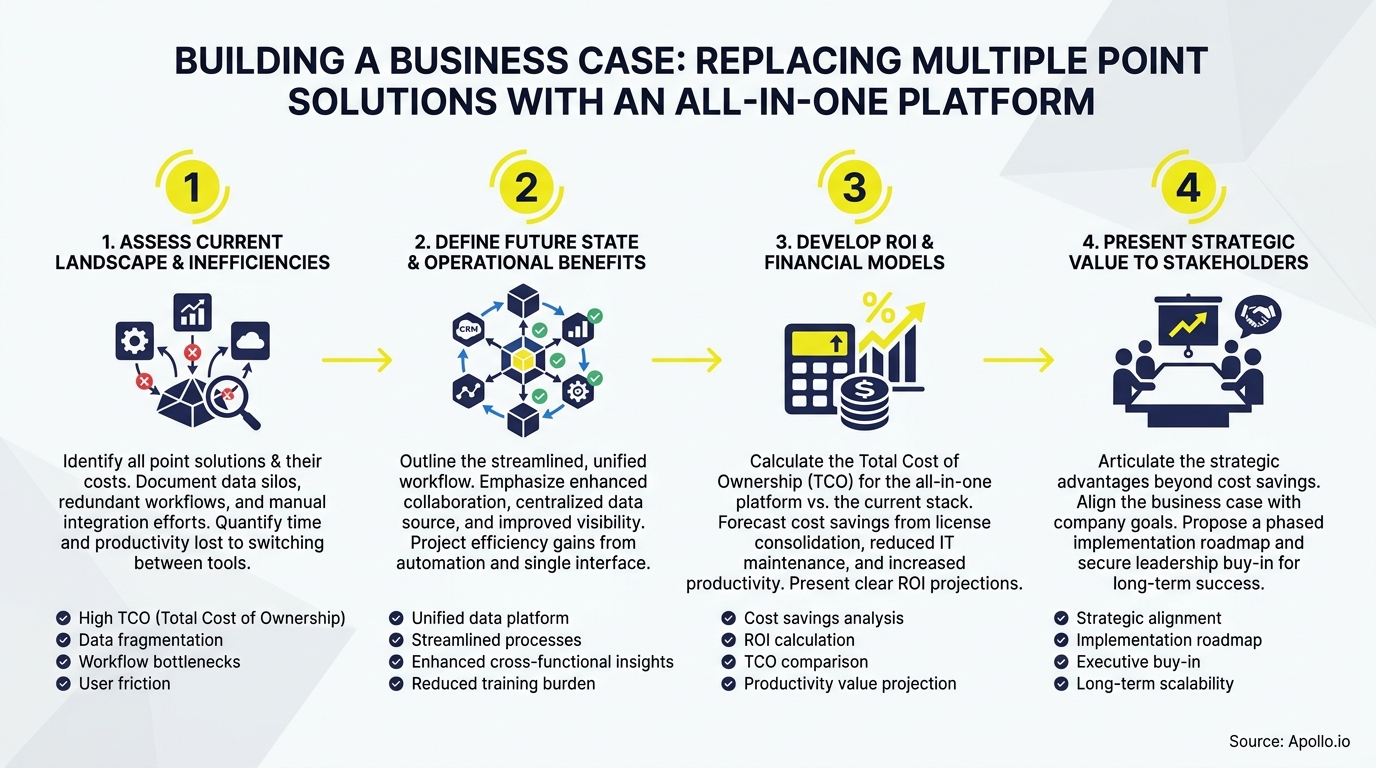
Quantify consolidation ROI by building a total cost of ownership (TCO) model that captures both hard costs (licenses, integrations) and soft costs (admin time, rep friction, data errors). This is the model that wins CFO approval — not a simple license-fee comparison.
Use this TCO framework as your starting template:
| Cost Category | Point Solution Stack | All-in-One Platform |
|---|---|---|
| Software licenses | Sum of all tool subscriptions | Single platform fee |
| Integration build & maintenance | Engineering hours × hourly rate | Native — minimal or zero |
| Admin overhead | Hours managing multiple vendors | Single admin layer |
| Data reconciliation | RevOps hours fixing sync errors | Single source of truth |
| Rep context-switching | Lost selling time across tools | Unified workflow |
| Onboarding & training | Per-tool training costs | One onboarding track |
Research from Waypost Marketing shows organizations implementing a strategic, well-integrated stack can see a 20–40% increase in marketing ROI. That range is your financial upside benchmark when presenting to leadership.
On the revenue side, data from Outreach.ai's RevOps research found that companies aligning people, processes, and technology across teams achieved 36% more revenue and up to 28% more profitability — the outcome of exactly the kind of unified workflow a consolidated platform enables.

How Do RevOps Leaders Build the Internal Business Case?
RevOps leaders build winning consolidation cases by framing the argument around revenue outcomes, not software savings. Finance and the C-suite respond to pipeline impact, not vendor rationalization.
Follow this sequencing when building your internal deck:
- Audit current state: List every tool, its cost, its owner, and what workflow it supports. Identify overlaps and gaps.
- Map handoffs: Document every data handoff between tools. Each handoff is a failure point and a latency risk for your pipeline.
- Quantify friction: Survey reps and managers. How many tools do they use daily? What breaks most often? How much time is lost?
- Model the TCO delta: Use the framework above. Include a conservative, base, and optimistic scenario.
- Build the vendor parity matrix: List every critical workflow from your current stack. Confirm the all-in-one platform covers each one natively.
- Define success KPIs: Set measurable targets — meeting booked rate, pipeline velocity, data accuracy, rep ramp time — before migration starts.
The G2 Software Buyer Behavior Report (cited by Brex) found that 84% of buyers would rather purchase one tool for multiple business problems, and 78% prefer to buy complementary products from a single vendor. Use this buyer sentiment data to show leadership that consolidation aligns with how the market is moving — your team is not the outlier.
For RevOps teams managing data synchronization headaches across multiple systems, consolidation directly eliminates the root cause rather than adding another integration band-aid.
What Does a Safe Migration Playbook Look Like?
A safe migration runs in three phases: audit and select, pilot and validate, and full rollout with governance. Skipping phase two is the most common reason consolidation projects fail.
Phase 1 — Audit and Select (Weeks 1–4):
- Complete the tool audit and TCO model.
- Score candidate platforms against your parity matrix.
- Validate security and compliance posture. Apollo's platform, for example, holds ISO 27001 certification and GDPR-compliant architecture — confirm your shortlisted platform meets equivalent standards.
Phase 2 — Pilot and Validate (Weeks 5–10):
- Run a 4–6 week pilot with one team (e.g., one pod of SDRs).
- Measure pilot KPIs against your defined benchmarks.
- Identify workflow gaps before full rollout.
- Collect rep feedback on usability and adoption friction.
Phase 3 — Full Rollout (Weeks 11–20):
- Migrate data, decommission redundant tools by contract renewal date.
- Run parallel systems only during a defined transition window.
- Report consolidation KPIs to leadership monthly for the first quarter.
This phased approach also directly supports the sales transformation process RevOps teams are responsible for leading — consolidation is not just a cost exercise, it is a structural upgrade to how your GTM motion operates.
Turn Funnel Gaps Into Predictable Pipeline
Pipeline forecasting a guessing game because quality leads never convert? Apollo surfaces in-market buyers with verified contact data so your reps reach the right prospects at right moment. 600K+ companies trust Apollo to build pipeline that actually closes.
Schedule a Demo →How Do AI Agents Change the Consolidation Calculus in 2026?
AI agents shift the ROI math from license consolidation to labor consolidation. In 2026, the most compelling business cases quantify time saved by AI-assisted workflows — prospecting research, call summaries, next-step recommendations — not just subscription line items eliminated.
The 2025 MarTech Replacement Survey found that 37.1% of buyers cited AI capabilities as important when choosing replacement tools, and 33.9% wanted AI as a primary reason to switch. If your current point solutions lack native AI, that gap is now a quantifiable productivity cost in your business case.
For sales teams, this means the consolidation argument includes:
- AI-assisted prospecting: Fewer hours spent manually researching and building lists.
- Automated sequencing: Personalized outreach at scale without additional headcount.
- Call intelligence: AI summaries and next steps without a separate conversation intelligence tool.
Spending hours on manual outreach across disconnected tools? Automate your GTM workflows with Apollo's AI sales automation — one platform for prospecting, sequencing, and pipeline management.
Apollo's all-in-one GTM platform consolidates the sales tech stack into a single workspace. Teams like Census report cutting their costs in half, while Cyera found that "having everything in one system was a game changer." Predictable Revenue summarized it directly: "We reduced the complexity of three tools into one."
How Do You Win Stakeholder Buy-In for Platform Consolidation?
Win stakeholder buy-in by tailoring your message to each audience: CFOs want TCO and risk reduction, CROs want pipeline velocity and rep productivity, and IT leaders want security, integration simplicity, and reduced vendor surface area.
| Stakeholder | Primary Concern | Key Message |
|---|---|---|
| CFO / Finance | Cost, risk, ROI | TCO savings + integration cost elimination |
| CRO / VP Sales | Pipeline, quota, rep efficiency | Fewer handoffs = faster cycle time |
| RevOps Leader | Data integrity, workflow | Single source of truth, no sync errors |
| IT / Security | Compliance, vendor risk | Fewer vendors, stronger security posture |
| Sales Reps (SDRs/AEs) | Usability, daily workflow | One workspace, less context switching |
The RevOps angle is particularly strong right now. According to JohnnyGrow's RevOps research, Gartner predicts that 75% of the highest-growth companies will adopt a Revenue Operations model by 2026, a 30% increase from two years prior. Consolidation is the operational foundation that makes RevOps function — you cannot align sales, marketing, and customer success on fragmented data.
For enterprise GTM teams evaluating enterprise sales solutions, consolidation also delivers advanced routing, governance controls, and admin visibility that point solutions simply cannot replicate at scale.

Build Your Business Case and Start Consolidating Today
Building a business case for platform consolidation comes down to four deliverables: a TCO model that captures the full cost of fragmentation, a vendor parity matrix that proves the all-in-one platform covers your critical workflows, a phased migration plan that reduces risk, and a set of KPIs that let you prove ROI to leadership within 90 days of rollout.
The market has already decided. The buyers, the data, and the competitive pressure all point in the same direction: fewer tools, fewer handoffs, and a unified platform that lets your GTM team move faster.
The only question is whether you build the case now or wait until a competitor does.
Apollo consolidates prospecting, engagement, pipeline management, and AI automation into one workspace — trusted by nearly 100K paying customers including Anthropic, Smartling, and Autodesk. Start a free trial and see how much stack you can cut.
Prove Pipeline ROI With Apollo
Budget approval stuck on unclear metrics? Apollo delivers measurable pipeline impact fast — so you walk into every renewal with hard numbers, not gut feelings. Leadium 3x'd annual revenue. You're next.
Start Free with Apollo →Don't miss these
Sales
Inbound vs Outbound Marketing: Which Strategy Wins?
Sales
What Is a Sales Funnel? The Non-Linear Revenue Framework for 2026
Sales
What Is a Go-to-Market Strategy? The 2026 GTM Playbook
See Apollo in action
We'd love to show how Apollo can help you sell better.
By submitting this form, you will receive information, tips, and promotions from Apollo. To learn more, see our Privacy Statement.
4.7/5 based on 9,690 reviews
