
How to Benchmark Outbound Email Open and Reply Rates Against Industry Standards
Most outbound teams are benchmarking against the wrong metrics. They compare open rates to industry averages, see a number that looks acceptable, and miss the fact that Apple Mail Privacy Protection (MPP) has made open rate comparisons nearly meaningless for cold outreach.
If you want to know how your outbound email program actually stacks up, you need a different framework entirely — one that starts with deliverability, not opens.
This guide gives SDRs, BDRs, RevOps leaders, and sales managers a practical, compliance-aware benchmarking system for 2026. Start with the outbound prospecting fundamentals before diving into metrics, and you'll have the full picture.

Research Less. Pipeline More With Apollo.
Tired of your reps burning hours hunting down contact info instead of selling? Apollo surfaces verified leads instantly so your team scales outreach without scaling headcount. Nearly 100K paying customers already made the switch.
Start Free with Apollo →Key Takeaways
- Open rate is no longer a reliable benchmark for cold outbound email due to privacy proxy inflation — shift your primary metric to reply rate and positive reply rate.
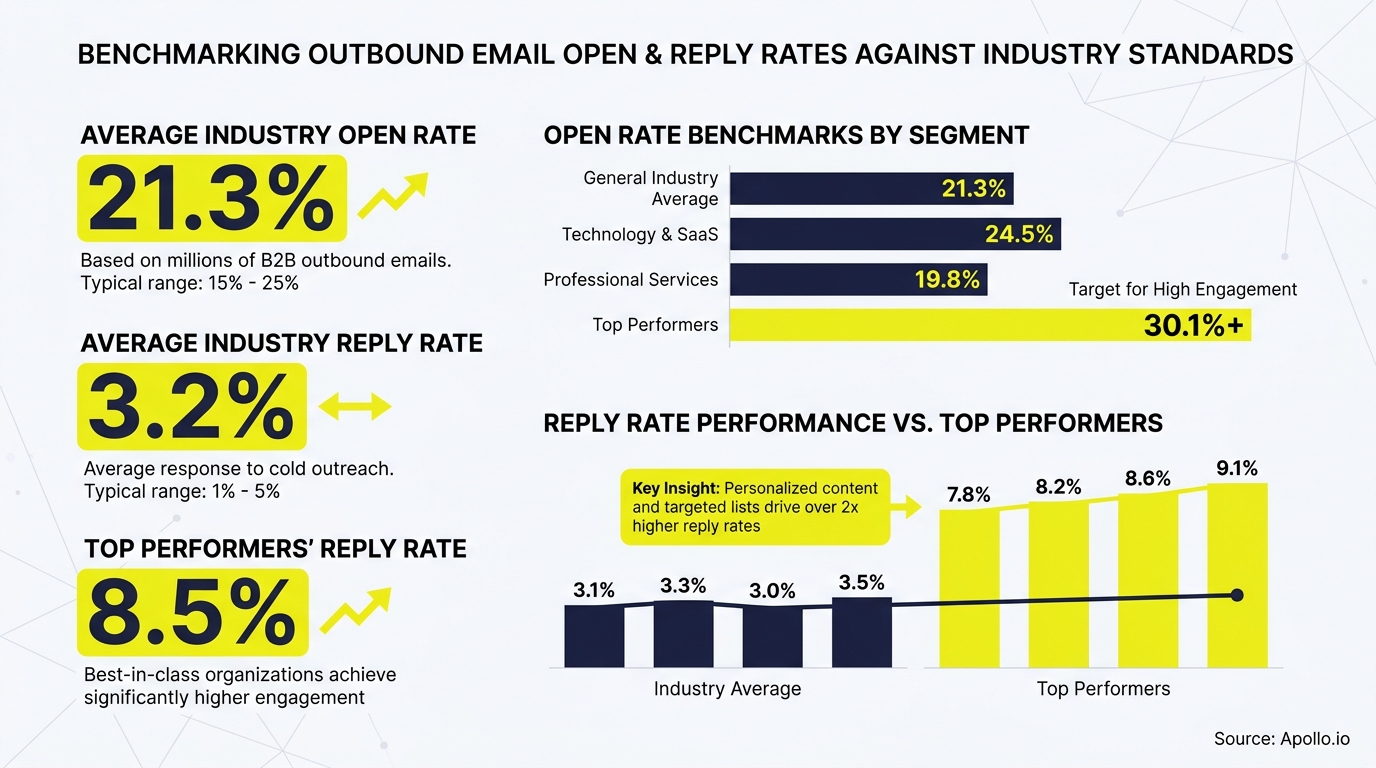
- Cold outbound reply rates average in the low single digits; top-performing programs with strong targeting and follow-up sequences can significantly outperform that baseline.
- Deliverability gating (SPF, DKIM, DMARC, complaint rate) must come before any engagement benchmarking — if you're landing in spam, your reply rate is meaningless.
- Automation level affects reply outcomes: manually reviewed and edited emails measurably outperform fully automated sends.
- The most useful benchmarks are segment-specific — cold outbound and opt-in email marketing operate in completely different performance ranges and should never be compared directly.
Why Is Open Rate an Unreliable Benchmark in 2026?
Open rate is unreliable for benchmarking because privacy proxies — not real humans — are responsible for a large share of all tracked opens. As noted by Sopro, Apple's Mail Privacy Protection (MPP) has significantly inflated open rates, making this metric less reliable for true engagement measurement. When one privacy feature can artificially inflate your reported open rate, comparing that number to any industry average becomes an apples-to-oranges exercise.
This is especially acute for cold outbound. MailerLite reports an average email open rate across all industries of 43.46% in 2025 — a figure heavily influenced by MPP-inflated opt-in marketing email. Cold outbound operates in a completely different environment. Comparing your cold sequence open rate to that number will give you false confidence or false alarm, depending on your tool's bot-filtering logic.
The fix: Treat open rate as a secondary signal at best. Use it only for trend direction within your own program (are opens going up or down over time?), not for external comparisons.
What Are the Right Benchmarks for Cold Outbound Email in 2026?
The right benchmarks for cold outbound email are, in order of reliability: inbox placement rate (IPR), reply rate, positive reply rate, and meetings booked per 1,000 sends.
| Metric | Average (Cold Outbound) | Good Performance | Top Quartile |
|---|---|---|---|
| Reply Rate | 3–5.8% | 8–10% | 15–25% |
| Open Rate (directional only) | 21–28% | 35–45% | Not recommended as primary KPI |
| Inbox Placement Rate (IPR) | Target: 85%+ | 88%+ | 92%+ |
| Spam Complaint Rate | Keep below 0.3% | Below 0.1% | Below 0.05% |
A study by Belkins found that average reply rates dipped to 5.8% in 2024, compared to 6.8% in 2023 — a signal that competition for attention is increasing. According to The Digital Bloom, top performers in 2024–2025 can achieve 15–25% with optimized hooks, targeting, and follow-up sequences. The gap between average and top-quartile performance is mostly explained by list quality, personalization depth, and sequence design — not volume.
Struggling to build sequences that actually get replies? Automate your multi-channel sequences with Apollo's sales engagement platform and track reply rate at every step.
What Is the Deliverability Preflight Checklist Before Benchmarking?
Before comparing your reply rates to any benchmark, verify that your emails are actually reaching inboxes. Engagement metrics are meaningless if a significant share of your sends are landing in spam folders.
Following Google and Yahoo's bulk-sender enforcement (effective February 1, 2024) and Microsoft Outlook's similar requirements (effective May 5, 2025), your sending infrastructure must meet these requirements or your benchmarks are invalid:
- SPF record: Configured and passing for your sending domain
- DKIM signature: Enabled on outgoing mail
- DMARC policy: At minimum a monitoring policy (p=none) in place
- One-click unsubscribe: Required for bulk senders per Google/Yahoo/Microsoft rules
- Spam complaint rate: Keep below 0.3% (Google Postmaster Tools threshold)
- Sending domain warm-up: New domains should ramp volume gradually over 4–6 weeks
Check your email deliverability with sequence diagnostics before drawing any conclusions from your engagement data. If your inbox placement rate is below 85%, fix deliverability first — then benchmark.

How Do SDRs and RevOps Leaders Segment Benchmarks Accurately?
SDRs and RevOps leaders get the most accurate benchmarks by segmenting performance data by outbound type, automation level, and list source — not by industry alone.
Two critical segmentation variables that most teams ignore:
1. Cold vs. opt-in email: These are fundamentally different channels. Opt-in marketing email benchmarks (43%+ open rates from tools like ActiveCampaign and MailerLite) are irrelevant to cold outbound sequences. Martal reports the average cold email open rate in 2024–2026 is 27.7% — a meaningful drop from ~36% in 2023 — which reflects both increased competition and privacy proxy effects. Never compare cold sequence metrics to opt-in email industry averages.
2.
Automation level: Fully automated sequences and manually reviewed emails produce measurably different outcomes.
Teams that invest in personalized email content consistently outperform fully templated sends.
Build separate benchmarks for your automated touches and your manually edited or personalized outreach to see the true delta in your program.
For RevOps leaders building reporting frameworks: segment your reply rate data by (a) sequence type, (b) ICP persona, (c) list source, and (d) send volume tier. These four variables explain more variance in performance than industry vertical alone.
Turn Funnel Guesswork Into Real Pipeline
Tired of watching marketing leads stall before they ever reach your pipeline? Apollo surfaces high-intent prospects and keeps your funnel moving with verified contacts. 600K+ companies stopped guessing and started closing.
Start Free with Apollo →How Do You Calculate Your Outbound Email Benchmarking Score?
Calculate your outbound benchmarking score by checking five metrics against the thresholds below and scoring each as green, yellow, or red.
| Metric | Green (On Track) | Yellow (Watch) | Red (Fix First) |
|---|---|---|---|
| Inbox Placement Rate | 85%+ | 75–84% | Below 75% |
| Reply Rate (cold outbound) | 5%+ | 2–4.9% | Below 2% |
| Positive Reply Rate | 40%+ of all replies | 20–39% | Below 20% |
| Spam Complaint Rate | Below 0.1% | 0.1–0.3% | Above 0.3% |
| Meetings per 1,000 Sends | 3+ | 1–2 | Below 1 |
Any red metric must be addressed before you can draw valid conclusions from the others. A high reply rate with a red spam complaint score means your list quality or targeting is off. A green reply rate with a red positive reply rate means your messaging is generating interest but not convincing prospects to move forward — review your sales email copy and value proposition.
Want better data to populate this scorecard? Start with Apollo's verified contact data to improve list quality before your next send.
What Else Affects Outbound Email Performance Beyond the Metrics?
List quality, subject line strength, and send timing are the three fastest levers to pull when your benchmarking scorecard shows yellow or red results.
- List quality: Verified business email addresses reduce bounce rates and protect sender reputation. Review your email verification process before each send.
- Subject lines: They directly influence whether a real human opens your email before a privacy proxy does. See cold email subject lines that boost open rates for tested approaches.
- Send timing: Timing affects reply rates across personas and industries. Check the best time to email prospects for data-backed windows.
- Follow-up cadence: Most replies come from follow-up touches, not the first email. A three-to-five touch sequence consistently outperforms single sends.
According to Built for B2B, good performance metrics for B2B cold email include open rates of 35–45% and response rates of 8–10% — targets that require optimized targeting, copy, and deliverability working together, not any single tactic in isolation.

How Do You Turn Benchmarks Into Better Pipeline Results?
Benchmarks only create value when they drive specific changes to your outbound program. Use your scorecard results to prioritize one improvement at a time, measure the impact over a 2–4 week cohort, and reset your baseline before making the next change.
For sales leaders managing SDR teams: build internal benchmarks by sequence type and persona before comparing to external figures. Your best benchmark is your own historical performance by cohort, segmented by the variables that matter to your ICP.
Industry averages are a starting point — your own data, cleaned and segmented, is the destination.
Apollo consolidates prospecting, sequencing, analytics, and enrichment in one platform, giving RevOps and sales leaders a single source of truth for outbound performance. As Cyera noted, "Having everything in one system was a game changer." Request a demo to see how Apollo tracks the metrics that actually matter for your outbound program.
Prove Pipeline ROI From Day One
ROI approval stuck because leadership can't see the pipeline impact? Apollo delivers measurable wins fast — 46% more meetings with AI-powered outreach. Nearly 100K paying customers justified the investment. Start yours today.
Start Free with Apollo →Don't miss these
Sales
Inbound vs Outbound Marketing: Which Strategy Wins?
Sales
What Is a Sales Funnel? The Non-Linear Revenue Framework for 2026
Sales
What Is a Go-to-Market Strategy? The 2026 GTM Playbook
See Apollo in action
We'd love to show how Apollo can help you sell better.
By submitting this form, you will receive information, tips, and promotions from Apollo. To learn more, see our Privacy Statement.
4.7/5 based on 9,690 reviews
