
How to Avoid Over-Automating Your GTM Motion and Preserve the Human Touch That Drives Conversion
Automation promised efficiency. But too many B2B GTM teams discovered a side effect: their pipeline went cold. Sequences fired, workflows triggered, and inboxes filled, yet reply rates dropped and deals stalled. The culprit is over-automation, specifically, automating the moments that buyers expect a real human. Building a B2B marketing funnel that converts requires knowing exactly where to deploy automation and where to deploy people.
The fix is not less automation. It is smarter automation with deliberate human checkpoints.
This guide gives you the decision framework, governance model, and practical triggers to protect conversion without sacrificing scale.

Research Less, Close More With Apollo
Tired of burning hours verifying emails and chasing dead-end contacts? Apollo surfaces verified business contacts instantly, so your team sells instead of searches. Nearly 100K paying customers have already made the switch.
Start Free with Apollo →Key Takeaways
- Over-automation hurts conversion when it removes human contact at high-stakes moments, not because automation itself is wrong.
- Buyers increasingly expect self-serve early in the journey but want authentic human engagement for complex or high-stakes decisions.
- A simple Automate vs. Escalate matrix tied to funnel stage prevents the most common conversion-killing mistakes.
- Data accuracy is the foundation of trustworthy automation: inaccurate contact data erodes buyer confidence faster than any messaging misstep.
- SDRs and AEs who use automation for research and logistics, while keeping outreach voice human, consistently outperform fully automated sequences.
Why Does Over-Automation Kill GTM Conversion?
Over-automation kills conversion by replacing human judgment and empathy at the exact moments buyers need them most. According to Gartner, buyers are now reversing previous trends toward self-serve, desiring authentic human engagement especially in complex or high-stakes transactions. When automation handles those moments instead, trust erodes and deals die quietly.
Research from ResearchAndMetric found that 64% of customers still crave authentic human interaction during critical touchpoints, even though 73% appreciate AI-driven efficiency. That tension is the core challenge: buyers want automation's speed but human credibility at decision moments.
A survey cited by Onramp found that 59% of customers feel businesses have already lost the human element in customer experience. That perception is a conversion barrier you are paying for right now.
What Is the Automate vs. Escalate Decision Matrix?
The Automate vs. Escalate matrix assigns each funnel stage to either automated execution or required human involvement based on deal complexity and trust stakes.
| Funnel Stage | Action | Mode | Reason |
|---|---|---|---|
| Awareness | Ad targeting, content distribution | Automate | Low trust stakes, high volume |
| First outreach | Initial email or social touch | Automate with human voice | Rep controls messaging tone and personalization |
| Qualification | Follow-up after form fill or signal | Human trigger required | Intent signals demand timely, credible response |
| Discovery call | Scheduling, prep briefing | Automate logistics, human on call | Scheduling friction is low-stakes; the conversation is not |
| Proposal / negotiation | Pricing, objection handling | Human only | High complexity, consensus buying, trust-critical |
| Onboarding | Welcome sequence, resource delivery | Automate | Repeatable, low-variance process |
For SDRs managing high-volume prospecting, the rule of thumb is: automate the logistics, personalize the message, and escalate on any signal of intent or friction. Reviewing your sales automation approach against this matrix reveals where most teams over-index on automation and lose reply rates.
Turn Funnel Guesswork Into Pipeline Clarity
Tired of forecasts built on stale data and gut feelings? Apollo surfaces verified, in-market prospects so your pipeline reflects reality—not wishful thinking. 600K+ companies already know what's in their funnel.
Start Free with Apollo →How Do SDRs and AEs Keep Outreach Human at Scale?
SDRs and AEs preserve the human element by using automation for research, scheduling, and data capture while keeping their actual voice in every message that reaches a prospect. Automation handles the groundwork; humans handle the conversation.
Practical tactics by role:
- SDRs: Use AI to pull account research and trigger alerts on job changes or funding signals. Write the first line of every email manually. A personalized opening line signals effort and beats any template opener.
- AEs: Automate meeting prep summaries and CRM updates. Stay personally present in every discovery and negotiation touchpoint. For high-ticket deals, full human ownership of the relationship is non-negotiable.
- RevOps: Build escalation rules into workflows. When a prospect replies, clicks pricing, or visits a case study twice, automatically route to a rep rather than continuing the automated sequence.
Struggling to keep outreach relevant without drowning in manual research? Apollo's multi-channel sales engagement platform lets reps control messaging tone and personalization inside automated sequences, so scale and human voice coexist in one workspace.

Why Does Data Accuracy Determine Whether Automation Builds or Destroys Trust?
Data accuracy determines automation's trustworthiness because a personalized message sent to the wrong person, role, or company signals to buyers that you do not actually know them.
That breaks credibility faster than a generic template.
Data from SuperAGI highlights that 75% of consumers prefer to interact with a human agent over a chatbot or automated system, even with advances in automation. When your automated touchpoints feel robotic or contain errors, buyers default to that preference and disengage.
For GTM teams, data governance is not an IT issue. It is a conversion issue. Enforce these minimums:
- Verify contact data before sequences launch, not after bounce rates spike.
- Set suppression rules for contacts who have changed roles, companies, or opted out.
- Use real-time enrichment triggers to update records when signals fire, not on a quarterly schedule.
- Audit email deliverability monthly. Spam placement destroys sender reputation and undermines every automated touch.
Tired of sequences failing because contact data is stale? Apollo's data enrichment keeps your 230M+ contact database verified at 97% email accuracy, so automation fires on accurate signals, not outdated records.
How Do You Build an Omnichannel Handoff That Preserves Voice Consistency?
An omnichannel handoff preserves voice consistency by treating every channel as one conversation, not separate campaigns. Buyers notice when the email tone, chat response, and call experience feel like they came from three different companies.
Research by Christopher Bevel on Medium found that 76% of decision-makers favor providers who consistently meet them across multiple platforms. Consistency is not a brand nicety. It is a conversion driver.
Four handoff governance rules for GTM teams:
- Single source of truth: All contact history, intent signals, and conversation notes live in one CRM record accessible to every rep and channel.
- Tone guide per channel: Email sequences, chat flows, and call scripts share core messaging but adapt format. The rep's voice stays recognizable across all three.
- Escalation trigger documentation: Define exactly which signals (reply, pricing page visit, demo request) move a contact from automated to human ownership, and who owns each trigger.
- SME attribution: When content or messaging cites a claim, attribute it to a named expert or verified source. Anonymous automation feels hollow; named expertise builds credibility.
For teams building or refining their outbound approach, reviewing cold calling frameworks that actually book meetings alongside your email sequences ensures voice stays consistent across channels.

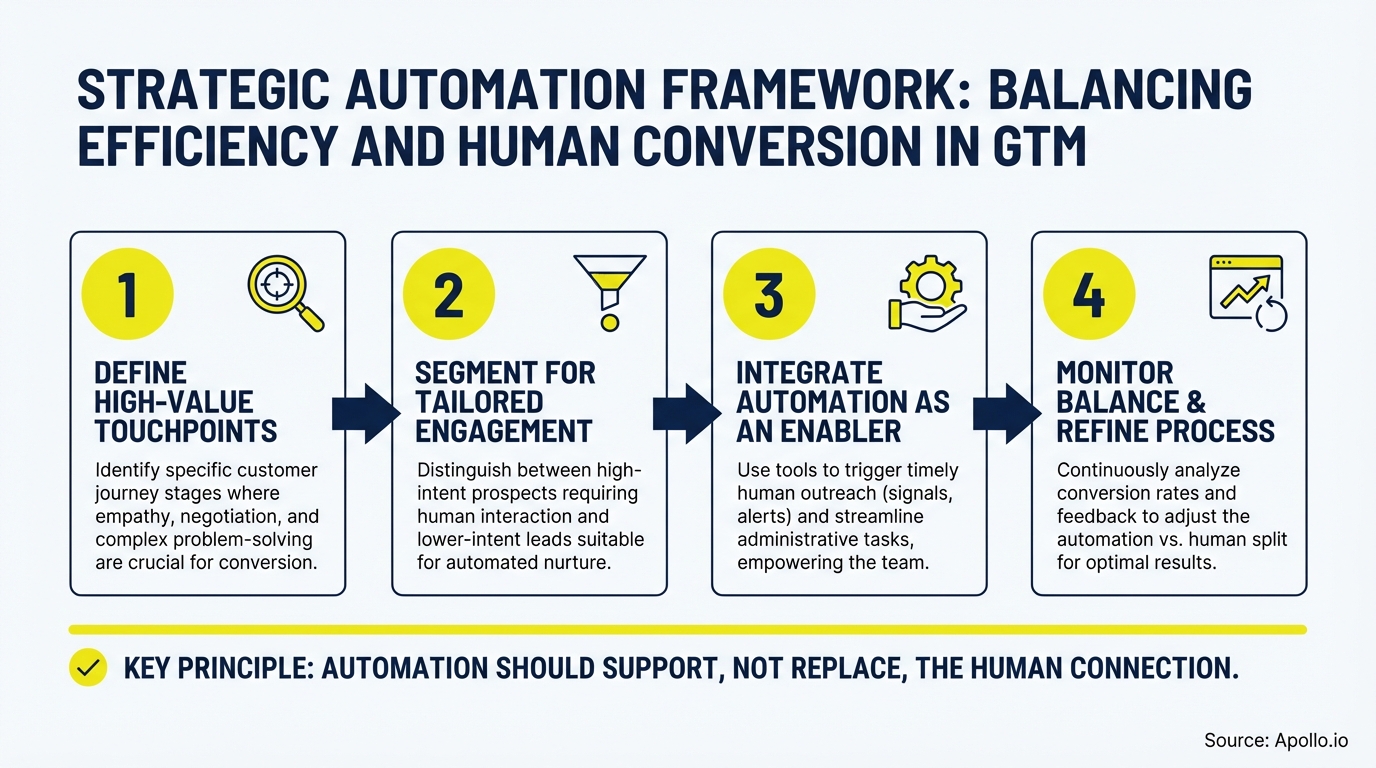
What GTM Automation Framework Protects Conversion in 2026?
The GTM automation framework that protects conversion in 2026 is hybrid-by-design: self-serve and automated early, human-led for complexity, risk, and consensus. Gartner describes this as a reversal of the pure self-serve trend, with buyers now expecting an escalation path to a credible expert when stakes rise.
The framework in practice:
- Automate to qualify, not to close. Use sequences and workflows to surface intent. Use humans to convert it.
- Personalize with context, not just merge fields. Reference a recent trigger (funding round, job change, content download) rather than just a first name. Reviewing subject lines that drive replies shows that specificity outperforms volume every time.
- Review sequence performance weekly. If reply rates drop or unsubscribes spike, a human tone audit is overdue before more volume is added.
- Keep humans accountable for pipeline momentum. Automation can book a meeting. Only a rep can own the relationship that closes the deal.
Cyera summarized the consolidation benefit well: "Having everything in one system was a game changer." When your GTM data, sequences, and pipeline live in one platform, human escalation is instant rather than a multi-tool handoff that loses context.
How Do You Start Balancing Automation and Human Touch Today?
Start by auditing your current sequences for the moments where automation is carrying conversations that a human should own. Map each touchpoint to the Automate vs.
Escalate matrix above. Then set escalation triggers so that rep involvement is automatic, not an afterthought.
The goal is not to do less. It is to automate the right things so your reps have more time for the conversations that actually close deals.
Teams that get this balance right consistently see stronger pipeline quality, better reply rates, and shorter sales cycles, without adding headcount.
Apollo consolidates prospecting, sequences, enrichment, and pipeline management in one workspace, giving SDRs, AEs, and RevOps teams the unified view they need to escalate at the right moment with the right context. As Predictable Revenue put it: "We reduced the complexity of three tools into one." Start prospecting with Apollo for free and build a GTM motion that scales without losing the human touch that drives conversion.
Prove Pipeline ROI With Apollo
ROI pressure killing your next budget approval? Apollo delivers measurable pipeline impact fast — Leadium 3x'd their annual revenue after making the switch. Start seeing returns before next review cycle.
Start Free with Apollo →Don't miss these
Sales
Inbound vs Outbound Marketing: Which Strategy Wins?
Sales
What Is a Sales Funnel? The Non-Linear Revenue Framework for 2026
Sales
What Is a Go-to-Market Strategy? The 2026 GTM Playbook
See Apollo in action
We'd love to show how Apollo can help you sell better.
By submitting this form, you will receive information, tips, and promotions from Apollo. To learn more, see our Privacy Statement.
4.7/5 based on 9,690 reviews
