
How to Audit and Improve Email Deliverability Across a Team of 10+ SDRs Sending at Scale
Running outbound with 10 or more SDRs means deliverability is no longer a personal problem — it's an operational one. One rep burning a domain or spiking complaint rates can drag down the entire program's inbox placement. And according to Landbase, approximately 16.9% of legitimate emails never reach intended inboxes, with 10.5% landing in spam despite legitimate intent. That's pipeline hiding in junk folders. Before you optimize copy, audit your deliverability infrastructure — that's where the real bottleneck lives.

Research Less, Pipeline More With Apollo
Tired of burning hours hunting down contact info that bounces anyway? Apollo delivers 230M+ verified contacts so your reps spend time selling, not searching. Join 600K+ companies building pipeline on accurate data.
Start Free with Apollo →Key Takeaways
- "Delivered" is not the same as "inbox placed" — teams must measure inbox placement separately by mailbox provider, not just track sent/delivered ratios.
- Gmail and Microsoft have fundamentally different filtering behaviors, so a single deliverability number across 10+ SDRs masks where damage actually occurs.
- Spam complaint rate governance (target: below 0.10%) must be an operational KPI owned by RevOps or a designated deliverability lead — not left to individual reps.
- Authentication (SPF, DKIM, DMARC) plus one-click unsubscribe (RFC 8058) are now baseline requirements for both Google and Microsoft bulk-sender compliance, not optional best practices.
- Deliverability governance that links measurement, guardrails, and rep behavior creates a compounding infrastructure advantage — protecting pipeline at scale.
Why Does Deliverability Break Down at SDR Team Scale?
Deliverability breaks down at scale because team-level volume triggers bulk-sender enforcement rules that individual senders avoid. Even if each SDR believes they're sending personalized 1:1 emails, the aggregate volume and tooling behavior resembles bulk sending — pulling the entire program into stricter filtering territory. As noted by VanillaSoft, Gmail and Yahoo rolled out new deliverability rules in February 2024, with Microsoft following in May 2025, all focusing on authentication, spam complaint rates, and single-click unsubscribing.
The core problem: a single SDR with poor list hygiene, high complaint rates, or misconfigured DNS can poison domain reputation for the whole team. Deliverability governance for scale means treating inbox access as a shared, managed resource — not each rep's individual responsibility.
How Do You Build a Provider-Segmented Deliverability Audit?
A provider-segmented audit means measuring inbox placement, spam rates, and "missing" mail separately for Gmail and Microsoft — not as a blended average. This distinction matters because provider filtering behavior varies significantly.
Aggregate dashboards hide where the real damage occurs.
| Audit Dimension | Gmail (Google Postmaster Tools) | Microsoft (Postmaster Tools / SNDS) |
|---|---|---|
| Primary tool | Google Postmaster Tools | Microsoft SNDS + Postmaster Tools |
| Key KPI | Domain reputation, spam rate | Complaint rate, IP reputation |
| Target spam rate | Below 0.10% | Below 0.10% |
| Critical threshold | 0.30%+ = mitigation ineligibility | 0.30%+ = deferrals/blocking |
| Auth requirements | SPF, DKIM, DMARC + RFC 8058 | SPF, DKIM, DMARC + unsubscribe headers |
Set up both postmaster tools at the domain level, not just the sending IP level. Assign a RevOps owner to review these dashboards weekly.
SDR managers should receive alerts when any domain crosses 0.08% complaint rate — giving you a buffer before hitting the 0.10% threshold.
What Is the Missing vs. Spam Diagnostic Framework for SDR Teams?
"Missing" mail is email accepted by the receiving server but never visible in the inbox or spam folder — a silent suppression that standard delivery metrics cannot detect. This is distinct from spam-folder placement and harder to diagnose without seed testing.
To implement a missing vs. spam diagnostic:
- Seed list testing: Maintain a set of monitored inboxes across Gmail, Outlook, Yahoo, and Apple Mail. Route a sample of each SDR's sequences through these seed addresses weekly.
- Inbox placement tools: Use platforms like GlockApps, Litmus, or similar to report inbox/spam/missing rates per provider per sending domain.
- Segment by rep and domain: Don't aggregate results. If Rep A's sequences are landing in spam on Outlook but Rep B's are fine, you need that granularity to isolate the issue.
- Postmaster telemetry integration: Cross-reference seed test results with Google Postmaster domain reputation scores to confirm whether placement issues are content-driven or reputation-driven.
Running seed tests consistently is a competitive advantage. Research by Insight Mark Research highlights the critical gap between delivery rate and inbox placement rate — while emails may be accepted at high rates, a meaningful portion never reach the intended inbox. Most teams still rely on open rates as a proxy for deliverability, which Sopro notes is increasingly unreliable given Apple Mail Privacy Protection inflating tracking data since 2022.
Turn Funnel Gaps Into Closed Deals
Pipeline forecasting a guessing game because quality leads never convert? Apollo surfaces in-market buyers with precision targeting so every rep focuses on prospects ready to buy. Nearly 100K paying customers stopped guessing and started closing.
Start Free with Apollo →How Do SDRs and RevOps Leaders Implement Authentication and Compliance at Scale?
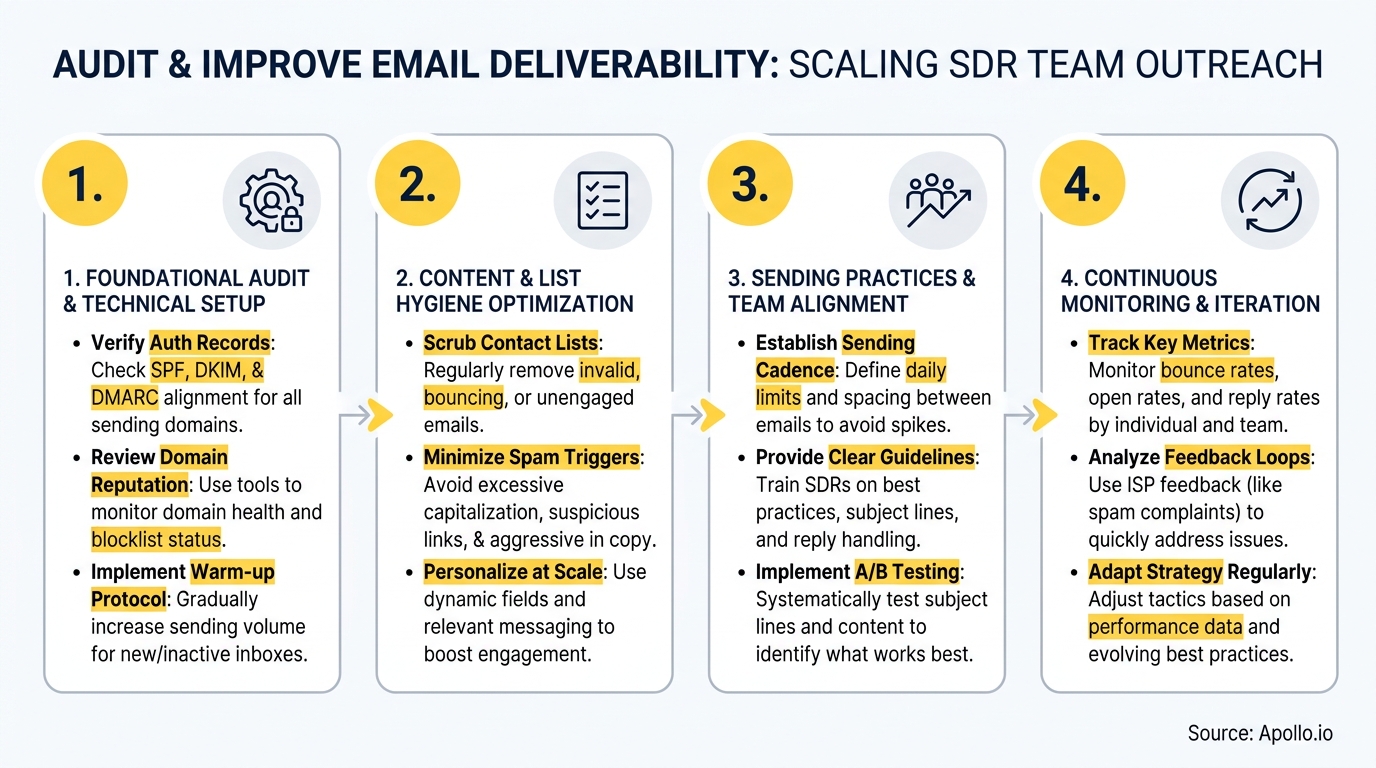
For SDR teams, authentication setup is an infrastructure prerequisite — not a one-time IT task. SPF, DKIM, and DMARC must be configured and aligned for every sending domain, including subdomain variants used for outbound sequences.
Authentication maturation roadmap:
- SPF: Authorize all sending sources (your SEP, CRM, email client). Keep your SPF record under the 10-lookup limit.
- DKIM: Enable DKIM signing on every outbound domain. Rotate keys at least annually.
- DMARC: Start with
p=noneto monitor alignment, then advance top=quarantineand eventuallyp=rejectas you confirm all legitimate streams are covered. - RFC 8058 (List-Unsubscribe): Implement one-click unsubscribe headers at the server/ESP level — not just a text link in the email body. This is required for Google and Microsoft bulk-sender compliance. Your sending platform must support the
List-Unsubscribe-Postheader.
For teams building a scalable sales tech stack, authentication alignment across all sending tools (your engagement platform, CRM sync, and any automation layers) prevents the misalignment that silently tanks deliverability. Struggling to keep contact data clean enough to protect your sender reputation? Start free with Apollo's 230M+ verified business contacts and reduce bounce rates before they damage domain reputation.

What Guardrails and Operational Playbooks Should SDR Teams Run?
Guardrails are the operational policies that prevent one SDR's bad day from becoming a program-wide deliverability crisis. These need to be systematized, not enforced manually.
Core guardrails for 10+ SDR teams:
- Per-inbox daily sending caps: Limit each inbox to a sustainable daily volume (commonly 50-100 emails/day per inbox depending on domain age and warm-up status). Use sending rotation across multiple inboxes per rep when volume requires it.
- Bounce rate pause rules: Automatically pause sequences if hard bounce rate exceeds 3% on any domain within a 7-day window.
- Complaint rate SLOs: Alert at 0.06%, pause at 0.10%, quarantine and investigate at 0.20%. Assign ownership to a RevOps lead or deliverability manager.
- List verification before launch: All prospect lists must pass email verification before loading into sequences. See how to verify email addresses for B2B sales to reduce invalid addresses that drive bounces.
- Suppression list enforcement: Centralize unsubscribes and bounces across all SDR inboxes. One rep's unsubscribe must suppress that contact for the entire team.
For RevOps leaders managing outbound infrastructure, these controls belong in your sales automation governance framework — not in individual rep training docs.
How Do SDR Managers Turn Deliverability Into a Revenue Metric?
SDR managers should frame deliverability as a pipeline multiplier, not a technical detail. If your team's average inbox placement is below benchmark, every sequence you run is underperforming before the copy is even read.
The revenue case is straightforward: improved inbox placement means more prospects actually see your outreach, which means more replies and more meetings — without increasing send volume or headcount. Spending hours on manual outreach only to have emails land in spam? Automate your sequences with Apollo's multi-channel sales engagement platform — built with deliverability controls that protect your sender reputation at scale.
Key executive-facing metrics to track:
- Inbox placement rate by provider (weekly, per domain)
- Spam complaint rate (daily monitoring, weekly reporting)
- Reply rate vs. send volume (leading indicator of placement health)
- Domain health score from Google Postmaster Tools
- Bounce rate by rep and list source (identifies data quality issues upstream)
Tie these metrics to pipeline reviews. When inbox placement drops, pipeline should be expected to drop within 2-3 weeks.
That connection makes deliverability a board-level conversation, not an IT ticket.
How Do You Build a 90-Day Deliverability Improvement Roadmap for SDR Teams?
A structured roadmap moves a team from reactive firefighting to proactive governance. Use this phased approach:
| Phase | Timeline | Priority Actions |
|---|---|---|
| Audit & Baseline | Days 1-30 | Verify SPF/DKIM/DMARC on all domains; set up Google and Microsoft Postmaster Tools; run first seed tests; establish baseline complaint rate and bounce rate per rep |
| Governance Build | Days 31-60 | Implement sending caps and pause rules; centralize suppression lists; deploy RFC 8058 unsubscribe headers; verify all contact lists before sequence activation; assign deliverability ownership to RevOps |
| Optimize & Scale | Days 61-90 | Progress DMARC to quarantine policy; build weekly deliverability dashboard for SDR managers; run provider-segmented reporting (Gmail vs. Microsoft); connect inbox placement trends to pipeline forecasting |
For teams scaling beyond 10 SDRs, also review your email deliverability fundamentals and consider domain portfolio strategy — dedicated sending subdomains per team segment reduce the blast radius when any single domain takes a reputation hit.

Start Protecting Your Pipeline with Better Deliverability Infrastructure
Deliverability governance for SDR teams at scale comes down to measurement, authentication, and operational controls working together. The teams that build this infrastructure now — provider-segmented dashboards, RFC 8058 compliance, complaint rate SLOs, and seed testing — will have a structural advantage as mailbox providers continue tightening enforcement into 2026 and beyond.
Apollo brings prospecting, sequence execution, and data quality into a unified platform, reducing the tech stack complexity that creates authentication misalignment and list hygiene gaps. As Cyera's team put it: "Having everything in one system was a game changer." Start Prospecting and build outbound infrastructure that actually lands in inboxes.
Prove Pipeline ROI With Apollo
ROI pressure making tool renewals feel impossible to justify? Apollo delivers measurable pipeline impact from day one. Leadium 3x'd their annual revenue — see what Apollo puts on your board.
Start Free with Apollo →Don't miss these
Sales
Inbound vs Outbound Marketing: Which Strategy Wins?
Sales
What Is a Sales Funnel? The Non-Linear Revenue Framework for 2026
Sales
What Is a Go-to-Market Strategy? The 2026 GTM Playbook
See Apollo in action
We'd love to show how Apollo can help you sell better.
By submitting this form, you will receive information, tips, and promotions from Apollo. To learn more, see our Privacy Statement.
4.7/5 based on 9,690 reviews
