
How Do B2B Tech Products Find Early-Adopter Customers Effectively in 2026?
Your first early-adopter customer may ask ChatGPT to recommend vendors before they ever visit your website. That shift changes everything about how B2B tech products must approach go-to-market. Understanding proven B2B sales techniques is no longer enough—you need to engineer familiarity, peer proof, and buying-group enablement before a single intent signal appears in your CRM.
The stakes are real. Research from data-mania.com shows customer acquisition costs in B2B tech jumped 40-60% from 2023 to 2025. Winning early adopters efficiently is now a financial imperative, not a nice-to-have.

Research Less, Connect More With Apollo
Tired of burning hours verifying emails that bounce and chasing numbers that go nowhere? Apollo delivers 97% email accuracy so your team spends time selling, not searching. Join 600K+ companies building pipeline faster.
Start Free with Apollo →Key Takeaways
- Early adopters represent roughly the first 16% of a market—design your ICP and outreach for that narrow segment, not your full TAM.
- Brand familiarity before formal research is a decisive advantage: buyers strongly favor products they already recognize when building shortlists.
- Peer proof (design partners, user references, community presence) is the highest-trust discovery path for early-stage B2B buyers.
- Most buyers prefer self-serve discovery, but still want seller-led validation at the moment they assess product fit for their specific context.
- Champion enablement—arming one internal buyer to win over the rest of the buying group—is the most under-invested lever in early-adopter GTM.
Who Are Early-Adopter Customers in B2B Tech?
Early-adopter customers in B2B tech are the roughly 16% of a market—combining innovators and early adopters from classic diffusion research—who will experiment with new products before mainstream buyers commit. They tolerate higher risk in exchange for competitive advantage, faster workflows, or category-defining outcomes.
These buyers share a recognizable profile:
- Job-to-be-done: They have an urgent, specific problem mainstream tools don't solve well.
- Risk tolerance: They accept rougher edges if the core value is clear and fast to realize.
- Buying-group shape: According to TechnologyAdvice, the average B2B buying group includes 6-10 decision-makers. Even early adopters need internal consensus.
- Proof needs: They want quick, low-risk value—not a 6-month implementation timeline.
For SDRs and founders building outbound, this means your ICP filter should be tighter than your TAM. Focus on job titles, tech stack signals, hiring patterns, and growth stage that indicate a buyer actively seeking change.
How Do You Build Pre-Research Demand Before Buyers Start Evaluating?
Pre-research demand means creating brand memory so buyers already recognize your product when they begin formal evaluation. The vendor preferred before sales contact wins the majority of deals—which means GTM teams must create familiarity long before an account appears "in market."
The tactics that build pre-research demand:
- Category narrative: Define a specific problem category your product owns. Name the pain, not just the feature.
- Answer engine visibility: Publish comparison content, use-case explainers, and thought leadership that AI systems and review platforms can surface. A G2 2025 Buyer Behavior Report found 29% of buyers now start research via LLMs more often than Google.
- Review seeding: Get verified reviews on G2, Capterra, and similar platforms early. Shortlists average only 2-3 products—you need to be in the consideration set before evaluation starts.
- Founder and practitioner content: Practitioners trust other practitioners. Podcast appearances, community contributions, and professional networks posts from credible voices build recall faster than paid ads.
A bevelroom.com analysis found approximately 67% of B2B research is completed digitally before buyers engage sales. Your content and community presence must do the early-stage work your sales team never gets to see.
Struggling to identify which early-adopter accounts are showing intent signals? Search Apollo's 230M+ contacts with 65+ filters to pinpoint your exact ICP.

How Does a Peer Proof Engine Accelerate Early-Adopter Acquisition?
A peer proof engine converts your earliest customers into a structured discovery channel, making peer-led referrals repeatable rather than accidental. Peer validation is the highest-trust path to early-adopter conversion in B2B tech.
Build the engine in three layers:
- Design partners: Formalize your first 3-5 customers as design partners with co-development access, early feature input, and a named case study as the output. This creates public proof and deepens retention simultaneously.
- Reference network: Build a structured reference program so your sales team can connect prospects with relevant customer voices quickly. Peer introductions should be as easy to trigger as a demo request.
- Community presence: Participate actively in Slack communities, subreddits, Discord servers, and industry forums where your ICP spends time. Authentic community engagement creates the organic mentions AI search systems and peer networks amplify.
For AEs managing early-stage deals, the peer proof engine shortens the trust-building phase and reduces the number of stakeholder objections. Pair reference calls with role-specific case studies so each buying-group member sees proof from someone in their own function. Explore how startup ecosystem partners can extend your reach without adding headcount.
Turn Funnel Guesswork Into Pipeline Clarity
Quota pressure mounting while marketing leads stall before becoming real opportunities? Apollo surfaces high-intent prospects and keeps your pipeline moving with accurate, real-time data. 600K+ companies trust Apollo to forecast with confidence.
Start Free with Apollo →How Do SDRs and GTM Teams Balance Self-Serve Discovery with Seller-Led Fit?
SDRs and GTM teams win early adopters by mapping their motion to buyer preference: self-serve for discovery and education, seller-led for fit assessment and risk reduction. In May 2026, Gartner reported that 45% of B2B buyers used GenAI in a recent purchase, yet 69% still preferred validating AI-generated insights with sales reps before committing.
The practical asset map by stage:
| Stage | Buyer Preference | Asset / Motion |
|---|---|---|
| Awareness | Self-serve | SEO/AEO content, review presence, community mentions |
| Consideration | Self-serve | Free trial, sandbox, interactive demo, ROI calculator |
| Fit Assessment | Seller-led | Technical discovery call, custom use-case walkthrough |
| Consensus Building | Seller-led | Champion kit, multi-stakeholder deck, security packet |
| Procurement | Seller-led | MSA templates, legal FAQ, procurement checklist |
The "fit-risk trigger" is the moment a buyer asks: "Does this work for our specific setup?" That is when seller involvement converts—not before. SDRs who interrupt the self-serve phase with premature outreach create friction.
Those who activate at the right signal (product usage, pricing page visits, security doc downloads) accelerate the deal.
Spending hours manually sequencing outreach to early-adopter prospects? Automate multi-channel sequences with Apollo's sales engagement platform so your team activates at the right moment, not just the available one.
Pairing self-serve assets with intent data signals lets RevOps teams route accounts to sellers at exactly the right fit-risk moment, reducing wasted outreach and improving conversion.
What Should a Champion Enablement Kit Include for B2B Early-Stage Deals?
A champion enablement kit gives your internal buyer the tools to win consensus without a sales rep in the room. For early-adopter deals, where skepticism is high and internal champions are often individual contributors advocating upward, this kit is the difference between a stalled POC and a signed contract.
Essential components:
- Multi-stakeholder deck: One slide set with role-specific value sections (IT security, finance, end users, executive sponsors).
- ROI model: A simple, editable spreadsheet showing time savings, cost reduction, or revenue impact tied to the champion's specific use case.
- Security and compliance packet: A lightweight one-pager covering data handling, access controls, certifications, and breach-history disclosure. G2's 2024 buyer survey found 81% consider a vendor's security incident history when evaluating software—having this document ready removes a late-stage blocker.
- Procurement checklist:Step-by-step guide for getting a new vendor approved: legal review, IT sign-off, budget approval, contract redline process.
- Customer evidence by role: Case studies matched to the job titles in the buying group, not just a generic logo slide.
For founders and revenue leaders at early-stage companies, the champion kit also serves as a forcing function: if you cannot articulate ROI in a simple model, your product narrative needs more work before you scale outbound. Review how to build a B2B marketing funnel that converts to ensure your enablement assets connect to every stage of the buyer journey.

How Do B2B Tech Products Find Early-Adopter Customers in 2026?
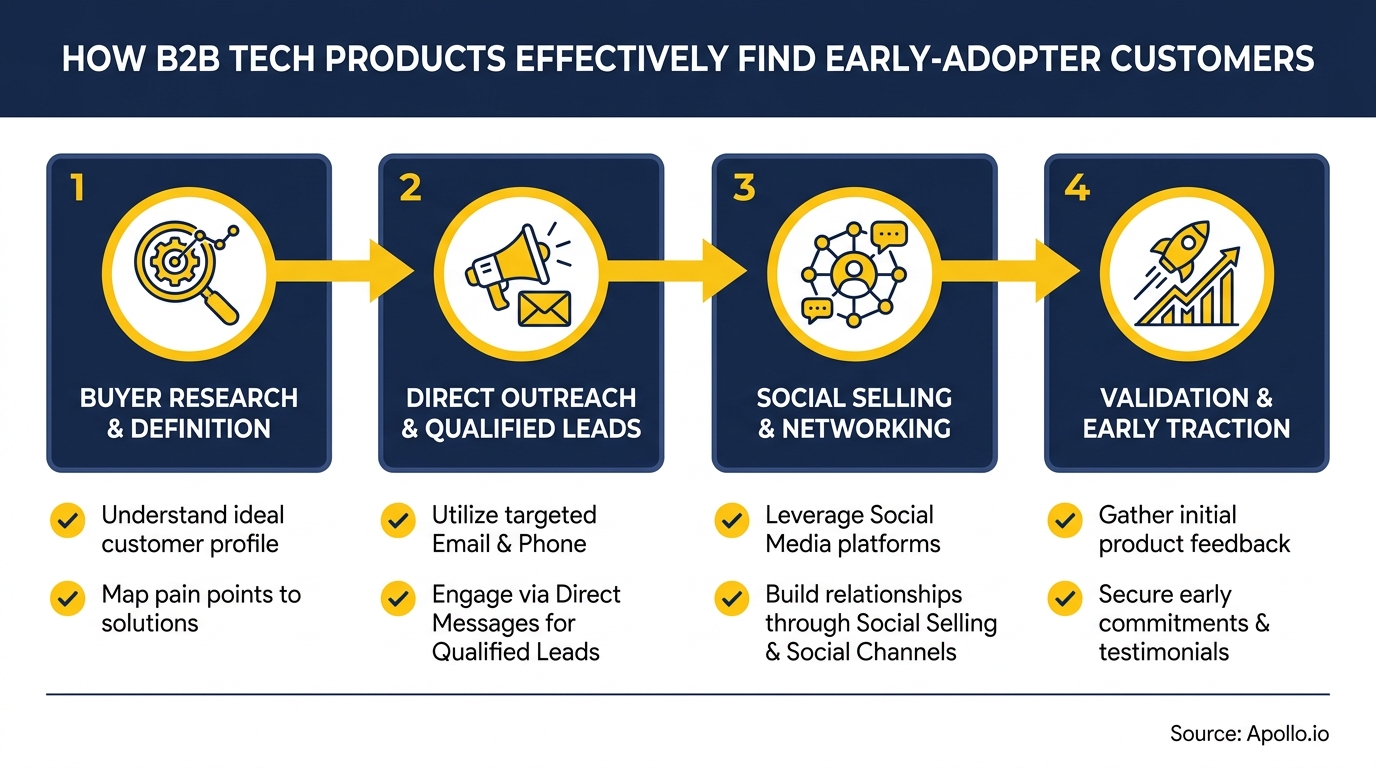
Winning early-adopter customers in 2026 requires engineering familiarity before buyers search, peer proof before they evaluate, and champion enablement before they decide. The teams that win are not the ones with the loudest launch—they are the ones already present in the conversations, review platforms, and AI-generated shortlists their buyers consult before raising their hands.
The retention data reinforces urgency: research from Amplitude shows top B2B products retain 15.6% of customers at three months, versus just 2.5% for median products. Getting the right early adopters—those who match your ICP tightly—is what drives that gap. Volume without fit produces churn, not growth.
Apollo gives B2B GTM teams a unified platform to identify early-adopter ICPs, run targeted outreach, and track deals from first touch to closed-won—without juggling five separate tools. "Having everything in one system was a game changer," said the team at Cyera. For outbound prospecting teams building early-adopter pipelines, that consolidation translates directly into faster ramp and lower CAC.
Get Leads Now and start finding your first 16% with Apollo's 230M+ contact database, 65+ ICP filters, and AI-powered outreach—all in one workspace.
Prove Pipeline ROI From Day One
ROI pressure killing your tool budget before it even starts? Apollo delivers measurable pipeline impact fast — so you walk into every budget review with numbers, not excuses. Leadium 3x'd their revenue. You're next.
Start Free with Apollo →Don't miss these
Sales
Inbound vs Outbound Marketing: Which Strategy Wins?
Sales
What Is a Sales Funnel? The Non-Linear Revenue Framework for 2026
Sales
What Is a Go-to-Market Strategy? The 2026 GTM Playbook
See Apollo in action
We'd love to show how Apollo can help you sell better.
By submitting this form, you will receive information, tips, and promotions from Apollo. To learn more, see our Privacy Statement.
4.7/5 based on 9,690 reviews
