
How Do AI Agents Automate the End-to-End Prospecting and Outreach Workflow?
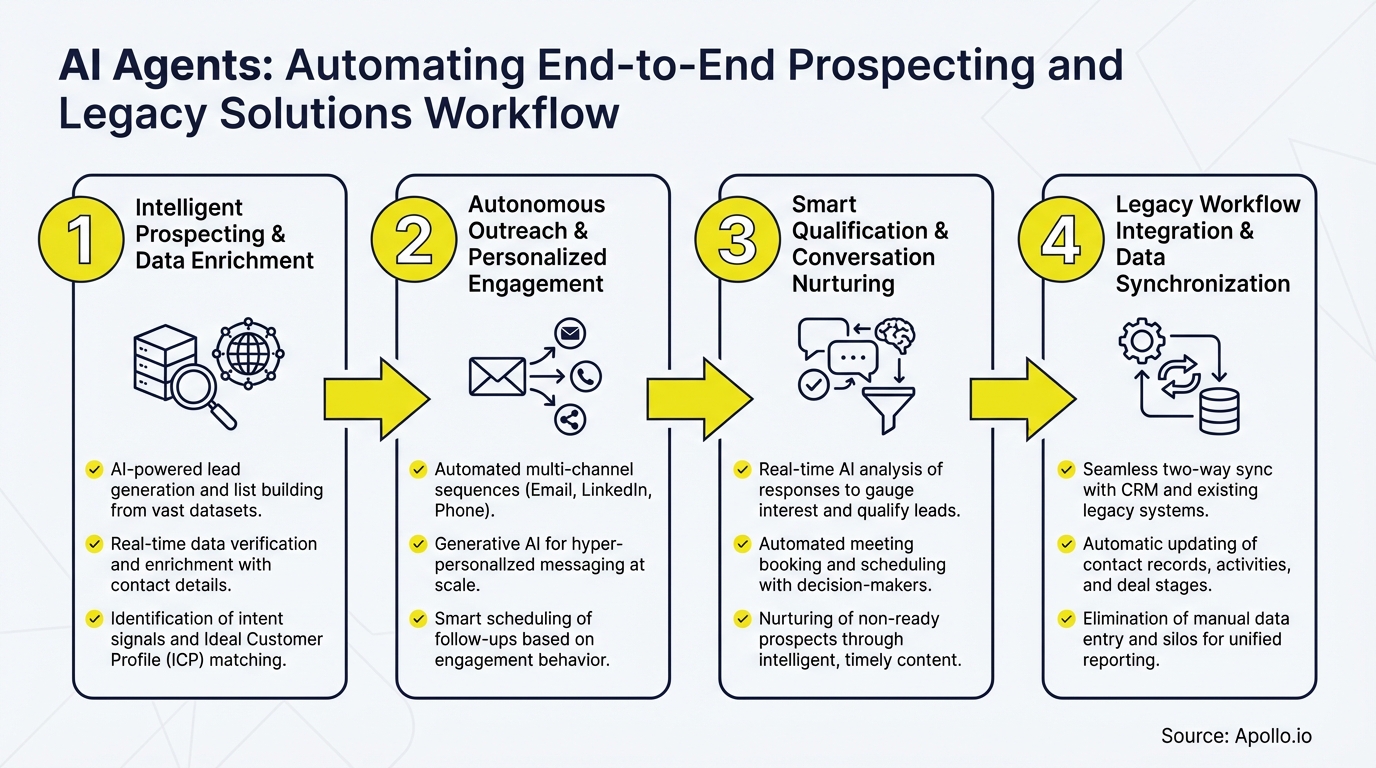
AI agents automate the end-to-end prospecting and outreach workflow by executing every stage autonomously: finding ICP-matched contacts, enriching data, scoring leads, drafting personalized messages, sequencing multi-channel touches, and logging outcomes to your CRM. This isn't assistive AI that waits for prompts.
It's a system that runs the workflow while your reps focus on conversations that close deals.
The business case is urgent. A Gartner forecast from October 2023 predicted that B2B sales organizations using embedded GenAI technologies would reduce time spent on prospecting and meeting prep by over 50% by 2026. That benchmark is now a north-star KPI that GTM teams are actively building toward. If your org hasn't moved from pilot to production, you're already behind the 21% of companies that have achieved enterprise-wide GenAI adoption in B2B sales, according to McKinsey's 2024 research.

Research Less, Close More With Apollo
Tired of your reps burning hours on manual research instead of selling? Apollo surfaces verified contacts instantly, so your team spends time closing — not digging. Join 600K+ companies building pipeline faster.
Start Free with Apollo →Key Takeaways
- AI agents now handle every stage of the prospecting workflow, from ICP matching and data enrichment to sequencing and CRM logging, freeing reps to focus on closing.
- Gartner's benchmark of over 50% time reduction in prospecting and meeting prep is the north-star KPI for 2026 GTM teams adopting agentic workflows.
- Deliverability engineering (authentication, throttling, bounce thresholds) must be built into the agent architecture, not added after deployment.
- SDRs and BDRs benefit most immediately: agents handle list building, research, and first-touch drafts so reps spend time on replies and booked meetings.
- The operating model shift is "agents execute, humans supervise": reps approve high-risk steps and own late-stage conversations, while agents run everything repetitive.
- Consolidating prospecting, enrichment, sequencing, and pipeline tracking into one platform eliminates integration overhead and data drift between tools.
What Does an End-to-End AI Agent Prospecting Workflow Look Like?
A fully automated prospecting workflow runs through seven sequential stages, each handled by a dedicated agent capability. According to Vector Agents, AI agents find leads matching the ideal customer profile using data about companies, technology, and behavior, then clean and sort data lists quickly and accurately.
| Stage | What the Agent Does | Human Role |
|---|---|---|
| 1. ICP Matching | Filters contacts by firmographic, technographic, and behavioral signals | Define ICP criteria |
| 2. Data Enrichment | Appends verified contact data, titles, and company attributes | Review data quality thresholds |
| 3. Lead Scoring | Ranks prospects by fit score and buying intent signals | Approve scoring logic |
| 4. Message Generation | Drafts personalized first-touch and follow-up copy per channel | Review templates and tone guardrails |
| 5. Sequencing | Enrolls contacts into multi-channel sequences (email, phone, social) | Set sending limits and frequency caps |
| 6. Routing | Assigns hot leads to the right rep based on territory and capacity | Handle escalations and exceptions |
| 7. CRM Logging | Logs all activity, outcomes, and next steps automatically | Audit data integrity periodically |
Struggling to find qualified leads efficiently? Search Apollo's 230M+ contacts with 65+ filters to build ICP-matched lists in minutes, not hours.
How Do SDRs and BDRs Benefit from Agentic Prospecting?
SDRs and BDRs gain the most immediate productivity lift because agents take over the highest-volume, lowest-leverage tasks in their daily workflow. List building, account research, first-touch drafting, and follow-up scheduling are all agent-executable, which means reps spend their time on replies, objection handling, and booked meetings.
Research from Jeeva AI shows teams using AI-driven personalization report 2x higher reply rates and a 30% increase in booked meetings. For SDRs managing hundreds of prospects per month, that compounding effect directly drives quota attainment. RevOps leaders benefit too: a single sales automation platform running the full workflow eliminates the data drift and attribution gaps that come from stitching together five separate point solutions.
Apollo customers have experienced this consolidation directly. "Having everything in one system was a game changer" (Cyera), and "We reduced the complexity of three tools into one" (Predictable Revenue). For SDR teams under quota pressure, that kind of stack simplification removes operational friction that was previously invisible.

Why Is Deliverability Engineering Non-Negotiable in Agentic Outreach?
Deliverability engineering is non-negotiable because AI agents can amplify mistakes at scale just as easily as they amplify results. When sending volume increases through automation, unguarded workflows trigger spam filters, damage domain reputation, and burn prospect lists before a single reply arrives.
Build these controls into your agent architecture from day one, not after deployment:
- Authentication: DMARC, SPF, and DKIM must be configured before any agent sends a single email.
- Domain warming: New sending domains need a ramp period before agents send at full volume.
- Bounce thresholds: Set automated pausing if hard bounce rates exceed 2%.
- Frequency caps: Limit touches per prospect per week to protect sender reputation.
- Opt-out handling: Agents must suppress contacts who unsubscribe within minutes, not hours.
- Throttling: Distribute send volume across time windows to mimic human sending patterns.
This is especially critical for outbound prospecting at scale. The teams winning in 2026 treat deliverability as infrastructure, not an afterthought.
Fill Your Funnel With Buyers, Not Noise
Running out of qualified leads before the quarter ends? Apollo surfaces in-market prospects matched to your ICP, so your outreach hits decision-makers — not dead ends. Nearly 100K paying customers stopped guessing and started closing.
Start Free with Apollo →How Do You Build Governance and Guardrails for AI Sales Agents?
AI sales agent governance means defining who controls the agent, what it can execute autonomously, what requires human approval, and how performance is audited. Without governance, agents make decisions that damage pipeline quality, brand reputation, or compliance posture.
A practical governance framework has three layers:
- Data access controls: Agents should only access contact lists that have cleared your ICP and suppression criteria. No agent should send to unverified or opted-out contacts.
- Approval gates: Require human sign-off before agents enroll new accounts above a defined deal size or send messages to executive-level contacts.
- Audit logging: Every agent action (list pull, message sent, CRM update) should be timestamped and reviewable. This supports QA and compliance review without manual tracking.
The operating model that works: agents execute repetitive steps autonomously, humans own exceptions and late-stage conversations. This is the "agents run, humans supervise" model that enterprise GTM teams are scaling toward in 2026. Pair this with an automated lead generation system that enforces data quality at the source, and governance becomes far easier to maintain.
What Is the ROI Framework for AI-Powered Prospecting Automation?
The ROI case for agentic prospecting rests on three measurable pillars: time recovered, pipeline volume, and tool consolidation savings. According to iCumulus, 70% of sales professionals who use AI for prospect outreach say it helps them get a higher response rate. That lift in response rate directly translates to more pipeline from the same headcount.
Use this framework to build your executive business case:
- Time recovered: Measure hours per rep per week previously spent on list building, research, and manual follow-up. Agent automation recaptures that capacity for selling.
- Pipeline impact: Track meetings booked per rep pre- and post-deployment. More meetings from the same team size is a clean productivity metric.
- Tech stack savings: Count the tools the agentic platform replaces. "We cut our costs in half" (Census) illustrates the consolidation dividend that CFOs and RevOps leaders care about most.
- Conversion improvement: Monitor reply rates, meeting-to-opportunity rates, and sequence performance to attribute revenue impact.
Spending hours on manual outreach instead of building pipeline? Automate your multi-channel sequences with Apollo and reclaim that time for conversations that close.
What Prospecting Tools Support Full Workflow Automation in 2026?
The best prospecting tools for full workflow automation in 2026 are unified platforms that handle data, enrichment, sequencing, and CRM logging in one workspace, not point solutions that require custom integrations to share data. The market has shifted toward platforms that coordinate research, engagement, and conversation intelligence without tool-switching.
When evaluating platforms for agentic workflows, prioritize these capabilities:
- ICP filtering with 65+ firmographic, technographic, and behavioral attributes
- Built-in data enrichment with verified contact accuracy
- Native multi-channel sequencing (email, phone, social outreach)
- Workflow automation engine for trigger-based enrollment and routing
- CRM sync that logs agent activity without manual data entry
- AI-powered message generation with tone and brand guardrails
Apollo's workflow automation engine covers all of these in a single platform, which is why teams like Census and Predictable Revenue consolidated their stacks onto Apollo rather than managing separate tools for each stage. See how Apollo compares to other platforms in our Apollo vs. Outreach vs. Salesloft comparison.

How Do You Get Started with Agentic Prospecting in 2026?
Getting started with agentic prospecting means running a focused pilot before scaling to the full workflow. Start with one ICP segment, one channel, and one agent capability, measure results, then expand.
A practical 30-day launch checklist:
- Define ICP criteria and suppression lists before any agent accesses contact data
- Configure DMARC, SPF, and DKIM on all sending domains
- Set bounce thresholds and opt-out automation before first send
- Build approval gates for executive-level contacts and high-value accounts
- Establish baseline metrics: meetings booked, reply rates, pipeline sourced
- Run a two-week pilot on one ICP segment before expanding to full list
- Review audit logs weekly during the first month to catch edge cases early
For AEs and revenue leaders, the fastest path to ROI is connecting agent-sourced pipeline to your sales prospecting list strategy, so every contact the agent touches traces back to a deliberate targeting decision. Use automated prospecting tools that enforce data quality at the source to keep your pipeline clean as volume scales.
AI agents are moving B2B sales from systems of record to systems of action. The teams that implement governance-first, deliverability-aware agentic workflows now will have a compounding pipeline advantage through the rest of 2026 and beyond. Schedule a Demo to see how Apollo's unified GTM platform automates every stage of your prospecting and outreach workflow in one workspace.
Prove Pipeline ROI Before Next QBR
ROI pressure killing your next tool approval? Apollo delivers measurable outcomes your exec team can't argue with. Leadium 3x'd annual revenue — your CFO wants numbers like that.
Schedule a Demo →Don't miss these
Sales
Inbound vs Outbound Marketing: Which Strategy Wins?
Sales
What Is a Sales Funnel? The Non-Linear Revenue Framework for 2026
Sales
What Is a Go-to-Market Strategy? The 2026 GTM Playbook
See Apollo in action
We'd love to show how Apollo can help you sell better.
By submitting this form, you will receive information, tips, and promotions from Apollo. To learn more, see our Privacy Statement.
4.7/5 based on 9,690 reviews
